
Team Charter: What to Include and a Template Leaders Can Use
Most teams start work before they agree on how they will work. A new project team gets a deadline, a few names on a kickoff invite, and a vague sense of the goal. Weeks later, the same team is arguing about who owns a decision, why a stakeholder was surprised, and what "done" was supposed to mean. A team charter prevents much of that friction. It is a short document, written by the team, that defines the team's purpose, goals, roles, working agreements, and boundaries before the real work begins.
This guide explains what a team charter is, what to include, how to create a team charter in one working session, and how to keep it useful after the kickoff. You will discover a free team charter template you can copy, plus team charter examples for a project team and a standing department team. Use the charter template as a starting point and adapt it to your own processes.

What Is a Team Charter?
A team charter is a written agreement that describes why a team exists, what it is expected to deliver, who does what, and how the team members will work together. It gives the entire team one shared reference point, so expectations are written down instead of assumed. In short, a charter outlines the agreements that help people work together effectively and achieve the team's goals.
A charter is usually one to three pages. It is not a contract and it is not a project plan. Think of it as the operating agreement for a group of people: the team's purpose, its goals and expected outcomes, team roles and responsibilities, decision rules, communication norms, resources, and the key stakeholders it serves.
Teams use a charter in several situations:
- New project teams that bring people together from different departments for a defined period.
- Cross functional groups such as a product launch team, a process improvement team, or a committee.
- Standing teams such as a leadership team, a department, or a new office that needs clear expectations from day one.
- Teams in trouble that need to reset roles, team values, and accountability after missed deadlines or conflict.
Team Charter vs. Project Charter
People often use the two terms interchangeably, but they answer different questions. A project charter authorizes a project. It is typically approved by a sponsor and describes the business case, scope, budget, milestones, and the authority of the project manager. A team charter describes the people side: how the team will collaborate, communicate, make decisions, and hold each other accountable.
A large initiative often needs both. The project charter tells the organization what the project is and why it is funded. The team charter tells the team how it will deliver that project together. If your organization already has a project charter, link to it from the team charter rather than repeating the scope and budget.
Why a Team Charter Matters
A charter will not solve every problem, but it removes several common causes of failure and sets up the team's success from the start. Every successful team needs shared direction, clear roles, and trust, and a charter supports all three. Here is what a good team charter does for a team:
- It creates a strong foundation. Writing the team's purpose and team goals down forces the group to agree on what success looks like before people start working in different directions.
- It sets clear expectations. Each team member knows their responsibilities, what others own, and what the team leader will decide.
- It connects the work to the organization's goals. A charter shows how the team activities support the larger strategy, which helps leaders protect the team's time and resources.
- It speeds up onboarding. New hires and late additions can read the charter and understand the team in minutes instead of weeks.
- It improves collaboration and communication. Agreed communication tools, meeting rhythms, and response norms reduce friction and duplicated effort.
- It gives the team a tool for accountability. When a commitment slips, the team can point to the agreement instead of making it personal.
- It builds transparency and teamwork. When roles, tasks, and decisions are visible to everyone, trust grows and team performance improves.
In practice, the most valuable part of the charter is often the conversation it forces. The document is the record. The real benefit is the shared understanding the team builds while writing it.
Key Components of a Team Charter
Every team charter template uses slightly different labels, but the key components are consistent. A complete charter answers nine questions.
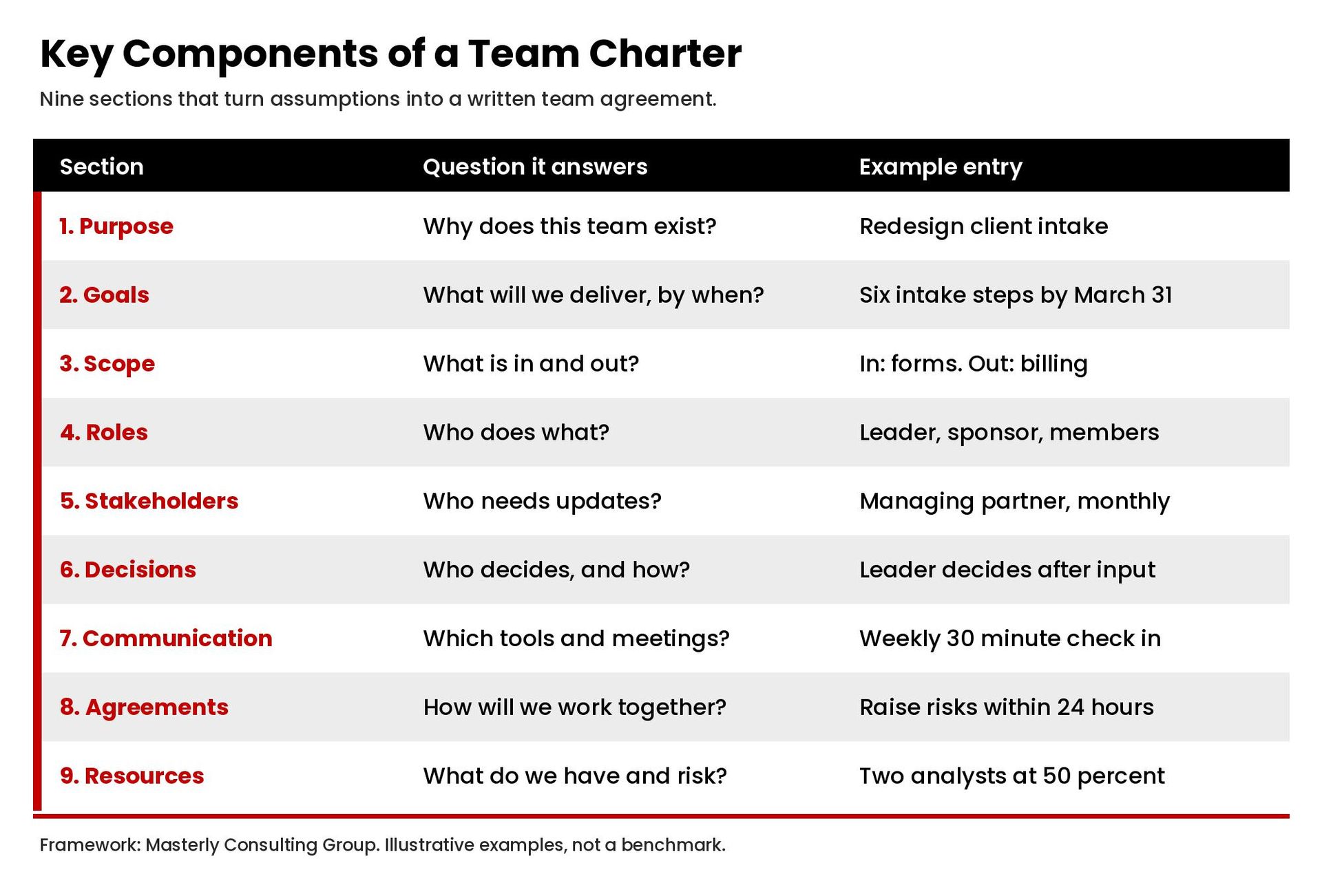
1. Team Purpose and Mission
State the team's purpose in one or two sentences: why the team exists and who benefits from its work. A clear mission statement keeps the team focused when priorities compete. Example: "This team will redesign the client intake process so new clients can begin work within one week of signing."
2. Goals and Expected Outcomes
List three to five objectives with measurable results. Many teams write them as SMART goals: specific, measurable, achievable, relevant, and time bound. Include expected outcomes and how the team will track progress. Goals tell the team where it is going. The rest of the charter explains how it will get there.
3. Scope and Boundaries
Describe what is in scope and, just as important, what is out of scope. Boundaries prevent scope creep and help the team say no to requests that belong to another group.
4. Team Members, Roles, and Responsibilities
Name each team member and define their role. Identify the team leader, the sponsor, and anyone with decision rights. For complex work, a RACI chart that shows who is responsible, accountable, consulted, and informed is a useful attachment. If your organization already maps ownership at the leadership level, keep the charter consistent with your accountability chart.
5. Key Stakeholders
List the key stakeholders outside the team: executives, clients, partner departments, and anyone who will be affected by the team's work. Note what each stakeholder needs from the team and how often they expect updates.
6. Decision Making
Write down how the team makes decisions. Does the team leader decide after input? Does the team vote? Which decisions need sponsor approval? Clear decision rules prevent stalled meetings and repeated debates. Many teams also keep a decision log so the reasoning behind key decisions is easy to find later.
7. Communication and Meetings
Agree on communication tools (for example, email for external updates, a chat channel for daily questions, and a shared drive for documents), expected response times within the team, and the meeting rhythm. A simple meeting cadence for weekly check ins and monthly reviews keeps meetings focused and predictable.
8. Team Values and Working Agreements
Team values describe how members will treat each other and the work. Working agreements turn those values into behavior: arrive prepared, raise risks early, give direct feedback, and disagree in the room rather than after it. Some teams call this section a team code of conduct. Keep this list short and specific. Values that everyone already assumes add little; values that change behavior add a lot.
9. Resources, Risks, and Sign Off
List the resources the team has and how members access them, such as budget, tools, data, software access, and time commitments, and the main challenges or risks it expects. End with a sign off section where every member and the sponsor confirm the agreement. Signing is symbolic, but it signals ownership.
How to Create a Team Charter
You can create a team charter in a single 90 minute to two hour working session. The leader should draft a starting point, but the team should write the final version together. A charter that the team builds is far more likely to be followed than one handed down.
- Prepare a draft. The team leader fills in the purpose, known goals, scope, and team roles from the project brief or sponsor conversation. Leave values and working agreements blank for the team.
- Hold a chartering session. Bring the entire team together, in person if possible. Full involvement matters more than polished wording. Walk through each section and invite challenges. Ask, "What would make this team fail?" and turn the answers into agreements.
- Agree on goals and success measures. Confirm the objectives are SMART, and that everyone shares an understanding of how progress will be tracked and how the team will determine success.
- Define roles and decisions. Clarify responsibilities, decision rights, and escalation paths. Resolve overlaps now, not during the first crisis.
- Write working agreements. Capture communication norms, meeting rules, and team values in plain language.
- Review with stakeholders. Share the draft with the sponsor and key stakeholders to confirm scope and expectations.
- Sign and share. Store the final charter where the team works every day and link it from the team's main channel or project page.
Tips for Running the Chartering Session
- Keep the group focused on behavior, not slogans. "We respond to teammates within one business day" is better than "We value communication."
- Give quieter members a chance to write ideas on sticky notes before discussion.
- Time box each section so the session does not stall on wording.
- If the team gets off course, return to the purpose statement and ask whether each idea helps the team achieve it.
- End the session with clear owners for any open questions and a date to finalize the charter.
Free Team Charter Template
Copy this free team charter template into a document or spreadsheet and replace each prompt with your team's details. The team charter template works for project teams, departments, and committees, and you can create a team charter from it in one session. Each row of the template maps to one of the key components above.
| Section | What to write | Prompt |
|---|---|---|
| Team name and date | Name, start date, version | "Client Intake Redesign Team, v1, January" |
| Purpose and mission | Why the team exists | "This team exists to..." |
| Goals and expected outcomes | 3 to 5 measurable, time bound objectives | "By [date], we will [result], measured by [metric]." |
| Scope | In scope and out of scope | "In: intake forms. Out: billing." |
| Team members and roles | Names, roles, time commitment | "Team leader, sponsor, members, advisors" |
| Key stakeholders | Who needs updates and how often | "Managing partner: monthly summary" |
| Decision making | Who decides what, and how | "Leader decides after input; budget goes to sponsor." |
| Communication | Tools, response norms, meetings | "Weekly 30 minute check in; chat for daily questions" |
| Values and working agreements | 4 to 6 specific behaviors | "We raise risks within 24 hours." |
| Resources and risks | Budget, tools, known challenges | "Two analysts at 50 percent; holiday slowdown" |
| Review and sign off | Review date and signatures | "Review at each milestone; signed by all members" |
A good team charter template is short enough to read in five minutes, and a free charter template in a shared document is all most teams need. If your draft is longer than three pages, move details such as task lists and timelines into a project plan and link to it.
Team Charter Examples
These team charter examples are illustrative and show how the template comes together for two different types of teams.
Example 1: Project Team Charter
- Purpose: Redesign the client intake process so new clients can start work faster.
- Goals: Reduce intake steps from twelve to six by March 31; launch a single online intake form by April 15.
- Scope: Intake forms, welcome emails, and handoff to the delivery team. Billing setup is out of scope.
- Roles: Operations director (team leader), two client service managers, one systems analyst, managing partner (sponsor).
- Decisions: The team leader decides after input; changes to client contracts require sponsor approval.
- Communication: Weekly 30 minute check in, shared project board, monthly update to the sponsor.
- Working agreements: Come prepared, raise risks early, and document decisions in the shared log.
Example 2: Department Team Charter
- Purpose: Provide accurate, timely financial reporting that leaders can trust for decisions.
- Goals: Close the books within five business days each month; deliver a monthly dashboard to the leadership team by the tenth.
- Roles: Finance manager (team leader), two accountants, one payroll specialist.
- Stakeholders: Executive team, department heads, outside auditors.
- Working agreements: No surprises; flag any variance over an agreed threshold to the manager the same day.
How to Keep Your Team Charter Useful
The most common mistake is treating the charter as a kickoff exercise that nobody reads again. To keep the charter useful:
- Review it at milestones. Revisit the charter at each major milestone or quarterly for standing teams. Update goals, roles, and agreements as the work changes.
- Use it in onboarding. Make the charter the first document new team members read.
- Refer to it in tough conversations. When a working agreement is broken, use the charter to discuss the behavior, not the person.
- Retire it when the team ends. For project teams, close out the charter with a short review of what worked. An after action review is a simple format for that discussion.
A charter is also a useful leadership tool. When leaders ask teams to charter their work, they create a regular habit of clarity that can boost productivity across the organization, enhance collaboration between departments, and give every team a clear roadmap.
Frequently Asked Questions
What are the components of a team charter?
The main components are the team's purpose and mission, goals and expected outcomes, scope, team members and roles, key stakeholders, decision making rules, communication and meeting norms, team values and working agreements, and resources, risks, and sign off.
What is the difference between a team charter and a project charter?
A project charter authorizes a project and defines its business case, scope, budget, and sponsor. A team charter defines how the team will work together, including roles, decisions, communication, and team values. Many projects use both.
What does a team charter do?
A team charter aligns the team on purpose, goals, and responsibilities, sets clear expectations for collaboration, and gives the team a written agreement it can use for onboarding and accountability.
Is there a free team charter template I can use?
Yes. The free team charter template above covers every key component. Copy the charter template into a shared document, fill it in during your chartering session, and update it as the team changes.
How long should a team charter be?
Most effective charters are one to three pages. Keep it short enough that every team member will actually read it, and link to separate documents for detailed plans.
Who should write the team charter?
The team leader usually prepares a draft, but the full team should shape and approve the final version in a working session. Shared authorship builds ownership.
Build Teams That Work From Day One
A team charter takes a couple of hours to write and can save months of confusion. If your organization is forming new teams, resetting a leadership team, or trying to fix roles and accountability across departments, contact Masterly Consulting Group to talk through where to start.