Change Management Plan: What to Include Before a Major Change
A change management plan is a written document that describes how an organization will manage change: who is affected, what will be different, how people will be informed and trained, and how progress will be reviewed. It is sometimes called a change management plan template when teams reuse the same structure for more than one change initiative. The plan sits beside the project or implementation plan. One covers the work. The other covers the people, communication, and adoption.
This article explains what to include in a change management plan before a major change rolls out, and it gives you a plan template you can copy. It is a management tool, not a promise of successful change implementation or employee engagement. Existing service pages on this site cover change management services, change leadership, and work with a change management consultant. This page is about the plan itself.

What a Change Management Plan Covers
Effective change management starts with a clear picture of the current state, the future state, and the gap between them. The change process then needs owners, a communication plan, training, and a way to hear from the people doing the work. Organizational change fails more often from weak adoption than from a missing technical step. A written change management strategy will not remove that risk, but it gives the change management team a clear framework and a place to record decisions.
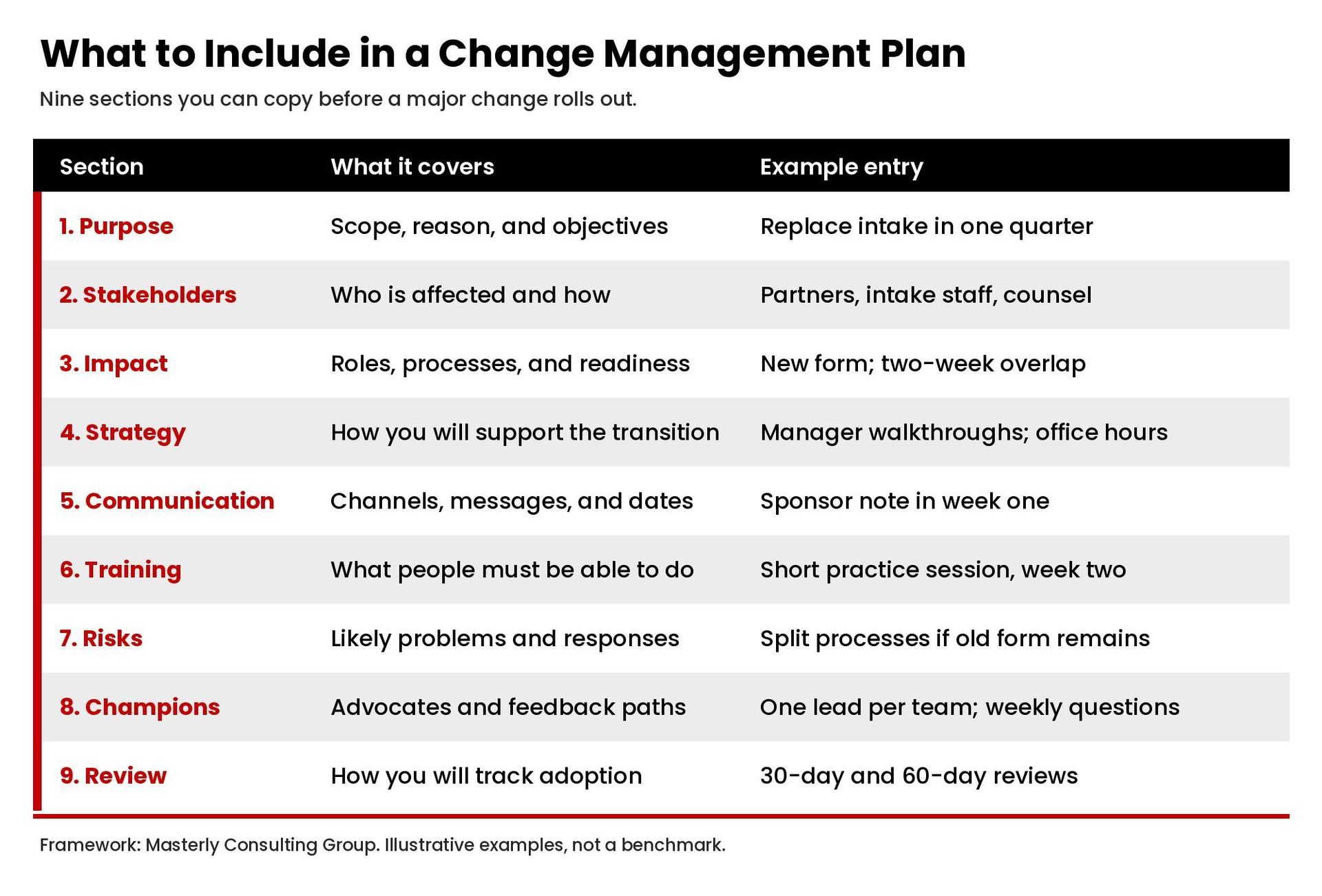
A change management plan usually includes:
- Purpose, scope, and clear objectives. What is changing, why, and what desired outcomes will count as progress.
- Stakeholder analysis. Identify stakeholders and each stakeholder group, including who must be informed, who must be involved, and who may resist.
- Impact assessment and readiness assessment. How the change affects roles, new processes, and company culture, and whether the organization is ready.
- Change management strategy. The approach you will use to involve the people affected, develop key messages, and support the transition process.
- Communication plan and communication timeline. Communication channels, key messages, owners, and dates.
- Training and knowledge. What people need to be able to do, and how they will learn it.
- Risk assessment and risk management. Potential risks, resource constraints, and how you will respond.
- Change champions and feedback mechanisms. Named advocates and a way to collect questions and concerns.
- Implementation and review. How the change implementation will be monitored, and when the plan will be updated.
The plan should also name a sponsor and a team member who owns day-to-day coordination. Project management and change management should stay in conversation, but they are not the same job.
Change Management Plan Template
Copy this change management plan template into a shared document and adapt it to the change in front of you.
Name of the change:
Sponsor and change management team:
Time period:
Current state:
Future state and desired outcomes:
Clear objectives:
Stakeholder analysis (groups, concerns, and how you will engage stakeholders):
Impact assessment and readiness assessment:
Change management strategy:
Communication plan (channels, key messages, communication timeline, owners):
Training and knowledge transfer:
Risk assessment and limits on time or budget:
Change champions and feedback mechanisms:
Implementation plan and review dates:
How to Build the Plan
Start by defining the change in one paragraph. Then identify stakeholders and do a short impact assessment before you write messages. Developing strategies first, without that understanding, usually produces a generic communication plan that no stakeholder group recognizes as their own.
Write a communication plan that uses more than one of the organization's communication channels: meetings, email, a manager brief, and a place for questions. Develop key messages for each audience. Effective communication is specific. "We are improving our systems" is not a message people can act on. "On March 3, intake will move to the new form, and your manager will walk through it that week" is.
Training should match the new processes people will actually use. Awareness comes first, then knowledge, then the ability to practice the work. That sequence is close to the five stages in the ADKAR model (Awareness, Desire, Knowledge, Ability, Reinforcement), a widely cited change management model from Prosci. You do not have to adopt the ADKAR model, or any other of the common change management models, to write a useful plan. If a model helps you, map it onto the template. If it does not, keep the sections above.
Kurt Lewin's three-step model (unfreeze, change, refreeze) is another well-known frame for the change process. Some teams also use a 30, 60, and 90 day check for managers after a rollout. Those are optional aids, not required rules, and they are not a substitute for a communication timeline and a review date.
To manage change well, the change strategy should engage stakeholders early, name change champions, and make resistance visible instead of hoping it will pass. The goal is to minimize resistance where you can, not to pretend it will not appear. Stakeholder engagement and employee engagement both depend on whether people understand the why, have time to learn, and can see support when the work gets hard.
Best practice here is modest: write the plan before the rollout, keep it short enough to use, and update it when significant changes appear. Limits on time and budget should be named in the open. A plan that assumes unlimited time and attention is not an implementation process anyone can follow.
Create the document early, define the change in writing, and keep resources next to the work, not in a side conversation. Implementing a change without that development work usually leaves the organization improvising. The benefits of a written change management process show up in fewer surprises, not in a certain result. Effective change management is the habit of adapting the plan as you learn, while still giving people enough support, training, and understanding to do the new work. A second look at change management models can help a sponsor choose a change strategy; the management plan still has to name owners and dates. Organizational change needs enough stakeholders in the room that the strategy matches how the organization actually works. Success is adoption you can review, not a slogan about success. To manage change on a live project, keep project management and the change management plan in the same calendar. Use this change management plan template, or adapt another plan template, as long as the change management plan stays specific. A change management strategy is only as strong as the communication and training behind it. If you need a second change management strategy for a later phase, create it as an update, not as a silent rewrite. More stakeholders can be added as the transition continues. Strategy should stay visible: if people cannot repeat the change strategy, the plan is not yet doing its job.
The change management plan should also spell out who will create training, who will create the messages, and who will define done. Implementing the technical work without implementing the people work is a common miss. Implementing a tool is not the same as implementing a habit. Name the resources, including people and time, and give the change enough support that a manager can support a team member who is stuck. The benefits should be stated in plain language, and the benefits for each stakeholder group may differ. Look at two or three change management models, then choose one change management plan template you will actually keep using. Process notes belong in the plan, not only in a slide. Development of new skills is part of the transition, not an afterthought. Keep the organization honest about what the organization can absorb at once. A slightly fuller change management strategy, tied to a short strategy review, is better than a long strategy no one rereads. Add a last pass over stakeholders and support before the rollout date. Create a short comparison of change management models if the sponsor asks, define the review date in the same meeting, and keep the strategy in view for every group of stakeholders.
A Short Example
This is one example, written for illustration, not as a benchmark or a forecast of successful change.
Change: A 60-person firm is replacing its client intake process.
Objectives: All intake uses the new process within one quarter; every client-facing team member completes a short training; average intake cycle time is reviewed monthly.
Stakeholders: Partners, intake staff, attorneys, and clients who start work during the transition.
Strategy: Manager-led walkthroughs, a two-week overlap of old and new forms, and weekly office hours.
Communication: Sponsor note in week one; team meetings in week two; a one-page brief in email and the intranet; a mid-point update.
Risks: Split processes if some teams keep the old form; time pressure during a busy month.
Review: Weekly standup during the transition, then a 30-day and 60-day review.
Frequently Asked Questions
What are the key principles of change management?
There is no single official list. In practice, a useful plan involves understanding the current state and future state, identifying the people affected, communicating clearly, training for the new work, and reviewing adoption. Those principles should show up as sections in the plan, not only as slogans.
What are the five steps of ADKAR?
ADKAR is commonly described as Awareness, Desire, Knowledge, Ability, and Reinforcement. If you use it, put each step next to a concrete action in the template. This article does not treat ADKAR as a required method.
What is Kurt Lewin's three-step model?
It is often summarized as unfreeze, change, and refreeze. It can help a team talk about preparing people, making the shift, and stabilizing new ways of working. It is one model among several.
What is the 30-60-90 rule for managers?
Some organizations ask managers to check in at 30, 60, and 90 days after a change. If that rhythm helps, add it to the review section. It is not a universal rule.
Write the Plan Before the Rollout
A change management plan is most useful when it is written before the organization asks people to work in a new way. Copy the template, name the owners, and set a first review date. If you want help building the plan or the broader change approach, contact Masterly Consulting Group or call (888) 209-4055 to talk through where to start.