Change Leadership What Managers Need to Guide Teams Through a Major Shift
Leadership announces a major change on Monday.
By Friday, employees have heard three different versions of what it means.
One manager says the new process starts immediately. Another tells employees to keep doing what they have always done. Senior leadership explains why the change matters, but employees still do not know how their daily work will be affected.
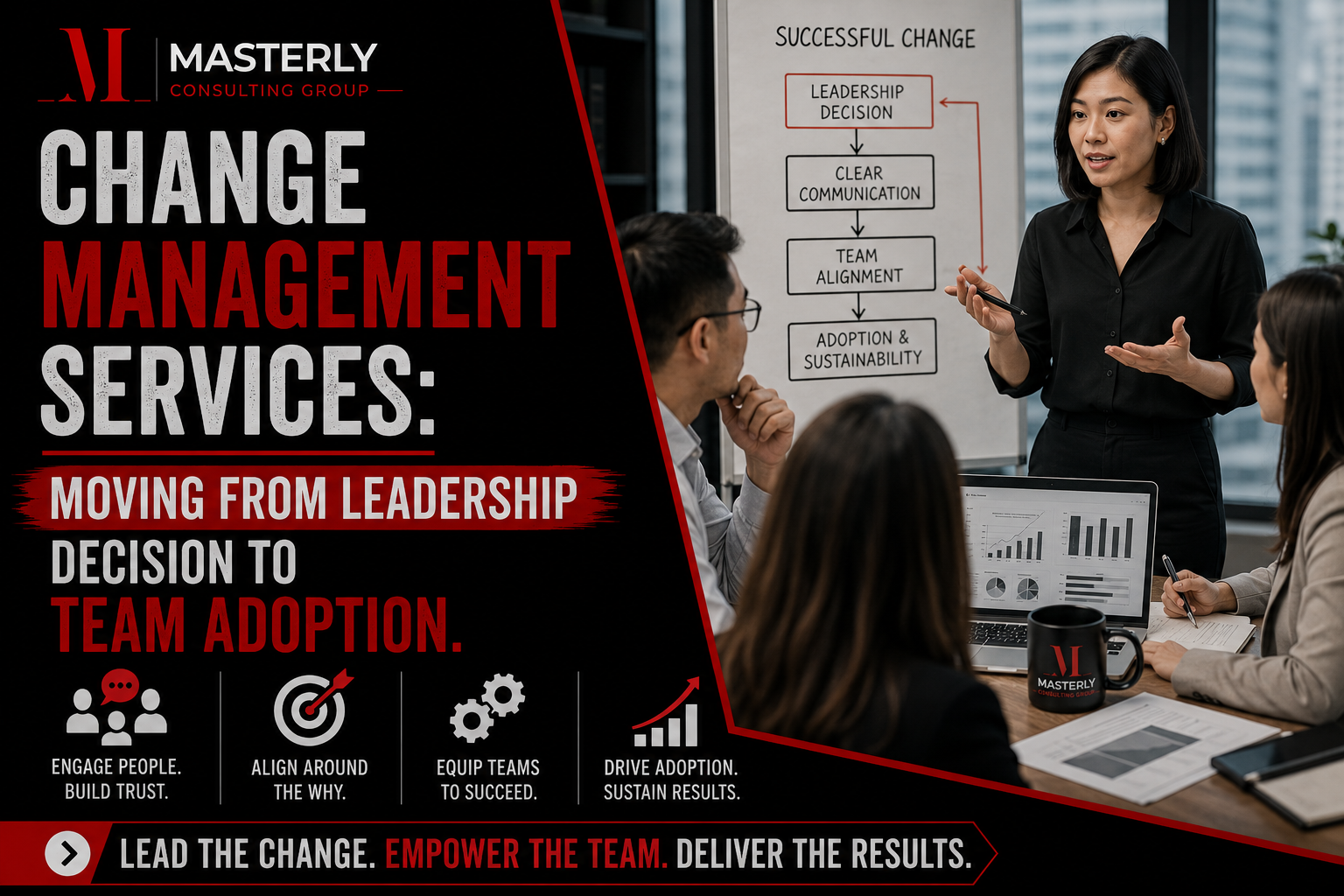
The organization may have a change plan. What it lacks is consistent change leadership: the leadership process that guides people through significant organizational shifts with clear direction, visible sponsorship, decision-making, behavior modeling, reinforcement, and communication strong enough to turn a stated vision into successful change.
Major organizational changes depend on more than an announcement. Employees watch what leaders communicate, what managers reinforce, what decisions leadership makes, and whether the organization behaves as though the change actually matters.
For executives, organizational leaders, managers, and spokespeople responsible for guiding teams through high-visibility change, effective leading change connects sponsorship, manager communication, employee resistance, adoption, reinforcement, decision clarity, and leadership behavior. It gives employees a clearer understanding of what is changing and gives managers a stronger foundation for guiding teams through uncertainty, reducing mixed messages and improving follow-through.
Masterly Consulting Group works with executives and organizational leaders on communication, leadership, change management, executive coaching, and high-stakes communication. Its executive media training also prepares leaders for situations where organizational decisions may receive public or stakeholder attention.
Change Leadership Starts When Team Members' Concerns Are, "What Does This Mean for Me?"
Executives often experience organizational change differently from employees.
Leadership may spend months discussing a restructuring, technology implementation, acquisition, expansion, leadership transition, or new operating model.
Employees may hear about it for the first time during a meeting.
That difference matters. Change leadership deals with human emotions, mindset, and culture, not just project decisions, so leaders have to ground communication in current reality and make space for different perspectives.
What feels like the end of a long decision process for executives may feel like the beginning of uncertainty for everyone else.
Employees may immediately wonder:
Will my responsibilities change?
Who will I report to?
Will the old process disappear?
What happens to current projects?
How will performance expectations change?
Why is the organization doing this now?
Leaders need to understand that announcing a decision does not automatically create understanding or adoption.
Employees need enough clarity to connect the organizational decision with their work, and enough empathy to acknowledge the emotional toll of transitions, address team members concerns, and build their ability to move forward.
Change Sponsorship Requires Visible Leadership
For business leaders overseeing change initiatives, an executive sponsor plays a critical role, not just a title on paper.
Employees care about what that sponsor actually does. Active sponsorship increases project success from 25% to 85%.
Change sponsorship becomes visible when senior leaders consistently explain why the change matters, make decisions that support it, remove barriers, and remain engaged after the initial announcement.
A leader who introduces an initiative and then disappears can create uncertainty.
Employees may begin wondering whether the change remains important.
Managers may hesitate to enforce new expectations.
Departments may continue operating under the previous model.
Strong sponsorship sends a different signal. Projects with active executive sponsorship are six times more likely to meet objectives.
Leadership behavior demonstrates that the initiative has organizational support and that the new direction is not simply another short-term program.
This is particularly important when change requires employees to stop familiar behaviors and adopt new ones. Many executives lack an adequate understanding of their sponsor role, which is why visible sponsor behavior matters.
Manager Communication Can Determine What Employees Actually Hear
Senior leaders may create the message, but frontline and middle managers often become the people employees question.
That makes manager communication critical.
A manager may need to explain the change during team meetings, talk directly with employees, answer practical questions, listen to team members concerns, clarify expectations, and correct misinformation.
If managers are not prepared, each one may interpret the change differently.
One department hears that the deadline is firm.
Another thinks it is flexible.
One manager explains the reason behind the change.
Another says, "Leadership told us to do it."
That inconsistency can weaken confidence.
Shared tools or guidance help managers communicate more effectively.
Masterly Consulting Group's current executive communication services specifically address communication during organizational changes, leadership transitions, new initiatives, and other high-impact situations. The company emphasizes clear and consistent leadership communication during periods of transition.
Managers therefore should not be treated only as recipients of a change announcement.
They are part of how the organization carries the message into daily operations.
Resistance Is Information Leaders Should Understand
Resistance is often treated as a problem employee attitude.
Sometimes it is.
But resistance can also reveal information leadership needs, and leaders should not ignore what it may identify.
Employees may resist because they do not understand the reason for the change.
Managers may see an operational problem executives missed.
Resistance can surface challenges identified by the people doing the work each day, along with ideas for improvement leadership would otherwise miss.
Employees may believe the new process creates more work without solving the stated problem.
A team may have experienced several abandoned initiatives and question whether this one will last.
Some employees may simply be uncomfortable leaving a familiar system.
These situations should not all receive the same response.
Effective change leadership distinguishes between reasonable questions, practical barriers, misinformation, competing incentives, lack of capability, and unwillingness to change.
The purpose is not to give every objection veto power.
It is to understand what is preventing movement so leadership can respond appropriately and produce positive outcomes.
Leadership Behavior Can Strengthen or Undermine the Message
Employees pay attention to what leaders do, and effective leadership sets high standards through visible action.
That makes leadership behavior one of the strongest signals during change.
Suppose executives tell employees that cross-department collaboration is now essential.
Then senior leaders continue protecting departmental boundaries.
Employees notice.
Or leadership introduces a new process but continues rewarding results achieved through the old one.
Employees notice that too. That often determines whether change efforts are taken seriously.
Masterly Consulting Group's current organizational consulting content emphasizes translating leadership expectations into daily behavior and recognizes the importance of leaders modeling the behaviors expected from the organization.
This is why communication alone cannot carry a major change.
The message and the management behavior surrounding it need to support each other.
Adoption in Change Management Is Different From Awareness
An employee can know about a change without adopting it.
That distinction matters.
An organization may hold meetings, send emails, distribute presentations, and update internal documents. Employees may understand perfectly well that a new system exists.
Then they continue using the old process.
Adoption occurs when the intended change begins becoming part of actual work across the broader change process.
It is how organizations achieve lasting change, not just awareness.
That may involve using a new system, following a new procedure, working under different responsibilities, communicating differently, or applying a new operating model.
Leadership therefore needs to look beyond whether the announcement was delivered.
The more important question is whether people are operating differently because of it.
Positive Reinforcement Helps Prevent the Return to Old Habits
The launch receives attention.
The following months determine whether the change lasts as teams make progress over time.
Reinforcement keeps the new direction visible after the initial announcement.
Managers may need to revisit expectations.
Leaders should celebrate short-term wins publicly to maintain momentum.
Leadership may need to resolve barriers that become clear only after implementation.
Teams may need additional support as they apply new processes in real situations.
Performance discussions may need to reflect the new expectations.
This is where many organizational changes can become difficult.
Employees naturally return to familiar methods when the new way creates uncertainty and the organization stops paying attention.
Reinforcement communicates that the change is not temporary.
It also gives leadership an opportunity to maintain focus on where implementation is working and where additional decisions are needed to sustain progress.
Leading Change Requires Decision Clarity
Employees struggle when leaders communicate a change but leave important decisions unresolved.
Imagine a company implementing a new customer-management platform.
The organization announces the technology and launch date.
But nobody has clearly decided:
Which system becomes the official source of customer information?
When does the old system stop being used?
Who owns data quality?
Which processes must change?
What happens when departments disagree about implementation?
These unresolved questions can create more resistance because employees are being asked to adopt something leadership has not fully operationalized.
Leading change requires enough decision clarity for employees and managers to understand what the new direction means.
Structured models such as Kotter’s 8-step process reinforce this by establishing urgency, building a guiding coalition, and creating a shared sense of why the shift matters.
Not every detail needs to be known on day one.
But leadership should distinguish between what has been decided, what remains under review, and who owns the unresolved decisions.
When leaders neglect key stages, change efforts can fail.
High-Visibility Change Requires Strong Executive Communication
Some organizational changes stay mostly internal.
Others attract attention from customers, boards, investors, community partners, employees, regulators, or the media.
A restructuring may generate questions.
A leadership transition may lead to interviews.
An acquisition may require executives to communicate with several audiences.
A major strategic change may place a CEO or spokesperson in front of reporters.
This is where change leadership and executive media preparation intersect.
The spokesperson needs to understand more than a set of talking points.
They should understand why the organization is changing, what leadership has decided, what stakeholders need to know, what remains uncertain, and where sensitive questions may arise.
Masterly Consulting Group's Executive Media Training service currently includes discovery around communication goals and sensitive issues, executive communication strategy, customized interview preparation, realistic interview simulations, message discipline, crisis communication, and stakeholder communication.
That preparation helps leaders communicate the organizational change with greater consistency when the audience extends beyond employees.
Inconsistent Leadership Messages Can Increase Uncertainty
Imagine an organization announcing a major restructuring.
The CEO tells employees the change will create greater efficiency.
A department leader says it is mainly about growth.
Another manager tells employees it will probably have little impact.
Then an executive gives an interview and introduces a fourth explanation.
Each statement may contain part of the truth.
Together, they create uncertainty.
Employees may wonder whether leadership is aligned.
Outside stakeholders may question whether executives agree on the strategy.
The issue is no longer only the restructuring.
Communication has become part of the story.
Masterly Consulting Group specifically identifies inconsistent messaging across leadership teams, contradictory public statements, and inconsistent leadership communication as risks its executive media preparation addresses.
Managers Need Preparation Before They Are Asked to Reinforce Change
Managers should not receive a major organizational announcement at the same moment as everyone they are expected to lead through it
.
They need context.
Managers and their project manager counterparts often help change leaders act on decisions in day-to-day operations.
What is changing?
Why?
What has been decided?
What questions should they expect?
What can they answer?
Which issues need escalation?
What behavior should managers model?
What should employees do differently?
This preparation supports more consistent manager communication.
It also reduces the chance that managers fill information gaps with assumptions.
The objective is not scripting every conversation.
Managers should still communicate naturally.
But they need enough shared understanding to avoid giving employees conflicting versions of the organizational direction. Effective change leaders are often described as working in three roles: agitator, innovator, and orchestrator.
Change Leadership Should Connect Communication With Operations
Change is not complete because the communication plan is complete.
A new direction may require changes to roles, systems, processes, incentives, training, resources, or management routines.
That is why change leadership needs an operating connection to the internal operating environment.
Masterly Consulting Group's current business-transformation content describes change management as part of making a new operating model become normal business practice. It identifies leadership alignment, stakeholder mapping, impact assessment, communication planning, and training design among relevant activities.
For leaders, the practical lesson is straightforward.
Employees are more likely to take the message seriously when organizational systems support what leadership is asking them to do.
Communication says what matters.
Operations demonstrate whether it really matters.
Successful transitions can strengthen resilience and adaptability for the future.
That systems support helps organizations succeed in a changing business world.
Masterly Consulting Group Helps Leaders Prepare for Important Change Communication
Major organizational changes can place unusual pressure on leadership.
Executives must explain decisions.
Managers must guide employees through uncertainty.
Stakeholders may expect answers.
Spokespersons may face difficult questions before every implementation detail is settled.
Masterly Consulting Group currently provides executive coaching and executive communication services addressing organizational change, leadership communication, decision-making, accountability, and strategic communication. Its Executive Media Training service provides customized preparation for executives and organizational spokespersons facing high-visibility communication situations.
The value of professional support is not simply producing better words.
It is helping leadership prepare for the conversations, behaviors, questions, and pressure surrounding an important organizational shift while keeping the bigger picture in view and supporting positive outcomes.

Frequently Asked Questions About Change Leadership
What is change leadership?
Change leadership is how leaders guide people through a significant organizational shift through direction, communication, sponsorship, decisions, behavior, and reinforcement; a change leader guides the organization through the change process, not just isolated announcements.
What is change sponsorship?
Change sponsorship is visible senior-leadership support for an organizational change. Effective sponsorship involves more than approving the initiative. Leaders need to remain engaged and make decisions that support the intended direction. Research consistently identifies active sponsorship as the leading contributor to change success by a three-to-one margin
.
Why is manager communication important during change?
Managers often become employees' closest source of information. Clear manager communication can reduce conflicting messages and help employees understand how organizational decisions affect their work.
Is employee resistance always negative?
No. Resistance can reveal misunderstanding, practical barriers, competing priorities, or concerns that leadership needs to understand. Leaders still need to make decisions, but useful feedback should not automatically be dismissed.
What is change adoption?
Adoption occurs when people begin using the new process, system, behavior, or operating approach rather than simply knowing that the change exists.
Why does reinforcement matter?
Reinforcement helps prevent employees and managers from returning to old practices after the initial attention surrounding implementation declines, and can include positive reinforcement to encourage the new behaviors that need to stick.
How does leadership behavior affect change?
Employees compare leadership messages with leadership behavior. When leaders model and reinforce the new expectations, their actions support the change. When behavior contradicts the message, credibility can weaken.
Can executive media training support change leadership?
Yes, particularly when executives or spokespersons must explain an organizational change publicly or to several stakeholder groups. Masterly Consulting Group's current service includes communication strategy, interview preparation, message discipline, crisis communication, stakeholder communication, and realistic practice.
When should leaders prepare for high-visibility change communication?
Preparation is most useful before important interviews, announcements, public appearances, or other situations where leadership communication could affect organizational reputation or stakeholder confidence. Masterly Consulting Group recommends beginning media preparation before interviews whenever possible.
Discuss Leadership Support for a Major Organizational Change or Implementation
A major change cannot depend on one announcement.
Employees need direction. Managers need clarity. Executives need alignment. Stakeholders may need answers. And leadership behavior needs to reinforce the organization’s stated priorities after the launch meeting ends.
Effective change leadership connects sponsorship, manager communication, resistance management, adoption, reinforcement, and consistent leadership behavior to support successful outcomes during big changes.
When the change also creates public visibility, executives and spokespersons need to be prepared to explain the decision under pressure without creating new confusion.
Masterly Consulting Group provides executive communication, executive coaching, and customized Executive Media Training for Leaders and Spokespersons. Its media-training work includes communication strategy, realistic interview practice, crisis communication, message discipline, and stakeholder communication.
Leaders also need education and focus to guide major change effectively.
Call Masterly Consulting Group at (972) 236-5051 to discuss leadership support for a major organizational change or implementation. The number is currently published on Masterly Consulting Group's website.