Team Performance What Leaders Should Fix Before Adding More Meetings or More People
A busy team is not always a high-performing team.
Team performance is how effectively a group works together to achieve expected outcomes, not how busy people look on paper. Employees can spend their days in meetings, answer messages quickly, and work long hours while important decisions still stall. Projects move between departments without clear ownership. Leaders add meetings to improve coordination, then consider adding people because everyone appears overloaded.
The real problem may be the way the team operates.
Strong team performance depends on more than effort. Role clarity, accountability, team goals, reliable handoffs, decision ownership, and a useful operating rhythm all affect whether capable people can perform effectively together. For executives and organizational leaders trying to improve team performance, organizational effectiveness, and leadership communication, these are the issues that usually explain why output lags even when effort is high.
Before adding headcount or another management process, leaders should understand what is creating the friction. This page focuses on the operating conditions behind performance barriers — including role clarity, accountability, team goals, cross-functional handoffs, decision rights, operating rhythms, and leadership communication — so leaders can fix the underlying system instead of responding with more meetings or more hires.
Masterly Consulting Group works with organizations on business consulting, organizational effectiveness, operational improvement, leadership, and executive communication. Its current organizational-effectiveness work addresses role clarity, decision rights, accountability, cross-functional workflows, performance rhythms, and execution systems.
Team Performance Problems Can Look Like Staffing Problems
When employees appear overloaded, hiring another person can seem like the obvious answer.
Sometimes additional capacity is necessary.
Other times, the existing team is spending too much time compensating for unclear structure.
Consider a project that moves through sales, operations, finance, and customer service.
Sales believes operations owns the next step.
Operations is waiting for information from finance.
Finance does not know the deadline.
Customer service becomes involved only after the customer complains.
Adding another employee does not automatically solve those problems.
The organization first needs to understand how work moves, where responsibility sits, and where performance barriers are creating unnecessary delays.
Masterly Consulting Group's current operating-model guidance identifies unclear ownership, cross-functional handoffs, decision rights, governance, and accountability as important parts of how work moves through a growing organization.
Role Clarity and Avoiding Role Confusion Give Capable People Room to Perform
Role clarity sounds basic until a team does not have it.
Employees may know their job titles but still be uncertain about operating responsibilities.
Who owns the final decision?
Who provides input?
Who communicates with the customer?
Who takes responsibility when work crosses departments?
Who has authority to resolve an exception?
Those questions matter because unclear roles create overlap and gaps
.
Two employees may complete the same work because each believes it belongs to them. In another area, neither person acts because each assumes the other owns the task.
Masterly Consulting Group's organizational-effectiveness guidance specifically connects role clarity with boundaries of authority, decision ownership, collaboration interfaces, and accountability.
For leaders, this means a performance problem should not automatically become a people problem.
Sometimes strong employees are working inside an unclear system.
Accountability Should Be Connected to Real Ownership
Telling everyone they are accountable can create the opposite result.
If five people own an outcome equally, employees may still be unsure who has the final responsibility.
Effective accountability requires clearer ownership.
Imagine a company promising customers a smooth onboarding experience.
Sales owns the initial relationship.
Operations manages delivery.
Finance handles billing.
Customer service responds to later questions.
Every function contributes, but who owns the overall onboarding result?
Without an answer, problems can move from department to department while each team completes only its portion.
Masterly Consulting Group's operating-model guidance emphasizes connecting accountability with actual responsibility and decision authority, particularly when work crosses functional boundaries.
Accountability becomes useful when people understand what they own and have enough authority to act.
High Performing Teams Need Clear Team Goals and Goal Setting
Individual employees can meet their targets while the team misses the larger objective.
That happens when personal responsibilities and team goals are poorly connected.
For example, one department may be rewarded for speed while another is measured primarily on risk reduction.
Both teams can perform well against their individual measures while creating conflict whenever work passes between them.
High performing teams need enough shared direction to understand what successful collective performance looks like.
That does not mean every employee has the same goal.
It means individual and functional priorities should support the outcome the organization actually needs, with individual goals aligned to the company's goals.
Leaders should therefore look beyond whether everyone is busy.
Are people working toward compatible outcomes?
Are competing priorities creating predictable friction?
Does the team know which goal takes priority when two objectives conflict?
Clear goals make those decisions easier.
Goal setting works better when goals are specific enough to be measured and reached within a timeline.
At the team level, collaborative goal setting can strengthen culture by reinforcing hard work around shared outcomes.
Tracking progress against goals supports motivation and commitment.
Handoffs Can Quietly Damage Team Performance
Many performance problems occur between roles rather than inside them.
These transition points are handoffs.
One employee completes a task and another must continue it. One department gathers information and another uses it. A customer moves from sales to service. A strategic decision moves from leadership to implementation.
Poor handoffs can create delays even when everyone involved is capable.
Information may be incomplete.
Ownership may be uncertain.
Employees may disagree about when responsibility officially transfers.
The receiving team may discover a problem that should have been addressed earlier.
Masterly Consulting Group's current organizational-effectiveness and operating-model materials identify cross-functional workflows, dependencies, interfaces, and handoffs as areas that can affect execution.
A team-performance review should therefore examine what happens between people, not just what each person does individually.
An Operating Rhythm Should Help Work Move
When coordination becomes difficult, organizations often add meetings.
A Monday meeting.
A project meeting.
A department meeting.
A leadership meeting.
A Friday status meeting.
Soon, employees spend significant time talking about work without necessarily making more decisions.
A useful operating rhythm has a different purpose.
It creates predictable points for reviewing performance, making decisions, resolving barriers, addressing risks, and maintaining accountability.
Masterly Consulting Group describes governance rhythm as the recurring pattern of leadership reviews, operating meetings, decisions, and performance discussions used to keep execution moving. Its current guidance emphasizes that meetings should exist because a particular type of decision or accountability requires a recurring forum.
The question is not whether the organization needs more meetings.
It is whether existing meetings have clear jobs.
Performance Barriers Should Be Diagnosed Before Solutions Are Chosen
A leader sees missed deadlines and assumes employees need better time management.
But the real problem is delayed approvals.
Another leader sees conflict and assumes employees need team building.
The actual issue is that two departments believe they own the same decision.
A third sees slow execution and assumes the company needs another manager.
Employees are actually waiting for senior leadership to approve routine decisions.
These are different performance barriers requiring different responses.
A useful diagnosis can examine several areas:
- Are roles clear?
- Is accountability connected to authority?
- Do teams share compatible priorities?
- Where do handoffs break down?
- Which decisions repeatedly stall?
- Are unnecessary approvals slowing execution?
- Do management meetings produce decisions?
- Are employees missing capacity, capability, skills, or simply clarity?
Effective diagnosis should also consider whether the team has the right mix of technical skills, experience, perspectives, and interpersonal abilities.
Diverse perspectives can reduce groupthink and improve problem-solving.
The objective is not to blame employees or management.
It is to identify what is actually limiting performance before the organization invests in a solution.
Decision Rights Affect How Quickly Teams Can Move
A team may understand its goals and still perform slowly if nobody knows who can make decisions.
Employees escalate routine matters.
Managers wait for executives.
Committees discuss issues several times because nobody has the final call.
Projects stop while people seek approval.
Masterly Consulting Group's organizational-effectiveness work identifies decision rights as a key element of organizational performance and focuses on clarifying who decides, who recommends, and who needs to participate.
Clear decision rights do not mean eliminating oversight.
They help put decisions at the appropriate level.
Senior executives can focus on matters requiring senior judgment while managers and teams handle decisions they are equipped and authorized to make.
That can improve team performance without adding another layer of management.
Communication Problems Can Reveal Operating Problems
Internal performance issues do not always stay internal.
Poor handoffs can affect customers and also signal problems in the team environment.
Unclear ownership can delay responses.
Conflicting priorities can produce inconsistent service.
A leadership team that is not aligned internally may also communicate conflicting messages externally.
Psychological safety is a shared belief that the environment is safe for interpersonal risk-taking.
Trust and psychological safety support engagement, employee engagement, and constructive disagreement as ideas are shared openly.
This becomes particularly important when executives and organizational spokespersons represent the company publicly.
Masterly Consulting Group's Executive Media Training for Leaders and Spokespersons addresses inconsistent messaging across leadership teams, stakeholder communication, communication strategy, message discipline, and preparation for challenging public situations.
A spokesperson may deliver the message, but the quality of that message can depend on how clearly leadership understands priorities, ownership, decisions, and organizational goals.
Team Alignment Matters Before High-Visibility Communication
Suppose a company is announcing an important operational change.
The CEO believes the initiative is about customer experience.
Operations sees it as an efficiency project.
Sales believes growth is the primary objective.
Employees have not received clear information.
Then a spokesperson is asked to explain the initiative publicly.
Media training can help that leader communicate effectively, but preparation may also expose a deeper alignment problem.
What is the organization's main message?
What decision has actually been made?
Which outcomes matter?
What can be discussed publicly?
Which stakeholders need specific information?
Masterly Consulting Group's current executive media training begins with the organization's communication goals, potential areas of concern, communication priorities, audience expectations, and sensitive issues before moving into customized interview preparation and realistic simulations.
That preparation helps connect executive communication with the organizational reality behind it.
Stronger Team Performance Does Not Always Require More Process
Organizations can overcorrect.
Leadership discovers unclear accountability and creates layers of approvals.
Poor communication produces more meetings.
One failed handoff leads to a complicated procedure.
The result can be more bureaucracy without better execution.
The goal should be clarity rather than process for its own sake.
Masterly Consulting Group's operating-model guidance makes the same distinction. A useful model should make routine decisions easier, clarify functional ownership, improve cross-functional execution, and help leadership meetings focus on decisions rather than repeated status updates.
Better structure should help capable employees work effectively.
It should not make simple work harder.
Masterly Consulting Group Helps Leaders Examine How Work Gets Done
When team performance declines, adding another meeting or another employee can treat the symptom without addressing the underlying operating problem.
Masterly Consulting Group works with organizations on issues involving organizational effectiveness, business operations, strategic execution, accountability, leadership, and related organizational challenges. Its published organizational-effectiveness approach examines areas including decision rights, role clarity, process accountability, cross-functional workflows, execution systems, and management rhythms.
For executives who also need to communicate important organizational decisions publicly, Masterly Consulting Group provides customized Executive Media Training for Leaders and Spokespersons. The current service includes executive communication strategy, interview preparation, realistic practice, crisis communication, message discipline, camera presence, and stakeholder communication.
The objective is not simply to make a team busier.
It is to help leadership identify the conditions that allow people to execute effectively, communicate organizational priorities with clarity, and use supportive leadership to empower team members and strengthen intrinsic motivation.
Relevant internal link: Masterly Consulting Group's Organizational Effectiveness Consultant: Improving Decision-Making, Accountability, and Execution page is the strongest supporting authority page for this topic because it directly addresses role clarity, accountability, handoffs, and performance rhythms.
Relevant service link: The Executive Media Training for Leaders and Spokespersons page supports the high-visibility leadership communication portion of the article without competing for the team-performance keyword.
Frequently Asked Questions About Team Performance
What is team performance?
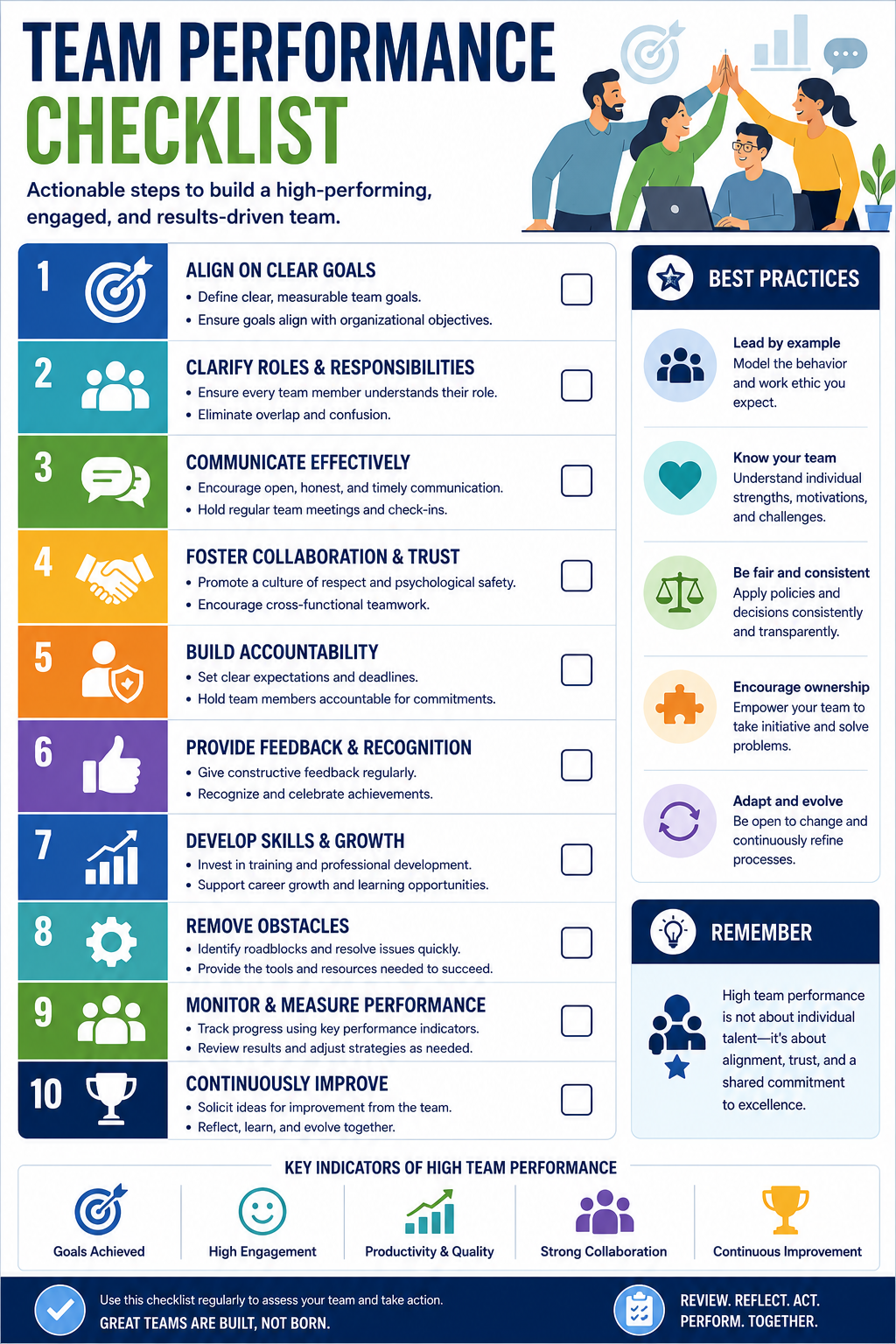
Team performance describes how effectively a group works together to achieve expected outcomes. It can be affected by goals, roles, decision rights, accountability, handoffs, management practices, and available resources, as well as whether people are on the same page about roles, expectations, and priorities.
What are common barriers to team performance?
Common performance barriers include unclear roles, role confusion when duties are not clearly defined, conflicting priorities, weak handoffs, unclear decision authority, duplicated work, poor accountability, and management routines that do not resolve problems.
Why is role clarity important?
Role clarity helps employees understand what they own, helps define roles and responsibilities, shows where their authority begins and ends, and clarifies how they should work with other roles to bring role clarity to life. Clear job descriptions can support this when they reflect current responsibilities. Tools such as the CliftonStrengths assessment can identify strengths, and people in different position types contribute to success in different ways. Leaders should also set examples in how they share information and collaborate across roles.
How does accountability affect team performance?
Accountability establishes clear ownership for decisions, responsibilities, and outcomes. It becomes stronger when the person responsible also has appropriate authority to act.
What makes high performing teams different?
High performing teams generally rely on the right mix of talent, clear expectations, defined responsibilities, workable decision processes, reliable coordination, and management practices that support execution. The right structure depends on the organization and its work.
People contribute more effectively when the importance of their work is clear and progress is recognized.
What are team handoffs?
Handoffs occur when responsibility, information, or work moves from one employee, department, or function to another. Unclear handoffs can create delays, duplicated work, and missed responsibilities.
What is an operating rhythm?
An operating rhythm is the recurring pattern of reviews, meetings, decisions, and performance discussions that keeps priorities and unresolved issues visible.
Should a company hire more people when performance declines?
Not automatically. Additional capacity may be appropriate, but leaders should first establish whether the issue is workload or a structural problem involving role clarity, decision rights, handoffs, priorities, or other operating issues, and whether the work assigned is directly related to each person's role.
Can executive media training support leadership-team communication?
Yes. Masterly Consulting Group's current executive media training addresses communication strategy, message discipline, stakeholder communication, inconsistent leadership messaging, interview preparation, and high-visibility communication.
Discuss a Team-Performance Review Focused on Structure, Accountability, and Execution
Your organization may already have talented people with the willingness and essential capability to succeed.
If work still stalls, the answer may not be another meeting, another process, or another hire.
Unclear roles, weak handoffs, competing team goals, uncertain decision authority, poor accountability, or an ineffective operating rhythm can limit team performance by making day to day activities harder to align and reducing employee satisfaction, even when employees are capable and committed and the work should make sense.
Masterly Consulting Group works with organizations on the structural and leadership issues behind execution. For executives and spokespersons facing high-visibility communication, the company also provides customized media training designed around organizational priorities, stakeholder expectations, realistic interview preparation, and message discipline.
To create role clarity is vital and critical to long-term success and productivity, and ultimately stronger execution.
Call Masterly Consulting Group at (972) 236-5051 to discuss a team-performance review focused on structure, accountability, and execution.