Process Improvement Consulting: Removing Bottlenecks Without Breaking What Works
What is Process Improvement Consulting?
If your business is losing time to inefficient processes, bleeding revenue through redundant tasks, or struggling with slow production that keeps you from hitting strategic goals, process improvement consulting delivers the structured approach needed to fix what's broken and build what works. Process improvement consulting can save companies 10% or more, and 21% of companies save 10% or more using process improvement strategies to improve efficiency.
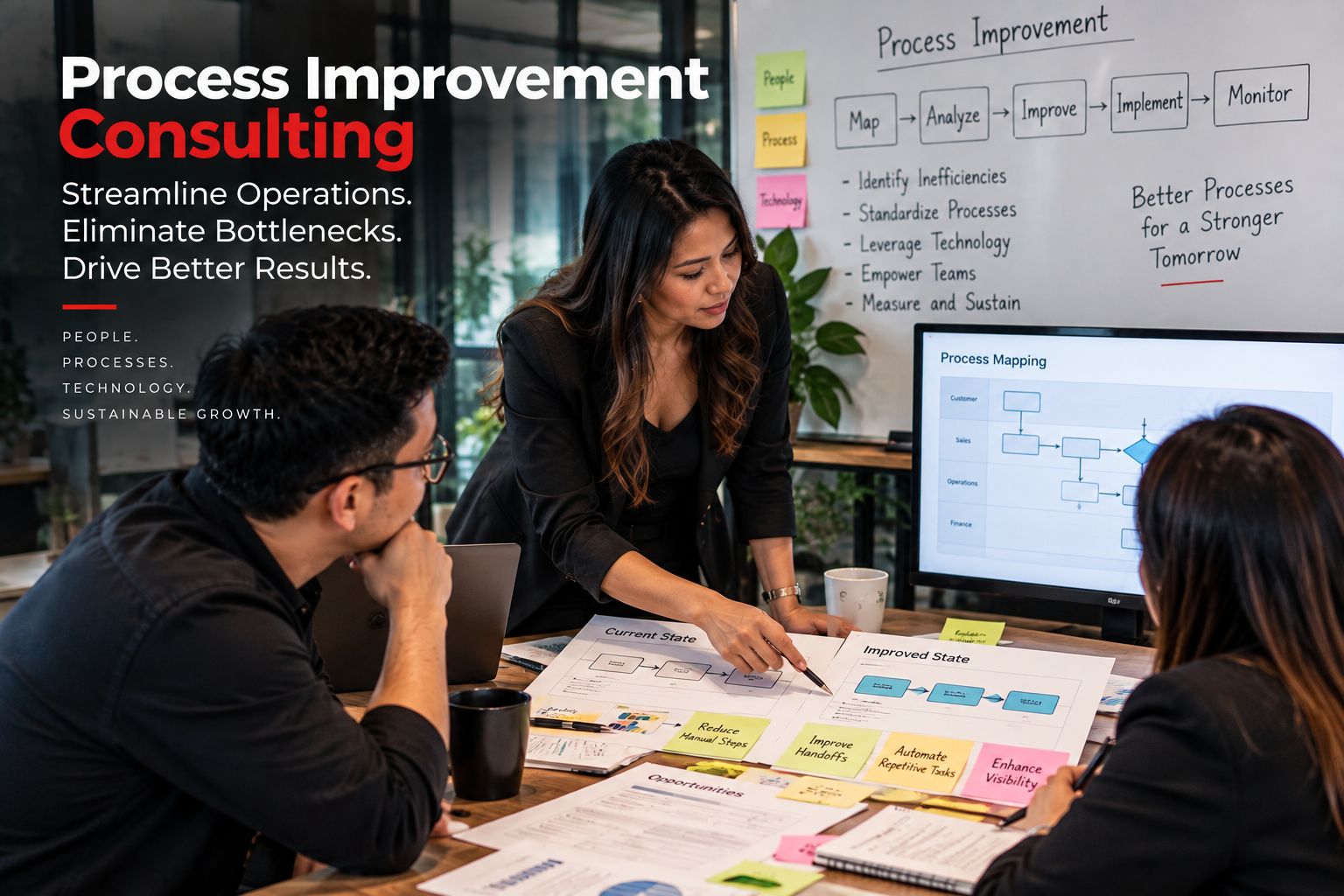
At its core, business process improvement consulting is a specialized advisory service that helps organizations analyze, redesign, and optimize their business operations. A process improvement consultant doesn't just point out problems - they diagnose root causes, focus on identifying inefficiencies and opportunities within business operations, quantify the cost of inefficiency, and implement solutions that deliver measurable results. Consultants diagnose inefficiencies through root-cause analysis, using tools like Value Stream Mapping, which visually diagrams material and information flows to identify bottlenecks, along with SIPOC diagrams, cross-functional flowcharts, and process mining software such as Lucidchart and Microsoft Visio.
What separates process improvement from other consulting services is the operational focus. Strategy consulting shapes corporate direction and market positioning. Technology consulting addresses systems and platforms. Process improvement consulting zeroes in on how work actually flows - the handoffs, delays, pain points, and waste embedded in current processes. It's driven by data, governed by proven methodologies, and measured by operational KPIs like cycle time, defect rate, throughput, and cost per transaction.
The key methodologies powering this discipline include:
- Lean - Lean targets the elimination of waste to optimize value flow, drawing from the Toyota Production System. Tools like 5S, Kaizen, and just-in-time production strip away non-value-adding steps so every action contributes to the customer outcome.
- Six Sigma - Six Sigma uses statistical data and the DMAIC framework (Define, Measure, Analyze, Improve, Control) to minimize error rates. At its highest level, Six Sigma targets roughly 3.4 defects per million opportunities.
- Lean Six Sigma - Lean Six Sigma is a common process improvement methodology that combines waste reduction with variation control for comprehensive operational improvement.
- Business Process Reengineering - Business process reengineering is used to redesign workflows fundamentally, reimagining processes from scratch rather than making incremental adjustments.
- Total Quality Management - Total Quality Management is a recognized process improvement method focused on organization-wide quality culture and continuous process improvement.
Process improvement consulting helps businesses build more efficient operations by applying these methodologies with discipline and precision.
Why Organizations Choose Process Improvement Consulting
Companies turn to improvement consulting when internal efforts stall, when growth outpaces existing workflows, or when the gap between where the business is and where it needs to be becomes too costly to ignore. Three factors consistently drive this decision.
External perspective that internal teams lack. When people work inside a process every day, they normalize bottlenecks and accept workarounds. A process improvement consultant brings cross-industry expertise, objective assessment, and specialized tools that identify gaps invisible to those closest to the work. They can quickly identify bottlenecks and improvement opportunities that internal teams have been stepping around for years.
Proven methodologies that deliver measurable results. Lean, Six Sigma, and business process reengineering come with established toolkits and statistical rigor used to optimize operations and improve business performance. These aren't theoretical frameworks - they're battle-tested systems that improve quality, reduce costs, and streamline operations with quantifiable outcomes. Organizations can achieve a 35% reduction in processing time when these methods are applied with rigor. Effective improvement programs define measurable targets to track success, and process improvement introduces clearer performance measures for informed decision-making.
Change management expertise for sustainable implementation. Without change management, most operational improvement gains erode within months. Organizational change management ensures newly redesigned processes are adopted, and Change Management utilizes models like ADKAR to drive user adoption during transitions. The best consulting support doesn't just redesign workflows - it builds the organizational muscle to sustain continuous improvement long after the engagement ends.
Our Process Improvement Consulting Services
Our process improvement consulting services span the full lifecycle of operational transformation - from diagnosing what's holding your business back to implementing technology solutions and building the systems that keep improvement moving forward.
Workflow Analysis and Operational Efficiency Optimization
Every engagement starts with understanding how work actually moves through your organization. We map existing workflows end to end, using process mapping and data analytics tools like Power BI and Tableau to measure performance and identify where delays, rework, and handoffs are destroying value.
Process mapping and bottleneck identification covers both manufacturing and service operations - from order processing to claims handling to internal approval chains. We identify each redundant task, every unnecessary handoff, and all the non-value-adding steps that slow production and drain resources. Process improvement can reduce operating costs by removing duplicated tasks.
Typical results include 20–35% reduction in process cycle times. Streamlined processes can enhance delivery speed and customer satisfaction, and standardized processes help reduce errors and predict outcomes as a company scales. A continuous improvement culture encourages regular problem identification by employees, keeping gains from eroding over time.
Technology Integration and Automation
Manual tasks are one of the largest drains on a company's ability to scale. 54% of employees believe automation can save them 2 hours daily - and our technology integration work is designed to capture that potential.
We assess your current technology stack and identify where automation delivers the highest impact. Robotic Process Automation leverages software bots to handle repetitive tasks, and automation tools include UiPath and Power Automate for deploying these solutions at scale. Beyond RPA, we implement CRM and ERP integrations, intelligent workflow engines, and AI-assisted processes that align with your strategic goals.
The key challenge isn't the technology - it's integration readiness. Research from PwC shows that 89% of organizations report digital investments falling short of expectations, primarily due to poor data quality, integration complexity, and user adoption issues. Our consulting services address all three, ensuring new technologies deliver the efficiency gains your business needs.
Quality Management Systems for Continuous Improvement
For organizations in regulated industries like healthcare, finance, and pharmaceuticals, process improvement must satisfy compliance mandates while still driving meaningful progress. We develop quality control processes and performance measurement systems using frameworks like ISO standards and Statistical Process Control.
Continuous improvement isn't a one-time project - it's a practice embedded into daily operations. Lean Six Sigma tools like Minitab support statistical analysis for ongoing defect reduction and process capability assessment. Data analytics tools like Power BI and Tableau measure performance across departments, giving leadership the visibility needed to make informed decisions.
We build compliance frameworks that satisfy regulatory requirements without creating the bureaucratic drag that undermines operational efficiency.
How Process Improvement Consulting Works
Process improvement projects typically take 2 to 6 months to complete, depending on scope, organizational complexity, and the depth of change management required. Smaller workflow optimizations can be completed in 4–8 weeks.
Discovery and Assessment Phase
We begin with stakeholder interviews across the organization - executives, department leads, and front-line teams - to understand how work actually happens versus how it's supposed to happen. We collect data on cycle times, defect rates, wait times, and costs to establish a performance baseline.
This phase uses process mining software, benchmarking against industry peers, and risk assessment to build a complete picture of where inefficient processes are costing you the most. Consultants use Agile frameworks to allow rapid response to changing priorities as discoveries are made.
Design and Planning Phase
Gap analysis reveals the distance between your current state and desired outcomes. We identify improvement opportunities, prioritize them by impact versus effort, and develop an actionable roadmap. A strategic roadmap aligns improvement initiatives with business goals, ensuring every change contributes to outcomes that matter.
The design phase produces future-state process models - leaner, with less waste, more automation, and clear ownership at every handoff. Pilot programs are designed to test improvements at small scale before committing to full rollout.
Implementation and Optimization Phase
Pilot execution comes first: controlled deployment to a limited area, with real-time monitoring and adjustment. Change management runs in parallel - communication plans, training workshops, and structured support to address resistance. Lean and Six Sigma methodologies help standardize and optimize processes during this phase.
Full-scale rollout follows successful pilots, with continuous monitoring through dashboards, feedback loops, and periodic reviews. We establish governance structures - process owners, steering committees, and continuous improvement programs - so that gains compound rather than decay. Continuous improvement requires tracking key metrics and data analysis to sustain momentum.
Proven Results from Process Improvement Consulting
Process improvement initiatives deliver returns that justify the investment many times over. Here's what clients across industries have achieved:
- 35% reduction in quote-to-cash processing time for an enterprise software company through workflow optimization and automation of approval chains.
- $2M in operational savings in the first year for an oil and gas client by eliminating process redundancies and streamlining workflows across operations.
- 99% reduction in account opening time achieved by a banking client through end-to-end process redesign and technology integration.
- 23% cost reduction per transaction through automated workflow implementation that replaced manual handoffs with intelligent routing.
- 36% average production increase per shift in manufacturing clients using Lean methodologies to eliminate waste and improve throughput.
- $328M boost in net present value from strategic process improvements applied across enterprise operations.
These aren't theoretical projections. They're the results of structured process improvement project execution with clear baselines, rigorous measurement, and disciplined implementation. Cost savings typically range from 15–30% of operational expenses when fundamentals are executed well.
Industries We Serve
Our process improvement consulting services support organizations across sectors where operational excellence creates competitive advantage:
- Manufacturing and Supply Chain - Lean-driven waste reduction, throughput optimization, predictive maintenance, and real-time quality control across production lines and distribution networks.
- Financial Services and Banking - Cycle time reduction for loan processing, compliance workflow automation, digital onboarding, and fraud detection process improvement.
- Healthcare and Pharmaceutical - Patient flow optimization, medical error reduction, protocol compliance, and drug manufacturing supply chain reliability within strict regulatory frameworks.
- Technology and Software Development - Agile and DevOps process optimization, CI/CD pipeline efficiency, bug triage workflow improvements, and release cycle acceleration.
- Professional Services and Consulting - Proposal-to-contract cycle streamlining, client management workflow optimization, billing automation, and role clarity across project management functions.
- Retail and E-Commerce - Order fulfillment optimization, returns processing, inventory management, and demand forecasting through ERP and WMS integration.
Frequently Asked Questions
How long does a typical process improvement project take?
Process improvement projects typically take 2 to 6 months, depending on scope, complexity, and the number of processes involved. Smaller workflow optimizations - such as streamlining workflows within a single department or automating a specific set of manual tasks - can be completed in 4–8 weeks. Larger initiatives involving multiple business units, enterprise systems, or significant culture change run toward the longer end. We scope every engagement with clear milestones so you know exactly what to expect.
What ROI can we expect from process improvement consulting?
Most clients see 3–5× return on investment within the first year. Companies can realize $2M in operational savings in the first year, and 21% of companies save 10% or more using process improvement strategies. Cost savings typically range from 15–30% of operational expenses, plus intangible benefits like improved customer satisfaction, higher quality output, and freed capacity for growth. ROI depends on the severity of baseline inefficiencies, leadership commitment, and the quality of data available for analysis.
How do you ensure changes stick after the project ends?
Sustainability is built into every phase of our work. We establish continuous improvement frameworks and governance structures - including process ownership, PDCA cycles, Kaizen programs, and performance dashboards - that keep improvement alive after the engagement ends. A continuous improvement culture encourages regular problem identification by employees. We embed changes into standard operating procedures, train teams on new practices, and align incentive structures so that maintaining gains is everyone's responsibility, not just leadership's.
Request a process improvement consultation with Masterly Consulting Group
If your organization is dealing with bottlenecks, rework, unclear ownership, slow handoffs, or inconsistent execution, the answer may not be asking your team to work harder. It may be improving the process that supports their work.
Masterly Consulting Group provides process improvement consulting for leadership and operations teams that want clearer workflows, stronger accountability, and more consistent execution.
Call (972) 236-5051 or visit Masterly Consulting Group to discuss your process improvement needs.