Business Succession Planning: Building Continuity Before Leadership Changes
What Is Succession Planning and Why It Matters in 2026
If your organization depends on a handful of key leaders or specialists-and most do-succession planning is the process of identifying, evaluating, and developing the people who will step into those roles when the time comes. With over half of U.S. employer-businesses owned by individuals aged 55 or older, and talent markets tighter than ever, waiting to figure out "who's next" is a risk most companies can no longer afford.
Succession planning is the process of building a deliberate, ongoing system to ensure leadership continuity across your organization. It is not a one-time event or a dusty binder on a shelf. It covers critical roles at every level-from the C-suite to technical specialists-and helps support business continuity by keeping operations, revenue, and strategy moving when executives, founders, or key employees depart.
The urgency in 2026 is driven by several converging forces. CDC data on the aging workforce shows dramatic increases in employment among workers aged 65 and older, meaning a wave of retirements is not hypothetical-it is already underway. The U.S. population aged 45–64 has decreased by about 2.68 million from 2020 to mid-2025, shrinking the pool of experienced leadership candidates. Meanwhile, remote and hybrid work has made it harder to spot and develop high potential employees through day-to-day observation. The tight labor market gives top talent more options, making retention of future leaders more fragile than ever.
This article is a practical, step-by-step guide for HR leaders, founders, and senior managers. Whether you lead a family business, a mid-size company, or a large enterprise, the goal is the same: build a well structured succession plan that helps future proof your organization.
Key Benefits of Succession Planning for Organizations
The benefits of succession planning go well beyond having a backup name in a file. A comprehensive succession plan touches business strategy, company culture, financial performance, business performance, and long term success. Here is what it delivers, in concrete terms.
Ensures Continuity in Critical Roles
When a CEO, CFO, head of sales, or lead engineer leaves without a successor, the impact is immediate: stalled projects, lost revenue, confused teams, and eroding stakeholder confidence. Succession planning ensures smooth business operations during leadership changes by keeping a maintained list of potential successors and readiness levels for each key role. Companies with succession plans maintain trust among stakeholders during transitions.
Consider a mid-sized manufacturer that loses its plant manager to a sudden illness. Without a plan, production slows, supplier relationships drift, and customer orders fall behind. With a ready successor-someone who has shadowed the role and understands the critical positions-the disruption shrinks from months to days.
Succession planning helps minimize operational disruptions during leadership changes, and the time-to-fill for critical roles drops sharply when internal candidates are identified and groomed in advance.
Builds a Strong Internal Leadership Pipeline
A strong leadership pipeline does not appear overnight. It is the result of integrating succession planning with talent development programs, leadership development initiatives, and structured career progression. Effective succession planning develops future leaders within organizations by creating clear pipeline stages: emerging leaders, mid-level managers, and senior leaders ready for the next step.
Organizations that promote from within typically see lower onboarding costs, fewer culture mismatches, and higher retention. When HR develops talent through structured leadership programs, the bench strength across the organization deepens-not just at the top, but at every level where leadership skills matter.
Improves Engagement, Retention, and Employer Brand
Succession planning boosts employee engagement by offering career opportunities that are visible and attainable. Employees are more likely to stay with companies that invest in their growth and support employee development. When people see a path forward-development opportunities, mentoring, stretch assignments-they are less likely to become a flight risk.
Companies with strong succession plans report higher employee loyalty and engagement. And in competitive talent markets, a reputation for nurturing talent and preparing future leaders gives your employer brand a competitive edge that helps attract top talent.
Protects Institutional Knowledge
Experienced leaders often hold undocumented knowledge-about clients, legacy systems, informal networks, decision-making shortcuts-that disappears when they leave. Effective succession planning improves knowledge retention through mentoring and training, and effective knowledge transfer minimizes operational disruptions during transitions.
Knowledge transfer should be a formal requirement in every succession plan, not an afterthought. Planned overlaps, shadowing, and documentation ensure that institutional knowledge is preserved and passed on, rather than walking out the door with a retiring executive.
Supports Strategic Agility and Long-Term Growth
Aligning successors' core skills and complementary skills with the future direction of the business and its strategic goals—digital transformation, sustainability, global expansion—makes strategy executable, not aspirational. Succession planning supports long-term business growth and transformation by ensuring that the leaders stepping into future leadership roles are equipped for where the organization is headed, not just where it has been.
Investors, boards, and lenders increasingly scrutinize succession risk during due diligence, especially in IPOs, private-equity deals, and acquisitions. Linking succession readiness to strategic planning cycles gives leadership-and external stakeholders-confidence that the business can adapt and grow.
Core Concepts: Succession Planning, Succession Management, and Replacement Planning
Three terms often get used interchangeably, but they represent very different levels of maturity. Understanding the distinctions helps organizations move beyond reactive fixes toward a system that actually works.
Succession Planning vs. Succession Management
- Succession planning is the design of who could step into specific leadership positions and how they will be prepared. It is strategic and forward-looking, defining not only current needs but anticipating future capabilities.
- Succession management is the ongoing governance around implementing, reviewing, and updating the plan. It involves continuous review cycles, leadership metrics, accountability, and connecting with talent management to support development and accountability over time.
Mature organizations move from treating succession planning as a one-off event to embedding succession management as a continuous discipline-reviewing talent, adjusting development plans, and holding leaders accountable for results.
Succession Planning vs. Simple Replacement Planning
- Replacement planning answers a narrow question: "Who sits in the chair tomorrow if someone leaves?" It typically involves naming a backup with minimal development or evaluation.
- Succession planning is broader and deeper: it focuses on readiness over time, not just naming a backup. It evaluates leadership potential, builds development plans, and aligns the successor pipeline with future business needs.
The risks of a replacement-only mentality are real: poor fit, limited diversity, no strategic alignment, and a false sense of security. Modern succession planning treats every critical role as requiring both an immediate contingency plan and a longer-term development pathway.
Types of Succession Planning (Enterprise-Wide and Specialized)
Organizations often need different succession approaches depending on role type, ownership structure, and company size. Here are the main categories.
Executive and C-Suite Succession
CEO, CFO, COO, and CHRO succession carries the highest stakes. Grooming internal candidates for these senior positions often takes 3–5 years or more. Boards typically become deeply involved, using external benchmarking, rigorous assessments, and sometimes running multiple candidates in parallel to build governance confidence. Yet 53% of companies lack a CEO succession contingency plan, a gap that exposes organizations to significant risk from unexpected leadership changes.
Succession in Family-Owned Businesses
Family owned businesses face a unique intersection of ownership, governance, and family dynamics. Common questions include which family members should lead, when the founder should step back, and what happens if no heir wants control. 43% of family-owned businesses lack a formal succession plan, and only one-third of family businesses transition successfully to the second generation. Just 13% of family businesses make it to the third generation. Separating leadership succession from ownership and estate planning is essential-and often the hardest part.
Succession for Technical and Specialist Roles
Roles like chief architect, lead data scientist, or master technician present distinct challenges. These positions often rely on tacit knowledge held by very few people. Succession here requires cross-training, thorough documentation, and apprentice-style shadowing. Creating deputy or "apprentice" roles in critical expert areas spreads knowledge and builds readiness.
Succession Planning in Small and Mid-Size Companies
Founders and small-business owners are often the single point of failure. Only 10% of small business owners have a formal succession plan. Resource constraints-limited headcount, tight budgets-mean SME succession plans tend to focus on a few critical roles, with ownership and exit planning tightly coupled. Banks, buyers, and potential successors look for evidence of continuity when valuing business assets, making even a simple written succession plan a significant differentiator.
Foundations of an Effective Succession Planning Strategy
Before launching a formal succession planning process, certain prerequisites must be in place. Think of these as the conditions that determine whether your plan will actually work-or gather dust.
Align With Organizational Strategy and Time Horizon
Succession criteria and development focus must match the business’s strategic goals and where it is headed in 3–5 years. If your strategy shifts-toward AI adoption, new geographies, sustainability-successor profiles must evolve accordingly. Effective succession planning includes assessing future leadership needs and syncing succession reviews with strategic planning and budgeting cycles.
Secure Top Leadership and Board Sponsorship
Succession planning must be visible at the CEO and board level. When senior leaders champion the process, it is more likely to be resourced, respected, and executed systematically. Without executive sponsorship, plans stay on paper. The board's role is especially important in CEO and C-suite succession oversight.
Clarify Governance, Roles, and Decision Rights
Who owns the process? Typically the CHRO or head of human resources. Who provides input? Line leaders and senior management. Who decides? The CEO and board. Define meeting cadence, data to review, confidentiality rules, and how to handle conflicts-such as when two executives push different candidates. A simple governance document makes these decision rights explicit.
Embed a Culture of Leadership Development
Succession plans only work if managers are expected-and rewarded-for developing people. Tie manager performance metrics to talent development and internal promotion rates. Systematic mentoring, coaching, and stretch assignments at all levels create the talent mindset that makes succession planning real, not theoretical.
The Succession Planning Process: 6 Practical Steps
Effective succession planning involves six key steps. Here is a clear, repeatable sequence HR leaders and executives can follow annually-from identifying critical positions to measuring results.
Step 1: Identify Critical Roles and Future Capability Needs
Identifying critical positions starts with a simple question: which roles, if vacant, would significantly disrupt operations, revenue, or strategy — in other words, which are the key positions? HR identifies successors for critical roles in organizations by mapping positions across leadership and specialist tracks. Look ahead 3–5 years to anticipate new roles driven by technology shifts, regulatory changes, or ESG requirements.
A critical role is one that is hard to replace (scarce skills, high leadership visibility) and whose absence creates immediate business risk.
Step 2: Map Competencies and Success Profiles
For each critical role, create a success profile: the key competencies, technical skills, leadership behaviors, cultural fit, and strategic vision required. Differentiate between what the current incumbent needs today and what the future role will demand as the business evolves. Gather input from current jobholders, customers, and stakeholders to build profiles that are grounded in reality.
Step 3: Assess Talent and Identify Potential Successors
Succession planning involves identifying potential successors early. Conduct talent reviews with multiple managers and raters, evaluating both performance and potential-including values alignment and mobility. Identifying potential successors involves evaluating employee performance records, leadership potential, and readiness.
Tag each candidate with a readiness level: "ready now," "1–2 years," or "3–5 years." Name primary and secondary successors for each key role. For highly scrutinized roles like CEO, maintaining a small pool of 2–3 internal candidates builds governance trust.
Step 4: Design Individual Development Plans for Successors
Succession planning includes developing individual development plans for successors. Every named successor should have a concrete plan tied to the target role-covering stretch assignments, role rotations, acting roles, mentoring, coaching, and formal training.
A well-designed succession plan helps businesses prepare employees for future responsibilities. Define specific timelines and objectives (e.g., "lead a cross-functional initiative by Q4 2027") and tie development milestones to performance reviews.
Step 5: Implement Development and Create Transition Scenarios
Execute development plans over 12–36 months, depending on the role and readiness level. Also prepare for sudden departures: designate temporary successors, define interim authority, and ensure outgoing role-holders cooperate with shadowing and partial handovers. Scenario planning-for both emergency and planned exits-is essential for resilience against unexpected leadership changes.
Step 6: Review, Update, and Measure Progress Annually
Succession planning should be reviewed and updated annually-or more often in volatile or high-turnover environments. HR monitors progress and provides feedback on succession plans. Set KPIs: percentage of critical roles with "ready now" successors, internal fill rate, diversity of the successor pool, retention of high potential talent, and performance of promoted successors after 12–24 months in role. Regular reviews of succession plans help adapt to changing business needs.
Tools and Frameworks to Structure Your Succession Plan
Practical tools make the plan visible, manageable, and easier to communicate to leadership and the board.
Succession Planning Charts and Matrices
A succession planning chart lists each critical role alongside the current incumbent, primary and secondary successors, readiness level, and risk exposure. Use color coding or risk indicators to flag roles with no ready successor. These charts help executives see bench strength holistically-not just role by role-and focus development where it matters most.
Talent Review Grids and Readiness Ratings
A two-dimension framework-performance versus potential-helps standardize evaluations and reduce bias. Use a readiness scale: "ready now," "ready in 12–24 months," "3–5 years," or "long-term potential." Document the rationale behind each rating and the planned actions to close development gaps.
Knowledge Transfer and Role Handover Checklists
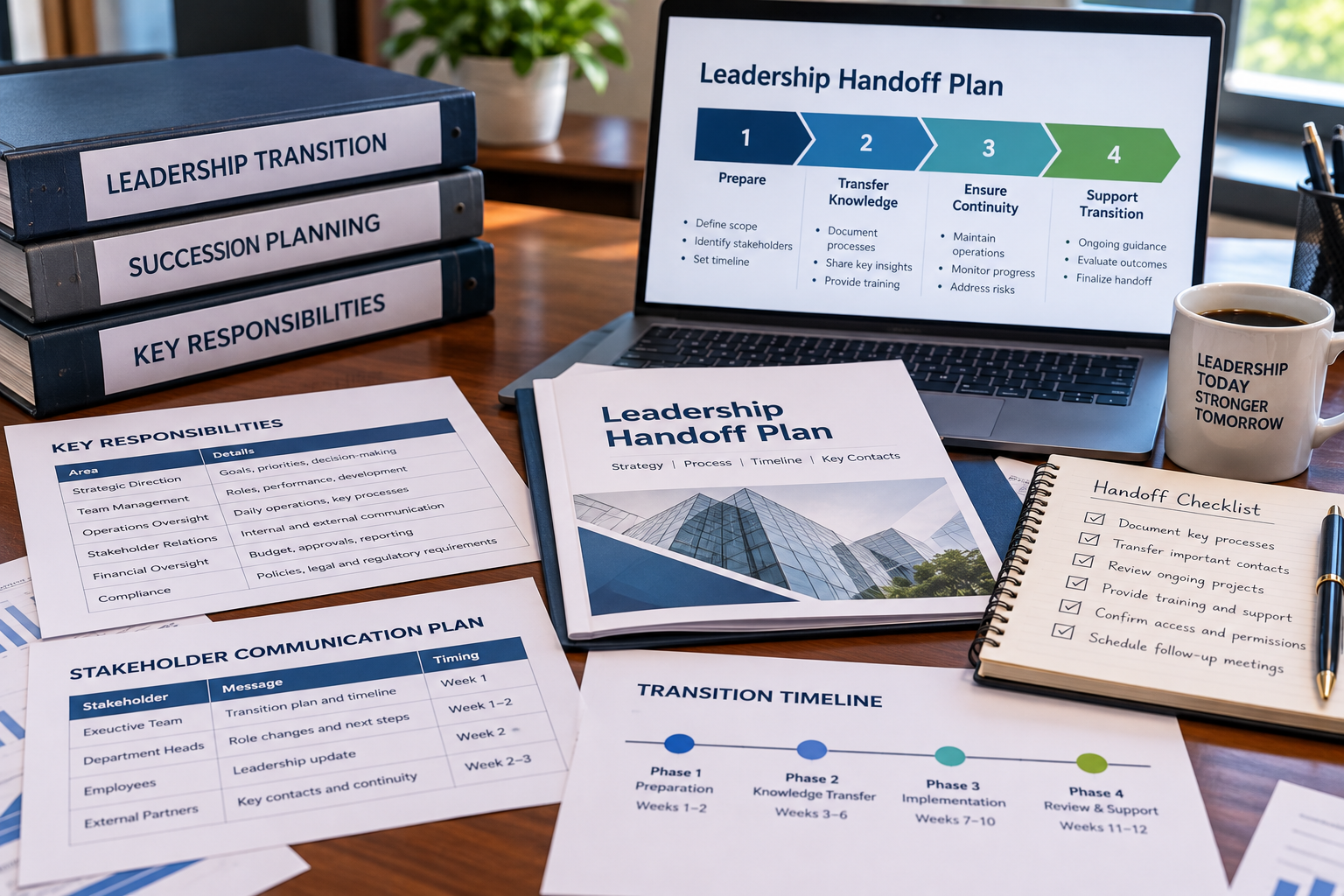
Create a checklist template for each critical role: key contacts, reports, processes, clients, decision rights, risk exposures, and governance interactions. Schedule overlap periods where outgoing and incoming leaders work through the checklist together. Store completed documents in a secure but accessible repository. Succession planning helps retain knowledge from experienced leaders when these tools are used consistently.
Developing Future Leaders: Practical Methods That Work
Naming potential successors is only half the job. The other half is actually developing them. Here are the methods that move people from "potential" to "ready."
On-the-Job Stretch Assignments and Rotational Roles
Stretch assignments are the most powerful leadership development tools available. Leading a cross-functional initiative, taking a temporary assignment in another region, or turning around a struggling unit builds the leadership skills and judgment that no classroom can replicate. Define clear learning objectives and provide support for each assignment. Training employees through real challenges accelerates readiness faster than any program alone.
Mentoring, Coaching, and Sponsorship
Mentoring provides guidance from experienced senior leaders. Coaching drives specific skills and behavior change. Sponsorship means actively advocating for someone's advancement-putting their name forward for key leadership roles and high-visibility projects.
Formal mentoring programs for identified high potential employees create structured relationships that accelerate growth. When preparing a VP for a C-suite role over the next 1–3 years, external executive coaching can provide the perspective and challenge that internal mentors may not.
Formal Learning and Leadership Programs
Structured courses, leadership academies, and targeted workshops build the foundation for future roles. Blend in-house programs with selected external programs or certifications. The key is linking any training back to succession profiles and the specific competencies each successor needs-not generic leadership content.
Feedback, Assessment, and Reflection
360-degree feedback, psychometric tools, and regular check-ins give successors honest insight into their strengths and gaps. Encourage successors to document lessons learned from major assignments and reviews. Repeated assessments over time track growth, validate readiness, and help adjust development plans.
Special Focus: Family Business and Founder Succession
Family and founder-led firms face distinct emotional, legal, and governance challenges that make succession planning both more personal and more complex.
When and How to Start Planning Founder Exit
Succession planning should start 5–10 years before transition-well before a founder is ready to step away. Even if no exit is planned, an emergency succession plan must be ready immediately. A phased transition, such as moving from CEO to chair or mentor role over several years, helps preserve business continuity while giving the next generation room to grow.
Selecting and Preparing the Next Generation
Use objective criteria-leadership competence, experience, motivation-not merely birth order or seniority. The next generation should gain outside work experience and independent credibility before stepping into the family business. Staged responsibility transfers-leading a business unit, then taking on P&L ownership, then broader stakeholder management-build confidence and capability.
52% of family businesses planning ownership changes intend to keep it in the family. That makes the quality of preparation even more critical.
Managing Family Dynamics and Non-Family Talent
60% of succession failures stem from unresolved family conflict. Sources of tension include sibling rivalry, expectations of non-active heirs, and competing visions for the business. Governance structures like a family council or advisory board help separate business decisions from family emotions.
Non-family executives must feel valued and fairly treated. Excessive favoring of family members without merit can result in losing key talent at the worst possible time. Legal mechanisms-shareholder agreements, buy-sell agreements, operating agreements-must be aligned with the succession plan.
Risk Management: Emergency Succession and Continuity Planning
Not all leadership transitions are planned. Sudden departures-through illness, resignation, or unforeseen events-can happen to anyone, at any time. Contingency plans are not optional.
Creating an Emergency Succession Plan
An emergency succession plan should contain:
- Interim leader for each critical role, with defined authority limits
- Communication plan for internal teams, the board, and external stakeholders
- Access protocols for key systems, banking, contracts, and payroll
- Board or ownership approval where applicable
Recommend naming at least one interim successor per critical role. 53% of companies lack a CEO succession contingency plan-a vulnerability that can be addressed with relatively simple documentation and pre-approval.
Linking Succession to Business Continuity and Exit Planning
Leadership succession, business continuity plans, and owner exit strategies are deeply connected. Insurance, buy-sell agreements, and shareholder agreements interact with succession planning in ways that require coordination between HR, finance, legal, and external advisors.
Only about 42% of business owners have a formal written transition plan. Integrating financial planning, tax planning, and legal structure with succession planning protects business assets and ensures that leadership changes do not trigger operational or legal crises.
Common Succession Planning Mistakes and How to Avoid Them
Many organizations create succession plans that never translate into action. Here are the most common pitfalls-and how to sidestep them.
Waiting Too Long to Start
The pattern is familiar: a founder announces retirement, and the scramble begins. By then, development windows are too narrow, options are limited, and external hires become the only choice. Only 34% of organizations consider their succession planning effective, and delay is a leading reason—which is why succession planning important work starts early, before limited development time weakens readiness. Start as soon as roles are identified as critical, regardless of the incumbent's age or plans.
Naming Successors Without Developing Them
A "paper plan" with names in boxes but no development actions, timelines, or milestones fails when tested. Every named successor needs a living, active development plan. Link development milestones to performance reviews and compensation to keep the plan real and accountable.
Ignoring Diversity, Inclusion, and Bias
Informal networks and similarity bias-promoting people who look and think like the current leader-produce homogenous successor slates and increase the risk of groupthink. Diverse talent slates, structured criteria, and multiple raters reduce bias. Non-diverse leadership pipelines carry business, reputational, and legal risks.
Failing to Communicate Transparently
Total secrecy breeds rumors and disengagement. Overpromising creates entitlement and resentment when plans change. A balanced approach works best: clearly explain the process, highlight development opportunities, and have honest career path conversations with high potential employees-without guaranteeing specific promotions.
Measuring the Impact of Succession Planning
What gets measured gets managed. Succession discussions without metrics risk losing leadership support and drifting into irrelevance.
Key Metrics and Indicators
Track practical KPIs to understand whether your succession planning process is delivering results:
- Percentage of critical roles with at least one "ready now" successor
- Internal vs. external fill rate for key leadership roles
- Time-to-fill for critical roles
- Retention rate of high potential employees
- Diversity of the successor pool
- Performance of promoted successors 12–24 months after stepping into the role
According to SHRM's 2025 benchmark research, only 22% of HR leaders reported their organization had a formal succession plan-and just 16% of small organizations had one, compared to 44% of extra-large companies. Tracking and reporting these numbers keeps the plan visible and resourced.
Using Insights to Improve the Plan
Use metrics to pinpoint gaps: functions with no bench strength, demographic imbalances, underperforming successors. Adjust development investments accordingly. Present outcomes to leadership and the board annually to maintain sponsorship and resources. Regular reviews of succession plans help ensure they meet future needs and adapt to changing business conditions.
Frequently Asked Questions About Succession Planning
These are the questions that most often delay organizations from starting-or improving-their succession planning.
When is the right time to start succession planning?
The right time is now. As soon as your organization has roles deemed critical, planning should begin-regardless of whether current incumbents are near retirement. For senior positions, start 3–5 years ahead of possible turnover. An emergency succession plan should be in place immediately.
How many successor candidates should we identify per role?
For truly critical roles, aim for at least one primary and one secondary successor. In large organizations, a small pool of 2–3 internal candidates is ideal. Smaller firms can build broader talent pools where individuals could potentially fill more than one role.
Should we tell employees they are on a succession plan?
There are trade-offs. Telling candidates can motivate and clarify expectations, but it risks creating a sense of entitlement or friction if plans change. The best approach: share development focus and future opportunities without guaranteeing specific promotions.
What if we don't have internal successors ready?
That is common, especially in smaller organizations. Use external hiring as a complement while building your internal bench. Identify and develop potential leaders through targeted talent development programs, and map external talent markets so you are not starting from scratch when a vacancy opens.
How often should we update our succession plan?
Succession planning should be reevaluated annually at a minimum. Also update following major organizational changes: mergers, restructures, key departures. In high-growth or high-turnover environments, semi-annual check-ins are wise.
Business planning consultation
Call (972) 236-5051 to schedule a business planning consultation and discuss strategies to improve your operations, address business challenges, and support long-term growth. Our team is ready to help you explore practical solutions tailored to your organization's goals.