Change Management Consultant: Helping Teams Move From Decision to Adoption
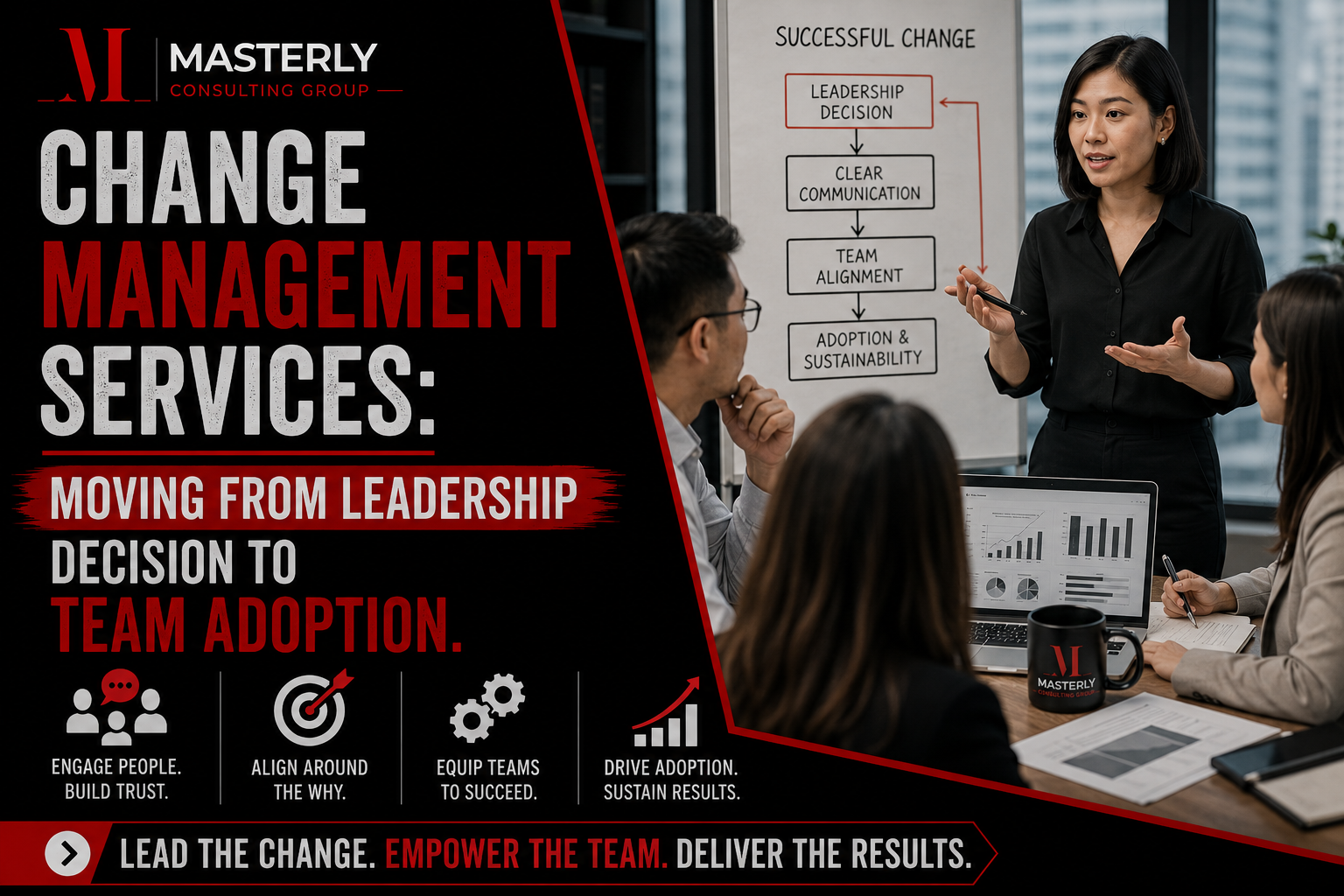
Most organizations invest heavily in deciding what to change. Fewer invest in making sure people actually adopt it. A change management consultant bridges that gap, turning leadership decisions into measurable, lasting behavior change across the organization. Here is what that work looks like in practice, when you need it, and how to find the right partner.
What a Change Management Consultant Does (and When You Need One)
A change management consultant is a specialist who helps organizations move beyond approving a new system, structure, or operating practice to the harder step: getting people to accept, use, and sustain that change. Change management consultants focus on the human side of business transformations-understanding resistance, culture, readiness, and engagement-rather than simply delivering project plans or slide decks.
Change management consulting helps organizations manage complex transformations. From ERP rollouts and digital transformation programs to hybrid-work policy shifts and operating model redesigns, the consultant's job is to ensure that what leadership decided actually becomes what employees do. A change management consultant assesses the impact and identifies potential barriers to change before those barriers stall progress. Successful change management minimizes disruption and maintains productivity, even when an organization is reshaping how it works.
This discipline is distinct from general management consulting and project management:
- Management consulting typically defines business strategy-what to change, where to cut costs, how to restructure. It stops short of ensuring adoption.
- Project management controls scope, timeline, and budget. It tracks whether deliverables are complete, not whether people have embraced them.
- A change management consultant owns the space between "the project is done" and "the organization is actually working differently."
Common triggers for engaging a consultant include stalled adoption of new technology, conflicting messages from the leadership team, high turnover during a transition, or prior failed transformations where business outcomes lagged despite planning.
Masterly Consulting Group works as a specialist partner in organizational change consulting, helping teams translate decisions into adoption through structured, people-centered methods.
How Change Management Consulting Differs From Other Consulting Approaches
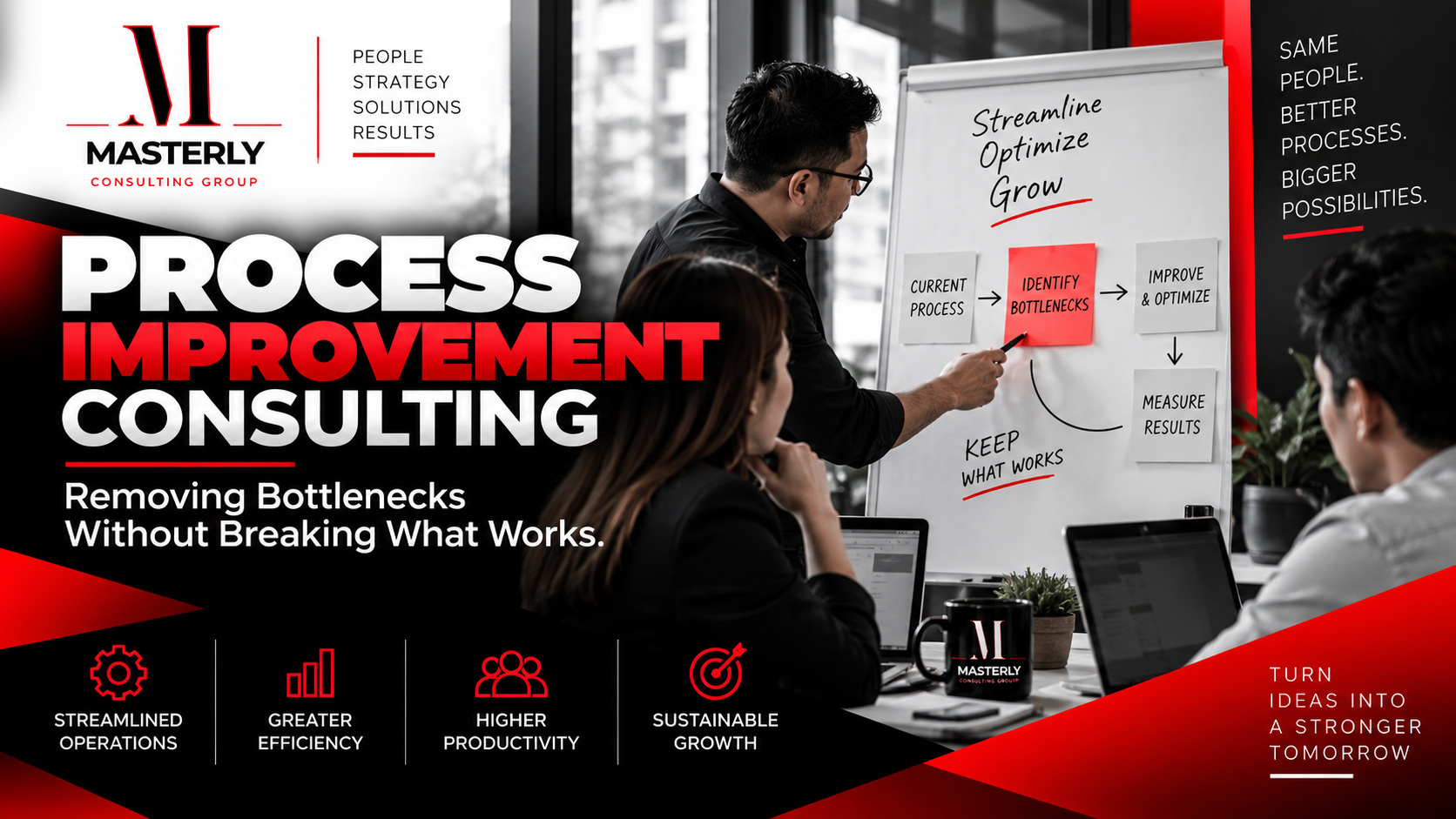
Management consultants often define what should change. Change management consultants focus on how people will understand, accept, and sustain those changes. That distinction is practical, not academic. A strategy firm might recommend consolidating shared services. A project team might build the platform. But without a deliberate change adoption strategy, employees revert to old processes within weeks.
Change management experts use established frameworks such as ADKAR or Kotter's 8-Step Process, adapting them to each client's organizational culture and maturity level. A structured change management approach can lead to faster implementation of projects because it surfaces resistance early and builds engagement before go-live, not after.
Outputs unique to change management consulting include:
- Stakeholder impact assessments
- Change adoption strategy documents
- Leadership alignment plans
- Communication blueprints and training enablement plans
- Adoption dashboards tracking leading and lagging indicators
Change management consulting firms also build internal capability instead of creating dependency. Consultants develop structured plans that outline communication, training, and stakeholder engagement, then coach internal change leads to own those plans long-term. Effective change processes help organizations transform more quickly because the focus is on sustainable change, not a one-time handoff. Change management strategies can lead to higher adoption rates for new systems precisely because adoption-not just delivery-is the measure of success.
Key Responsibilities of a Change Management Consultant
On a week-to-week basis, a change management consultant does far more than facilitate meetings. Key responsibilities of a change management consultant include assessing readiness and managing employee resistance across every impacted group.
Here is what that looks like in practice:
- Conduct readiness assessments to diagnose how prepared leaders and employees are for the change initiative
- Map impacted roles, processes, and stakeholders to build a clear picture of who is affected and how
- Design stakeholder communication plans tailored to different audiences-executives, managers, front-line employees
- Define role-based training and enablement so the right people develop new capabilities at the right time
- Plan reinforcement tactics such as recognition programs, updated performance metrics, and feedback loops
- Facilitate decision making among executives by clarifying sponsorship roles, prioritizing organizational priorities, and agreeing on visible leadership behaviors
- Advise on governance structures including steering committees and change champions networks
- Translate business strategy and digital transformation roadmaps into concrete behavior change for different employee groups
Resistance management involves identifying pushback early and addressing employee concerns directly, rather than waiting for problems to surface after go-live. Change management skills can be developed through structured training, and consultants often coach managers to handle resistance themselves.
Consider a new CRM implementation: the consultant would assess readiness before configuration begins, map every team that touches customer data, design role-based training paths, craft messaging for each audience, and build a feedback mechanism to catch adoption gaps within weeks of launch. Masterly Consulting Group positions its consultants as both advisors and hands-on partners across this entire lifecycle.
Typical Change Management Consulting Process
The change management process typically consists of five stages, though most organizations group them into three phases of work: preparing for the change, managing the change, and reinforcing the change. Change management should begin as soon as the need for change is recognized-not the week before go-live.

Here is the staged flow a consultant follows:
- Discover and diagnose. Assess current state, past change history, and organizational culture. Produce a readiness report, stakeholder map, and risk register. Involve senior leadership, HR, and the project team.
- Design. Define the change adoption strategy, leadership alignment plan, communication blueprint, and training syllabus. Engage executive sponsors, the implementation team, technology leads, and internal change agents.
- Deliver and execute. Launch communications, conduct training workshops, run pilots or phased go-lives, and implement two-way feedback mechanisms. The project manager, department managers, and front-line staff are all active participants.
- Embed and sustain. Reinforce new behaviors through performance metrics, coaching, and change champion networks. Build adoption dashboards. Hand ownership to internal leaders so the organization retains the capability.
Culture shapes how fast and how formally each phase moves. A highly regulated bank requires more governance and slower timelines than a SaaS scale-up running rapid pilots. Masterly Consulting Group tailors the depth of each phase to the initiative, from a 12-week focused change project to a 24–36 month enterprise transformation.
When to Bring in a Change Management Consultant
Leaders must prepare employees for change to reduce resistance, and the earlier that preparation starts, the better the outcomes. Organizations that manage change well see less employee resistance and faster project success. Effective change management reduces employee resistance to 30% compared with organizations that skip structured adoption work.
Bring in a consultant if you see these signals:
- Technology projects go live but usage stays low-employees revert to spreadsheets, workarounds, or the status quo
- Critical process changes are rolled out with minimal involvement from the project team or middle managers
- Employee surveys between 2020 and 2025 show rising change fatigue, declining trust, or disengagement
- Major restructures are announced without clear role impacts, and unnecessary tasks persist
- Prior transformations delivered on time but failed to capture full value in performance or revenue
Scenarios that benefit most include ERP or HRIS implementations, mergers and acquisitions, operating model redesigns, shifts to hybrid or flexible work, and introduction of new leadership behaviors. Masterly Consulting Group typically enters at the portfolio or program level, partnering with the PMO, HR, and technology sponsors to align the change effort with implementation planning from day one.
Core Capabilities and Skills of Effective Change Management Consultants
When selecting a change management consultant, look for practical, observable capabilities rather than generic traits. Effective communication improves decision making by incorporating diverse stakeholder input, and the best consultants design for that outcome. Leaders should engage with empathy during transformations, and consultants should model that standard.
Key skills to evaluate:
- Strategic thinking tied to outcomes - links change adoption to revenue, cost savings, or competitive advantage so leaders see the business case
- Senior-level facilitation - runs alignment workshops and sponsor briefings that produce clear decisions, not just discussion
- Data-driven adoption analysis - uses readiness assessments, pulse surveys, and usage analytics to spot where adoption is weak and adjust course
- Stakeholder communication design - tailors messaging by audience; identifying stakeholder needs enhances the effectiveness of communication strategies
- Adult learning and training design - builds role-based, experiential learning paths that build confidence and new capabilities
- Cultural sensitivity - reads organizational norms, regulatory constraints, and past change history before prescribing solutions
- Coaching and trust-building - earns credibility with resistant managers and supports front-line teams under pressure
Relevant credentials include Prosci certification, ACMP membership, ICF coaching background, and sector-specific experience in healthcare, financial services, or manufacturing. Masterly Consulting Group's consultants combine these skills with deep sector knowledge to deliver greatest value.
How Change Management Consultants Drive Leadership Alignment
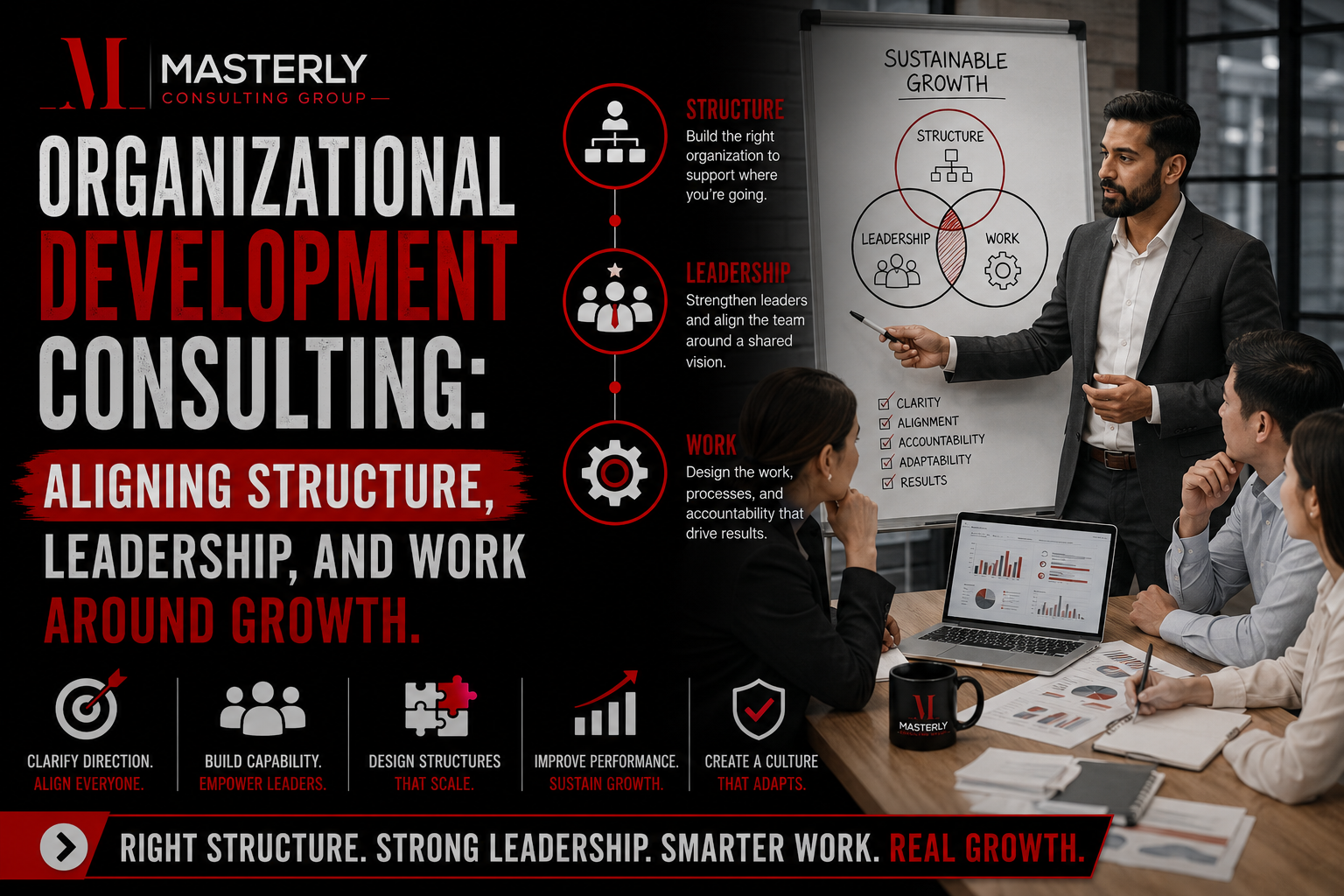
Leadership alignment means that executives share a common narrative about the change, demonstrate visible sponsorship behaviors, apply consistent decision criteria, and deliver unified messaging. Without it, the leadership team sends mixed signals, middle managers hedge, and employees disengage. Culture can make or break a transformation effort, and leadership behavior is the single strongest lever on organizational culture.

Research shows that 96% of transformations succeed with leaders who engage head, heart, and hands. Engaging leaders increases transformation success by 96% because visible leadership commitment cascades through every layer of the organization. A high-performance culture fuels ongoing transformation, and leaders are the ones who set that culture in motion.
Practical techniques consultants use include:
- Alignment workshops that surface disagreements early and produce a shared vision
- Sponsor roadmaps mapping each leader's role and visibility commitments
- Decision logs that create transparency and accountability
- Leadership communication toolkits with talking points, FAQ guidance, and channel recommendations
- Coaching sessions between C-suite leaders and their direct reports to model new practices
In one 2024 logistics sector study, organizations where leaders actively listened to resistance and provided consistent messaging had 62% better odds of transformation success. When leaders model new behaviors, middle managers and teams follow. Masterly Consulting Group treats leadership alignment as a formal workstream-not a side activity-in every change adoption strategy it delivers.
Supporting Employee Adoption: Communication, Training, and Reinforcement
Helping employees embrace change requires more than a launch email. A change management consultant builds adoption through three areas: stakeholder communication, enablement and training, and reinforcement.
Effective communication helps reduce uncertainty and confusion during transitions. Stakeholder communication builds trust between organizations and stakeholders by making the "why" behind the change clear and credible. Choosing the right communication channels increases stakeholder engagement-town halls reach different audiences than collaboration tools or manager-led team huddles. Regular updates enhance transparency and accountability in projects, and employees must feel seen and supported during change for adoption to hold.
For training, consultants coordinate with learning teams to define who needs what skills by when. They create role-based learning paths, plan just-in-time support like job aids and virtual office hours, and ensure that new behaviors are practiced, not just explained. This approach helps develop new capabilities where they matter most.
Reinforcement is what separates temporary compliance from sustained success. Key tactics include:
- Integrating new practices into performance reviews and management routines
- Pairing change champions with lagging teams to build momentum and support building momentum across the organization
- Monitoring adoption metrics over 3–12 months post-go-live
- Encouraging feedback from stakeholders, which provides valuable project insights and fuels continuous improvement
Fostering employee engagement can improve commitment to changes. Engaging employees increases transformation success by 96%, and organizations with engaged employees see 21% higher profitability. Masterly Consulting Group places particular emphasis on two-way feedback-not just top-down communication-to refine adoption activities as the change process unfolds.
Measuring Change Adoption and Organizational Impact
A professional change management consultant defines success beyond "the project went live on time." Monitoring adoption metrics helps sustain the changes within an organization and gives leaders visibility into whether the transformation is delivering its intended benefits.
Key metrics and tools include:
- System usage by role - are the intended users actually logging in, completing workflows, and abandoning old tools?
- Process cycle times and error rates - faster cycles and fewer errors signal real behavior change
- Employee sentiment - pulse surveys and focus groups capture engagement, concerns, and trust levels
- Leadership behavior observations - are sponsors visibly modeling new ways of working?
- Customer satisfaction changes - external-facing improvements often lag internal adoption by weeks or months
- Stakeholder heat maps - visual dashboards showing which teams are on track and which need intervention
A change scorecard combines leading indicators (awareness, training completion, manager readiness) with lagging indicators (usage, financial impact, satisfaction). Data-driven insights help adjust communication, training, and reinforcement plans mid-course rather than waiting for annual reviews.
Organizational culture drives adaptation and innovation, and organizations must embed culture in structures and policies to sustain progress. Research from 2025 found that organizations with healthy change adoption report roughly twice the year-over-year revenue growth. Masterly Consulting Group builds measurement into the change plan from the outset, so clients see clear links between investment in change management and realized business outcomes.
Selecting the Right Change Management Consulting Partner
Choosing the right partner is as important as choosing the right change strategy. Not every firm that claims change expertise has recent, relevant experience delivering sustained adoption.
Evaluate potential partners against these criteria:
- Proven experience with similar change types - ask for concrete case examples from 2021–2025 showing how the firm improved adoption, not just delivered presentations
- Methodology flexibility - can the firm adapt its approach to your organizational culture, or does it apply one rigid framework regardless of context?
- Capability transfer - does the firm build your internal team's ability to manage change, or does it create long-term dependency?
- Stakeholder collaboration - how does the consultant work alongside HR, IT, the PMO, and front-line leaders? How do they handle resistance?
- Sector fit - experience in your industry (healthcare, financial services, manufacturing, technology) helps the consultant understand regulatory and cultural constraints
- Confidentiality and trust - change work surfaces sensitive information; ask how the firm manages that responsibility
Most organizations benefit from a partner that emphasizes co-design, practical tools, and measurable adoption outcomes. Masterly Consulting Group operates with this philosophy, working alongside clients rather than replacing internal teams. If you are evaluating options, a structured consultation is a practical first step to explore fit.
FAQs About Working With a Change Management Consultant
- How early should we bring in a change management consultant? Ideally before detailed design is complete. Early engagement means the change effort shapes the project, not the other way around. Waiting until go-live limits what a consultant can influence and increases the risk of stalled adoption.
- How long does a typical engagement last? It depends on scope and complexity. A focused change initiative might run 12 weeks. Enterprise-wide transformations-ERP rollouts, merger integrations, operating model redesigns-often span 18 to 36 months with phased delivery.
- How do change management consultants work with existing project managers? The project manager owns scope, timeline, and budget. The change consultant owns adoption, stakeholder engagement, and behavior change. The two roles are complementary, not competing. A strong managing director or program lead ensures both workstreams stay connected.
- How do we avoid becoming dependent on an external consultant? The best change management consulting firms build internal capability as a core deliverable. That means coaching internal change leads, creating playbooks, and training managers so the organization can manage change independently after the engagement.
- What influences the cost of a change management engagement? Scope, duration, number of impacted stakeholders, geographic complexity, and the depth of capability transfer all shape investment. A single-site CRM rollout requires different resources than a global transformation involving thousands of employees.
- What is the difference between one-time project support and building internal change capability? One-time support addresses a specific change initiative. Capability building is a 12–24 month investment in developing your team's ability to manage future changes without external help-creating a lasting competitive advantage.
For questions specific to your organization, requesting a change-management consultation with Masterly Consulting Group is a practical next step.
Next Steps: Request a Change-Management Consultation
Organizations implementing new systems, structures, leadership expectations, or operating practices achieve the full value of those investments only when people adopt and sustain the change. A dedicated change management consultant turns that ambition into a structured, measurable process that protects productivity, engagement, and progress.
To explore how your organization can successfully navigate change and achieve sustained success, contact Masterly Consulting Group. Our experienced change management consultants specialize in guiding leadership teams and implementation teams through every phase of the change management process, ensuring alignment with your organization's values and priorities.
Request a change-management consultation today to build confidence, manage change effectively, and realize the full value of your transformation efforts.
Masterly Consulting Group
Phone: (972) 236-5051
Website:
https://www.masterlygroup.com/