Organizational Development Consultant: Building Structure for Sustainable Growth
Growth creates pressure. New locations, new employees, new products, and shifting market conditions expose gaps in structure, roles, and leadership that were invisible at a smaller scale. An organizational development consultant helps companies address those gaps before they become barriers to performance.
This article covers what an organizational development consultant does, when to bring one in, and what an engagement with Masterly Consulting Group looks like from start to finish.
What an organizational development consultant actually does
An organizational development consultant helps companies improve their overall effectiveness by aligning strategy, organizational structure, culture, and people. The focus is not on short-term HR fixes like filling open jobs or running payroll. It is on planned, systemic change that builds capacity and resilience for long-term improvement rather than just quick fixes.
Organizational development focuses on both culture and processes. A consultant in this space typically works across several areas: organizational design and structure, leadership development and succession, role clarity and employee roles, culture strategy, team effectiveness, and performance management. The goal is to help build a more capable and efficient organization by addressing root causes, not symptoms.
Consider a 150-person tech company expanding into a new region. Rapid hiring stretches existing leadership. Reporting lines blur. Decision making slows because no one is sure who owns what. An organizational development consultant would step in to redesign the structure, clarify decision rights, and coach leaders through the transition. Hiring an OD consultant in this scenario is about solving the right problems, not just finding a qualified individual.
How does this differ from a human resources generalist or a strategy consultant? An HR generalist handles recruitment, compliance, and operations. A strategy consultant defines business direction and market positioning. An organizational development consultant occupies the space between: building the systems, processes, and culture that turn strategy into execution over a 12- to 36-month horizon. Good OD consultants utilize diagnostic rigor to identify both formal and informal organizational structures, and they value systems thinking, seeing organizations as interconnected. Assessment of organizational structure and performance is fundamental to their role. OD consultants should focus on long-term sustainability rather than temporary solutions.
When a growing organization should consider OD support
Organizations pass through four growth stages: startup, growth, maturity, and decline. At each transition, structure and leadership demands change. If you lead a company with 50 to 500 employees, here is what to look for.
Decision rights are unclear; meetings end without owners or deadlines. Responsibilities overlap between leaders or teams, causing duplicated work and dropped tasks. Strategic initiatives stall because the organizational structure cannot support them. Rapid growth strains existing business processes and communication channels, overwhelming the team. Culture drift appears: core values at headquarters no longer match behaviors in satellite offices or remote teams. The founder-led model hits its ceiling, and decisions stay centralized, slowing operations. Post-acquisition integration creates friction between merging cultures and overlapping job roles. New opportunities arise (entering a new market, launching a product line), but internal capacity for organizational change and change management is overwhelmed.
Strong leadership provides vision and direction during organizational growth, but even experienced business leaders can't redesign structure and culture while running daily operations. Market demand drives organizational growth by ensuring customer revenue, yet that growth needs to be managed. Effective growth management requires clear goals and continuous monitoring.
If three or more of these symptoms describe your company, it is time to explore organizational development services.
Core domains of organizational development consulting
OD work clusters into interconnected domains. Treating any one of them in isolation often produces partial results or change fatigue; addressing them together creates durable improvement.
Organizational design and organizational structure determines how functions are grouped, how decisions flow, and where accountability sits. As a company scales, this domain keeps decision making fast and clear. Leadership structure and succession defines who leads, who decides, and who is next. It reduces dependence on a few individuals and prepares the organization for future growth. Role clarity and job description alignment eliminates overlaps and gaps by mapping purpose, outcomes, and decision boundaries for each position. OD consultants optimize workflows and job descriptions for better efficiency. Performance management systems connect individual goals and feedback cycles to organizational strategy, creating accountability. Culture and engagement shapes the norms, behaviors, and collaboration patterns that determine how work actually gets done. OD consultants analyze and improve corporate culture through interviews, observation, and structured interventions. Strategic planning facilitation helps leadership translate direction into execution plans aligned across all functions.
An effective OD consultant uses a data-driven approach, relying on qualitative and quantitative data. OD consultants evaluate the current state of a business using surveys and interviews. Assessing staffing needs can lead to better organizational design, and organizational structure impacts team effectiveness and engagement directly.
Masterly Consulting Group integrates these domains into a single engagement rather than treating them as disconnected projects, which reduces change fatigue and produces results that hold.
How organizational design and structure create clarity
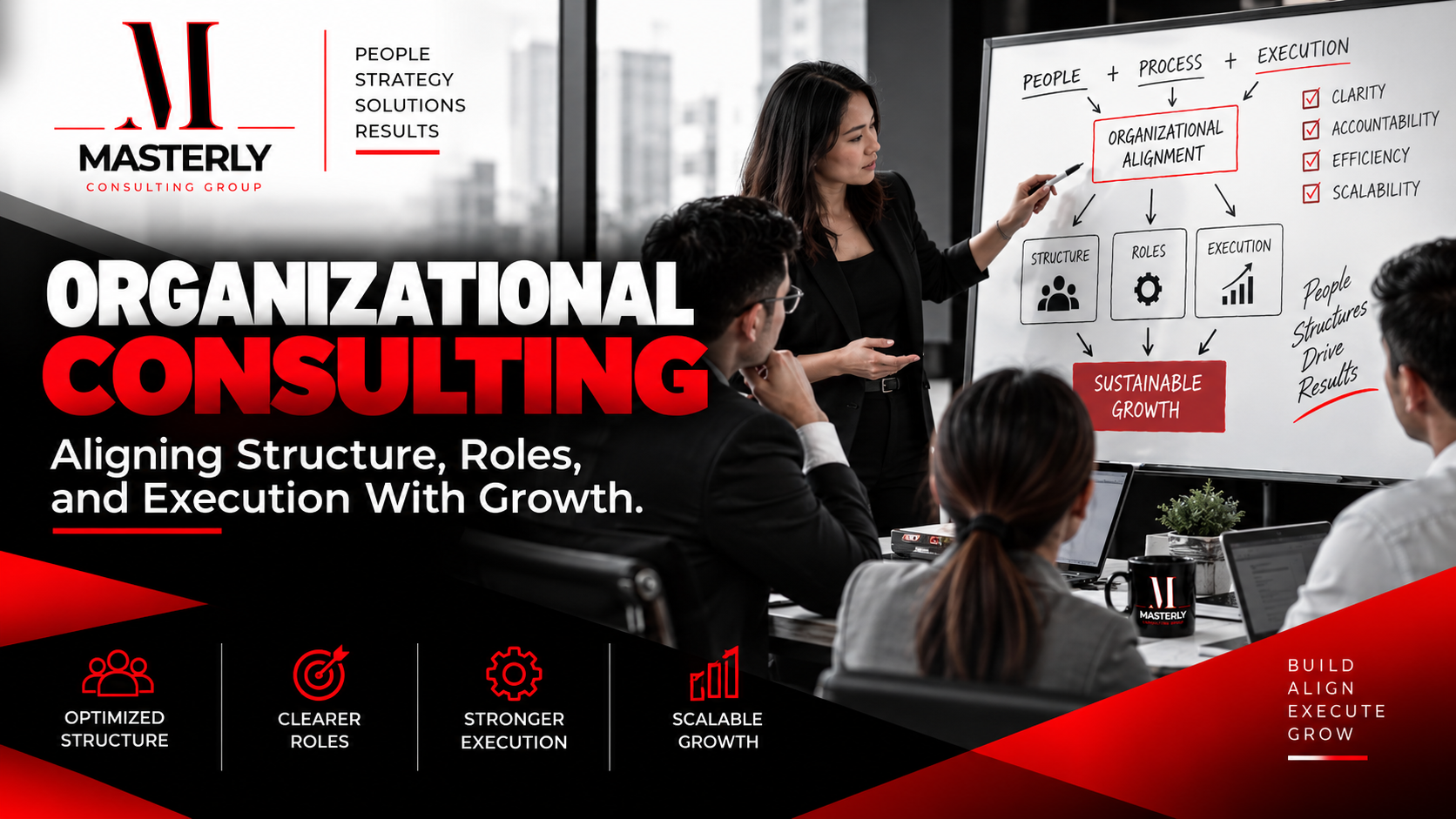
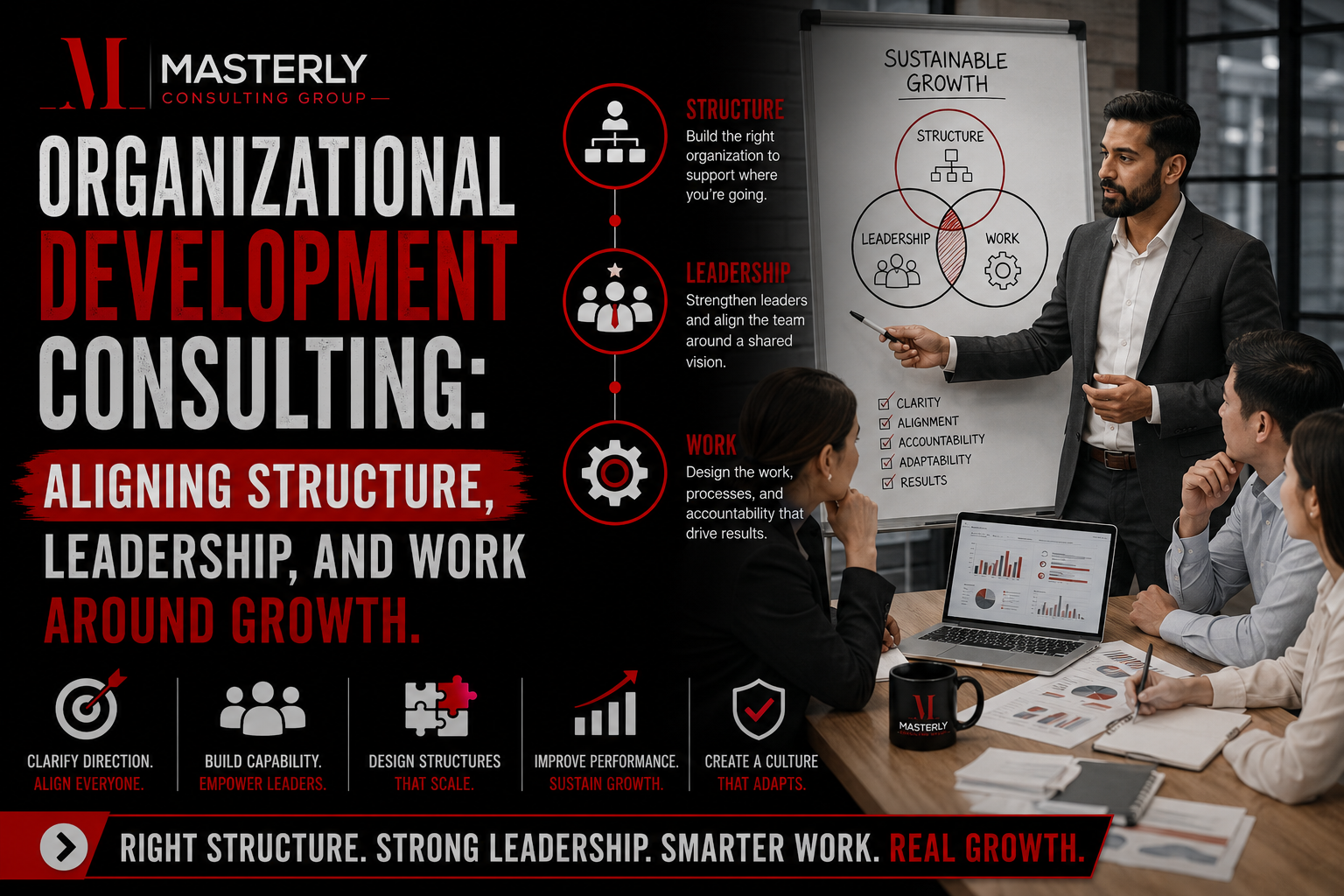
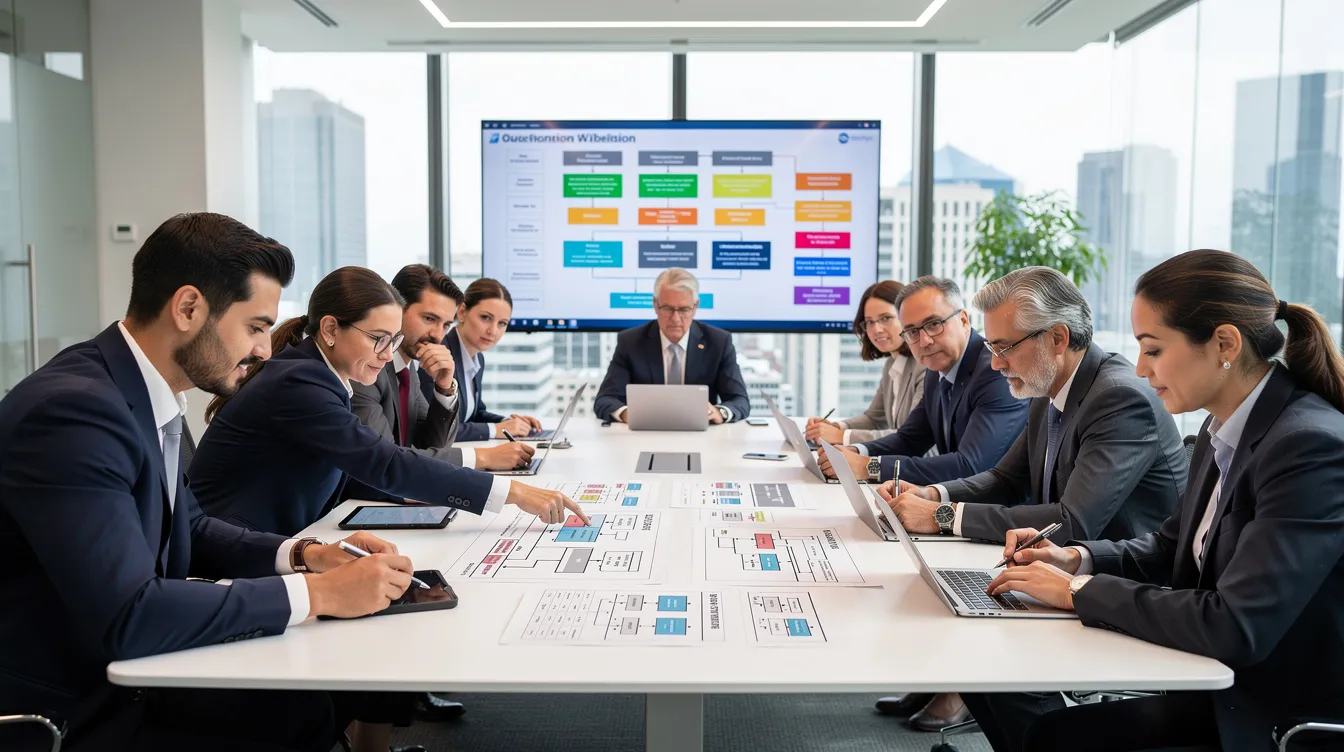
Organization design is the discipline of aligning structure, roles, and workflows with strategy. Without that alignment, growth compounds confusion rather than capability.
A consultant assesses whether a functional, divisional, matrix, or hybrid structure best fits the company's current state and growth trajectory. Each model carries trade-offs: functional structures concentrate expertise but slow cross-team collaboration; divisional structures speed local decisions but risk duplication; matrix structures balance both but create reporting ambiguity. The consultant maps reporting lines, decision rights, and cross-functional collaboration pathways to identify bottlenecks and overlaps. Redefining reporting lines can enhance decision making processes. Streamlining workflows eliminates inefficiencies in organizations.
A regional services company in 2026 had been operating flat with a single operations lead. When it opened offices in three new cities, decisions stalled and accountability disappeared. An organizational development consultant recommended creating regional managers, defining a leadership team, and assigning decision rights for regional versus headquarters decisions. The result: decisions took hours instead of days, each regional office had local leadership, and the central team maintained strategic oversight.
Diagrams or simple org-chart visuals are useful tools here. Alt text for any such visual should describe the organizational structure before and after redesign.
Structural shifts translate into day-to-day clarity for teams only when they connect to clear employee roles, updated job descriptions, and well defined roles at every level.
Role clarity, job descriptions, and performance management
When roles are vague, teams duplicate effort, responsibilities fall through gaps, and tensions build. Lack of role clarity can lead to employee frustration and demotivation, especially during periods of rapid growth when new employees join without clear expectations.
An organizational development consultant audits current job descriptions, team charters, and informal expectations to uncover where overlap or ambiguity exists. The audit reveals which roles most need attention and where setting clear expectations will have the largest effect on operations. Transparent communication fosters role clarity among team members, so the process includes interviews and observation alongside document review.
Consultants help leaders define each role by its purpose, key outcomes (not just tasks), decision boundaries, and interdependencies with other positions. Role clarity enhances team performance and reduces confusion. Clearly defined roles improve employee engagement and accountability, because people understand what they own and what they do not. Role clarity helps set goals and informs decision making processes, feeding directly into a more effective performance management system: goal setting, feedback, professional development plans, and talent development tied to organizational targets.
During a 2025 reorganization for a company launching a new product line, job descriptions were revised to include outcomes like "customer adoption metric" rather than tasks like "manage product launch." Onboarding improved, new hires ramped faster, and cross-team friction dropped. Effective job matches leverage human resources efficiently, and collaboration with HR ensures that job levels, compensation bands, and development pathways align with the new clarity. When employees take on more responsibility, they need descriptions that reflect that shift.
Cultivating culture, collaboration, and team effectiveness
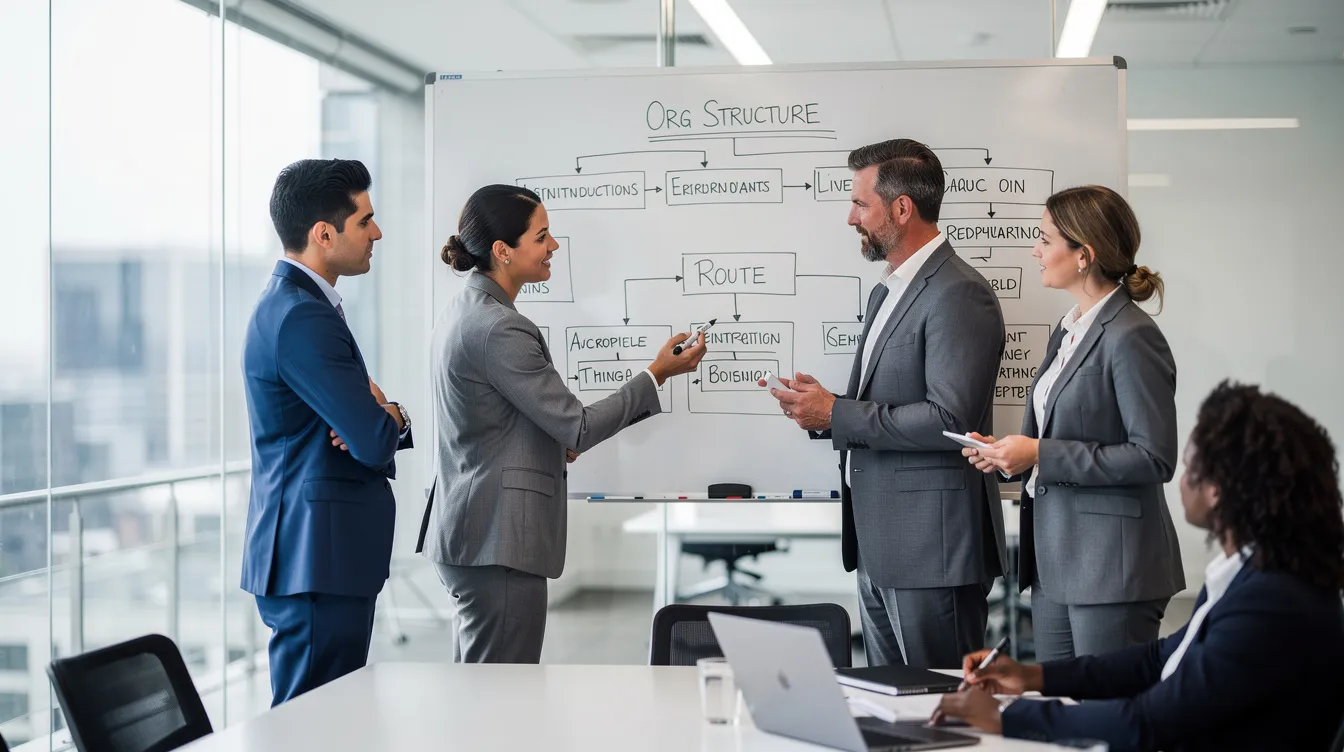
Company culture is how work actually gets done: the norms, habits, and behaviors that shape daily interaction. It is not the list of core values painted on a lobby wall. The gap between stated values and actual behavior is where culture problems live.
Organizational development consultants assess that gap through interviews, surveys, and observation. They look for where culture undermines strategy or structure, especially in hybrid or remote teams where communication channels can fragment. Their interventions improve communication and create a positive work environment by making implicit norms explicit.
Practical interventions include team building workshops focused on purpose and conflict mediation training, leadership behavior standards, cross-functional working agreements, and rituals that reinforce the desired culture (weekly all-hands, recognition of values in action). Effective leadership fosters collaboration and continuous learning in organizations. Investing in R&D can drive growth through innovation and new products, but only if the culture supports experimentation and clear communication.
One leadership team had been reacting to constant crises, with no structured rhythms for strategy or planning. With consultant support, they adopted weekly and quarterly review cycles. Over time, reactive urgency dropped. Teams began proactively owning decisions. Cross-functional collaboration improved between product, marketing, and operations. This kind of shift creates a high performance culture.
Masterly Consulting Group prioritizes sustainable behavior change over one-off events, aligning culture strategy with organizational growth plans so that improvements in process improvement and collaboration persist as the organization scales.
Change management as the engine of sustainable growth
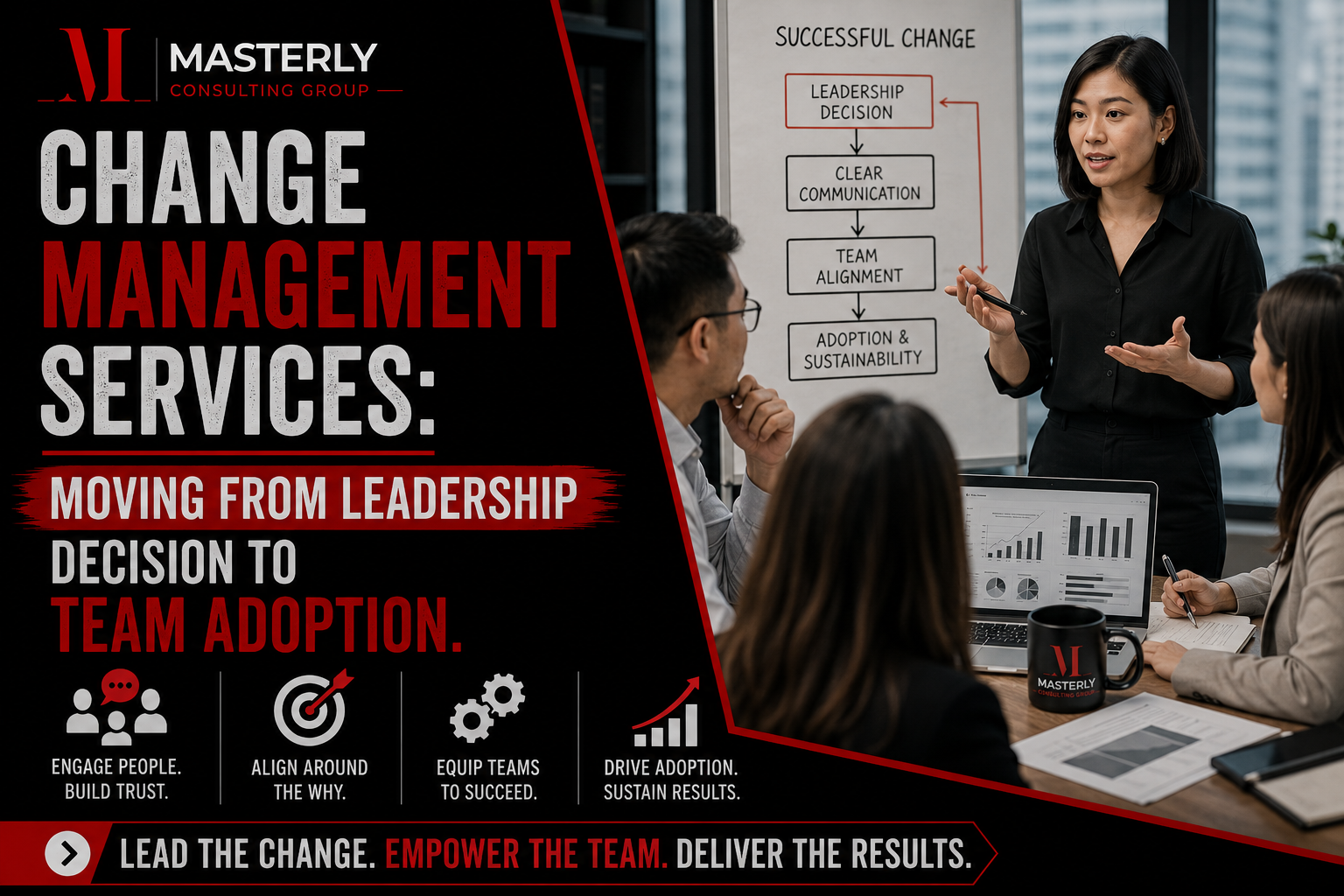
Change management is the practical side of organizational development: how leaders move people from the current state to a desired future without burning them out. Without it, even well-designed reorganizations fail. OD consultants diagnose underlying issues and manage change, helping organizations navigate transitions like mergers, restructuring, and strategic pivots.
OD consultants help businesses adapt to change with less friction by designing change roadmaps with several common elements: a clear case for change (why it is necessary and what happens without it), leader alignment so leadership speaks with one voice, stakeholder mapping to identify concerns and involvement needs, communication planning for timing and channels, and feedback loops to adjust the approach based on adoption. Change management helps integrate new processes and technologies with minimal disruption.
Consider post-acquisition integration. Two companies merge, bringing overlapping roles, conflicting cultures, and incompatible systems. Effective change management minimizes disruptions during these operational changes. In a renewable-energy plant case with roughly 75,000 global employees, a two-year OD intervention that included execution rhythm redesign, leadership coaching, and culture reinforcement produced a 9% increase in overall plant productivity within 18 months, an 11% reduction in downtime, and an 18% drop in output quality deviations.
OD consultants must manage resistance to change through strategic communication and leadership involvement. Change management ensures smooth transitions during organizational growth stages, and a structured approach to change fosters a culture of continuous improvement. Change management is also crucial for optimizing operations in maturity stages, when efficiency and continuous improvement determine whether the company sustains its position or enters decline.
Masterly Consulting Group combines structural work (org design, role clarity) with people-focused change support, because either alone produces weaker results.
What an OD consulting engagement with Masterly Consulting Group looks like
An engagement with Masterly Consulting Group follows a structured but flexible path, tailored to the organization's size, industry, and growth stage. Customization of approaches is crucial for effective consulting; a framework that works for a 60-person professional services firm will not fit a 400-person manufacturer scaling across regions.
Phase 1: Initial consultation and contracting. The engagement begins with scoping: defining the business problem, identifying an executive sponsor (CEO, COO, or CHRO), and setting expectations for involvement and timeline.
Phase 2: Organizational assessment and diagnostics. Consultants gather data through surveys, interviews, observation, and document review. This phase maps the current state of structure, roles, culture, and capability gaps.
Phase 3: Co-design of solutions. Based on diagnostic findings, the consulting team works with leadership to develop strategies for structure redesign, role definitions, performance systems, and culture rituals. Scenario planning helps leaders evaluate trade-offs.
Phase 4: Facilitated alignment with leadership. Workshops and communication plans ensure that leaders are aligned and focused on long-term goals. OD consultants ensure leadership teams are aligned before changes reach the broader organization. They provide coaching to leaders to strengthen management skills and require credibility and strong communication skills to influence leadership at every level.
Phase 5: Implementation coaching. The consultant supports managers as they embed changes, monitors feedback loops, and makes course corrections. Consultants should track measurable impacts to prove return on investment, focusing on employee engagement and worker productivity.
The consultant's role is to build internal capability, not to replace internal leadership or HR functions. Once the engagement concludes, the organization should have the knowledge, tools, and skills to sustain its new direction without perpetual external support.

FAQs about organizational development consultants
How is an organizational development consultant different from a management consultant? A management consultant often focuses on operations, cost efficiency, or short-term projects. An organizational development consultant works on systems of people, structure, and culture over 12 to 36 months, with a focus on behavior change and long-term sustainability.
How long does OD work usually take? Diagnostic phases typically run four to six weeks. Design phases span several months. Full implementation, covering structure, culture, and performance management, can take 6 to 24 months depending on scope and complexity.
Do we need to be a certain size to benefit from OD consulting? Organizations with 50 to 500 employees most commonly hit the structural limits that organizational development services address. Larger companies with multiple sites also benefit. The global OD consulting market was valued at approximately USD 622.93 million in 2024, serving both enterprise and mid-market clients.
How involved should our leaders be? Leaders must sponsor the change. Their role includes defining strategy, signaling commitment, participating in workshops, and taking decisions on structure. Without executive alignment, interventions stall. Leadership development includes coaching individuals to improve management skills, and conflict resolution skills are essential for effective leadership development. Leadership development enhances decision making and communication skills across the organization. Customized eLearning programs can also support leadership development initiatives.
What about cost? Cost depends on scope (number of domains), complexity (multi-site, hybrid, geographic spread), and duration. Fees are typically structured per phase with milestone metrics. There are no standard prices; the right question is whether the investment in expertise addresses a problem that is already costing the organization in turnover, missed deadlines, or stalled growth.
Call to action and supporting resources
For sustainable organizational growth, clear structure, aligned roles, and an intentional company culture are essential. Masterly Consulting Group specializes in providing expert organizational development consulting to help your business navigate these complexities and achieve long-term success.
Discuss organizational development support with Masterly Consulting Group today by visiting www.masterlygroup.com or calling (972) 236-5051. Explore our resources on leadership development, role clarity, and strategic facilitation to deepen your understanding and prepare your organization for growth.
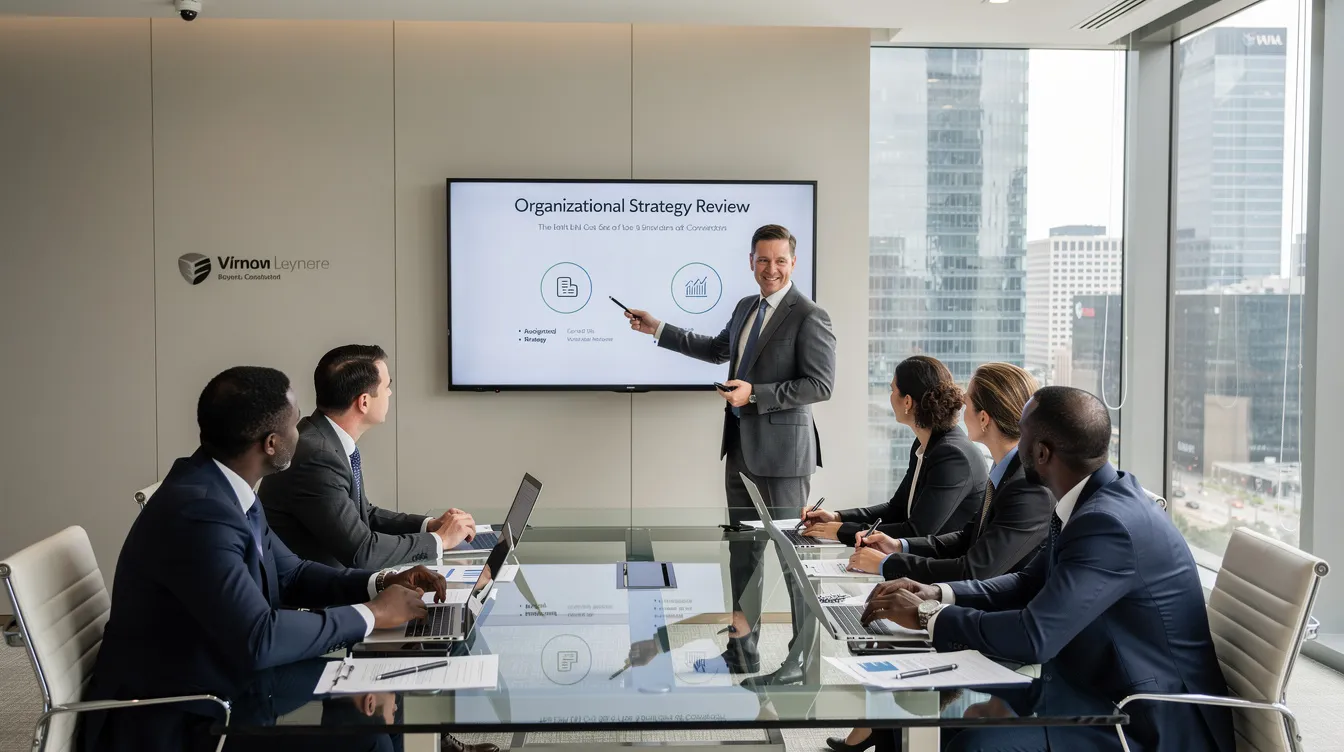
Partner with us to build strong leadership, enhance productivity, and support your team through complex organizational change. Masterly Consulting Group works as a long-term partner, building internal capability and helping your organization positively impact its people, its clients, and its future through every stage of development.