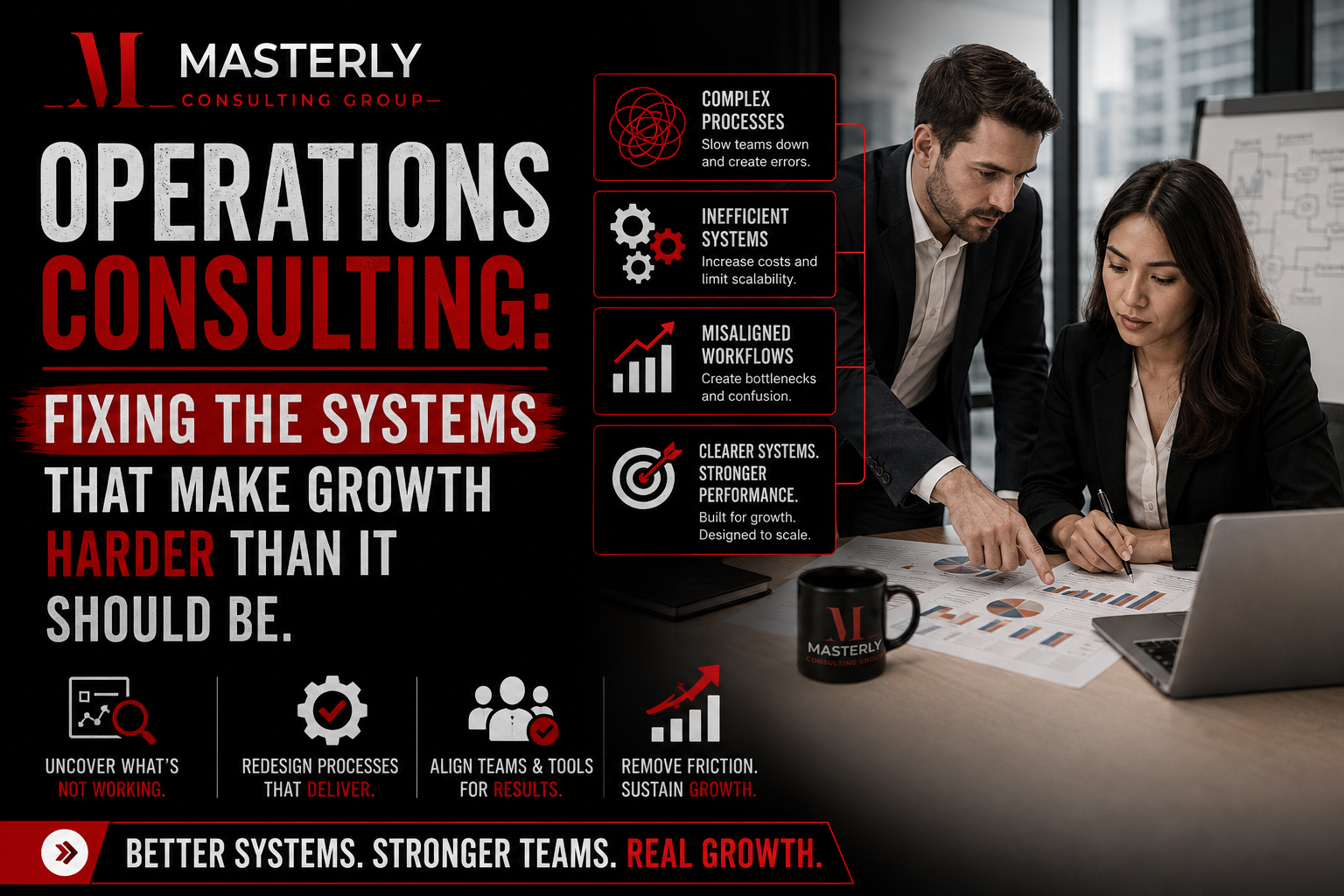
Business Process Consultant: Finding the Workflow Gaps That Drain Time and Revenue
A business process consultant analyzes how work actually moves through your organization, from the first customer inquiry to final delivery and payment. They find the bottlenecks, handoff failures, and unclear ownership that quietly drain time and revenue, then design improvements that hold up under real conditions.
If your company is growing but your workflows haven't kept pace, you're likely dealing with repeated errors, missed deadlines, or rising customer complaints. These aren't people problems. They're process problems. And they tend to compound as you scale.
What Is a Business Process Consultant?
A business process consultant is a specialist who examines end-to-end workflows, such as quote-to-cash, order-to-delivery, or customer support resolution, to locate where time, money, or quality are lost. Business process consultants help organizations improve efficiency by identifying areas of improvement within business operations and then translating findings into documented, repeatable changes.
The typical client is a growing company with 20 to 500 employees. At this stage, the informal processes that worked when the team was small start breaking down. Workflows become inconsistent across departments. Ownership of key steps gets murky. Delivery slows. Operational efficiency, which is the optimal use of resources, erodes even as headcount grows.
This work goes well beyond strategy on paper. A qualified consultant drives business process improvement from diagnostic through implementation and measurement. They create standard operating procedures for clients, build dashboards, define roles, and coach leaders. Businesses often hire consultants during periods of rapid growth or digital transformation when internal bandwidth can't keep up with operational complexity.
Masterly Consulting Group focuses on operational excellence and durable standard operating procedures, not one-off quick fixes. The goal is sustainable growth rooted in processes that survive leadership changes and staff turnover. Hiring the right consultant significantly impacts a company's efficiency and growth trajectory.
When Do You Need a Business Process Consultant?
Most leaders sense the symptoms long before they can name the root cause. Fire drills become daily operations. Everyone is busy, but outcomes aren't improving. Here are common triggers:
- Projects routinely miss dates even though "everyone is working hard." Progress stalls at unknown dependencies or handoff gaps between teams.
- Rework and quality issues are climbing, but key performance indicators and ownership are unclear. No one can point to exactly where errors enter the workflow.
- Customer complaints or churn have risen since a specific growth period, such as a post-2023 scaling push, because current processes couldn't keep pace.
- New hires take months to ramp because standard operating procedures are outdated, missing, or followed differently by every team.
- Multiple functions have overlapping responsibilities, leading to duplicated repetitive tasks or gaps in accountability.
An operational review, sometimes called an operations process review, is the structured method a business process consultant uses to investigate these symptoms. Over one-third of professionals prioritized operational efficiency in 2023, and that number continues to grow as companies realize that optimized processes provide a foundation for scalability in business operations.
A workflow consultant adds the most value when the leadership team no longer has the time or objectivity to deeply diagnose process problems on their own.
Core Role of a Business Process Consultant
The consultant's key part is to connect daily operations to the company's business goals and performance metrics. They often work as independent contractors for multiple clients, bringing cross-industry experience that internal teams lack. Industry experience helps consultants understand regulations and operational challenges specific to each sector.
Core activities include:
- Mapping current business processes, from lead to cash, order to delivery, and ticket to resolution. Process mapping techniques create comprehensive flowcharts for clients that reveal how work actually moves.
- Running an operational review to identify where time, money, or quality are lost. Business process consultants analyze data to identify inefficiencies, using evidence and data for process analysis and improvements.
- Facilitating problem solving with cross-functional teams rather than imposing top-down fixes. Effective communication is crucial for conveying complex concepts to stakeholders across departments.
- Designing and documenting future-state processes and SOPs. Software knowledge aids in recommending tools for efficiency, and data analysis skills help identify improvement opportunities.
- Setting up KPIs and dashboards to monitor process performance after changes. Performance monitoring establishes key performance indicators to track success, while gap analysis compares current performance against industry benchmarks.
Leadership skills are essential for guiding organizational changes, and project management skills help organize consulting processes effectively. At Masterly Consulting Group, consultants also coach internal leaders so improvements survive leadership changes and staff turnover.

Step-by-Step: How a Business Process Consultant Runs an Operational Review
An operations process review follows a structured flow regardless of industry. Here is how it typically unfolds:
- Preparation and scoping with leadership. Define which value streams will be reviewed, such as order-to-cash or customer onboarding. Agree on what success looks like and which stakeholders need to participate.
- Initial management meeting and objective setting. Senior management clarifies business goals, for example, "reduce order cycle time by 20% before year-end" or "cut billing errors in half." This meeting gets everyone on the same page about priorities and metrics.
- Interviews, employee feedback, and data gathering. The consultant speaks with frontline employees, middle managers, and support staff to surface practical issues, workarounds, and hidden delays. System logs, error rates, and throughput data are collected.
- Systems and process mapping review. "As-is" workflows are documented visually. The consultant maps actual tool usage against the documented process and flags gaps, redundancy, or misaligned responsibilities. Consultants integrate technology to support streamlined processes wherever possible.
- Synthesis, reporting, and recommendations. Findings are combined into insights: what is costly, slow, or error-prone, and what root causes emerge. Both tactical quick wins and longer-term redesign recommendations are presented.
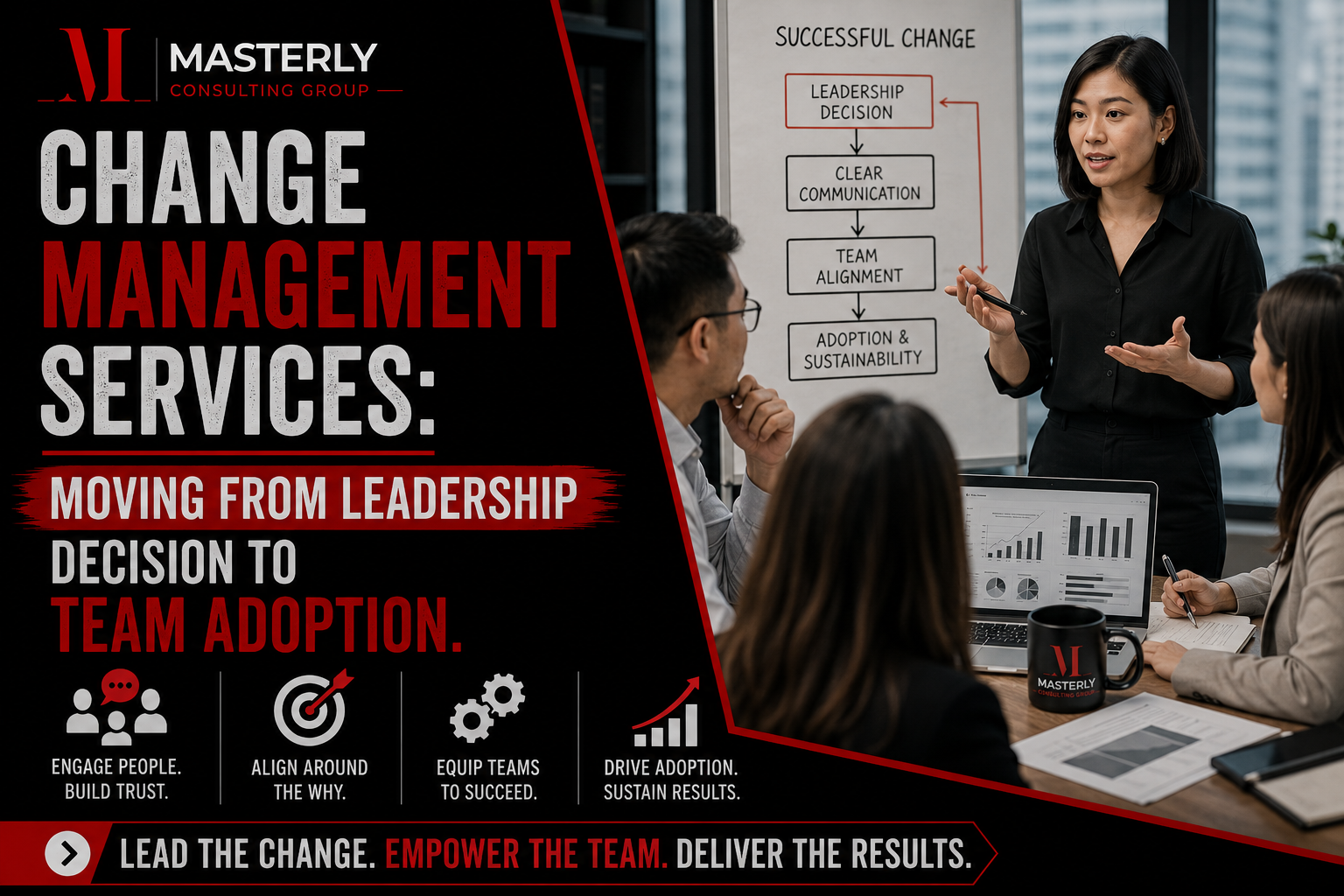
- Review of results and prioritization of next actions. Proposed changes are ranked by impact, effort, and risk. Owners and timelines are set. Change management ensures high adoption rates and minimizes resistance during rollout.
Masterly Consulting Group typically completes an initial operational review within four to six weeks for one or two primary value streams, depending on scope and data availability.
Inside the Review: Management Meetings, Interviews, and Systems Analysis
This section zooms into the most critical conversations and analysis that happen during an operational review.
Management meetings align on business goals and clarify the leadership team's frustrations. For example, a company might target reducing its order cycle time by 20% before year-end 2026, eliminating billing errors in its invoicing workflow, or cutting client onboarding delays. These meetings also decide which KPIs will define success for the engagement. Concrete metrics are more meaningful than general claims about improving efficiency, so the team agrees on specific numbers.
Employee interviews and feedback uncover friction that leadership often doesn't see. Confidentiality and psychological safety are crucial so employees candidly share what's broken. Frontline employees often surface practical problem solving ideas and hidden workarounds. In one common scenario, interviews reveal that two teams are performing duplicate data entry into separate systems because neither trusts the other's records. That kind of waste only surfaces when you talk to the people doing the work.
Systems review compares how teams actually use tools like CRM, ERP, and ticketing software against the documented process. The consultant checks alignment with policies, controls, and communication standards, then identifies where automation or integration could eliminate manual steps and reduce human error.
Process Mapping and KPI Design: Turning Chaos Into a Clear Workflow
Process mapping and KPI design translate messy operational reality into a shared picture and measurable targets that keep everyone aligned.
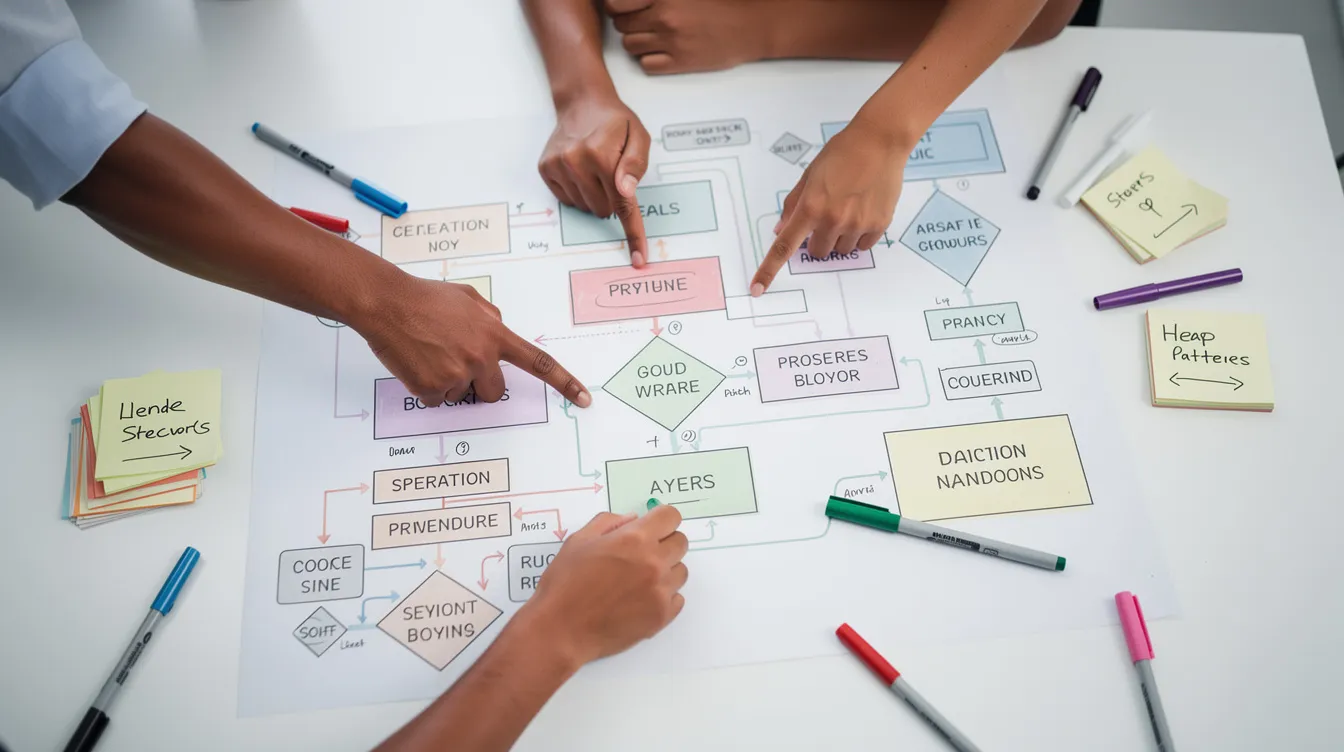
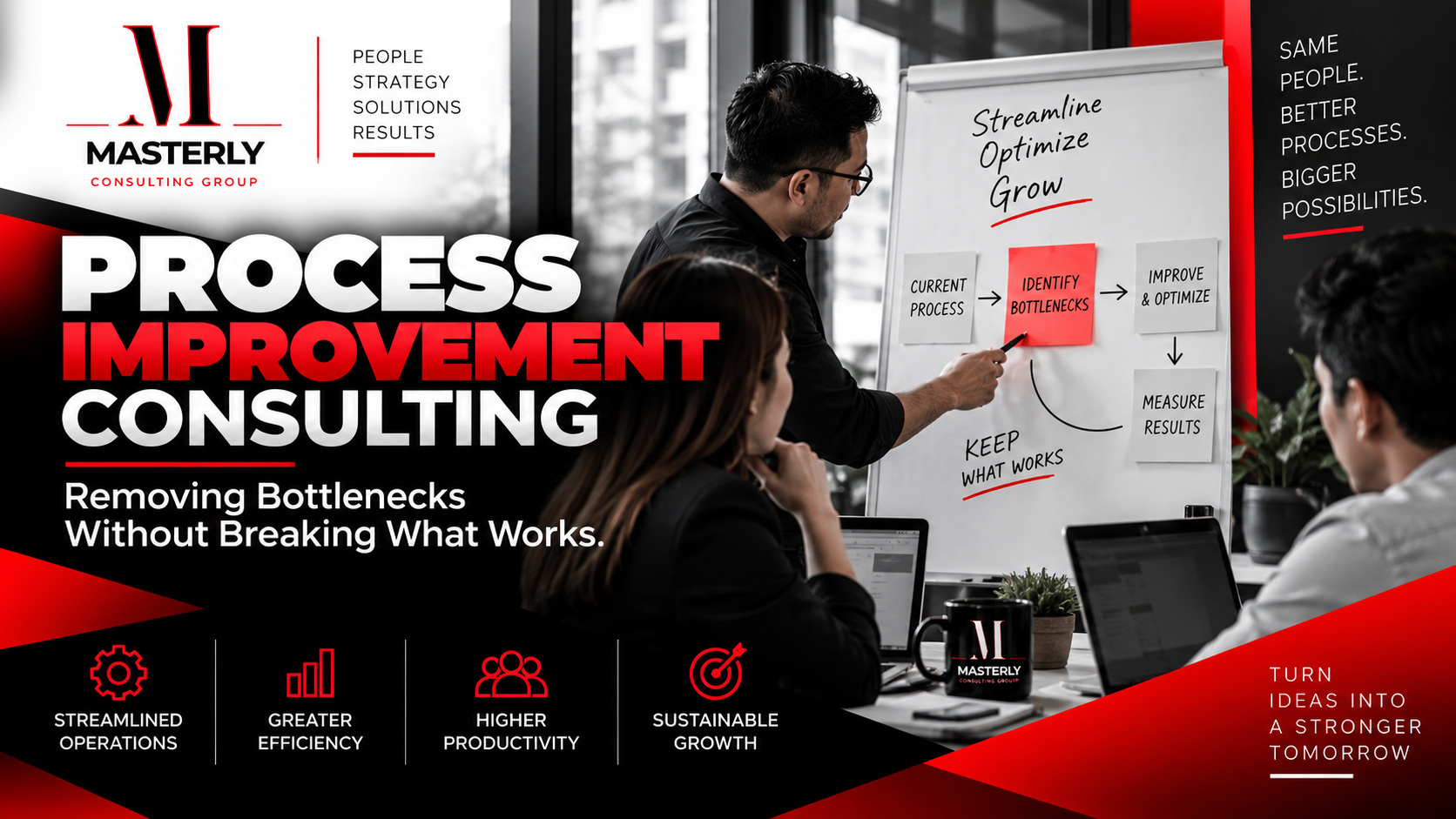
Consultants map "as-is" processes visually using swimlane diagrams or BPMN-style flows. For example, a mid-size services firm might map its quote-to-cash process from first client contact through proposal, contracting, delivery, invoicing, and payment. The map immediately exposes bottlenecks, rework loops, and unclear ownership that narrative descriptions miss. Redesign and optimization then eliminate redundancies and reduce cycle times. Streamlined workflows increase efficiency in task completion across the entire value stream.
Key performance indicators are chosen to balance multiple dimensions:
- Speed: cycle time from request to delivery.
- Quality: error rates, rework percentages, ticket reopening rates.
- Cost: cost per transaction or labor hours per unit.
- Experience: customer satisfaction scores such as NPS or CSAT.
For a support team, a useful KPI set might include first-response time, average resolution time, and percentage of SLA targets met. Data-driven decision making is facilitated by metrics and analytics frameworks that remove guesswork from management discussions.
These KPIs are embedded into dashboards and tied to monthly or weekly operational reviews so leaders can monitor progress using real time data rather than waiting for quarterly reports to surface problems.
From Insights to Action: Process Improvement, SOPs, and Implementation Support
Improvements only count when they show up in daily behavior. The shift from diagnosis to action is where many consulting engagements fall apart, and where the right consultant earns their value.
A workflow consultant develops improvement strategies using structured methods. Lean methodology focuses on maximizing customer value and minimizing waste. Six Sigma targets no more than 3.4 defects per million opportunities. The PDCA cycle fosters ongoing enhancements in quality and efficiency. Agile projects are divided into iterations lasting one to four weeks, allowing rapid testing. Total Quality Management involves all members in continuous improvement. These aren't competing frameworks; they're tools selected based on the problem. The consultant prioritizes quick wins, such as automating duplicate data entry, alongside foundational redesign projects that require more development time.
SOP creation is where new processes become real. SOPs provide sequential instructions for consistent processes and improve efficiency by providing necessary task information at the point of need. They help in onboarding new team members effectively and ensure compliance with government regulations and industry standards. Documenting improved processes leads to standardized SOPs that any employee can follow. For example, a standardized onboarding checklist can cut ramp time significantly by giving new hires a clear path from day one.
Automation reduces manual effort and improves accuracy in processes, and consultants design improved workflows that are efficient and scalable. Implementation includes pilot tests, training sessions, and change communications. The consultant helps managers integrate new processes into performance reviews and team rituals.
Masterly Consulting Group stays involved long enough to make sure new business workflows stick instead of reverting to old habits.
How Business Process Consultants Drive Operational Efficiency and Excellence
Operational efficiency and operational excellence aren't abstract ideals. They translate into fewer delays, lower error rates, better margins, and stronger service quality that creates competitive advantage.
Here is how improved processes affect a growing company:
- Cost: Less rework, fewer manual touches, and better use of software solutions already owned. Cost reduction occurs by eliminating waste and optimizing resources, making operations more cost effective without adding headcount.
- Speed: Shorter cycle time from request to delivery. A digital agency that redesigns its project intake process, for example, can move from a five-day intake to a two-day intake by removing approval bottlenecks and improving processes at each handoff.
- Quality: More consistent outputs and fewer customer complaints. When processes are clear, human error drops and you improve quality across every deliverable.
- People: Improved employee morale results from reducing bottlenecks and repetitive tasks. Clearer expectations mean less firefighting and stronger employee engagement.
Continuous improvement is what separates lasting results from temporary fixes. Regular operational reviews and KPI monitoring create a feedback loop that catches new potential issues before they become expensive. Employee feedback is used to refine processes over time through a proactive approach rather than one-time "big bang" changes. This is how enabling organizations build operational discipline into their culture and gain increasing profitability year over year.

How Masterly Consulting Group Works With Growing Companies
Masterly Consulting Group structures engagements to match the pace and resources of growing companies, not enterprise bureaucracy.
A typical engagement follows this path:
- Initial discovery call to understand business goals and current pain points. This conversation helps scope the work to your most critical value streams rather than trying to fix everything at once.
- Focused business-process assessment scoped to one or two primary value streams, such as order-to-delivery or client onboarding. This keeps the analysis actionable and delivers findings within weeks, not months.
- Prioritized roadmap for process improvement with clear owners, timelines, and performance metrics tied to organizational goals.
What makes the approach distinctive:
- Emphasis on practical, documented workflows over abstract slide decks. Every recommendation maps to an SOP, a checklist, or a dashboard your team can use immediately.
- Coaching internal leaders so operational excellence becomes a capability within your organization, not a dependency on outside resources. This ensures improvements hold through leadership changes.
- Balanced attention to technology, people, and process mapping. The right analysis considers all three, because a new tool won't fix a broken workflow and a perfect SOP won't help if your team isn't trained on it.
For related services, including SOP development and implementation consulting, visit Masterly Consulting Group.
FAQ: Working With a Business Process Consultant
What is the difference between a business process consultant and a management consultant? A business process consultant focuses on internal workflows, process mapping, SOPs, and implementation at the operational level. A management consultant typically works at a broader strategic level, covering market entry, M&A, or growth strategy. The overlap exists, but process consultants are more hands-on in improving processes and measuring results within daily operations.
How long does a typical business process improvement project take? An initial operational review of one to two value streams typically takes four to six weeks. Full implementation of redesigned processes, including training and pilot testing, may extend several additional months depending on the company's size and complexity. The key areas that need the most work are usually identified within the first few weeks.
What internal resources will we need to commit during an operational review? Expect to make key stakeholders available for interviews and management meetings. The consultant handles the heavy lifting of data analysis, process mapping, and reporting, but your team's input is critical for accuracy and buy-in.
Can a consultant work with existing tools like our ERP or CRM, or will we have to replace systems? Most engagements work with your current technology stack. The goal is to improve efficiency within your existing tools by aligning how they're used with how your processes actually need to flow. Replacing systems is recommended only when existing tools genuinely block progress.
How will we know if the engagement is successful? Success is measured against the specific KPIs and business goals agreed upon at the start, such as reduced cycle time, fewer errors, lower operational costs, or improved customer satisfaction. If the metrics move in the right direction and hold over time, the engagement delivered.
Request a Business-Process Assessment
If your team is working hard but outcomes aren't keeping pace, the issue likely lives in your workflows, not your people. Inconsistent processes, unclear ownership, and inefficient processes compound as you grow, draining time and revenue that should be fueling your next stage.
Request a business-process assessment to get started. Here's what happens after you reach out:
- A brief consultation to clarify your goals and key areas of concern.
- A scoped proposal for an operational review and process mapping effort tailored to your most critical value streams.
Reach out before your next planning cycle so improvements can align with your strategic timelines and reduce costs heading into the next quarter.
Masterly Consulting Group
https://www.masterlygroup.com/
(972) 236-5051