
Standard Operating Procedures: How to Write SOPs That Work
Standard operating procedures (SOPs) are written, step by step instructions that describe how a business completes a specific task or process the same way every time. Effective SOPs reduce errors, make new employees productive faster, support quality control, and give leaders a clear baseline for continuous improvement.
Standard operating procedures SOPs are one of the simplest tools for operational efficiency. Many growing companies run on knowledge that lives in a few people's heads. That works until someone is out sick, leaves, or the team doubles. This guide explains what standard operating procedures are, why SOPs are important, the key components of an SOP document, the main SOP formats, and a practical step by step process for creating SOPs your team will actually use.

What Are Standard Operating Procedures?
Standard operating procedures are documents that describe how routine tasks and complex processes should be performed. The US Environmental Protection Agency defines an SOP as a set of written instructions that document a routine or repetitive activity followed by an organization ( EPA, Guidance for Preparing Standard Operating Procedures, EPA QA/G-6).
In practice, standard operating procedures SOPs cover anything a business does repeatedly and needs done consistently: onboarding a client, closing the books each month, handling a customer complaint, processing payroll, publishing content, or shipping an order. Some SOPs are short checklists. Others are detailed instructions with decision points, visual aids, and quality control steps.
SOPs are used in various industries. In regulated fields, they are often required. For example, US drug manufacturers must follow written procedures for production and process control under federal current good manufacturing practice rules ( eCFR, 21 CFR 211.100). Most small and mid-sized businesses are not under rules that strict, but the same discipline helps them maintain high quality standards and ensure consistency as they grow.
Why Are SOPs Important?
Understanding standard operating procedures starts with what they do for the business. SOPs are important because they turn individual habits into shared standards. SOPs play several roles at once:
- They reduce errors. Clear guidelines and concise instructions mean fewer errors and less rework, especially on complex tasks with many steps.
- They facilitate training. New employees can learn a process from the SOP document instead of shadowing someone for weeks. Training becomes faster and more consistent.
- They improve operational efficiency. When everyone follows the same steps, teams spend less time asking how something should be done and more time doing it.
- They support quality control. An SOP defines what "done correctly" looks like, which makes it possible to check work against a standard.
- They help maintain compliance. Where regulatory requirements, industry standards, or internal policies apply, SOPs show how the business meets them and help ensure compliance during audits or client reviews.
- They make continuous improvement possible. You cannot improve a process that is done differently every time. A written standard gives the team a baseline to measure and refine.
- They protect the business from key person risk. If only one person knows how a critical process works, the business is exposed. An SOP keeps that knowledge in the company.
For leaders, the biggest benefit is often freedom. When routine work runs on effective SOPs, managers can delegate with confidence and spend their time on decisions only they can make.
What Are the Key Components of an SOP Document?
Every SOP document should be easy to scan and easy to follow. These are the key components most effective standard operating procedures include:
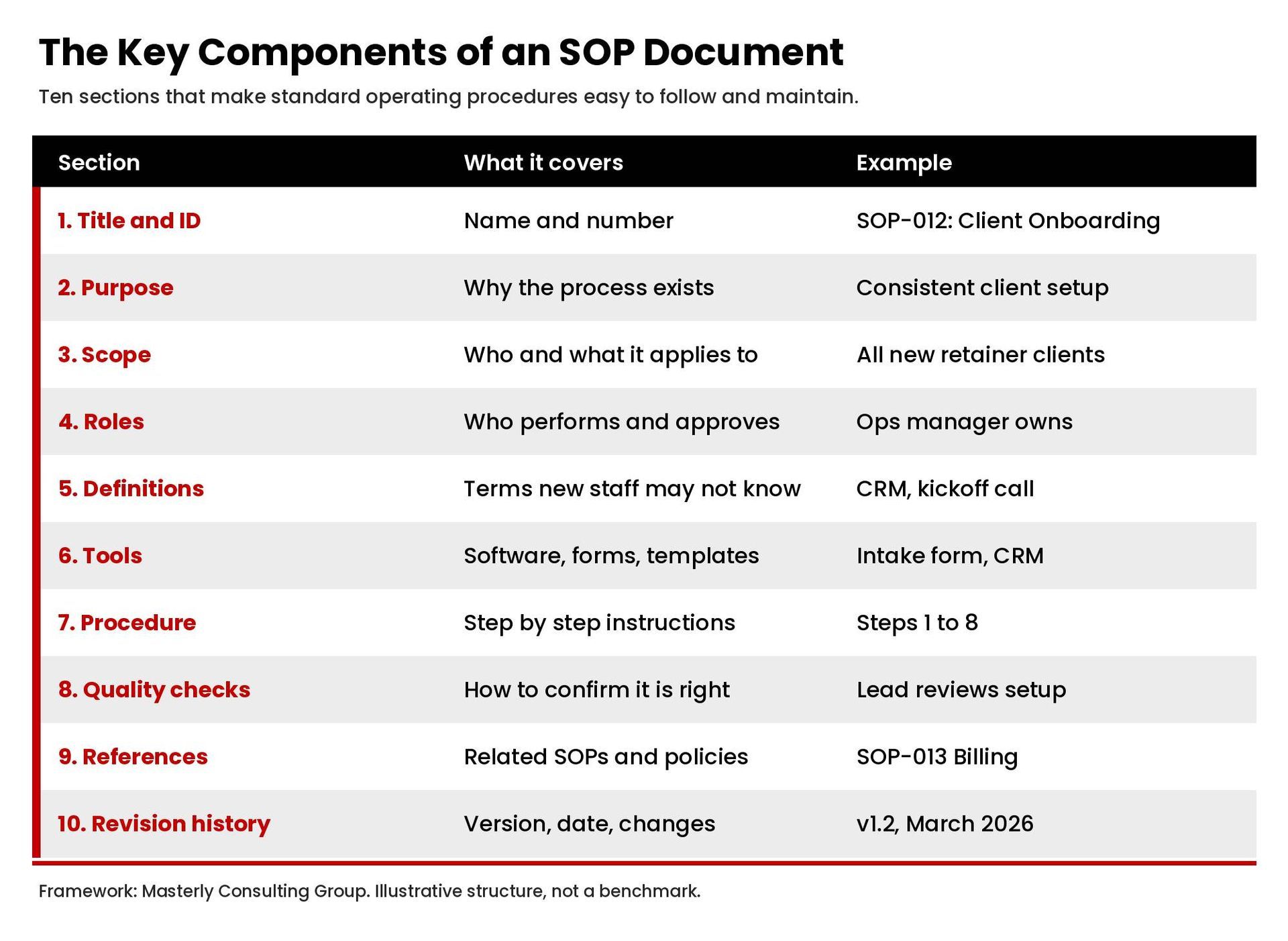
- Title and ID. A clear name and a number, such as "SOP-012: Client Onboarding."
- Purpose. One or two sentences on why the process exists and what outcome it produces.
- Scope. Who and what the SOP applies to, and what it does not cover. A line such as "This SOP applies to all new retainer clients" prevents confusion.
- Roles and responsibilities. Who performs each step, who approves, and who owns the SOP.
- Definitions. Any terms, abbreviations, or systems a new employee might not know.
- Materials and tools. The software, templates, forms, or equipment needed to complete tasks.
- Procedure. The step by step instructions, written in concise language with one action per step.
- Quality control checks. How to confirm the work was done correctly before it moves on.
- References and related SOPs. Links to forms, policies, or connected processes.
- Revision history. Version number, date, author, and a short note on what changed.
The procedure section is the heart of the document. Keep each step short, start it with a verb, and include key points such as warnings, decision points, or approval requirements where they belong rather than in a separate section nobody reads.
What Are the Common SOP Formats?
The right SOP format depends on the specific process. Three formats cover most business processes:
Simple step by step format
A numbered list of actions works best for routine tasks with few decisions, such as setting up a new user account or running an end-of-day report. It is the fastest format to write and the easiest to follow.
Hierarchical format
A hierarchical SOP uses main steps with sub-steps underneath. It suits more complex processes where each major step has several detailed instructions, such as month-end close or client onboarding.
Flowchart format
A flowchart format shows decision points visually. Use it when the specific process branches based on conditions, such as how to handle a refund request depending on the amount and the reason. Many teams combine a flowchart with written instructions, so readers see the full path and the details for each step.
Whatever the format, visual aids such as screenshots, annotated images, or short screen recordings make SOPs easier to follow. A screenshot of the exact field to fill in prevents more errors than a paragraph describing it.
How Do You Write Standard Operating Procedures?
Creating standard operating procedures does not require a large project. Creating SOPs works best in small batches with input from relevant stakeholders. Use this step by step guide:
1. List and prioritize your processes
Start by listing the business processes your team performs. Prioritize SOPs for processes that are high risk, done often, done inconsistently, or known by only one person. Do not try to document everything at once.
2. Involve the people who do the work
The best SOP writing starts with the person who performs the task. Ask them to walk through the process while someone records each step. This captures the details and shortcuts that never appear in a manager's version of the process, and it helps identify inefficiencies and unnecessary steps.
3. Write the initial draft
Use a consistent SOP template. Write in plain, concise language, one action per step, in the order the work happens. Include who does each step and what the output should be.
4. Test the draft
Ask someone who has never done the task to follow the SOP exactly. Every place they get stuck is a gap in the document. This review process is the single best test of whether the SOP works.
5. Review with relevant stakeholders
Have the process owner, a manager, and anyone affected by the output review the SOP. For processes tied to regulatory requirements or client contracts, include whoever is responsible for compliance.
6. Publish it where people work
Store SOPs in one central location that the team can search, such as a shared drive, a knowledge base, or your project management tool. An SOP nobody can find does not exist.
7. Train the team
Walk the team through new SOPs, explain why the process matters, and make the SOP the reference for training new employees.
8. Review and keep updating SOPs
Assign an owner and a review date for every SOP. Updating SOPs should happen whenever the process, software, or regulatory requirements change, and at least once a year for active processes. Treat SOPs as living documents, not a one-time project.
What Are SOP Examples Across Industries?
SOP examples look different by industry, but the structure stays the same. A few common uses:
- Manufacturing. A manufacturing process SOP covers machine setup, safety checks, and quality control inspections, so every shift follows the same key steps and the plant meets industry standards.
- Healthcare. Healthcare providers use standard operating procedures for patient intake, infection control, and medication handling, where clear SOPs promote consistency and support regulatory compliance.
- Professional services. Firms use SOPs for client onboarding, proposal writing, billing, and file management, which improves business operations and overall performance.
- Retail and e-commerce. Stores use SOPs for opening and closing, returns, inventory counts, and order fulfillment.
- Administrative teams. Office and virtual support teams use SOPs for calendar management, inbox triage, and travel booking.
Organizations aiming for consistent results in any of these settings follow the same pattern: document the process, train the team on it, and review it on a schedule. Standardized processes give everyone a solid understanding of what good work looks like, which leads to fewer mistakes and enhanced productivity.
What Are Best Practices for Writing SOPs?
Writing SOPs well is a skill. These practices make effective SOPs easier to follow and easier to maintain:
- Write for the newest person on the team. If a new hire can follow the step by step instructions without help, the SOP is clear enough.
- Use concise instructions. One action per step, starting with a verb. Concise instructions are easier to scan during task execution.
- Show, do not just tell. Add screenshots, photos, or a short video for any step that is easy to get wrong.
- Include the following elements in every SOP: purpose, scope, owner, procedure, quality checks, and revision date.
- Keep the format consistent. When every SOP follows the same template, people know where to look.
- Link related SOPs. Many processes connect. A link from one SOP to the next keeps the workflow intact.
Teams that embrace SOPs this way find that clear SOPs ensure the process survives turnover, growth, and new tools.
What Does an SOP Example Look Like?
Here is a short example of a simple step by step SOP for a professional services firm:
SOP-007: Sending a Client Proposal
- Purpose: Send accurate, consistent proposals within two business days of a discovery call.
- Scope: Applies to all new client proposals over a set value.
- Owner: Operations manager.
- Procedure:
- Open the proposal template in the shared drive.
- Complete the client name, scope, timeline, and pricing fields from the discovery call notes.
- Attach the standard terms.
- Send the draft to the account lead for review.
- After approval, send the proposal to the client and log the date in the CRM.
- Set a follow-up task for three business days later.
- Quality control: The account lead confirms scope and pricing match the discovery notes before sending.
Even this short SOP removes guesswork, protects quality, and makes the process easy to hand to a new team member.
What Mistakes Make SOPs Fail?
Most SOPs fail for the same reasons:
- Too long or too vague. A 20-page document for a 10-minute task will not be used. Neither will a document that says "process the order" without explaining how.
- Written without the people who do the work. SOPs written only by managers often miss real steps.
- No owner and no review date. Outdated SOPs quietly teach the wrong process.
- Stored in the wrong place. If people have to hunt for the SOP, they will ask a coworker instead.
- Treated as paperwork. SOPs work when leaders refer to them, train with them, and update them as part of operational excellence, not when they are written once for an audit.
How Do SOPs Support Operational Excellence and Continuous Improvement?
SOPs are the foundation for scaling a business. They let teams streamline workflows, delegate with confidence, and enhance efficiency without lowering quality. They also make continuous improvement measurable: when a process is standardized, the team can change one step, compare results, and update the SOP when the change works.
At the leadership level, a library of effective SOPs connects to the broader operating system of the business, including clear roles, a regular meeting rhythm, and a continuous improvement rhythm. If inconsistent processes are slowing growth, our guide to process improvement consulting explains how to find and fix the bottlenecks first, and an accountability chart clarifies who owns each process.
Frequently Asked Questions
What is the main purpose of standard operating procedures?
The main purpose is to make sure a specific task or process is performed consistently and correctly, no matter who does it. SOPs reduce errors, facilitate training, support quality control, and help maintain compliance.
What are the five key elements of an SOP?
Most SOPs include a purpose, a scope, roles and responsibilities, the step by step procedure, and a revision history. Many also add definitions, tools, quality control checks, and references.
How long should an SOP be?
As long as the process requires and no longer. A routine task may need a one-page checklist. A complex process may need several pages with a flowchart. Clarity matters more than length.
How often should SOPs be updated?
Review active SOPs at least once a year and update them whenever the process, tools, or regulatory requirements change. Each SOP should have a named owner and a review date.
Is there a free SOP template I can use?
Yes. Many teams start with a simple free template in a word processor that includes the key components listed above: title, purpose, scope, roles, procedure, quality checks, and revision history. The template matters less than using it consistently.
Turn Know-How Into a Repeatable System
Standard operating procedures turn individual know-how into a system the whole business can rely on. If your company is growing faster than its processes, contact Masterly Consulting Group to talk through which processes to standardize first and how to build SOPs your team will use.