
After Action Review: How Teams Turn Results Into Lessons
An after action review (AAR) is a short, structured discussion held after a project, event, or decision to compare what was planned with what actually happened, understand why the two differed, and agree on what the team will keep or change next time. It turns experience into lessons learned the team can use right away.
The method was originally developed by the US Army and is now used by businesses, healthcare teams, and many other organizations. This guide explains the four key questions, how to run an effective AAR, and how to make the lessons stick.

What Is an After Action Review?
An after action review is a facilitated team conversation, usually 30 to 90 minutes, that looks back at a specific event while the details are still fresh. Formal AARs were originally developed by the US Army. They are now used by all US military services and many other organizations, and businesses use them as a knowledge management tool. The technique compares the intended outcome with the actual outcome and identifies practices to sustain and practices to improve ( Wikipedia, After-action review).
In a business setting, the action review process works the same way. The project team that did the work reviews its own performance, identifies root causes, and records a few specific actions. The goal is to capture lessons and drive continuous improvement, not to create a report that sits in a shared drive. For example, a sales team might hold an action review (AAR) after a major proposal, whether it won or lost, to see which parts of the preparation helped and which slowed the team down.
An AAR is not the same as a post mortem in the traditional sense. A post mortem is often held only after a failure and can turn into a search for blame. An after action review is held after successes too, because a team can learn as much from what went right as from what went wrong.
What Are the Four Key Questions of an AAR?
Most formal AARs follow four questions. Wharton's executive education faculty describe the same basic structure for leaders outside the military ( Wharton, After-Action Reviews: A Simple Yet Powerful Tool).
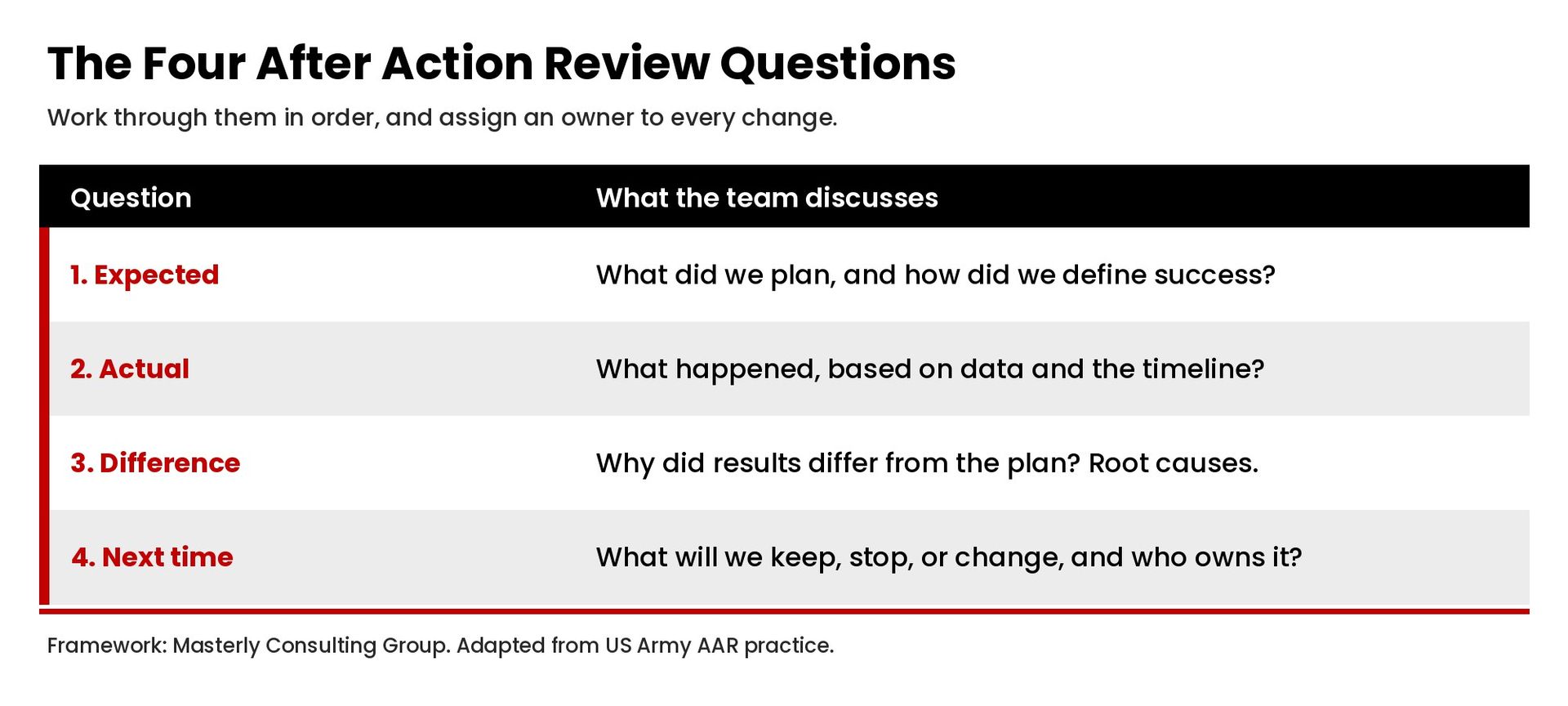
- What did we expect to happen? Restate the plan, the goal, and the standard of success. If the team cannot agree on what was expected, that is the first lesson.
- What actually happened? Build a shared, factual account using relevant data such as timelines, metrics, customer feedback, and the decisions made along the way.
- Why was there a difference? Look for root causes in the process, the plan, the information available, and the resources. Ask "why" more than once.
- What will we keep or change next time? Agree on what to repeat, what to stop, and what to try. Each change needs an owner and a date.
These four questions keep the discussion focused. They also make the review repeatable, which matters if you want AARs to become part of how the business runs.
Why Do After Action Reviews Improve Team Performance?
An AAR improves team performance because it closes the gap between doing the work and learning from it. Without a review, lessons stay in individual heads and leave when people change roles. With a review, the team captures lessons while memory is accurate and turns them into practices the next team can use.
A 2005 Harvard Business Review article on the Army's approach recommends starting with projects that are critical to the team's mission, holding brief daily AARs during periods of intense activity, and making sure the lessons first benefit the team's own next action rather than a report for someone else ( Harvard Business Review, Learning in the Thick of It).
For leadership teams, the benefits are practical:
- Faster correction. Problems in a process surface in days, not at the end of the year.
- Shared understanding. Participants leave with the same account of what happened, which reduces repeated debate.
- Accountability without blame. The focus on the process, not the person, makes it easier for people to discuss their own mistakes.
- Better planning. Key takeaways feed the next plan, budget, strategy discussion, or project kickoff.
- Clearer expectations. Restating the objective at every review shows whether expectations were clear from the start.
How Do You Run an Effective AAR?
An effective AAR is short, prepared, and specific. Use this sequence:
Before the review
- Pick the event. Choose a defined project, launch, client engagement, or decision with a clear start and end.
- Invite the people involved. Include everyone who made decisions or did the work. Keep the group small enough for real discussion.
- Gather data. Collect the plan, the timeline, results against targets, and any feedback from customers or employees. Good preparation lets the group spend its time on answers, not on reconstructing the facts.
- Name a facilitator. Ideally someone who did not lead the work, so the team leader can participate as a member.
During the review
- Set the ground rules. No blame, no rank in the room, and the discussion stays on the event.
- Work through the four questions in order. Do not jump to solutions before the team agrees on what happened.
- Limit the lessons. Three to five specific changes are more useful than a long list nobody acts on.
- Assign owners. Every change gets a named owner and a follow-up date.
After the review
- Write a one page summary. Record the expected outcome, the actual outcome, root causes, and the agreed actions.
- Share it. Send it to the people who will run the next similar project.
- Check follow-through. Review open actions in your regular leadership meeting. Our guide to meeting cadence for leadership teams explains where this fits in an operating rhythm.
What Should an After Action Review Template Include?
A simple after action review template keeps every review consistent. A useful template includes:
- Event and date. What is being reviewed and who participated.
- Objective. What we expected to happen and how success was defined.
- Actual result. What happened, supported by data.
- Differences and root causes. Why the results differed from the plan.
- Sustain. What worked and should be repeated.
- Improve. What should change, with an owner and due date.
- Follow-up. When the leadership team will check progress.
Keep the template to one page. A long form discourages honest discussion and slows the review process.
What Are Common AAR Mistakes?
The most common mistakes come from treating the AAR as paperwork:
- Waiting too long. Reviews held weeks later rely on memory, and memory favors a good story over the facts.
- Turning it into a performance evaluation. If participants fear consequences, they protect themselves instead of sharing what happened.
- Skipping successes. Teams that only review failures miss the practices that should be repeated.
- Collecting lessons without acting. A list of lessons learned is not improvement until someone changes a process.
- Letting the most senior person dominate. Leaders should speak last so others can share their view first.
How Do AARs Fit Into Change Management and Continuous Improvement?
AARs are one of the simplest tools for building a continuous learning culture. They work alongside root cause analysis for recurring problems and a broader continuous improvement rhythm for the whole business. During a change management effort, short AARs after each phase help leaders see what is landing with employees and adjust before the next phase begins.
For quarterly or annual planning, a set of AAR summaries gives the leadership team real evidence about what to repeat. Our guide to the quarterly business review shows how those findings can feed the next quarter's priorities.
Frequently Asked Questions
What is the purpose of an after action review?
The purpose is to learn from a specific event by comparing what was planned with what happened, identifying why there was a difference, and agreeing on changes the team will make next time.
What are the four AAR questions?
What did we expect to happen? What actually happened? Why was there a difference? What will we keep or change next time?
How long should an AAR take?
Most business AARs take 30 to 90 minutes. A quick review after a small event can take 15 minutes. A complex project may need a longer, more formal session.
Who should lead an after action review?
A neutral facilitator works best. That can be a leader from another team, an internal operations lead, or an outside consultant, so the people who did the work can focus on the discussion.
Is an AAR the same as a post mortem?
They are similar, but an AAR is held after successes as well as failures and is designed to avoid blame. A post mortem is often held only after a problem.
Build a Review Habit That Leads to Better Results
An after action review is simple, but its value depends on consistency and follow-through. If your leadership team wants help building a review process into its operating rhythm, contact Masterly Consulting Group to talk through where reviews would make the biggest difference.