Strategic Plan Template: A One-Page Structure for Leadership Teams
A strategic plan template is a short, reusable format a leadership team can use to write a strategic plan on one page. The point is clarity: a few goals, the main approaches behind them, owners, a timeline, and a simple way to track progress. This article gives you a strategic plan template free to copy into a document, plus notes on how to fill it in. You do not need to download a special file. The same plan template works as a starting point for a one-year plan or a tighter two- to three-year view.
It is a planning tool, not a promise of success. It is also not a substitute for a strategic planning consultant when the team wants outside facilitation, or for a strategic planning facilitator who will run the working session with the team. Once the page is written, it should connect to the team's annual operating plan, where the work is broken into owners, budgets, and dates.
What Belongs on a One-Page Strategic Plan
A useful strategic plan is a living document. It should be short enough to read in one sitting and specific enough that the team can use it in monthly or quarterly reviews. A long deck can support the plan. It should not replace this short strategic plan.
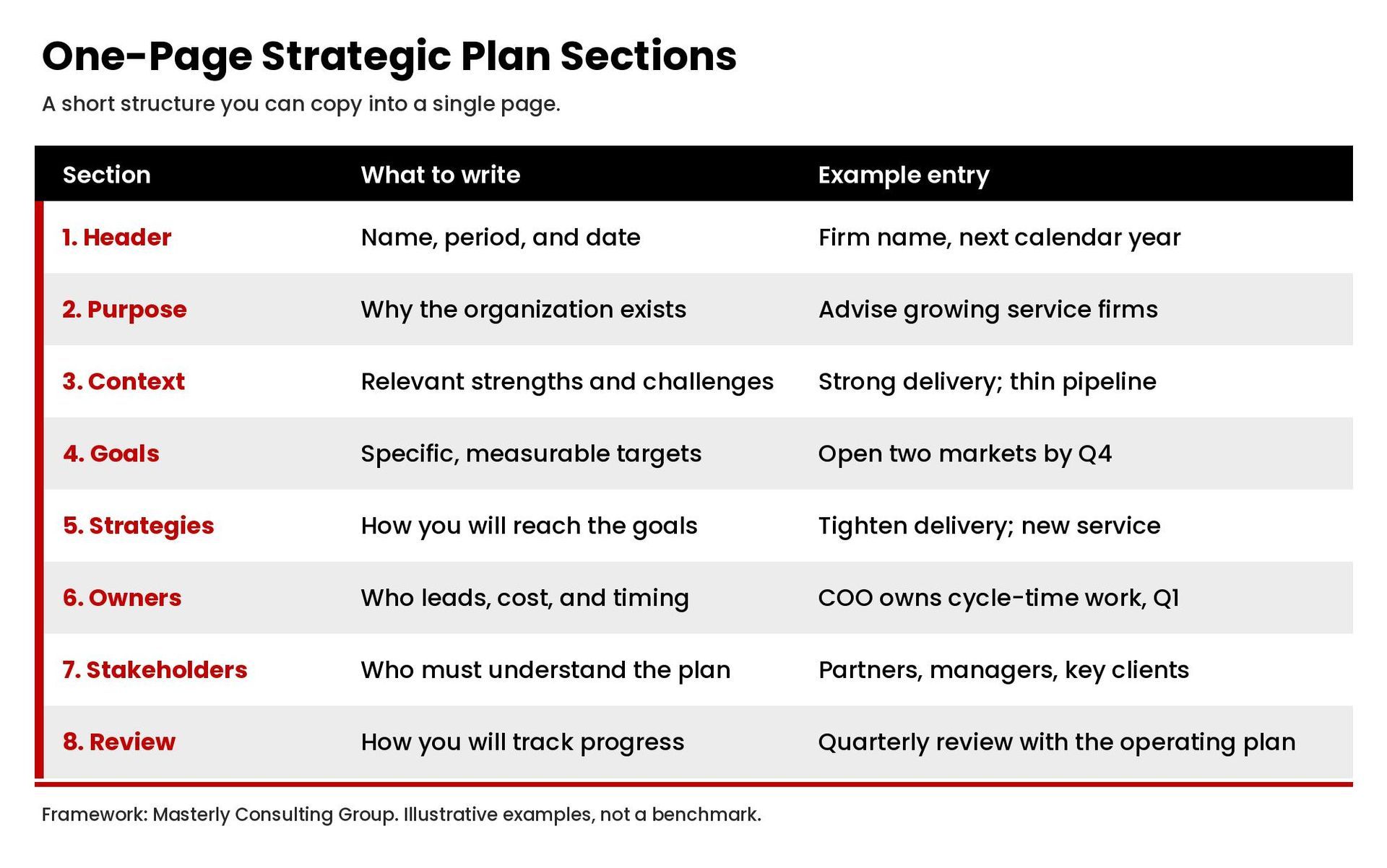
These are the sections most leadership teams need:
- Header. The page is headed with the organization name, the time period, and the date of the latest update.
- Purpose and overview. In a few lines, state why the organization exists and what this period is for. This is the executive summary of the plan, not a separate report.
- Context. Note the relevant strengths, weaknesses, opportunities, and challenges, plus any data driven insights you already trust. Do not turn this into a second plan.
- Goals and measurable targets. Write a small set of goals that are specific, measurable, and achievable. Include a number and a date where you can.
- Key strategies and tactics. For each goal, name the approach and the first actions, projects, or initiatives that will implement it.
- Owners, resources, and timeline. Who leads, what resources and cost are involved, and when the work should reach a review point.
- Key stakeholders and clients. Who must understand the plan, inside the organization and among the people you serve.
- Review. How the team will track progress, how often, and where the notes will live. Keep this light. Some monitoring is enough; more monitoring is not better.
There is no single official list of five, six, or seven stages. Use the sections above as a practical outline. If a longer process helps your team, keep it in a backup document and leave this plan as the roadmap the group will actually maintain.
Strategic Plan Template You Can Copy
Copy this strategic plan template free of extra software requirements into a shared document. Keep it to one page. Letter and A4 sizes both work. Other formats are fine if the content still fits on a single sheet.
Organization:
Time period:
Date and version:
Purpose and overview:
Context (strengths, weaknesses, opportunities, challenges):
Goals and measurable targets:
Key strategies, tactics, and projects:
Owners, resources, cost, and timeline:
Key stakeholders and clients:
How we will track progress:
Next review date:
Before the planning meeting, email the blank template to the team and ask each person to come with two proposed goals. After the session, email the draft, collect comments by email or in a shared doc, and send the final page by email so everyone has the same version. You can also leverage last year's results in the context section, as long as they do not quietly restart every old project.
How to Fill In the Template
Create the plan in a working session, not in a private draft that arrives as a finished surprise. Start with purpose, then goals, then strategies. Implementation details come after the team has chosen what matters. Explore only a few options before you decide; a one-page plan cannot hold every idea.
Measurable Targets
Write goals in plain language. "Grow the business" is not enough. "Open two new client markets by Q4 and keep existing client revenue at or above this year's level" can be reviewed. Put a person next to each major action. If no one owns it, it is not a plan.
Keep the quality of the plan high by cutting, not by adding. If a section does not help the team make a decision, remove it. The benefits of a short plan are focus and a lower cost of tracking. A clear plan can also save money by stopping work that does not support the goals. That is a planning choice, not a forecast.
Practices that help: treat the plan as a living document, review it on a set calendar, and update the date when something changes. The review habit should be light enough that it actually happens. A quarterly check tied to the operating plan is usually enough.
A comprehensive binder is not the goal. The value of this format is clarity: a short strategic plan the business can actually use while developing the year ahead. Use ordinary tools (a document, a slide, or a printed page). The plan should describe the organization's future in concrete objectives the team can achieve, not in a slogan. Write those objectives next to the goals, and keep each one relevant to the work of the business. If a target is not achievable in the period, rewrite it.
Fill the template in a few steps: send it, discuss it, decide, and assign owners. Those steps are the whole process. The same process works for a small business and for a larger business. A strategic plan template of this kind is still a strategic plan; it is just short. Use this strategic plan template, or a simpler plan template, and keep the header honest so people do not treat the page as a brainstorming list. A second strategic plan template is useful only if you need a clean copy. Add only as many projects as the business can staff. Success here means people can explain the plan in a few minutes, not that every number will land. Write objectives that the business can achieve, keep those objectives visible, and add a third objective only if it has real value. Ordinary tools are enough. The plan does not have to be comprehensive in length, but the objectives should be comprehensive enough to cover the year the business is actually running. If the strategy is unclear, rewrite the strategy before you add more work. A good strategic plan template helps people achieve what they wrote down, because the plan template stays in view. If you already have a strategic plan template in your files, start there and cut it down. Review the objectives when you review the plan.
A Short Example
This example is illustrative, not a benchmark and not a forecast of results.
Organization: A 40-person professional-services firm.
Period: Next calendar year.
Goals: Keep client retention above 90 percent; launch one new service line by June; reduce average project cycle time by 15 percent by December.
Approaches: Tighten delivery standards; appoint an owner for the new service; improve intake and scoping.
First actions: Rewrite the kickoff checklist in Q1; assign a lead for the new service in January; review cycle-time data monthly.
Review rhythm: Quarterly review of the written plan, with operating details in the annual plan.
A three-year or five-year view can use the same template, with fewer numbers in the outer years and a clearer near-term set of tasks. A meeting agenda for the planning session can follow the same section order: purpose, context, goals, strategies, owners, and review.
Frequently Asked Questions
How do you create a strategic plan outline?
Use the eight sections above, or a shorter set if your team is small. Write the outline first, then fill each section in a single working session.
What is a good example of a strategy?
A strategy names how you will reach a goal, not only the goal itself. In the example above, "tighten delivery standards" is a strategy for client retention. The checklist rewrite is a tactic. If you cannot name the strategy in one sentence, the goal is still only a wish.
What are the 5 components, or the 6 or 7 stages, of strategic planning?
Those lists vary by author. This article does not treat any of them as a required standard. If a familiar set of components helps your team, map them onto the template. Do not add stages that the team will not use.
Can you provide a PDF or a 3-year plan in a downloadable file?
This article is the template. Copy it into your own document and download or print that file if you need a PDF. The same format can cover one year or three years.
Put the Plan in Writing
A strategic plan template is only useful if the team writes it down, assigns owners, and comes back to it. Use this strategic plan template, or another plan template you already like, as long as the strategic plan stays short. The strategic plan template is the starting point, not the finished conversation. Owners and other leaders should be able to walk through it together. That is the test for whether leaders will use it. Copy the sections, keep the page short, and set a review date. If you want help turning the page into decisions, owners, and a working session, contact Masterly Consulting Group or call (888) 209-4055 to talk through where to start.