Vision Statement Examples: How Leadership Teams Write One That Guides Decisions
A good vision statement example might read: "By 2032, every mid-market manufacturer will monitor and reduce its carbon footprint using our automation platform." Or: "By 2035, we will be the default payroll system for distributed teams across North America and Europe." Each one paints a specific desired future state in one sentence and gives leaders a filter for daily decisions. The rest of this article provides vision statement examples by company type, a four-step method to write your own vision statement, and guidance on using it in planning and hiring.
What a Vision Statement Is (Clear Definition)
A vision statement describes the future state an organization aspires to reach within a defined time frame, typically five to ten years. It answers one question: where are we going? A vision statement outlines future aspirations, not current operations.
Vision statements differ from mission statements. The mission covers what you do today, for whom, and how. The vision points to the destination. Together, mission and vision statements sit alongside core values as a small set of enduring direction tools. These three elements communicate a sense of direction for the entire organization and filter large decisions.
A company's vision statement is not a slogan or tagline. It is an internal decision filter. If a leadership team cannot use the statement to accept or reject a real initiative, the statement is not doing its job.
Vision vs. Mission Statement: What Each One Does
Leaders often confuse mission and vision statements because both describe the company in aspirational language. That confusion erodes execution. Teams end up chasing broad inspiration without knowing whether a specific project moves them closer to the future they want.
A mission statement defines the organization's core purpose and values in present tense: what you do, whom you serve, and how you serve them. A vision statement describes the future state you are building toward, usually five to ten years out. Vision statements are usually future oriented and inspirational; mission statements focus on what the organization does in the present.
The key difference between the two shows up in four areas. Time horizon: mission is now, vision is years ahead. Emotional tone: mission grounds the team in today's work, while an inspiring vision statement pulls them toward a destination. Level of specificity: mission names actions and audiences, vision names outcomes and impact. Use in planning: mission shapes daily operations, vision shapes the
strategic plan and multi-year bets. Vision statements focus on long term aspirations rather than daily operations.
Here is a side-by-side example for a fictional company called "BridgeHR," a B2B SaaS firm serving mid-sized employers:
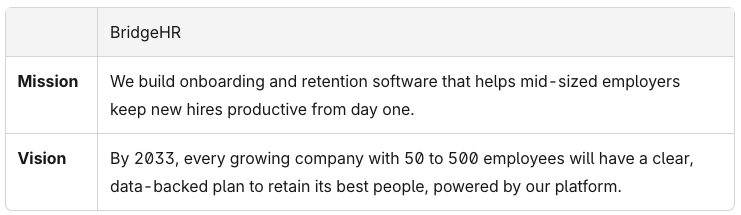
The mission tells employees what to build today. The vision tells them what success looks like in seven years. Both matter, but they do different work.

Why Vision Statements Matter for Growing Companies
A clear vision helps founders and leadership teams choose between competing opportunities. When a company scales from 50 to 200 employees between 2026 and 2030, it encounters more product ideas, more partnership offers, and more market segments than it can pursue. Without a vision, every opportunity looks equal. With one, leaders can ask: "Does this move us closer to our 2033 destination?" Strong vision statements provide a clear filter for decision making.
Vision statements also help motivate employees and stakeholders by connecting daily work to a meaningful future. Employees who find their company's vision statement meaningful report engagement levels roughly 52% higher than those without that alignment. And aligned organizations grow revenue 58% faster than unaligned ones. A
meta-analysis of 60 empirical studies found that clear visions relate to positive employee attitudes, behavior, innovation, and financial performance.
A good vision statement also strengthens company culture. When everyone shares a picture of the future, behaviors, rituals, and hiring decisions start pointing in the same direction. Vision statements help unite teams toward a shared purpose.
Consider a scale-up with 120 employees in 2028 pursuing three product lines, two new geographic markets, and hiring 40 people per quarter. Without a clear vision, leaders shift focus every month. New hires bring conflicting priorities. Teams compete for resources instead of compounding each other's work. Post-mortem reviews reveal that no single filter was applied to the biggest bets. Companies without a vision statement limit their growth opportunities.
Investors, board members, and senior hires often probe for a vision statement to test leadership clarity. A leadership team that cannot articulate where the company is heading in five years raises questions about strategic coherence, and that shows up in valuation conversations.
Key Elements of a Good Vision Statement
Most strong vision statements share several key elements, even when their industries and wording differ. Research on
sustainability visions and corporate strategy converges on a consistent set of traits.
Future state. A good vision statement paints a clear picture of what the organization and its market look like years from now. Effective vision statements describe a desired future state, not today's reality.
Time-bound horizon. Anchoring the statement to a specific year (e.g., "by 2032") makes it concrete. A vision statement outlines future aspirations for five to ten years, long enough to be ambitious, short enough to feel real.
Specificity without metrics. A vision is not an OKR. It names the outcome you want ("every growing company retains its best people") without pinning down quarterly targets. A vision statement should be specific enough to motivate the team, but not so overly detailed that it becomes a checklist.
Alignment with core values. An effective vision statement is aligned with an organization's core values. If the vision points one direction and the values point another, decisions will feel inconsistent.
Emotional resonance. A strong vision statement should be inspirational and ambitious. It should matter to the people doing the work, not just the CEO. A well-crafted vision statement should connect to a larger impact on society or industry. Well-known companies illustrate this: Disney's vision is to lead in entertainment and information. Tesla aims to drive the world's transition to electric vehicles. IKEA's vision is to create a better everyday life for many people. Nike's vision is to inspire every athlete in the world. Kellogg's vision is a good and just world where people are fulfilled.
Brevity. Clear and concise language in vision statements helps in memorability. Research suggests effective vision statements average 11 to 22 words. A good vision statement should be concise, ideally one to three sentences. A concise statement that a new employee can repeat after hearing it twice will spread faster than a paragraph nobody reads.
Relevance to your market. The statement should name, directly or indirectly, the people or systems you are trying to change. This keeps it from becoming a generic aspiration any company could claim.
Here is a fictional example that checks all the boxes: "By 2034, NovaBridge will be the platform one million small business owners use to access affordable credit within 24 hours, replacing the month-long bank loan process." It is future oriented, time-bound, specific, ambitious, and tied to a real market problem.
Good mission and vision statements are tightly linked but distinct. Both should be testable: when a real initiative lands on the leadership team's desk, can you use the vision to decide whether to pursue it?
Vision Statement Examples by Company Type
The examples below are original statements for fictional companies. They are here for inspiration, not for copying. Each one is written as a realistic draft a leadership team might produce during a workshop. A few examples emphasize company culture, while others focus on impact, scale, or innovation.

B2B SaaS. B2B SaaS companies often anchor their vision to a measurable change in their customers' operations.
- "By 2033, every logistics company with a fleet of 50 or more trucks will plan routes using real-time carbon and cost data from our platform."
- "By 2035, mid-market CFOs will close their books in one day, not ten, because automated reconciliation is the norm."
- "We will be the most trusted infrastructure layer for global payroll, serving 500,000 distributed teams by 2034."
Consumer products. Consumer visions tend to describe the customer's life after the product succeeds.
- "By 2032, three million families will replace single-use cleaning products with refillable systems designed to last a decade."
- "We will be the first name parents trust for screen-free play, reaching every major retail channel in North America by 2031."
- "By 2035, our community members will treat our brand as the starting point for every home-cooked meal."
Professional services. Services firms often tie vision to talent and reputation.
- "By 2033, we will be the advisory firm mid-market CEOs call first when they need to restructure for growth."
- "Our firm will be known as the most customer centric company in management consulting, with a client retention rate above 90% for five consecutive years by 2034."
- "By 2035, every engagement we deliver will measurably improve the client's decision making process within six months."
Nonprofit. A nonprofit's vision often describes the world it wants to create. Some of the best-known nonprofits anchor their vision to a specific social outcome. The Alzheimer's Association, for instance, centers its work on a future without that disease. Original fictional examples:
- "By 2032, every child in our region will have access to a licensed mental health counselor within their school district."
- "A just world where no family faces hunger because of a medical crisis."
- "By 2035, 100,000 formerly incarcerated adults will hold stable employment through our training network."
Health and education. These sectors often blend impact and reach.
- "By 2033, our diagnostic tool will screen for three critical illnesses in under ten minutes, reaching rural clinics in 40 countries."
- "Every public school teacher in the state will have a personalized professional development plan by 2031, powered by our platform."
- "We will make early childhood literacy assessment universally accessible to every school district in the country by 2034."
Some of these statement examples are concept-based (describing a changed world), while others are quality-based (describing the organization's aspirations for excellence). Both approaches work. The choice depends on whether the leadership team wants to emphasize what changes externally or what the organization becomes internally.
Vision Statements vs. Purpose and Core Values
Purpose is why the organization exists, often timeless. Core values are non-negotiable behaviors that guide how people work together. A mission statement defines what you do now. A vision statement sets a future destination. Trying to compress purpose, mission, vision, and values into one sentence usually produces a vague statement that guides nothing.
Here is how a fictional company, "GreenShift Analytics," might articulate all four:
- Purpose: We exist to help businesses operate without harming the planet.
- Vision: By 2034, 50,000 mid-sized manufacturers will cut waste by half using our analytics platform.
- Mission: We build waste-tracking software that gives plant managers real-time data on material usage, energy consumption, and emissions.
- Core values: Transparency in data, long-term thinking over quarterly wins, and collaboration across every function.
A clear vision must align with core values. If GreenShift's vision demands rapid, global scale but its values prioritize "deep, local partnerships," the leadership team will face contradictions in every growth decision. That inconsistency erodes trust with both employees and customers. A vision statement plays a crucial role only when it fits coherently into this larger framework.
How to Run a Vision Statement Workshop (Four Steps)
The best vision statements come from a structured workshop with the leadership team, not from a solo drafting session by the CEO. Research on vision statement development shows that involving cross-functional leaders improves clarity, buy-in, and alignment. Involving employees in writing a vision statement enhances engagement across the organization.
The four steps are: Diagnose, Draft, Test, Commit.
Who should be in the room: CEO or founder, functional heads (product, sales, finance, people), and possibly one board member. Send pre-work at least a week in advance: market data, customer research, competitive landscape, and any existing strategy documents.
Timing: A half-day or full-day offsite works well. Most growing companies run this process once every three to four years, unless a major strategic shift demands earlier revision. This workshop should connect directly to the company's annual operating plan and management operating system, so the vision cascades into measurable priorities.
Step 1: Define the Future Outcome You Want
The first workshop step is to clarify the concrete outcome you are building toward. Who do you serve? What problems do you solve? What does success look like five to ten years from now?
Have each leader answer these questions independently before the group discusses:
- If we are wildly successful by 2033, what is true about our customers?
- What is true about our people and company culture?
- What is true about our market position?
- What problem have we solved that no one else has?
- What does the world look like because we exist?
- Which of our current bets paid off, and which did we stop?
Focus on outcomes, not outputs. "Ten million small businesses thriving" is stronger than "our app used in 80 countries" because it names the change, not just the distribution. Vision statements inspire organizations to move toward long-term goals when those goals describe a future worth reaching.
Here is a short example of a leadership conversation at this stage. The CTO says, "By 2033, every mid-market CFO closes their books in a day." The head of sales pushes back: "That is a product feature, not a vision." The CEO reframes: "What if our vision is about what happens for the CFO's business once their books close faster?" That reframe moves the team from an output to an outcome.
Step 2: Add the Unique "Twist"
Every growing SaaS company wants to "transform" its industry. Every nonprofit wants to "create a better world." A great vision statement needs a twist; the specific angle that separates your organization from competitors with similar ambitions.
Differentiating angles include: a distinctive company culture (e.g., the most creative organization in your sector), proprietary technology, an unusual customer segment (e.g., sole focus on a diverse group of frontline workers), or a specific social impact (e.g., create economic opportunity for underserved communities).
Before (generic): "We will be the leading platform for financial analytics."
After (with twist): "By 2034, every CFO at a family-owned manufacturer will use our platform to make investment decisions in hours, not weeks, because we built the only analytics engine trained on private-company data."
The twist should reflect real strategic choices. If your roadmap does not prioritize private-company data, that vision is marketing, not strategy. Sanity-check by asking: "Would we turn down a large enterprise deal because it conflicts with this vision?" If the answer is no, the twist is not real.

Step 3: Calibrate Scope and Time Horizon
Most growing companies benefit from a seven-to-ten-year horizon. Shorter than five years, and the vision becomes a goal you can achieve with a good quarter. Longer than fifteen, and it feels abstract enough that nobody plans against it.
A vision statement should not be a 12-month target ("launch in three new markets by Q4"). That belongs in the annual operating plan. It also should not be so broad that any company could claim it ("change the world"). The best scope names a specific population, a specific change, and a plausible timeline.
For multi-business or multi-region organizations, a single corporate vision usually works better than separate visions per unit. Business units can set their own strategic goals that ladder up to the corporate vision, but the top-level statement should be one that the entire organization can rally behind and that reaches a broad audience.
Over-specific (too narrow): "By 2028, 12,000 dental practices in Texas will use our scheduling tool." This reads like a sales target.
Rewritten (enduring but clear): "By 2034, independent healthcare practices across the U.S. will run on a single platform that handles scheduling, billing, and patient communication, freeing clinicians to focus on care." The rewrite is still specific, but it survives a market expansion without needing a rewrite.
Step 4: Make It Human and Memorable
Draft language from a workshop often reads like a strategy document. The final step is to translate it into something employees can repeat and remember.
Write in present tense or near-future language. Use plain words. Avoid technical terms and acronyms. Claire Hughes Johnson of Stripe has described mission, vision, and long-term goals as documents that should not change often, which means the language must hold up over years.
Techniques that build emotional connection: storytelling ("a world where every small business owner sleeps well because cash flow is predictable"), a vivid image ("the default choice for…"), or a direct statement of who benefits ("for the 30 million freelancers who…").
Here are a few fictional examples that show strong human connection and would clearly motivate employees:
- "By 2033, no parent will wait more than 48 hours for a child mental health appointment in our network."
- "We will be the company that made sustainable energy affordable for every apartment building, not just homeowners, by 2035."
- "By 2032, our tools will help one million creators earn a full-time living from their work."
Apply a quick "hallway test": read the vision statement to a new manager once. Wait ten minutes. Ask them to repeat it. If they get the gist right, the statement is memorable. If they struggle, shorten it or replace abstract words with concrete ones.
Testing and Refining Your Vision Statement
Before finalizing, test the draft with a small group of managers and high-potential employees outside the leadership team. This group adds perspective the C-suite might miss.
Ask specific feedback questions:
- What decisions become easier with this vision?
- What still feels vague or unrealistic?
- Could you explain this to a new hire in one sentence?
- Does this make you proud to work here, or does it feel like a poster?
Incorporate feedback without diluting the statement into something generic. If three out of five testers say "it could apply to any company," the twist is missing. If they say "I don't believe we can do this," the scope may need calibration.
Check alignment: does the vision connect to the mission statement, the core values, and current strategic bets? If the vision says "most trusted" but the values never mention trust, there is a gap. An organization's vision statement only works when the rest of the strategic framework supports it.
Using the Vision in Strategic Planning
The vision statement should sit at the top of the annual operating plan and cascade into three-year priorities and 12-month goals. It is the starting point, not an afterthought on the last slide of a strategy deck. Vision statements help guide strategic planning and decision making at every level.
Leadership teams can use the vision to accept or reject big initiatives, acquisitions, or product bets. The process is straightforward: describe the initiative, then ask, "Does this move us closer to our 2033 vision or further away?" If the answer is ambiguous, the vision may need sharpening, or the initiative may need a stronger case.
A clear vision statement guides strategic decision making for organizations at critical turning points. Tools like annual operating plans, management operating systems, and OKR frameworks translate vision into measurable execution. The vision is the "why" behind each objective, and the OKR is the "how much by when."
Concrete example: In 2027, a B2B SaaS company faces two product roadmaps. Roadmap A adds enterprise features for large banks. Roadmap B deepens automation for mid-market CFOs. The company's vision reads: "By 2033, every mid-market CFO will close their books in one day." Roadmap B wins, because it moves the company toward its stated future. Without the vision, the larger revenue potential of Roadmap A might have pulled the team off course.
Using the Vision in Hiring, Culture, and Communication
Bake the vision statement into job descriptions, onboarding, and manager training so it shapes company culture and daily behavior. A vision that lives only in a strategy document has no impact on employee behavior.
Hiring. Add a question to every interview loop that tests resonance with the mission and vision. For example: "Our vision is [statement]. What about that future excites you, and what concerns you?" This surfaces candidates who connect to the destination, not just the role. It also helps attract a broad audience of talent aligned with the organization's aspirations.
Onboarding. New hires should hear the vision on day one and see how their role connects to it within the first week. Explain not just what the vision says, but how the team uses it to make decisions.
All-hands and reviews. Reference the vision in quarterly business reviews, performance conversations, and all-hands meetings. Leaders who repeat the vision in context (not as a slogan, but as a decision filter) keep it alive. Research on CEO communication of vision shows that when leaders clearly communicate the vision, employees report higher engagement and perceive more meaningfulness in their work. Strong vision statements should motivate employees and stakeholders, but only if leaders keep referencing them.
Mission and vision statements should be visible on internal tools, strategy docs, and intranet pages. If people have to search for them, they will not use them.
Common Mistakes to Avoid with Vision Statements
Confusing mission and vision. This is the most common error. A leadership team writes one sentence that tries to cover what they do now and where they are going. The result guides neither operations nor strategy. For teams over roughly 20 people, combining mission and vision statements into one sentence weakens both.
Writing by committee without a clear owner. Workshops should involve multiple voices, but one person (usually the CEO) must own the final draft. Without an owner, the statement becomes a compromise no one loves.
Bad: "We strive to be the world's leading producer of innovative solutions that empower communities and drive positive impact across all stakeholders."
Better: "By 2034, every rural clinic in Southeast Asia will diagnose three critical illnesses in under ten minutes using our portable screening device."
The first version uses jargon and says nothing specific. The second names the audience, the outcome, and the timeline. It also creates clear direction for product and market decisions.
Making it too long. If the vision cannot fit in two sentences, it is probably mixing in mission, values, or strategy. A concise statement wins over a paragraph. Some of the world's leading producers of consumer goods use vision statements under 15 words.
Never referencing it after launch. A vision statement that gets unveiled at an offsite and never mentioned again is a daunting task wasted. Leaders must bring inspiration from the vision into weekly and monthly conversations.
Using internal jargon. The vision should be readable by any community member, job candidate, or board member. If it requires a glossary, rewrite it.
Quick audit checklist for your current vision:
- Can a new hire repeat it after hearing it twice?
- Does it describe a future state, not today's operations?
- Does it name who benefits and how?
- Does it help you say "no" to at least one real initiative?
- Has it been referenced in a leadership meeting in the last 90 days?
If the answer to two or more of these is "no," it is time to revisit.

FAQ: Vision Statement Basics for Leadership Teams
How long should a vision statement be? One to two sentences, or roughly 15 to 40 words. Research on effective vision statements finds that those averaging 11 to 22 words tend to be more memorable and more frequently referenced by employees. A vision that fills a full paragraph usually means the team has mixed in mission, values, or strategy. Example of a good length: "By 2034, every mid-market manufacturer in North America will monitor and reduce waste in real time using our platform." That is 20 words and passes the hallway test.
What is the difference between a vision and a mission statement? A mission statement defines the organization's current purpose: what you do, for whom, and how. A vision statement describes the future state you are building toward. Vision statements differ from mission statements in time horizon, specificity, and use. The mission grounds daily work. The vision filters long-term bets. Both are necessary. Neither replaces the other.
How often should a company update its vision statement? Every three to five years, or after a major strategic shift such as entering a new market, completing a large acquisition, or undergoing a leadership change. Regularly revisiting your vision statement keeps it relevant as the company evolves, but revising it every year erodes trust. Teams start to assume leadership lacks stability. If the vision still passes the five-question audit checklist above, leave it alone.
Who should be involved in crafting the vision? The CEO, co-founders, and functional heads should lead the process. Including a small number of high-potential managers or long-tenured individual contributors adds perspective and builds buy-in. The goal is input from a diverse group, not a vote. One person owns the final draft.
How do you roll out a new vision statement? Start with the leadership team, then share it at an all-hands with context: why now, what changed, and what decisions it will affect. Embed it in onboarding, strategy documents, and performance reviews. Spread ideas about the vision through real stories and examples, not just a slide. The vision gains traction when leaders use it to explain a real "yes" or "no" decision.
Next Steps: Turn Your Vision into Daily Decisions
A strong vision statement provides a clear understanding of the future, aligns mission and vision, and guides real trade-offs. It is not a poster. It is a decision filter that every member of the organization can use.
Review your current mission statement and vision statement with your leadership team. Run through the audit checklist. If the statement does not help you say "no" to a real initiative, schedule a half-day workshop using the four steps above.
If you want an experienced facilitator to run that workshop, or if you need to connect your vision to an annual operating plan or OKR framework, schedule a consultation with Masterly Consulting Group. The team works with founders and leadership teams at growing companies to align strategy, build management operating systems, and turn vision into measurable execution.