Leadership Development Plan: How to Build One for a Manager or Team
A leadership development plan is a written roadmap for how a person, or a group of people, will build leadership skills over a set period. It is sometimes called a personal leadership development plan, a personal development plan, or, in HR teams, an individual development plan template. A personal leadership development plan is simply the same tool written for one person. You can also use a personal leadership development plan as the individual section inside a team or cohort document. The document should name current leadership skills, the development areas that matter next, the actions that will build those skills, and how progress will be reviewed.
This article shows how to make a leadership development plan for a manager or a team, includes a leadership development plan template you can copy, and gives short examples you can adapt. It is a management tool, not a promise of promotion, organizational success, or employee loyalty. If you later want help designing a program with a leadership development consultant, that page explains what a consulting engagement usually includes.

What a Leadership Development Plan Is
An effective leadership development plan is a structured roadmap, not a wish list. It connects personal goals and career goals to organizational needs, so skill development serves both the person and the work. A good development plan is specific enough to act on and short enough that people will actually use it.
Organizations use a development plan in several situations:
- A new manager who needs an action plan for the first year in the role.
- Current and future leaders in a cohort, with shared leadership competencies and individual goals.
- Aspiring leaders who are not yet in leadership roles but are preparing for career progression.
- Experienced leaders who want continuous growth in a new area, such as strategic thinking or conflict resolution.
A leadership development program can hold several of these plans at once. The program is the system. The plan is the individual's (or team's) written path inside that system. Talent development and succession planning may use the same template, but a plan still has to be written for a real person, not only for a bench chart. Succession planning works poorly when the document is generic.
Key Components of the Plan
Most plans work better when they include the same key components, whether you are writing a personal plan or a team version.
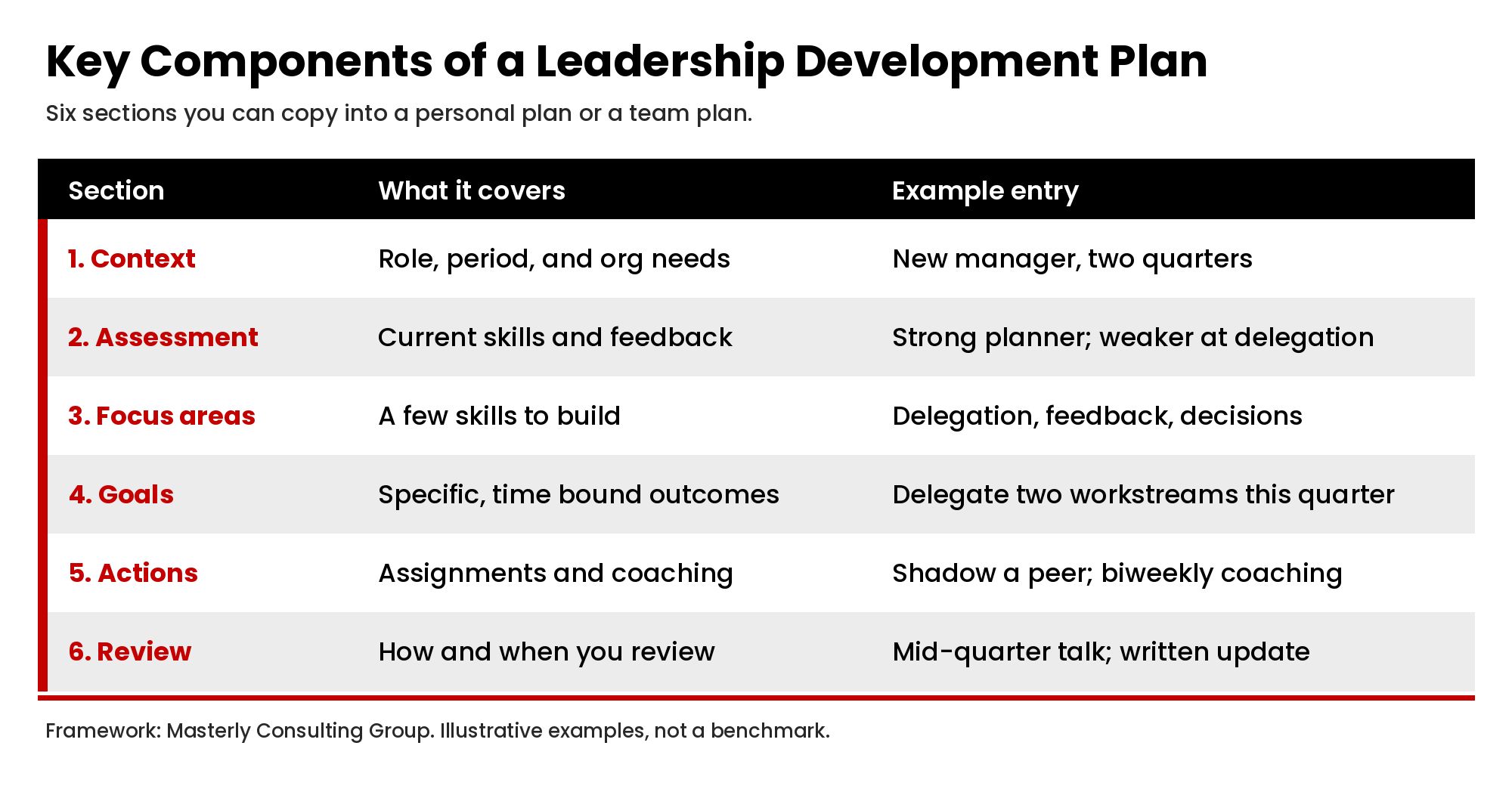
1. Context and role. Where the person sits today, what the role requires, and which organizational objectives the plan should support.
2. Self assessment and input from others. An honest look at current skills, plus constructive feedback and feedback from peers, direct reports, or a manager. Self awareness is part of the work, not a side topic. A second pass of self assessment, after the first round of comments, often sharpens that self awareness.
3. Development areas and skills. A short list of leadership capabilities or leadership qualities to build. These might include emotional intelligence, strategic thinking skills, decision making, delegation skills, or active listening. Emotional intelligence, in this context, means noticing your own reactions and the effect they have on other people, then adjusting how you respond. Plans often over-promise emotional intelligence; write a visible behavior, such as how you handle a hard conversation, rather than treating emotional intelligence as a personality label. Name a few leadership skills, not a dozen, and be plain about which leadership style you want to practice. Conflict resolution belongs on the list only if the role actually requires it.
4. Goals. Write goals in a simple format sometimes called SMART: specific measurable achievable relevant, and time bound. Goal setting works better in that form than as a slogan. "Improve communication" is too vague. "Lead two cross-functional reviews this quarter and collect written feedback after each one" is an action you can review.
5. Actions and support. Stretch assignments, coaching sessions, formal coaching, online courses, industry conferences, and practice in real world scenarios. Executive coaching is one support option when the goals are senior or highly individual.
6. Measures and review. How you will know something changed, and when you will look again. Leadership growth is an ongoing process. Ongoing reflection, a mid-point check, and a quarterly review keep the plan from sitting in a drawer.
A leadership development framework is useful when many people will use the same template. Keep the framework light: shared competencies, a common review rhythm, and room for personal goals.
Leadership Development Plan Template
Copy the leadership development plan template below into a shared document. You can keep it in a folder both people can access, or in a Microsoft Teams channel if that is where the team already works. This is also a workable individual development plan template; change the headings if your company already uses different labels.
Name and role:
Manager or sponsor:
Time period: (for example, the next two quarters)
Current role and context:
Organizational needs this plan should support:
Self assessment: current leadership skills and strengths:
Feedback received (peers, manager, or direct reports):
Priority development areas:
Goals (specific measurable achievable relevant, and time bound):
Actions, owners, and support (courses, coaching, stretch assignments):
How progress will be reviewed, and when:
Notes and ongoing reflection:
Review the plan in regular one-on-ones so it stays tied to the work, not only to an annual form.
A Short Example
The example below is illustrative, not a benchmark and not a promise of results.
Role: First-time manager of a six-person operations team.
Period: Two quarters.
Development areas: Delegation skills, constructive feedback, and decision making.
Goals:
- By the end of the first quarter, delegate two recurring workstreams with written owners and a weekly check-in, and ask the team for feedback on clarity.
- By the end of the second quarter, run monthly one-on-ones that include at least one feedback exchange, and complete a short decision log for significant team choices so decision making is visible.
Actions: Shadow an experienced leader on a planning meeting; take one internal workshop on giving feedback; work with the manager in coaching sessions twice a month; take a stretch assignment leading a cross-team process review.
Review: Mid-quarter conversation and a written update at the end of each quarter.
A team or cohort plan can use the same structure, with one shared set of key leadership competencies and a short individual section for each person. That is often how future leaders are prepared without pretending every career path will be a seamless transition.
How to Build the Plan
Start with a self assessment, then add other voices. Ask for feedback from peers and, when it is appropriate, from direct reports. Look for skill gaps that actually affect the work, not every possible weakness. Choose two or three development areas and write goals you can review.
Then pick actions that match how the person learns: a stretch assignment for practice, an online course for a specific skill, a conference for wider context, or formal coaching for a harder leadership style shift. Effective leadership is built in the job more than in a classroom, so the action plan should include real work, not only reading.
Connect the plan to the team's goals. Seek feedback after each major action, not only at the annual review. If the leadership team already uses an OKR framework, the development goals should not fight those objectives. Personal growth and professional growth land better when they help the team's success as well as the individual's career growth.
Treat the plan as a living document. Continuous learning and continuous improvement matter more than a perfect first draft. Seek feedback after stretch work, adjust the actions, and keep the next review on the calendar. An effective leadership development plan is one people reopen, not one they file.
Some training programs talk about the "5 C's" or "7 C's" of leadership, a 30-60-90 rule, or a "leadership blueprint." Those are labels, not required rules. Use them only if they help you write a clearer plan. The same is true of any single leadership journey narrative: the useful part is the written goals and the next actions. Your leadership journey does not have to be told as a story before the plan can be useful. A plan does not require a dramatic clear vision statement. It does need enough direction that the person and the sponsor agree on what leadership growth looks like in this role. Studying experienced leaders can be useful; this article does not treat any template as a path that produces successful leaders. The aim is to enhance leadership capabilities the work actually requires, through professional development and continuous learning, not through a slogan about a leadership journey.
Frequently Asked Questions
How do you make a leadership development plan?
Name the role and time period, assess current skills, collect feedback, choose a few development areas, write specific goals, list actions and support, and set review dates. Keep the plan short enough to use.
What is an example of a development plan, or of an individual development plan?
The first-time manager example above is one. Another common version is a personal plan for an aspiring leader that focuses on one or two specific skills, a mentor or coaching relationship, and a stretch project before a formal role change.
What are some leadership development activities?
Useful activities include stretch assignments, coaching sessions, formal coaching, online courses, industry conferences, structured feedback, and practice in real meetings. Choose activities that match the goals, not a generic catalog.
How do you make a development plan for an employee who is not yet a manager?
Use the same template, with goals tied to upcoming work rather than to a title. Focus on skills the person can practice now, such as leading a project, facilitating a meeting, or mentoring a peer.
What are the 5 C's, the 7 C's, or the 30-60-90 rule in leadership?
Those phrases appear in some leadership materials. They are not a standard this article requires. If a simple 30, 60, and 90 day ramp helps a new manager, write those checkpoints into the plan. If not, use a quarterly review instead.
Put the Plan in Writing
A leadership development plan only helps if it is written down, reviewed, and tied to real work. Leadership skills grow when people use them in leadership roles they already have, or in stretch work that comes close. Copy the template, set a review date, and start with two or three goals. If your organization wants help building a plan or a broader program for current and future leaders, contact Masterly Consulting Group or call (888) 209-4055 to talk through where to start.