Leadership Development Consultant: What Growing Organizations Should Expect
Introduction: Why Leadership Development Consultants Matter for Growing Organizations
Between post-pandemic expansion, hybrid work arrangements, and the accelerating adoption of AI, organizations scaling in 2024–2026 face a common problem: their people are growing faster than their leaders. First-time managers get promoted before anyone teaches them how to run effective meetings, hold people accountable, or make decisions under pressure. The result is inconsistent performance, bottlenecks at senior levels, weak succession pipelines, and burnout that spreads quietly across the organization.
A leadership development consultant is an external partner who helps organizations build practical, measurable leadership behaviors—not just host inspirational retreats. If you look at how trusted sources like Merriam Webster define leadership and accountability, the meaning centers on responsibility and influence. That is exactly why leadership development must be behavior-based: it is about what managers actually do, not what they know in theory.
This article will walk you through what a leadership development consultant actually does, what a typical engagement looks like, what to focus on when choosing one, and how to judge whether it is the right investment for your organization right now.
What a Leadership Development Consultant Actually Does
A leadership development consultant is not a motivational speaker or a person who shows up for a single workshop and disappears. A leadership development consultant helps organizations strengthen leadership capability by partnering deeply with the business over time. Leadership consultants enhance leadership capabilities within organizations through a combination of assessment, design, coaching, and measurement.
In practice, the responsibilities are concrete. Consultants diagnose leadership gaps using assessments and interviews, gathering information from multiple levels of the organization to understand where manager capability falls short. They design tailored development programs to address identified leadership gaps, whether those gaps live in frontline supervisors or senior executives. Consultants use 360-degree feedback to evaluate leadership performance across teams. They provide coaching and personal development training to leaders, including one-on-one coaching to enhance executive leadership skills through real situations rather than hypothetical case studies. Succession planning is a key responsibility of leadership development consultants, ensuring the organization is not one resignation away from a crisis.
For example, in a 500-person healthcare organization, a consultant might be engaged to reduce turnover among frontline supervisors by improving accountability and communication habits. In a growing financial services company, the focus might be aligning leadership behaviors with a new strategy after an acquisition.

When Growing Organizations Should Consider Engaging a Leadership Development Consultant
Growing organizations rarely have perfect timing, but there are clear signals that it is time to bring in external leadership expertise. You do not need to wait for a crisis. Proactive investment in leadership development often prevents expensive failures down the road.
Rapid headcount growth—say 50% or more over 18 months—frequently outpaces the development of new managers. People get promoted because they were good at their previous role, not because anyone prepared them to lead. When first-time managers are promoted faster than they are developed, the ripple effects hit every team.
Strategic shifts such as M&A activity, entrance into new markets, or launching AI-enabled products demand new decision-making patterns and cross-functional collaboration that existing leaders may not have practiced. Assessing cultural alignment is especially important during organizational change of this nature.
Rising regrettable turnover among high performers or critical managers is another signal, often tied to poor people leadership rather than compensation. Leadership development initiatives often increase employee engagement and retention, making them a direct lever against this problem. Consultants work across various industries including finance and healthcare, so previous experience in a related field is usually available.
Culture concerns—low accountability, missed commitments, weak follow-through—show up in project delays and quality issues. Communication breakdowns between field teams and headquarters, or between senior leadership and middle management, compound the damage. Succession risk becomes acute when one or two senior leaders hold most institutional knowledge.
Consider this: a failed senior manager hire can cost an organization 1.5 to 3 times that person's annual salary in direct and indirect costs. A consultant-led engagement targeting the same leadership level typically costs a fraction of that and helps organizations improve productivity and employee engagement at the same time.
Core Focus Areas: What Leadership Development Consultants Work On
Serious leadership development is not a generic course. It targets a defined set of capabilities linked to business results. A management development consultant often works on the same core areas, because many engagements aim to upgrade day-to-day manager capability—not just develop senior "leaders." Leadership development fosters organizational effectiveness and adaptability when it addresses the right behaviors.
Accountability means setting clear expectations, following through on commitments, and addressing missed standards promptly. When accountability is weak, deadlines slip and trust erodes. Stronger accountability directly improves on-time delivery and team confidence.
Verbal communication skills cover running effective 1:1s and team meetings, giving and receiving feedback, and presenting decisions clearly. Effective communication reduces rework, prevents conflict, and accelerates execution. Better communication in meetings alone can recover hours of lost productivity each week.
Decision-making involves using structured processes, weighing risks, bringing the right voices into the room, and avoiding analysis paralysis. Executive coaching improves interpersonal skills and decision-making in leaders, which is why this area often combines workshops with individual coaching.
Coaching and development focus on having growth-oriented conversations, delegating stretch work, and building successors. Leaders who can develop their people create a stronger bench and reduce the organization's reliance on external hires.
Managing change requires communicating the "why" behind initiatives, addressing resistance, and stabilizing teams through uncertainty. Cross-functional collaboration involves aligning priorities, negotiating trade-offs, and resolving conflict without escalation.
Effective consultants measure the impact of leadership development initiatives by tying each of these focus areas to specific performance indicators. Every capability has a business outcome attached.
How a Leadership Development Engagement Typically Works
Most serious engagements run over several months and follow a deliberate process rather than a single workshop event. A leadership development consultant does not simply show up, deliver content, and leave. Leadership consultants guide organizations toward strategic goals through a phased approach.
The engagement begins with discovery and scoping. This involves interviews with executives and managers, review of engagement surveys and performance data, and clarification of success metrics. This is where the consultant identifies what the organization needs and what progress will look like.
Assessment follows. Consultants use tools like 360 feedback, leadership inventories, and direct observation of meetings to understand current behaviors and identify gaps. They also review existing processes such as decision-making routines and communication cadences.
Design comes next: building a tailored program that could include workshops, coaching, action learning projects, and on-the-job experiments. The intent is to create experiences that connect to real work, not abstract theory.
Delivery means interactive sessions, simulations, and discussions focused on current business challenges. This is where skills get practiced in a safe but realistic environment.
Application and reinforcement ensure behavior change sticks. Manager toolkits, peer-learning groups, and leader check-ins keep the development alive between sessions.
Measurement and adjustment close the loop. The consultant tracks leading indicators like behavior shifts and lagging indicators like retention, project delivery times, and engagement scores—refining the approach as data comes in.
A concrete example: a regional financial services firm might engage a consultant for a 6-to-9-month initiative targeting 40 mid-level managers. The engagement would move from diagnostic interviews through cohort-based workshops, monthly coaching, and quarterly measurement reviews. Some consultants also help build internal leadership development infrastructure—resources like manager playbooks and internal facilitators—so the system can sustain itself after the engagement ends.
Delivery Methods: Workshops, Coaching, and Blended Approaches
Leadership development consultants combine multiple formats so learning translates into daily behavior. No single method works alone. The nature of adult learning demands relevance, practice, and reinforcement.
Workshops and labs are live sessions—in-person or virtual—focused on specific skills like accountability conversations or verbal communication skills for managers. These sessions create shared language and give leaders a chance to explore new approaches with peers.
Individual coaching provides one-on-one support for executives and key managers to work through real situations and adopt new leadership habits. A student of their own development, the leader sets goals and tracks progress with the coach's help.
Group or cohort programs are structured journeys for manager groups that include peer discussion, practice, and shared commitments. These build relationships across functions and create accountability among participants.
On-the-job projects let leaders apply new skills to current priorities—for example, redesigning a team's decision-making process—with consultant support. This is where innovation meets daily execution.
Digital support includes micro-learning, toolkits, and prompts that keep concepts front-of-mind between sessions.
A common blended design might look like this: a two-day leadership workshop at the beginning of an engagement, followed by 90 days of biweekly coaching and a peer-learning group that meets monthly. This combination ensures that skills developed in a workshop actually take root in how leaders show up every day.
Measuring Impact: How to Know Leadership Development Is Working
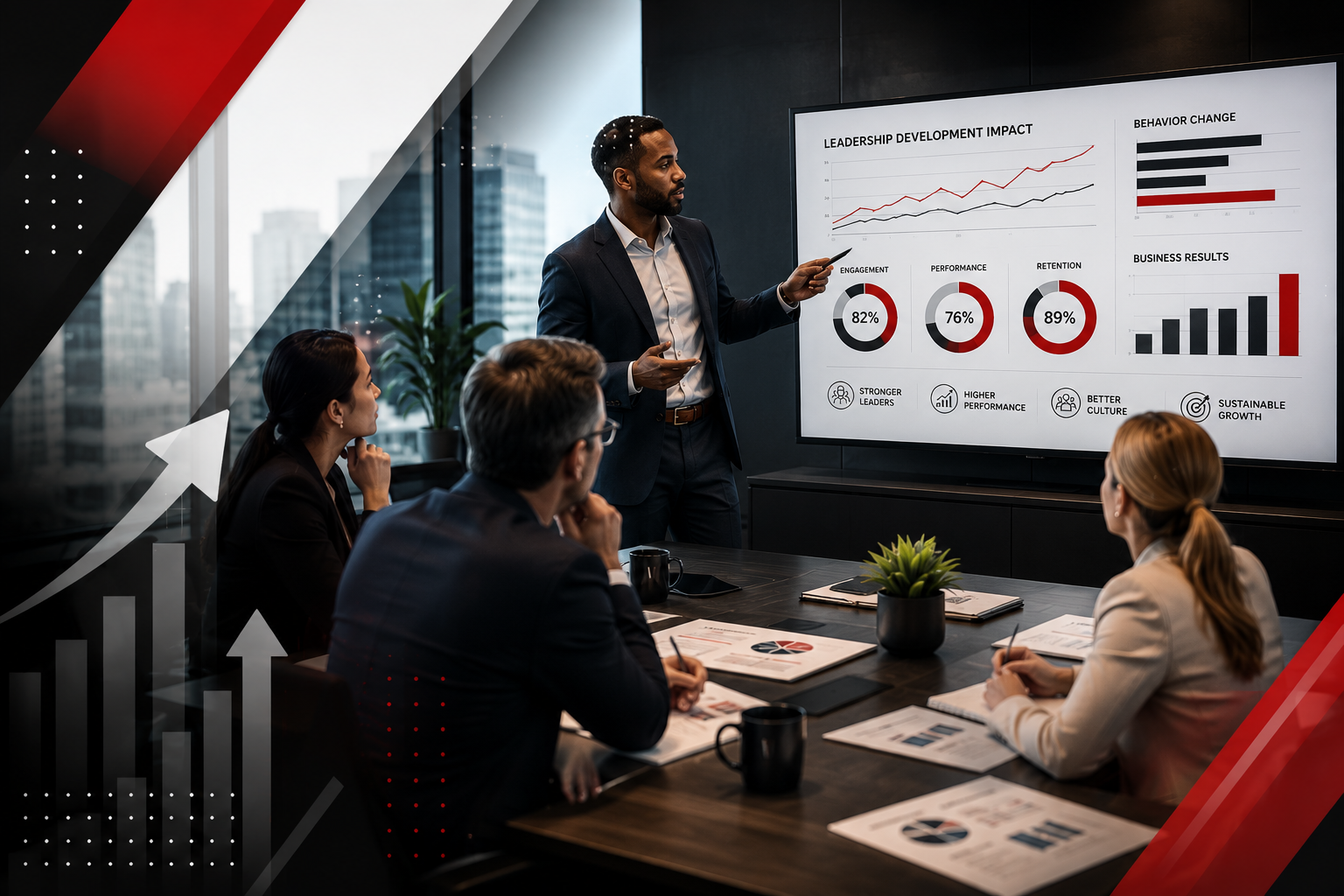
Leadership development should be evaluated like any other strategic investment. If you rely solely on participant satisfaction surveys, you are measuring the wrong thing. The extent to which development changes behavior—and behavior changes results—is what matters.
Behavior metrics track whether leaders are actually doing things differently. Are 1:1 meetings happening consistently? Are goals clear? Is feedback timely? Is meeting effectiveness improving? These are leading indicators that signal change is taking hold.
People metrics include engagement survey items related to trust in managers, clarity of expectations, and communication quality. Retention of key talent is a lagging indicator that often improves 6 to 12 months into a well-designed program.
Performance metrics connect leadership behavior to business outcomes: project delivery times, error rates, client satisfaction, and revenue or margin where appropriate. In one large-scale study, every dollar invested in leadership development generated an average of seven dollars in return, with gains attributed to better manager performance, retention savings, and revenue increases.
Pipeline metrics assess the strength of succession plans, bench depth for critical roles, and internal promotion rates versus external hires. In one case, a global enterprise used simulation-based assessments and saw "ready now" leaders double over one year, with overall cohort performance rising from 58% to 74%.
Qualitative data—leader and employee interviews, observation, anecdotal evidence—complements quantitative metrics to build a fuller picture. Any consultant who cannot articulate how they will help you measure impact may be offering training, not true leadership development.
What to Look For When Choosing a Leadership Development Consultant
The right partner should match your organization's stage of growth, your challenges, and your culture. Not every consultant fits every context, and the factors that matter most vary depending on your situation.
Look for previous experience with organizations of similar size and complexity. A consultant who has helped a company scale from 100 to 1,000 employees or has worked with multi-site healthcare systems brings relevant knowledge that a generalist may lack. Specialization in a niche area can help target consulting services more effectively.
Evaluate whether the consultant can connect leadership development to measurable outcomes—not just participant satisfaction. Ask for case examples with data from the last two to three years showing relevance to today's hybrid and fast-changing environment.
Assess facilitation presence and communication skills. The consultant needs to resonate with your leader population, whether that is frontline supervisors or senior executives. Interested parties should sit in on a sample session if possible.
Look for a practical, behavior-focused methodology. Proposals should describe realistic practice, tools, and follow-through mechanisms—not heavy theory. Willingness to customize programs to your culture, language, and strategic priorities is essential.
A clear stance on accountability matters: how will leaders be expected to show up, complete work between sessions, and support their teams? Programs without built-in accountability produce limited results.
A bachelor's degree is required to become a leadership consultant, and practical experience in leadership roles is essential for consultants who want credibility with senior stakeholders. Industry certifications can enhance a leadership consultant's qualifications, and an MBA can lead to senior leadership consulting positions. Ask about these credentials during your discovery calls.
Questions worth asking: How do you ensure skills transfer into daily leadership behavior? What metrics do you define up front? How do you build reinforcement into the program?
Leadership Development vs. Management Training: Why the Distinction Matters
Many organizations start with management training—a short course on policies, processes, and basic supervisory tasks like scheduling, compliance, and system usage. This has its place, but it is event-based and focused on knowledge transfer. Once the workshop ends, behavior change is left to chance.
Leadership development is a different commitment. It is built around mindsets and behaviors such as accountability, ethical decision-making, and effective communication that shape culture over time. Where management training teaches a person what to do, leadership development changes how they think, decide, and engage their team. The efficiency gains from development come not from a single education session but from sustained behavior shifts that compound over months.
A leadership development consultant typically partners with HR and operations to integrate both: ensuring managers know the basics and can also lead humans through real-world complexity. One common pattern is an organization that initially invested only in one-off manager training and then pivoted to a longer-term leadership development approach after seeing limited impact on turnover and engagement scores.
Great consultants provide additional information and ongoing resources beyond the initial curriculum—coaching, toolkits, peer groups, and reinforcement that keep development alive. The money spent on a standalone workshop rarely produces lasting change without these elements.
Getting Started: How to Prepare Your Organization for a Leadership Development Consultant
The effectiveness of any consultant is amplified when the organization does some groundwork before the engagement begins. You are not a passive recipient of training. You are an active partner in the process.
Clarify your top three to five leadership challenges and link them to specific business outcomes. Are you concerned about missed deadlines? Client churn? Safety incidents? Family-owned firms transitioning to professional management? Naming the problems gives the consultant a clear account of where to focus.
Gather existing data: engagement survey results, turnover trends, performance metrics, exit interview themes, and any prior leadership program feedback. This gives the consultant a head start in gathering information and avoids redundant discovery work.
Confirm senior leader sponsorship and expectations. Senior leaders need to model new behaviors and hold themselves accountable—not delegate development to HR and walk away. Without this, even the best initiatives stall.
Identify priority populations. Are you developing new managers, mid-level leaders, or high-potential talent? Be realistic about time commitment windows so participants can fully engage without sacrificing operational responsibilities.
Decide early how you will measure success and what time horizon makes sense—6, 12, or 18 months. Results vary depending on the scope and depth of the engagement.
Align your stakeholders on key terms. When your leadership team says "accountability," does everyone share the same sense of what that means? Agreeing on definitions—even referencing straightforward sources for clarity—reduces confusion later and strengthens the foundation for the consultant's work.
Next Step: Discuss a Leadership Development Engagement with Masterly Consulting Group
For growing organizations, investing in a leadership development consultant is often the difference between scaling chaos and scaling with intent. The programs, initiatives, and functions described in this article are not theoretical—they are implemented every day by consultants working with organizations across industries and growth stages.
Masterly Consulting Group specializes in partnering with organizations like yours to build leadership capability that delivers measurable business results. With deep experience in accountability, communication, and decision-making, our consultants tailor solutions to your unique challenges and culture.
If you are seeing the signals—gaps in accountability, communication breakdowns, succession concerns, or managers who were promoted before they were ready—contact Masterly Consulting Group for an exploratory conversation. We will help clarify your priorities and determine whether now is the right time to act.
Call us today at (972) 236-5051 or visit www.masterlygroup.com to schedule your consultation. Even a single conversation can sharpen your thinking about what your leadership bench needs to look like over the next three to five years. The goal is not just to solve today's problems but to build an organization where leadership strength compounds over time.