Strategic Planning Facilitator: How Leadership Teams Turn Priorities Into Action
Most leadership teams don’t lack ideas—they lack a structured process to turn those ideas into decisions and measurable progress. A strategic planning facilitator changes that equation entirely by guiding teams to clearer priorities and actionable plans.
Why a Strategic Planning Facilitator Matters Now
In early 2025, an executive team at a growing mid-sized company sat through their third quarterly retreat with the same vague priorities they had a year earlier. The energy was low, and nothing moved forward. Bringing in a strategic planning facilitator shifted the outcome within weeks: three clear strategic goals, named owners, and a review cadence that kept the team accountable.
A strategic planning facilitator is an external expert who designs and leads planning sessions so leaders can focus on insight, decisions, and commitment rather than managing the meeting. Facilitators help define an organization’s direction and allocate resources toward common goals. Effective strategic planning requires organizational alignment, which rarely happens without someone managing the process from the outside.
The core value is straightforward: better decisions, clearer priorities, and an implementable action plan aligning the team around 3–5 strategic goals for the next 2–3 years.
DIY strategy days vs. facilitated strategic planning:
- Vague outcomes vs. clear, ranked priorities
- Low follow-through vs. documented action plan with owners and timelines
- Dominated voices vs. balanced participation across the group
By the end of this article, you’ll know when to use a strategic planning facilitator, what to expect, and how to choose the right partner for your next leadership retreat or planning cycle.
What a Strategic Planning Facilitator Does
A strategic planning facilitator manages the process, structure, and dynamics of planning so your leadership team stays focused on strategy. Their role includes managing discussions, keeping the agenda and time on track, and resolving conflicts.
Core responsibilities:
- Scoping the engagement and diagnosing organizational context
- Designing agendas and processes for each session
- Pre-interviewing leaders and stakeholders to surface expectations and tensions
- Facilitating meetings with clarity and discipline
- Synthesizing input and documenting decisions to support implementation
- Supporting follow-up and accountability after the retreat
What a facilitator is not:
- Not a note-taker or recorder
- Not an all-knowing strategist dictating your plan
- Not a motivational speaker providing energy but no structure
Facilitators balance process and content, bringing proven frameworks while leaving ownership of strategic goals and trade-offs with the leadership team. They build ownership and commitment, ensuring the plan belongs to the leaders, not the consultant.
For example, in early 2026, a regional association facing membership decline used a facilitator for a 2-day retreat. Day one focused on environmental scanning and stakeholder data; day two on priority-setting, initiative design, and assigning owners. Within a week, a draft plan was before the board—a momentum that rarely happens by accident.
Strong facilitators design for decisions that can be measured and revisited over time, not just inspiring conversation.
When to Bring in a Facilitator
Not every planning conversation needs external help, but certain inflection points almost always do. Strategic planning can be challenging, and internal facilitation during high-stakes moments often results in recycled talk without resolution.
Critical scenarios to hire a facilitator:
- After mergers, acquisitions, or consolidations
- When a new CEO, superintendent, or executive director joins
- Ahead of launching a multi-year strategic plan (e.g., 2027–2030)
- Before major capital campaigns or fundraising cycles
- After rapid growth, contraction, or crisis
- When the external environment shifts sharply (technology, regulation, customer expectations)
- When prior plans ended with low implementation and drifting priorities
There’s an important distinction between annual operating planning and true multi-year strategic planning. Facilitators are most impactful for 3- or 5-year horizon decisions and “big, one-way-door” choices that are difficult to reverse.
Signs your current process isn’t working:
- Meetings recycle the same issues without resolution
- Unclear decision rights—no one knows who decided what
- Strategic goals are task lists without measurable outcomes
- Initiatives stall six months after the retreat
In 2024, one organization ran its leadership retreat internally with an overloaded agenda and no follow-up mechanism. In 2025, with a facilitator, they gained clarity, four focused priorities, assigned owners, and monthly reviews. By mid-2026, stalled initiatives were launched or dropped cleanly.
Assess your next 12–24 months. If these scenarios describe your future, a facilitated process can de-risk your decisions.
Inside a Facilitated Strategic Planning Process
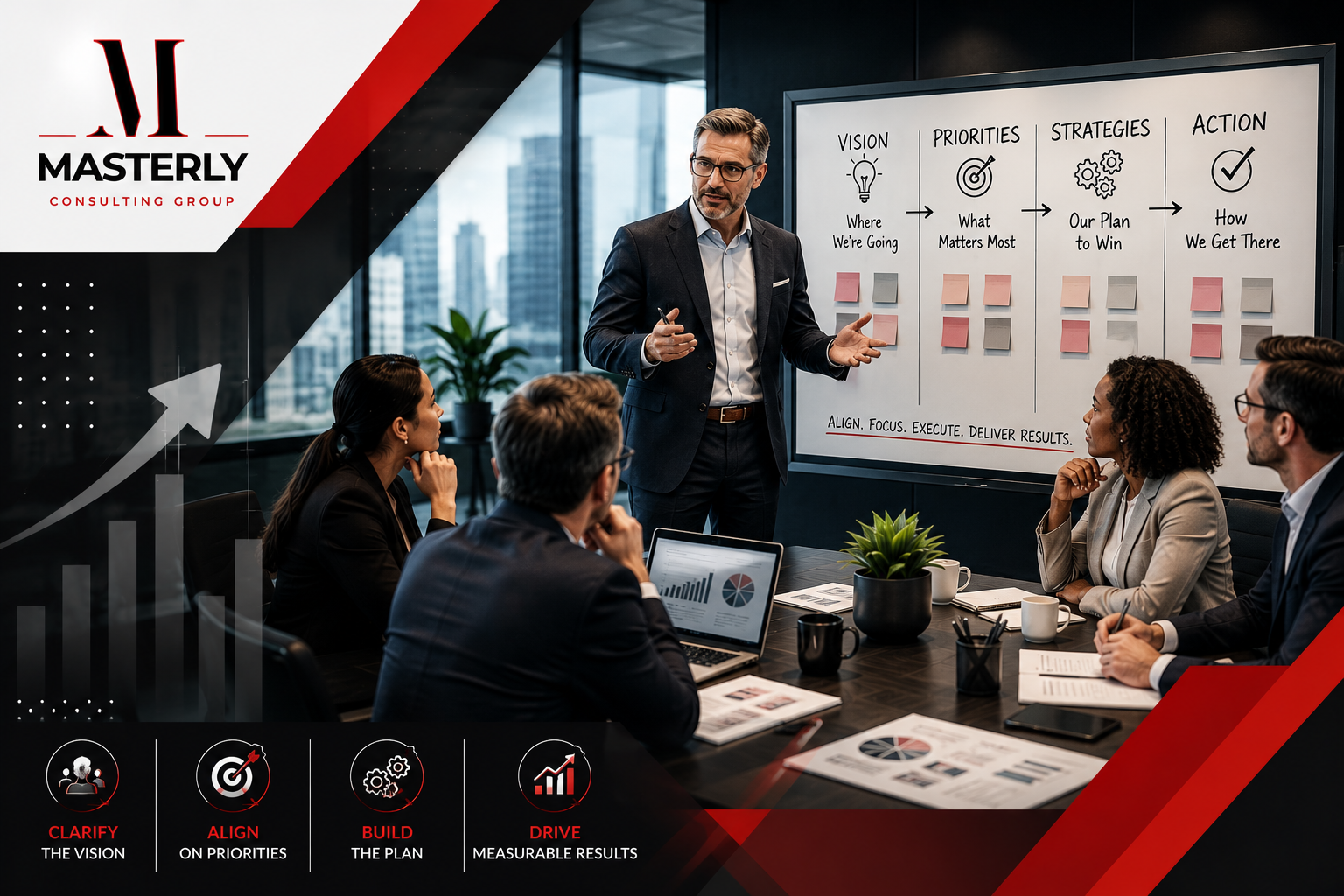
A skilled facilitator treats strategic planning as a structured, end-to-end process—not just a single retreat. The process includes preparation, vision and mission setting, strategy development, action planning, and follow-up. It is collaborative, evidence-based, and adaptable.
Typical phases:
- Discovery and scoping: Leadership interviews, stakeholder surveys, document reviews (financials 2021–2024, program data, engagement scores), and external environment scans
- Strategy workshops and retreats: Sessions to align on mission, clarify current state, and set 3–5 strategic priorities for 3 years. SWOT analysis is common here.
- Drafting and validation: Facilitator synthesizes input into a draft plan; leadership reviews and refines
- Final plan and rollout: Communication plan, resource alignment, integration into budgets and performance systems
- Follow-up: Quarterly reviews, dashboards, ongoing accountability
Pre-work is critical: leadership interviews to surface blind spots, stakeholder surveys to bring diverse voices, and external research on competitive and regulatory trends.
Example timeline:
Weeks 1–2: Scoping calls and data gathering
Weeks 3–4: Analysis and agenda design
Week 5: 2-day offsite retreat
Weeks 6–7: Draft review and board approval
Weeks 8–10: Rollout and communication
Quarterly check-ins start the next fiscal quarter
Though organizations differ—schools, associations, executive teams—the facilitation principles remain: clarity, participation, and executable decisions.
Designing an Effective Leadership Retreat
The leadership retreat is often the centerpiece of strategic planning. A skilled facilitator shapes it to do real strategy work, not just team building. Leadership retreats enhance team effectiveness, strategic alignment, and trust. They typically last 1–3 days and are held offsite.
The facilitator helps choose location (quiet, neutral venues), length, and participants—usually executive team members, senior leaders, and board representatives. Sometimes individual contributors with critical expertise join.
Key design elements:
- Mix plenary discussions, small group breakouts, and pair-share exercises
- Allocate time for reflection and personal growth
- Distribute pre-reading and data packs so participants arrive informed
- Use visual capture (whiteboards or digital canvases) to make ideas visible
- Encourage inclusive participation to ensure all voices are heard
Participants create solutions to achieve objectives only if the facilitator keeps focus on strategic questions, parking non-strategic topics, and applying decision frameworks for complex choices.
Sample mini-agenda:
- Day 1 morning: Review external trends, internal diagnostics, and mission alignment
- Day 1 afternoon: Generate strategic options, weigh trade-offs, begin prioritizing
- Day 2: Align on priorities, define initiatives, assign owners, plan communication and next steps
The best retreats end with clear commitments, documented next steps, and shared momentum—not just a group photo.
Decision-Making Frameworks Used by Facilitators
Big choices about priorities, trade-offs, and investments require structure. Facilitators select frameworks that scaffold discussion and evaluation without over-engineering.
Common frameworks:
- One-way vs. two-way doors: Distinguishes irreversible decisions from reversible ones, helping leaders act quickly on low-risk choices and deliberate on high-stakes ones
- Priority matrices: Score options on impact vs. feasibility or risk vs. return to visualize trade-offs
- Must/Should/Could filters: Categorize initiatives to focus resources on what matters most
- RACI (Responsible, Accountable, Consulted, Informed): Clarify responsibility and ownership for each initiative
Effective facilitators maintain neutrality, ensuring unbiased process management. Successful facilitation fosters honest discussion and diverse perspectives, leading to better strategic choices. The goal is not consensus at all costs but clear ownership, transparent rationale, and visible next steps.
For example, in 2025, a facilitator helped a leadership team weigh three growth paths—geographic expansion, product diversification, and digital investment—using a decision grid scored on impact, feasibility, risk, and mission alignment. The team eliminated one option and combined the other two into a focused strategy, preventing months of second-guessing.
These frameworks are used selectively for major, long-term decisions; minor operational choices don’t need complex matrices.
From Strategic Goals to a Concrete Action Plan
Strategic planning succeeds only when it translates into a practical action plan with owners, timelines, and measures. An action plan describes how organizational objectives will be met with clear, current steps.
Facilitators translate high-level strategies into actionable plans with assigned owners and timelines, turning broad ambitions into specific projects.
Action plans should be developed within six months to one year and include:
- 3–5 strategic priorities (major focus areas over multiple years)
- 2–4 specific initiatives under each priority
- Defined outcomes and metrics for each initiative
- Named owners with clear responsibility
- Start dates, milestones, and review cadences
- Required resources (budget, people, technology)
For example, a goal like “strengthen leadership pipeline” could yield initiatives such as launching a leadership development program, updating succession plans, investing in coaching, and creating stretch assignments.
The facilitator keeps the plan realistic and focused. While creating an exhaustive initiative list is easy, making trade-offs—what to start, stop, or defer—is where real value lies. A complete action plan has clear priorities, measurable outcomes, named owners, realistic resources, success metrics, and regular reviews for progress evaluation and adjustment.
Ensuring Accountability, Follow-Up, and Real Progress
Many leadership retreats fail afterward because accountability and follow-up are vague or optional. Successful efforts are 80% follow-through and 20% planning. An action plan is a work in progress and should be regularly revised as conditions shift.
A strategic planning facilitator helps establish clear tracking mechanisms: quarterly strategy reviews, dashboards visible to leadership, or named owners accountable for milestones.
Naming who decides, leads, and must be consulted reduces confusion and rework. When roles are clear, plans move forward instead of stalling.
Sample follow-up cadence:
- Monthly executive team check-ins starting January 2027
- Semiannual board updates tied to key metrics
- Annual strategic refresh or mid-year recalibration workshop
- Media or stakeholder communications aligned to milestones
Facilitators may stay involved after the initial engagement via virtual check-ins, CEO coaching, or mid-year workshops to discuss progress and changes.
The goal is a culture where strategic goals are living, revisited regularly—not shelved until the next cycle.
Choosing the Right Strategic Planning Facilitator
Facilitation is a relationship business. The right fit matters as much as methodology. Choose a facilitator who supports difficult conversations, challenges assumptions respectfully, and delivers usable plans—not binders that gather dust.
Selection criteria:
- Experience with your organization type (executive teams, associations, schools, growing companies)
- Comfort with your time horizon (3-year, 5-year, or both)
- Ability to facilitate honest disagreement respectfully
- Approach to data, customer research, and stakeholder input
- Clarity on deliverables (strategy map, detailed plan, slide deck, or all)
- Track record helping clients move from strategy to execution
- Willingness to stay involved for follow-up and accountability
Questions to ask:
- How do you structure a leadership retreat? Can you walk me through a recent engagement?
- How do you handle disagreement among leaders when priorities conflict?
- What does your follow-up and accountability approach look like?
- Can you share anonymized examples of strategic or action plans you’ve produced?
Look for plans with clear metrics, named owners, realistic resourcing, and review cadences. Avoid jargon-filled plans with impossible objectives.
Consider cultural fit. Will your leaders speak candidly? Will the facilitator respect your values and constraints? A short discovery call (30–45 minutes) can reveal alignment on expectations, style, and outcomes.
Next Steps: Partner with Masterly Consulting Group for Strategic Planning Success
If your leadership team, association, school district, or company is preparing for a strategic planning cycle or leadership retreat in 2025–2027, now is the time to engage a trusted partner who delivers clarity, alignment, and actionable results.
Masterly Consulting Group specializes in strategic planning facilitation tailored to your organization’s unique context and goals. With extensive experience guiding executive teams through complex decisions, Masterly Consulting Group ensures your plan is not just a document but a living roadmap to success.
Schedule a Strategic Planning Conversation with Masterly Consulting Group today. Expect a 30–45 minute virtual meeting to discuss your context, objectives, and timing. This is a working conversation about your organization’s future—not a sales pitch.
Visit www.masterlygroup.com or call (972) 236-5051 to start the conversation and turn your leadership team’s priorities into decisive, aligned action. Partner with Masterly Consulting Group and experience strategy done well.