Business Growth Consultant: Turning Strategy Gaps Into an Actionable Operating Plan
Most established companies don't lack ideas. They lack a reliable system for turning those ideas into coordinated action across departments, quarters, and teams. That's exactly the gap a business growth consultant is built to close.

Executive summary: What a business growth consultant actually does
A business growth consultant is a senior external expert who sits at the intersection of strategy and operations. Business growth consulting is focused on improving sales and marketing effectiveness, but the scope goes further: consultants typically take a holistic view of the business, diagnosing constraints across functions and designing plans that leadership can actually execute. They help organizations identify opportunities for sustainable growth and help companies expand revenue and increase profitability.
Think of the role as a hybrid of business strategy consultant and operations consultant. Instead of producing a slide deck and walking away, a growth consultant translates high-level direction into an execution roadmap with accountable owners, clear priorities, and defined milestones. The focus is on aligning business growth plans, leadership alignment, process improvement, and operating rhythms so your team knows what to do next quarter, next month, and next week.
Typical results include clearer priorities, faster decision cycles, fewer dropped balls, and better cross-functional coordination. This is not one-off coaching, generic management consulting, or pure financial advisory. It's ongoing, coordinated growth support designed for companies that need structure as much as they need strategy.
At Masterly Group, our business growth consultants help you close the gap between strategy meetings and on-the-ground execution.
When should you hire a business growth consultant?
Not every company needs outside help. But there are specific trigger moments when established businesses benefit most from bringing in expertise. Here's a practical checklist.
Common triggers:
- Revenue has plateaued for one to two years despite continued investment in marketing or hiring
- Post-acquisition integration has outpaced your internal systems and created coordination problems
- Rapid scaling introduced chaos into day to day operations, and quality is slipping
- You're entering new markets or planning expansion decisions for 2026 and beyond
Symptoms that signal misalignment:
- Constant firefighting despite strong sales
- Conflicting priorities between sales, business operations, and finance
- Leaders setting business goals that never get fully implemented
- Delayed projects because resources required were never clarified
- Customer experience declining as the company scales
Research shows 94% of employer firms reported financial challenges in the prior year, and many of those challenges stem from poor coordination rather than poor demand.
Consultants provide specialized expertise to avoid costly trial-and-error methods. They can also assist companies in planning market expansion strategies when the stakes are highest.
A growth consultant is best suited once a company has a stable core offering and recurring revenue-not when it's still searching for product-market fit.
Example: Imagine a 70-person manufacturing firm expanding its supply chain footprint to a second distribution center. Sales are growing, but operations can't reliably fulfill orders, inventory planning is poor, and leadership hasn't clarified who owns sequencing. A growth consultant's diagnostic and roadmap could align departments and fix the bottlenecks.
Let's look at how a consultant structures that plan.

How a business growth consultant builds a practical business growth plan
A business growth plan outlines goals and growth tactics-but unlike a generic template, a consultant's plan is built for execution. It starts with an executive summary and cascades into clear objectives, initiatives, and operating changes. A growth plan helps clarify where the business is headed, and more importantly, how you'll get there.
Core components:
- Executive summary tailored for busy owners, investors, and stakeholders
- Customer, market, and capability analysis rooted in current data, including market research and competitive analysis
- Growth objectives with timeframes and accountable owners, ideally structured using the SMART goals framework, which is ideal for business growth plans
- Strategies, processes, and process improvement priorities
- Resources required and funding implications
- Risk factors, milestones, and review cadence-because a growth plan should include a clear timeline for achieving objectives
The consultant often repurposes this plan for both internal alignment and external stakeholders (lenders, partners, board members), ensuring language is accessible beyond the leadership team. Masterly Group's consultants emphasize keeping the document under control-a tight 15–25 page core plan plus appendices-so it's actually read and used.
This is fundamentally different from a traditional business plan created at startup. While 20% of new businesses fail within their first year due to poor planning, the growth plan is not about launching something new. It's about scaling, sequencing, and executing with discipline inside an established company.
Strategy to execution: Connecting top-down goals with bottom-up reality
Strategies are set in Q1 but forgotten by Q3 because the "how" and "why" are never clearly connected. One role of a business growth consultant is to conduct performance diagnostics that bridge this gap.
The top-down layer:
- The leadership team sets a small number (5–10) of strategic objectives
- These are framed as outcomes-"Improve on-time delivery from our supply chain"-rather than vague aspirations like "be more efficient"
- The consultant helps clarify what success looks like in specific, measurable terms
The bottom-up layer:
- Managers and front-line employees surface current constraints and recurring problems
- Real-world insights inform which initiatives are feasible within the next 12–24 months
- This prevents leadership from over-committing or setting unrealistic timelines
The iterative process:
- Asking "How will we achieve this objective?" repeatedly to identify performance drivers
- Asking "Why are we doing this activity?" to connect daily work back to strategic objectives
- Documenting these links in a simple, visual execution roadmap or strategy-execution matrix
Consultants implement measurable systems to track progress toward goals, and they often conduct market research and competitive analysis to inform priorities. Masterly Group consultants facilitate sessions that combine both views in the same room, avoiding strategy designed in isolation from operations.
The positive impact: greater ownership, fewer duplicate projects, and clearer justification for each major initiative moving forward.
Leadership alignment: Getting your senior team on the same page
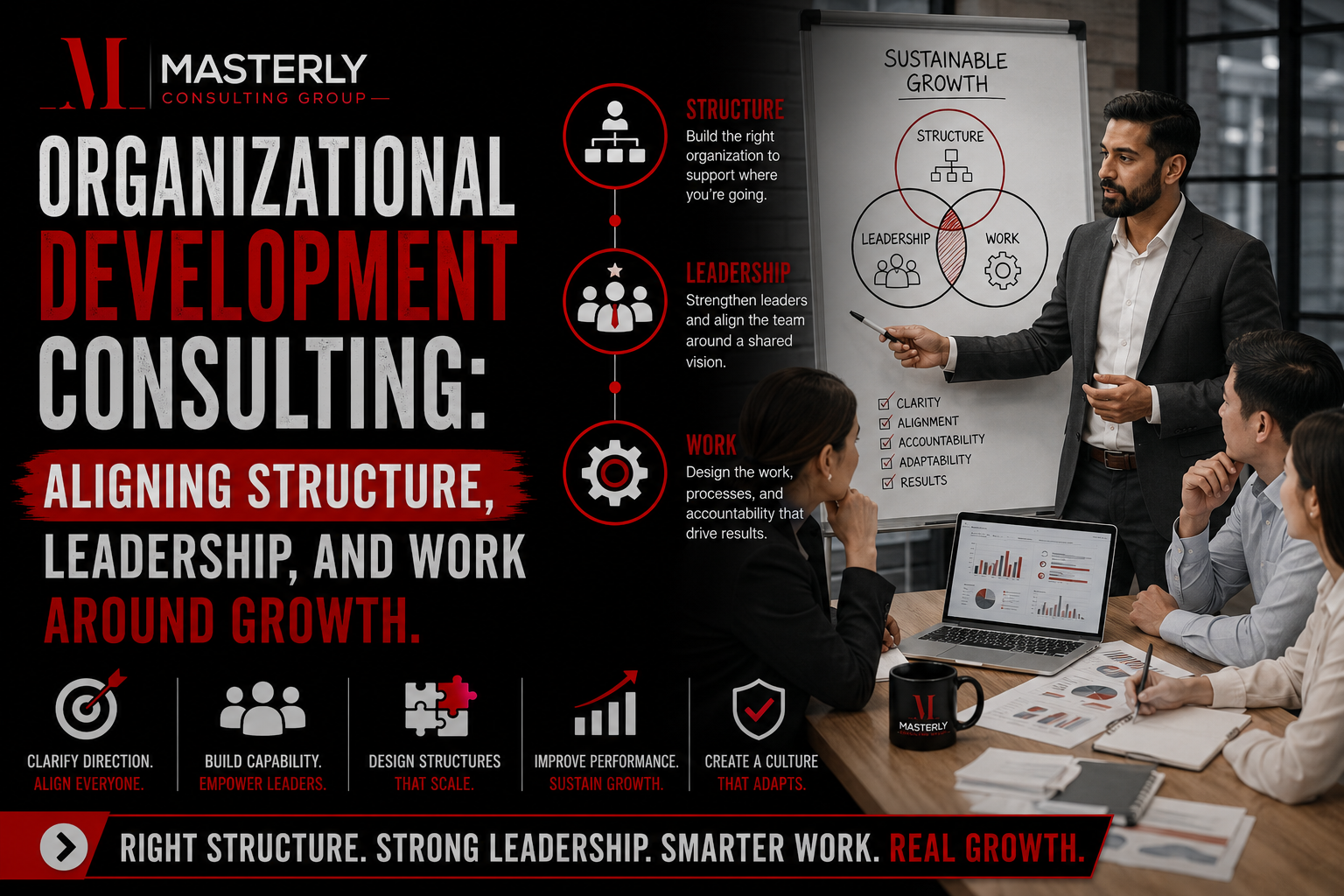
Leadership alignment is the invisible operating system that either accelerates or quietly blocks growth. Leadership alignment creates a consistent organizational culture, while misaligned leadership can create employee resentment and unfairness. Getting leaders on the same page is critical to every other initiative in the plan.
What misalignment looks like in practice:
- Different leaders rewarding conflicting behaviors
- Competing priorities for the same team or budget
- Mixed messages about which metrics matter this quarter
- Tension between "sell more" and "protect margins" with no agreed trade-offs
How a business growth consultant structures alignment:
- Facilitated management offsites or half-day sessions designed around intentional discussions among leaders, which improve leadership alignment
- Shared articulation of leadership principles and decision rules documented on one page
- Agreement on 3–5 company-wide priorities and objectives for the next 12 months
- Monthly leadership review meetings with consistent agendas and accountability standards
Alignment is not about identical leadership styles. It's about consistent expectations, escalation paths, and transparency. Leadership alignment requires ongoing effort and intentionality-it isn't a one-time event.
The downstream results for employees are significant. Effective leadership alignment enhances team performance and morale. Staff see fewer reversals of decisions, clearer career paths and new roles, and a more predictable culture that supports retention and development across industries.
Process improvement and operations: Turning growth bottlenecks into capacity
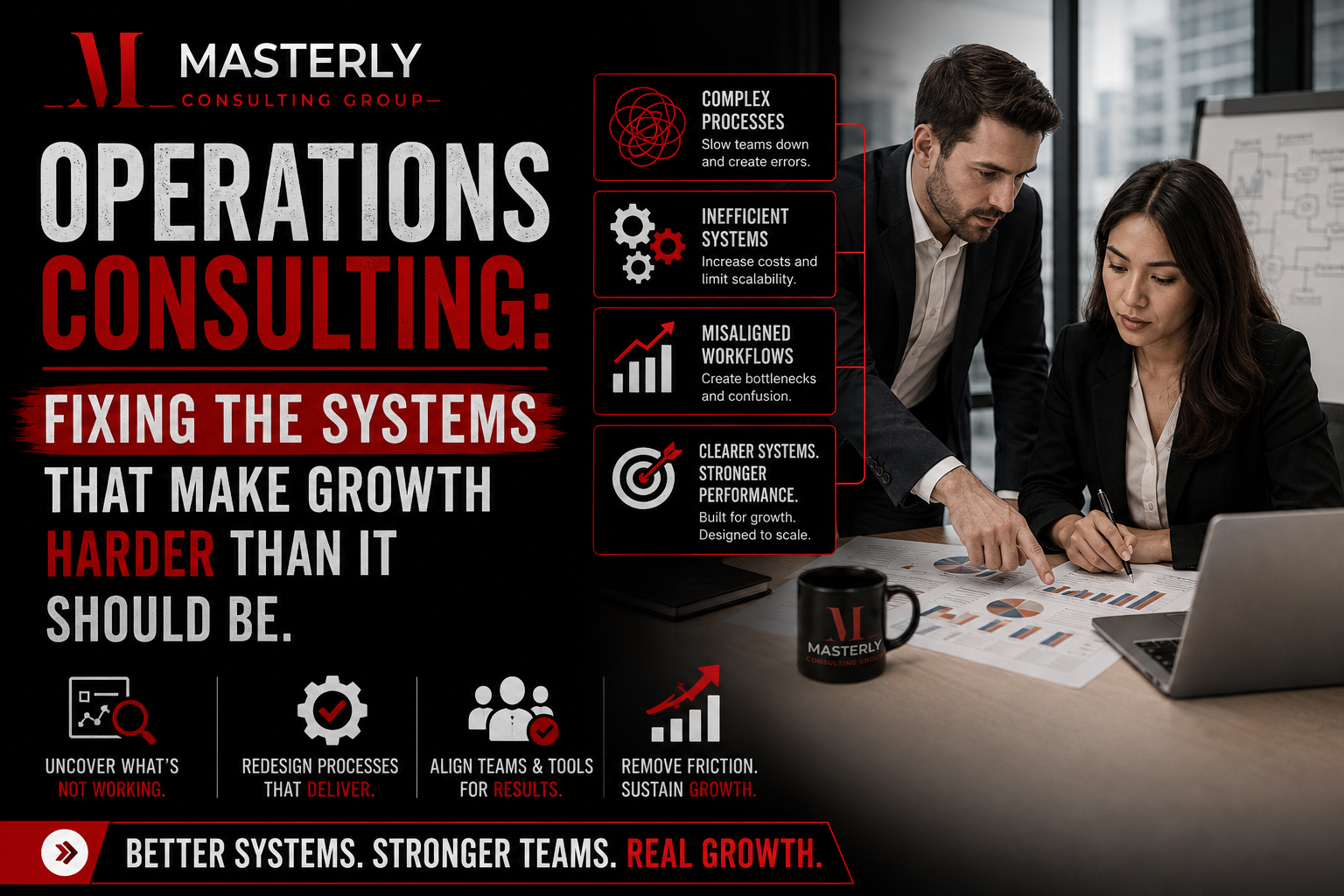
Many growth problems are actually process problems: lead times, rework, handoff delays, or unclear ownership. Strategies used by business growth consultants include process optimization and customer retention programs, integrated directly into the growth plan rather than as isolated improvement projects.
Consultants provide an objective, data-driven perspective to diagnose bottlenecks. They identify internal bottlenecks that may not be visible to company leadership and improve operational efficiency by streamlining workflows and reducing inefficiencies.
Typical steps:
- Identify the few core processes that most affect customer experience, cash flow, or margin (e.g., order-to-cash, lead-to-close, new-hire onboarding and training)
- Process mapping creates detailed flowcharts of current processes, including steps, new roles, systems, and where work is re-entered or stalled
- Use basic data (cycle time, error rates, queue length) to find bottlenecks
- Co-design improvements with the affected teams, not imposed from outside
Key methodologies consultants draw from:
- Lean methodology focuses on maximizing customer value while minimizing waste
- Six Sigma aims for no more than 3.4 defects per million opportunities
- The PDCA cycle fosters ongoing enhancements in quality and efficiency
- Business Process Reengineering seeks dramatic improvements in performance measures
- Continuous monitoring tracks key performance indicators for process effectiveness
Example: A B2B company restructured its quote-to-invoice process with standardized templates, clearer approval thresholds, and better CRM usage. These small fixes unlocked working capital and shortened the cash conversion cycle. In supply chain contexts, streamlining purchasing approvals, vendor onboarding, or inventory planning can support growth without stockouts or over-buying.
Real-world results demonstrate what's possible. A regional distribution company improved warehouse productivity by 32% and reduced fulfillment time by 28% in just 12 weeks. A global food processor increased monthly revenue run rate by $2.7 million after fixing order fulfillment and inventory accuracy over six months.
Masterly Group's consultants focus on practical changes that can be tested within 30–90 days, then scaled if they work-delivering high quality products and service while maintaining momentum through innovation and automation where appropriate.

Structuring the execution roadmap: Priorities, initiatives, and cadence
The execution roadmap is the bridge from "plan on paper" to "what happens in the next 12 months." Without it, even the best strategy stays abstract. This is where project management discipline meets growth planning.
What the roadmap contains:
- 3–5 company-level priorities tied to strategic objectives
- A handful of named initiatives under each priority with clear owners
- Quarterly milestones, not just annual targets
- Dependencies and key risks for each initiative
How a business growth consultant builds it:
- Facilitated workshops to sequence projects and avoid overload
- Clear definition of resources required for each initiative-people, time, technology, systems, and capital
- Alignment with the organization's existing planning and budgeting cycles
The importance of cadence:
- Monthly performance reviews focusing on progress, obstacles, and decisions
- Quarterly strategy check-ins to adjust priorities based on new data and insights
- Lightweight dashboards or scorecards focused on a small set of metrics that create accountability without confusion
Masterly Group emphasizes simplicity: a roadmap that fits on one or two pages so companies can carry it into every planning conversation. The goal is to develop a living document, not a binder that gathers dust. Knowledge of the plan should extend beyond the leadership team to the talent and teams doing the work, so everyone understands the direction and can effectively contribute to the transformation.

Measuring positive impact: Metrics that matter for growth consulting
Measurement is central to any engagement. It proves whether the consulting work is creating a positive impact beyond anecdotes, and it's the foundation for every decision about what to do next. Measuring performance metrics is essential for tracking business growth.
Categories of metrics a consultant will help define:
- Growth and commercial outcomes: revenue growth rate, new customer wins, lifetime value trends
- Operational health: cycle times, error rates, capacity utilization, on-time delivery
- Organizational alignment: engagement scores, leadership meeting attendance, project completion rates
- Financial resilience: cash conversion cycle, contribution margin by segment, costs per acquisition
Each objective should have one to three clearly defined indicators. Leading indicators (e.g., qualified pipeline volume) are tracked alongside lagging indicators (e.g., quarterly revenue) so you can begin adjusting before results lag.
Masterly Group encourages clients to start with existing data sources-ERP, CRM, HR systems-rather than building elaborate new tools. The consultant's role includes helping leadership interpret the data, make trade-offs, and avoid metric overload that confuses teams. Measurement is not only for reporting; it's a feedback loop that informs the next round of process improvement and resource allocation, helping your business achieve its full potential and succeed in a competitive world.
How to choose the right business growth consultant for your company
Not all consultants are the same. Choosing the right partner means evaluating fit across several dimensions-not just credentials.
Key evaluation criteria:
- Experience with companies of your size and industry complexity
- Ability to work across strategy, operations, and people systems-not just one discipline
- Clear methodology for building business growth plans and execution roadmaps
- Willingness to engage with your leadership team, not only the CEO
- Focus on capacity building so your team can sustain improvements and join in the work after the engagement ends, creating lasting value and skills within the structure of your organization
Questions to ask in an initial consultation:
- "How do you connect strategic goals to day to day operations?"
- "What does a typical 90-day engagement look like for a company our size?"
- "How do you help us clarify resources required before we commit to new initiatives?"
- "How will we know if the work is having a positive impact?"
Masterly Group positions its service as collaborative, system-oriented, and designed for established businesses-not new businesses still searching for product-market fit. Our consultants work alongside your relationships, your clients, and your market sense to build something that lasts.
The first step is understanding where your strategy gaps live.
Request a business growth strategy consultation to review your current plans, leadership alignment, and operating bottlenecks with the Masterly Group team.

Frequently asked questions
What's the difference between a business growth consultant and a business coach? A coach focuses primarily on individual leadership development and mindset. A business growth consultant diagnoses issues across the entire organization-strategy, operations, processes, and people-and helps implement coordinated changes.
How long does a typical engagement last? Assessment-focused engagements often run 6–10 weeks. Advisory work that includes implementation, governance, and operating model design typically spans 3–6 months. Larger transformations may extend to 12 months.
Is my company too small for growth consulting? If you have a stable core offering, recurring revenue, and at least a small leadership team, you're likely ready. Growth consulting is most effective after product-market fit is established-not before.
How do I measure whether the consulting engagement is working? Track a small set of agreed-upon metrics tied to your key principles and strategic objectives. Both leading and lagging indicators should show movement within the first 90 days.