RACI Chart: Clarifying Who Owns, Approves, Supports, and Needs to Know
Work slows down when several people are involved but no one knows who truly owns the result.
A project may have a large team, regular meetings, and detailed plans, yet key decisions still remain unresolved. Employees may complete the same task twice, wait for approvals that never arrive, or assume someone else is responsible. Leaders may become involved too late because no one knew when to consult or inform them.
A professionally developed RACI chart helps growing organizations clarify these working relationships. It defines who is responsible for completing the work, who is accountable for the final result, who should be consulted, and who needs to stay informed.
The chart itself is only one part of the solution. Lasting role clarity requires leadership agreement about decision ownership, team accountability, and project governance. Masterly Consulting Group helps founders, executive teams, project leaders, and operations teams create operating structures that support timely decisions and reliable execution.
Unclear Ownership Creates More Than Project Delays
Ownership problems often appear as missed deadlines, repeated meetings, incomplete tasks, or delayed approvals. The deeper cost can be much greater.
When employees do not know who owns a decision, they may escalate routine questions to senior leaders. Executives then become a bottleneck because too many matters require their attention. At the same time, important decisions may be made without leadership input because the team did not know when consultation was required.
Unclear ownership can also create tension between departments. One team may believe it provided everything required, while another believes the work was incomplete.
Employees may feel blamed for decisions they did not control. Managers may be held accountable for results without having the authority to direct the process.
As these problems repeat, trust can decline. Employees may become less willing to take initiative because they fear crossing an invisible boundary. Leaders may begin assigning more approvals and check-ins, which can make the process even slower.
A RACI chart gives the organization a structured way to address these concerns before they become accepted parts of the culture.
What a RACI Chart and Responsibility Assignment Matrix Clarify
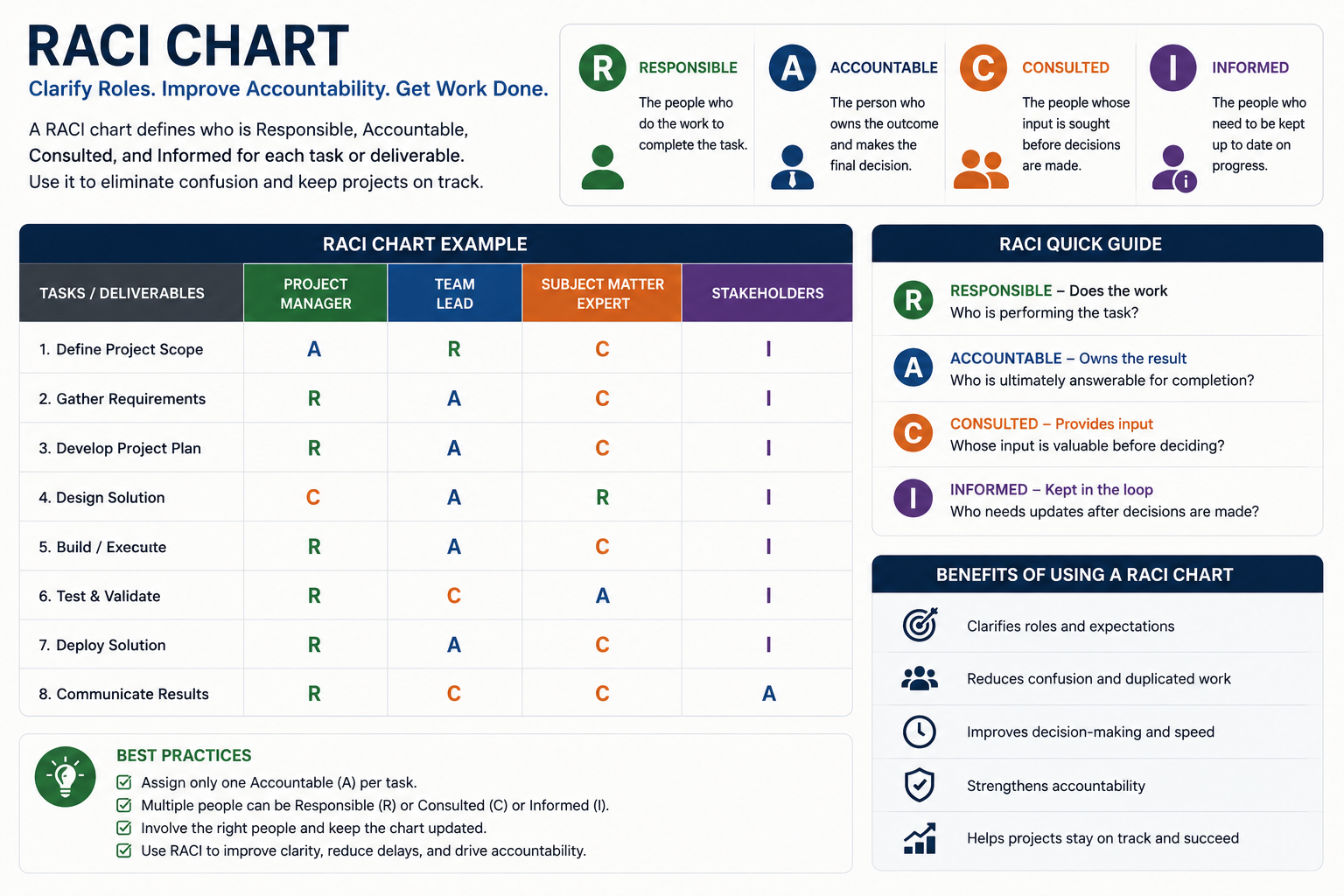
A RACI chart is a project management tool and RACI matrix that connects important tasks or decisions with the roles required to move them forward. RACI stands for the four components: responsible, accountable, consulted, informed.
The responsible person or group completes the work. There may be more than one responsible party when several people must contribute.
The accountable person owns the final result and confirms that the work meets expectations. Strong accountability usually requires one clearly identified owner, with each item assigned to exactly one accountable owner.
Consulted parties provide expertise or input before the work or decision is completed. Communication with these individuals is typically two-way.
Informed parties receive updates about progress, decisions, or outcomes. They need awareness but do not need to participate in every discussion.
These distinctions help teams understand that involvement does not always mean ownership. A senior leader may need to be informed without approving every step. Subject Matter Experts may need to be consulted without becoming responsible for the full project. A project manager may coordinate the work while another executive remains accountable for the result.
Masterly Consulting Group helps organizations define these distinctions in language that fits their real operating environment.
Roles and Responsibilities Clarity Must Match the Actual Work
A RACI chart can look organized while still failing to reflect how the organization operates.
This happens when titles are assigned without examining the real workflow. A department head may appear accountable on paper even though another leader controls the budget, information, or final approval. An employee may be marked responsible but lack the authority or resources needed to complete the task.
Effective role clarity requires more than filling cells in a table. Leadership must examine how work currently moves, where decisions stop, and which roles have the knowledge and authority to act.
The chart should address meaningful tasks, decisions, and handoffs. If it remains too broad, people may interpret each category differently. If it becomes too detailed, the chart may be difficult to use and maintain.
The goal is a practical structure that teams can apply during daily work.
Masterly Consulting Group reviews the responsibilities behind the titles. This helps ensure the completed chart reflects the company’s operations rather than an ideal structure that does not exist.
Decision Ownership Prevents Approval Bottlenecks
One of the most important purposes of a RACI chart is to clarify decision ownership.
Growing organizations often depend heavily on founders or senior executives. This may work while the company is small, but it becomes difficult as the number of employees, clients, projects, and departments increases.
When every decision returns to the founder, work slows down. Managers may avoid taking action because they are unsure which decisions they can make. Employees may send routine questions through several leadership levels. The founder remains involved in small details while strategic responsibilities receive less attention.
The opposite problem can also occur. Several leaders may believe they have authority over the same decision. Teams then receive conflicting instructions, and employees must decide which leader to follow.
Clear decision ownership defines who can make the decision, who provides input, and who must receive the final information. When authority is disputed, it should also be clear who has the final call. It also identifies decisions that should remain with senior leadership because of financial, legal, strategic, or reputational importance, including cases where input from the legal team is required.
Masterly Consulting Group helps leadership teams define these boundaries so authority can move to the right level without removing appropriate oversight.
Team Accountability Requires Authority and Resources
Organizations often ask for greater team accountability, but accountability cannot succeed when ownership is unclear.
A person marked accountable should understand the expected result and have enough authority to guide the work. The organization should also provide access to the people, information, time, and systems needed to deliver that result.
Without those conditions, accountability becomes a label rather than a workable responsibility.
For example, a manager may be accountable for a project deadline but unable to secure required input from another department. A marketing leader may own campaign performance but have no control over the sales follow-up process. An operations leader may be responsible for service quality while policies are set elsewhere.
A professional RACI review can reveal these gaps. Leadership can then determine whether authority, resources, or expectations need to change.
This creates a stronger foundation for performance conversations. Leaders can evaluate results based on responsibilities that were clearly assigned and reasonably supported.
Project Management Governance Becomes More Important as Teams Grow
Project governance defines how a project is directed, approved, monitored, and escalated within broader project management. A RACI chart can support that structure by clarifying the roles involved in key activities and decisions.
Without clear governance, a project may have many participants but no reliable path for resolving issues. Meetings become the default place for every decision. Minor questions wait until the next group discussion. Major concerns may remain hidden because employees do not know who should receive them.
RACI charts are also widely referenced in PMBOK, IPMA, and Project Management Institute guidance as a practical way to define responsibility and accountability.
A clear governance structure can show who approves scope changes, who manages the schedule, who controls the budget, who reviews quality, and who handles stakeholder communication to support effective stakeholder engagement.
It can also define escalation. Teams should know what they can resolve directly and what must move to a manager or executive. Even so, the chart should be revisited because it does not fully account for project dynamics as work changes.
Masterly Consulting Group helps organizations connect the RACI chart with broader project and operating practices. This prevents the chart from becoming a separate document that employees rarely use.
Common Signs That a RACI Review Is Needed
Organizations may benefit from a professional RACI review when they experience repeated confusion about ownership or approval.
Common warning signs include:
- Several people believe they own the same decision, which points to overlapping responsibilities
- No one accepts responsibility for a missed result
- Employees wait too long for routine approvals
- Too many Rs can signal that one person is overloaded with responsibility
- Too many Cs can slow input and create conflicting advice
- Senior leaders are involved in too many operational details, often because roles and responsibilities are poorly defined
- Projects regularly stall between departments
- Teams repeat work because responsibilities overlap
- Managers receive conflicting instructions
- Stakeholders are surprised by decisions because informed stakeholders were not kept updated
- Meetings are used to resolve basic ownership questions
- Employees are held accountable without proper authority
- A review can identify issues at the task level before they spread
These issues may affect one project or appear throughout the organization. When the pattern is widespread, the company may need a broader operating-structure review rather than a chart for one team.
Masterly Consulting Group helps determine the right scope based on where confusion appears and how it affects performance.
Why Generic RACI Templates Often Fall Short
A general template can show the basic format of a RACI chart, also called a responsibility assignment matrix, but it cannot decide how authority should work inside a specific company.
Every organization has different services, departments, leadership roles, risks, and approval requirements. The same title may carry different authority in two companies. A responsible assignment that works for one team may create a bottleneck for another.
Internal politics can also affect the process. Leaders may hesitate to give up approval authority. Departments may protect existing responsibilities. Employees may assume that accountability brings greater risk without additional support.
These issues require discussion and leadership judgment. The organization must decide how it wants work and decisions to move, not simply document confusion around specific tasks that already exists.
Teams should also avoid over-reliance on the chart alone, since judgment and discussion are still required.
An outside consultant can provide structure and neutrality during these conversations. Masterly Consulting Group helps teams surface different assumptions, evaluate operational needs, and reach clear agreements.
A RACI Chart Should Become Part of Daily Operations
A completed chart has limited value if it is saved in a folder and forgotten.
The assignments should be communicated to everyone affected. Managers should communicate roles so the entire team has clear expectations. They should use the chart during project planning, delegation, decision-making, status updates, project reviews, and performance discussions to create clarity in daily operations. New employees and new team members should learn how their roles connect with the broader workflow, which supports faster onboarding through a clear understanding of responsibilities.
The chart also needs to remain current. Changes should be documented so the completed matrix stays clear and current. Responsibilities may change when the company hires new leaders, reorganizes departments, introduces technology, changes services, or expands into new markets.
A regular review helps confirm that the chart still reflects actual work. It also gives leadership an opportunity to address new bottlenecks before they become recurring problems.
Masterly Consulting Group can help clients connect the RACI structure with role descriptions, meeting practices, approval paths, project plans, and accountability systems.
Done-for-You RACI Chart Support From Masterly Consulting Group
Masterly Consulting Group provides done-for-you support as a RACI framework and project management process support offering for organizations that need clearer ownership across projects, departments, and leadership teams.
Our work may include supporting project initiation and information gathering, identifying key decisions and each project task, interviewing stakeholders and team members, documenting ownership conflicts, and developing a practical RACI chart.
We can also help leadership define decision rights, approval authority, consultation requirements, communication expectations, and escalation paths within the project plan and project scope. When the issue extends beyond one project, we can review the broader operating structure and identify where roles or governance need clarification.
The engagement is built around the organization’s actual needs. A project team may need a focused RACI chart for one major initiative or a raci matrix example to guide implementation. A growing company may need a wider review for larger projects and complex projects across marketing, sales, operations, finance, and leadership.
Our goal is to create a structure that employees can understand and leaders can support.
Frequently Asked Questions About a RACI Chart
What is a RACI chart?
A RACI chart assigns responsible, accountable, consulted, and informed roles and responsibilities to important tasks, decisions, or deliverables.
What does responsible mean in a RACI chart?
Responsible identifies the person or group completing the work. It is assigned at the task level for each project task. More than one person may contribute, but their duties should remain clear.
What does accountable mean?
Accountable identifies the person who owns the final result or decision, so defining accountable roles clearly helps ensure proper oversight and communication. There should usually be one clear accountable owner for each item.
What is the difference between consulted and informed?
Consulted parties provide input before a decision or task is completed. Informed parties receive updates in a timely manner but do not need to participate in the decision.
Can a RACI chart improve role clarity?
Yes. Key benefits include helping teams define roles and create clarity around ownership, approval authority, consultation needs, and communication expectations when it reflects the real workflow.
Does every project need a RACI chart?
Not every small task requires one. A RACI chart is most useful when several roles, departments, approvals, or stakeholders are involved. In smaller teams, one person may be both Responsible and Accountable, but ownership should still stay clear.
Can a RACI chart solve every accountability problem?
No. The organization must also provide authority, resources, communication, and leadership support, and the chart works best when paired with effective leadership rather than treated as a complete solution by itself. The chart helps define the structure for those responsibilities.
Can Masterly Consulting Group review an existing RACI chart?
Yes. We can assess whether the existing assignments reflect actual work, confirm whether the completed matrix matches how the team actually operates, identify gaps or overlapping duties, and help leadership create a more practical structure.
Discuss an Operating-Structure Review When Ownership Remains Unclear Across Teams
Masterly Consulting Group can develop a professional RACI chart and RACI matrix as a project management tool that strengthens role clarity, decision ownership, project governance, team accountability, and project performance, while supporting the wider project management body.
Call (972) 236-5051 or visit Masterly Consulting Group to discuss an operating-structure review.