Span of Control: Knowing When a Manager Has Too Many Direct Reports to Lead Well
A growing team can create new opportunities for a business, but it can also place more responsibility on managers than they can reasonably handle.
A manager who once supported four employees may suddenly have ten or fifteen direct reports. Meetings fill the calendar. Approvals take longer. Employees receive less feedback. Important decisions move slowly because too many questions depend on one person.
These problems are not always signs of poor management. They may show that the organization’s span of control no longer matches the work.
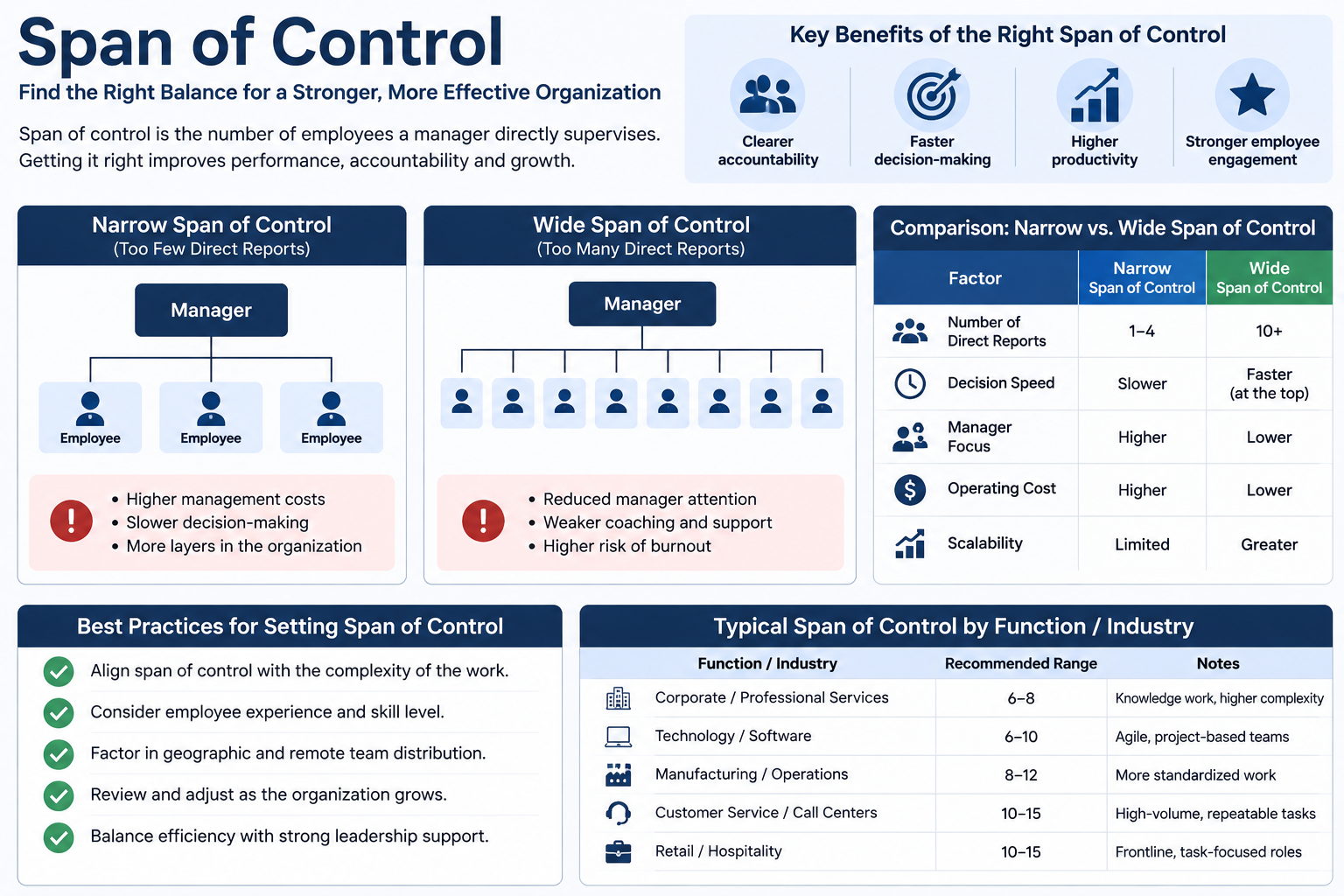
Span of control describes the number of employees who report directly to one manager. The right number depends on the complexity of the work, employee experience, decision requirements, operating systems, and the support available to the manager.
Masterly Consulting Group provides business consulting for organizations that need to redesign reporting lines, management layers, and team responsibilities during growth. We help leaders examine manager capacity and create a team structure that supports accountability, communication, and timely decisions.
When Growth Quietly Overloads Managers
Manager overload often develops slowly.
The company adds employees as demand increases, but it does not reconsider how those employees are organized. New team members are assigned to the manager who already understands the work. The arrangement appears efficient because it avoids creating another leadership role.
Over time, the manager’s responsibilities continue to expand. The person may be expected to supervise employees, approve work, manage clients, solve operating problems, attend leadership meetings, and complete individual assignments.
The team may still produce results, but warning signs begin to appear.
Employees wait longer for answers. Performance discussions are delayed. Small problems receive attention only after they become urgent. Experienced employees feel they lack authority, while newer employees struggle to receive enough support. The manager works longer hours but remains behind.
Adding more direct reports may appear less expensive than creating another management role. However, the hidden costs can include slow decision making, uneven performance, preventable turnover, and reduced service quality.
A professional span of control review helps leadership determine whether the current structure still supports the company’s needs.
Span of Control Is Not One Standard Number
There is no single correct span of control for every manager.
A leader supervising experienced employees who perform similar, well-documented work may be able to support a larger team. A manager responsible for new employees, complex projects, sensitive decisions, or highly varied work may need a smaller group.
The right span can also depend on the manager’s other responsibilities. A manager who spends most of the week coaching and coordinating employees has different capacity from a leader who also manages major client accounts or completes technical work.
Other factors include:
- The experience and independence of employees
- The complexity and variety of the work
- The number of decisions requiring manager approval
- The quality of systems and documented processes
- The amount of coaching employees require
- The geographic or time-zone distribution of the team
- The manager’s individual workload
- The level of change inside the organization
- The availability of team leads or other support roles
This is why simply comparing the company’s numbers with a general benchmark may not solve the problem. Leadership must understand what the manager and team are actually expected to accomplish.
Masterly Consulting Group evaluates span of control within the broader operating environment.
Direct Reports Need More Than Access to a Manager
The number of direct reports matters because each employee requires some level of management attention.
That attention may include setting expectations, reviewing performance as part of performance management, removing obstacles, approving work, supporting professional development, and addressing concerns. Managers must also coordinate the team’s work and connect it with company priorities.
When the manager’s capacity is too limited, employees may receive only urgent or corrective attention. Important coaching, planning, and development conversations disappear from the schedule.
This can create an unfair experience across the team. Employees who speak up frequently may receive support, while quieter employees are overlooked. Strong performers may receive more work because the manager trusts them, but they may not receive the recognition or development they need.
The problem can also affect accountability. Employees cannot be expected to meet unclear standards or follow decisions that were never communicated. Managers may appear inconsistent because they are responding quickly rather than leading through a stable process.
A well-designed span of control gives managers enough capacity to lead, not only react.
Manager Capacity Depends on the Workload Behind the Headcount
Manager capacity should not be measured only by the number of names on an organizational chart.
Two managers may each have eight direct reports but face very different demands. One may supervise a stable team with clear procedures and few exceptions. The other may oversee employees with different roles, manage several projects, approve client work, and lead a major organizational change.
The second manager may reach capacity much sooner, even though the headcount is the same.
Leadership should also consider the work managers perform outside team supervision. Some managers remain responsible for individual production because their roles evolved from technical positions. They may still be the main person completing complex tasks while also carrying full management responsibilities.
This creates a role conflict. The manager must choose between finishing personal work and supporting the team. Both responsibilities may suffer, even when the manager is capable and committed.
Masterly Consulting Group helps leaders identify the responsibilities consuming manager capacity and determine whether the issue requires a different span of control, clearer delegation, stronger systems, or a redesigned role.
Team Structure Shapes Communication and Accountability
A strong team structure makes it clear who leads the work, who makes decisions, where employees should go for support, and how defined roles support that clarity.
When the structure is unclear, employees may bypass managers and contact executives directly. Senior leaders may give instructions without involving the manager. Employees may receive conflicting priorities from several people.
These patterns weaken accountability because reporting relationships no longer match the way decisions are made.
A redesigned team structure may involve creating departments, assigning team leads, using a divisional structure, separating technical and management responsibilities, or moving certain roles under different leaders. The right choice depends on the organization’s strategy, workflow, and available leadership talent.
Structural decisions should not be made only to reduce the number of direct reports. They should improve how work moves across the organization.
Masterly Consulting Group reviews the relationships between roles, not only the boxes on the organizational chart. This helps leadership create a structure that supports real operating needs.
Reporting Lines Should Reflect How Work Actually Moves
Clear reporting lines show employees who is responsible for setting expectations, reviewing performance, and making decisions about their work.
Problems arise when the official reporting line does not match daily operations. An employee may report to one manager as their primary manager but receive most instructions from another leader. Project managers may direct the work without having authority over priorities. A department head may be held accountable for results produced by employees who report elsewhere.
These arrangements can sometimes be necessary, especially in project-based or cross-functional organizations. A matrix structure is a common example of this kind of reporting arrangement. However, the relationships must be defined clearly.
Employees need to know which leader sets priorities, who approves changes, and where conflicts should be resolved. Managers need to understand which outcomes they own and which decisions belong to another role.
A span of control review can reveal reporting lines that exist on paper but do not support the actual workflow.
Management Layers Can Help or Slow the Organization
Adding management layers is one possible response to an overloaded span of control, but it should be considered carefully.
An additional layer can improve coaching, coordination, and decision speed when the new manager has a clear purpose and proper authority. It can also create confusion if the role simply passes information between employees and executives without adding meaningful leadership.
Too few layers may cause every decision to reach senior leadership. Too many layers may slow communication and separate executives from customers and employees.
The right number depends on the organization’s size, complexity, and strategy. A growing company may need team leads or middle management before the need appears obvious, especially in a hierarchical structure where added layers can scale smoothly with growth when each level has a clear purpose. Another company may need to remove unnecessary approval levels rather than add new ones.
Masterly Consulting Group helps leaders evaluate whether a new management layer will solve the underlying problem or create additional complexity.
Delegation Must Include Real Decision Authority
Effective delegation can increase manager capacity, but assigning tasks is not enough.
Managers must be able to transfer appropriate decision authority, access to information, and responsibility for results. If employees must return to the manager for every small approval, the manager remains the bottleneck.
Delegation also requires clear boundaries. Employees should know which decisions they can make, when they should consult the manager, and which issues require escalation.
Some managers struggle to delegate because the organization has not defined these boundaries. Others may fear that mistakes will reflect poorly on them. Employees may hesitate to act because earlier decisions were reversed by leadership.
These are structural and cultural concerns, not simply personal habits.
Masterly Consulting Group helps organizations connect delegation with role clarity, decision rights, and accountability. This creates a more dependable system for moving work away from overloaded managers.
Signs That a Manager’s Span of Control May Be Too Wide
A wide span of control may be affecting performance when:
- Employees wait too long for decision making or approvals
- One-on-one meetings are frequently canceled
- Performance feedback happens only when something goes wrong
- Managers spend most of their time responding to urgent issues
- Employees are unsure which decisions they can make
- Senior leaders are pulled into routine operating questions
- Work quality varies across the team
- Strong employees leave because they lack support or development
- Managers cannot focus on planning or improvement
- Projects slow down at the same approval point
- The manager continues performing a full individual workload
- Team responsibilities overlap or remain unclear because there are no clearly defined roles
One sign alone does not prove that the span is incorrect. Several patterns together may indicate that the current structure deserves a closer review.
How Poor Organizational Structure Affects the Business and Its Reputation
An overloaded manager can affect the experience of employees, customers, and partners.
Employees may interpret limited communication as a lack of care or direction. Customers may experience slower responses or inconsistent service. Partners may receive different answers depending on which team member they contact.
Leadership may also struggle to carry out important changes. Managers play a central role in translating strategy and new strategies into daily work. If they are already at capacity, new priorities or new processes may be announced but never fully adopted.
The company’s reputation can suffer when internal confusion becomes visible outside the organization. Repeated errors, delayed decisions, and inconsistent communication may make the business appear less reliable.
A thoughtful structure protects the organization by giving managers enough capacity to lead and employees enough clarity to perform.
Done-for-You Business Consulting From Masterly Consulting Group
Masterly Consulting Group provides business consulting for organizations redesigning teams during growth.
Our work may include reviewing the current span of control, mapping reporting lines and the org chart, examining manager workloads, assessing team responsibilities, identifying decision bottlenecks, and evaluating management layers.
We can also help leadership clarify roles, define decision ownership, strengthen delegation, and design a team structure that aligns with business priorities.
The engagement is shaped around the organization’s specific needs. A company may need a focused review of one overloaded department. Another may need a broader organizational design assessment because manager capacity concerns appear across many teams, as they do in many organizations.
Masterly Consulting Group brings an independent view to these decisions. We help leaders move beyond assumptions about headcount and examine how the structure affects performance, accountability, and communication to support more informed decisions.
Span of Control and Operational Efficiency Across Growing Teams
A well-designed span of control supports operational efficiency by creating direct communication between lower-level employees, their direct supervisor, and top management. In larger companies and big tech companies, unclear reporting lines can separate human resources, agile teams, and the C-suite, causing confusion and slowing decisions. Effective management means balancing manager capacity, budget constraints, and business goals while enabling organizations to consider new ideas and improve overall efficiency.
Frequently Asked Questions About Span of Control
What is span of control?
Span of control is the number of employees who report directly to one manager.
How many direct reports should a manager have?
There is no single correct number. Not all managers should be compared to the same benchmark, because the right number depends on work complexity, employee experience, manager responsibilities, systems, and decision requirements. It also depends partly on a manager’s ability to coach and coordinate the work.
What happens when a manager has too many direct reports?
Decisions may slow down, employees may receive less support, performance issues may go unnoticed, and the manager may become focused on urgent problems instead of leadership.
Can delegation solve a wide span of control?
Delegation can help when employees receive clear authority and responsibility. It may not be enough if the team structure or reporting lines remain unclear.
Does reducing direct reports always require another manager?
No. The organization may also consider team leads, process improvements, clearer decision rights, role changes, or better systems. In some cases, smaller teams with clearly defined leadership roles may solve the issue better than simply adding another manager.
Can a span of control be too narrow?
Yes. A very narrow span may create unnecessary management layers, especially in flat structures and flat organizations, increase costs, and slow communication or decisions.
When should an organization review its span of control?
A review may be useful during rapid growth, restructuring, leadership changes, repeated delays, manager burnout, overloaded communication or support systems that contribute to employee burnout, or declining employee support.
Can Masterly Consulting Group review our organizational structure?
Yes. We can assess span of control, manager capacity, reporting lines, management layers, delegation, and related organizational design concerns across different organizational structures, including a matrix structure, hierarchical structure, or divisional structure when relevant. As one example, a review may also consider whether a network structure or network organizational structure suits distributed or collaborative work. Some reviews also look at specialized expertise, cross functional collaboration, shared resources, and defined roles across the entire organization.
Request a Strategic Structure Review When Growth Has Overloaded Managers or Slowed Decisions
Masterly Consulting Group can review your organization’s span of control, direct reports, manager capacity, team structure, and the way those issues affect the entire company to identify where growth has created leadership bottlenecks.
Call (972) 236-5051 or visit Masterly Consulting Group to request a strategic structure review.