Institutional Financial Audits: Preparing Before Problems Surface
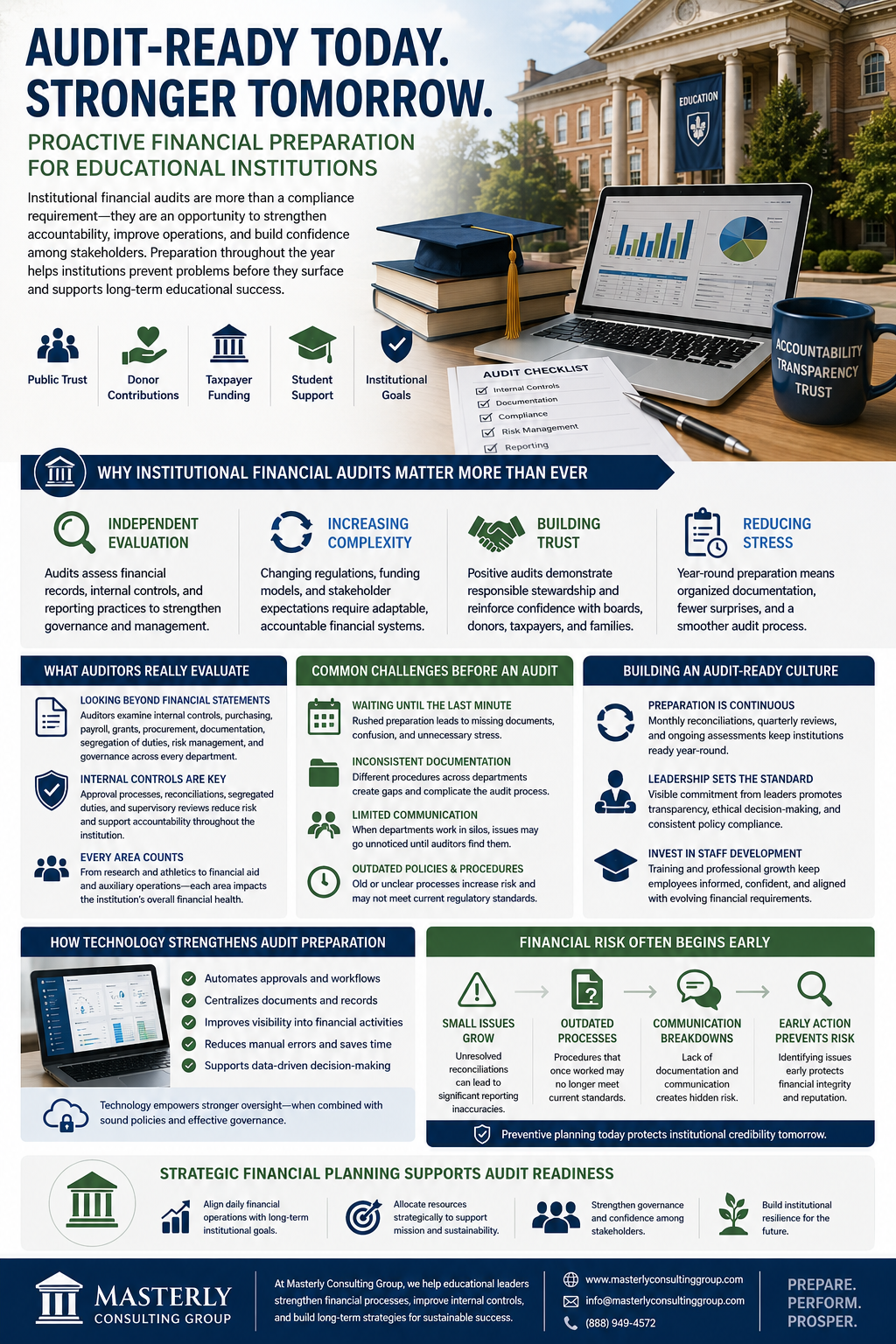
Educational institutions manage far more than budgets and financial statements. They oversee public trust, steward donor contributions, allocate taxpayer funding, support students, and ensure every financial decision aligns with institutional goals. As financial oversight continues to evolve, institutional financial audits have become more than a compliance requirement—they are an opportunity to strengthen accountability, improve operations, and build confidence among stakeholders.
Many colleges, universities, school districts, and K-12 organizations assume that an audit begins when external auditors arrive on campus. In reality, successful audits begin months earlier through consistent planning, reliable documentation, effective internal controls, and strong leadership. Institutions that prepare throughout the year often experience smoother audits while identifying opportunities for operational improvement before small issues become significant concerns.
At Masterly Consulting Group, we believe financial preparedness should never be reactive. Through comprehensive consulting services, we help educational leaders establish effective financial processes, strengthen internal controls, improve organizational transparency, and develop long-term education strategy initiatives that support sustainable institutional success. Rather than viewing audits as stressful events, institutions can transform them into valuable tools for continuous improvement and strategic decision-making.
Whether your institution serves elementary students, K-12 campuses, community colleges, or large research universities, proactive audit preparation provides meaningful benefits that extend well beyond compliance. Throughout this article, we will explore how institutions can prepare before problems surface while building stronger financial operations that support the long-term mission of education.
Why Institutional Financial Audits Matter More Than Ever
Financial audits provide independent evaluations of an institution's financial records, internal controls, and reporting practices. Although many administrators view audits primarily as regulatory obligations, they also provide valuable insights that strengthen governance and improve financial management across the institution.
Educational institutions operate in increasingly complex environments. State funding formulas change, federal regulations evolve, technology investments continue expanding, and stakeholder expectations continue growing. These realities require financial systems capable of adapting while maintaining accountability and transparency.
Strong audits also demonstrate responsible stewardship. Governing boards, donors, accreditation agencies, taxpayers, grant providers, and families all want confidence that institutional resources are managed responsibly. A positive audit reinforces public trust while strengthening an institution's reputation within the broader community.
Preparation also reduces unnecessary stress. Institutions that establish consistent financial procedures throughout the year often spend less time responding to auditor requests because documentation is already organized, accessible, and complete.
Understanding What Auditors Really Evaluate
Looking Beyond Financial Statements
Many institutional leaders mistakenly believe auditors focus only on financial balances and accounting reports. While financial accuracy remains important, modern audits evaluate much broader operational practices that influence institutional performance.
Auditors often examine internal controls, purchasing procedures, payroll administration, grant management, procurement practices, documentation standards, segregation of duties, risk management efforts, and governance structures. Together, these areas provide a clearer picture of financial accountability.
For universities, these evaluations frequently extend into research funding, auxiliary operations, scholarships, athletics, endowments, and federal financial aid compliance. Each department contributes to the institution's overall financial health.
Understanding this broader perspective helps institutions prepare more effectively. Instead of gathering paperwork only before the audit begins, departments can establish year-round documentation practices that reduce risk while improving operational efficiency.
Internal Controls Form the Foundation
Strong internal controls remain one of the most important components of successful institutional audits. These controls establish procedures that reduce opportunities for fraud, errors, and financial mismanagement.
Examples include approval processes, spending authorizations, separation of financial responsibilities, regular reconciliations, documented purchasing procedures, and periodic supervisory reviews. When implemented consistently, these practices strengthen accountability throughout the institution.
Effective controls also protect employees. Clearly documented responsibilities reduce confusion while helping staff members understand expectations surrounding financial transactions.
Institutions with mature internal control environments often discover that audits become more collaborative because auditors can quickly verify processes already supported by reliable documentation.
Common Challenges Institutions Face Before an Audit
Waiting Until the Last Minute
One of the most common audit preparation mistakes involves delaying preparation until auditors announce their arrival. Unfortunately, rushed preparation often reveals incomplete documentation, inconsistent reporting, and unresolved financial questions.
When departments scramble to locate invoices, contracts, purchase approvals, or grant documentation, valuable administrative time disappears. Staff members become overwhelmed, increasing the likelihood of errors and unnecessary delays.
Instead, successful institutions incorporate audit readiness into everyday operations. Maintaining organized financial records throughout the year allows employees to respond confidently whenever documentation is requested.
This proactive approach also improves communication among finance offices, department administrators, academic divisions, and executive leadership, creating stronger institutional alignment.
Inconsistent Documentation Across Departments
Educational institutions frequently consist of multiple departments operating with varying administrative procedures. While decentralization offers flexibility, inconsistent documentation practices can complicate financial audits.
One department may maintain detailed purchasing records while another relies on informal email approvals. Some offices may archive contracts systematically, while others store information across multiple locations.
Standardized documentation expectations improve institutional consistency. Developing common templates, approval workflows, and document retention procedures helps reduce confusion while improving organizational efficiency.
Standardization also simplifies employee onboarding because new staff members quickly understand institutional financial expectations.
Limited Communication Between Departments
Audit preparation should never become the sole responsibility of the finance office. Every operational division contributes information that supports financial accountability.
Academic departments, human resources, procurement teams, information technology professionals, grant administrators, athletics personnel, advancement offices, and executive administrators all influence institutional financial reporting.
Regular communication encourages departments to resolve discrepancies before external auditors identify them. These conversations also strengthen institutional relationships while improving operational coordination.
Building stronger collaboration creates a culture where financial accountability becomes everyone's responsibility rather than a task assigned to one office.
Building an Audit-Ready Culture Throughout the Institution
Preparation Becomes a Continuous Process
The strongest institutions rarely prepare for audits only once each year. Instead, they establish continuous review processes that identify issues before they grow into larger financial concerns.
Monthly reconciliations, quarterly policy reviews, internal financial assessments, documentation updates, and departmental reviews help maintain audit readiness throughout the fiscal year.
This consistent attention reduces last-minute pressure while improving confidence among administrators and governing boards.
Over time, continuous preparation also strengthens institutional resilience because financial procedures become integrated into daily operations rather than temporary compliance exercises.
Leadership Sets the Standard
Financial accountability begins with institutional leadership. When executives demonstrate commitment to transparency, employees recognize that accurate financial management represents an organizational priority rather than an administrative obligation.
Visible support from presidents, superintendents, chief financial officers, provosts, and governing boards encourages departments to follow established procedures consistently.
Leadership involvement also reinforces the importance of ethical decision-making, documentation standards, and policy compliance throughout every level of the institution.
Strong leadership creates organizational cultures where accountability becomes part of everyday decision-making instead of a response to external oversight.
Investing in Staff Development
Financial policies continue evolving alongside regulations, accounting standards, grant requirements, and institutional priorities. Ongoing professional development helps employees remain informed about changing expectations.
Providing regular training opportunities strengthens institutional knowledge while reducing costly procedural mistakes. Employees who understand financial requirements perform their responsibilities with greater confidence and consistency.
Professional development also improves retention because staff members appreciate organizations that invest in expanding their professional skills.
As institutional expertise grows, departments become better prepared to address financial questions before they affect audit outcomes.
How Technology Supports Stronger Audit Preparation
Educational institutions increasingly rely on technology to strengthen financial oversight and improve operational efficiency. Modern financial platforms help automate approvals, organize documentation, monitor expenditures, and improve reporting accuracy.
As digital transformation continues reshaping education, institutions have greater opportunities to improve financial accountability through integrated financial management tools. Automated workflows reduce manual errors while increasing visibility into financial activities across departments.
Cloud-based document management platforms also improve access to contracts, invoices, procurement records, grant documentation, and supporting financial information. Instead of searching through paper files, authorized personnel can retrieve records quickly during audit reviews.
Technology should support—not replace—sound financial governance. Institutions that combine effective systems with strong policies often experience smoother audits while improving operational consistency.
Financial Risk Often Begins Long Before Auditors Arrive
Most significant audit findings do not appear overnight. Instead, they develop gradually through repeated procedural inconsistencies, outdated policies, incomplete documentation, or communication breakdowns.
Minor reconciliation differences may seem insignificant initially. However, unresolved discrepancies can expand over time, creating reporting inaccuracies that become more difficult to correct.
Similarly, outdated financial procedures may continue operating successfully for years until regulatory expectations change. Without periodic reviews, institutions may unknowingly rely on practices that no longer align with current standards.
Recognizing these risks early allows institutions to respond strategically rather than reactively. Preventive planning protects both financial integrity and institutional credibility.
The Role of Strategic Financial Planning in Audit Readiness
Connecting Daily Operations to Long-Term Goals
Audit preparation should never exist separately from institutional planning. Financial accountability supports broader organizational objectives, including enrollment management, infrastructure improvements, academic programming, student success initiatives, and operational sustainability.
A comprehensive strategy aligns financial decision-making with institutional priorities. When every department understands how budgeting, procurement, reporting, and compliance contribute to larger organizational goals, financial management becomes more consistent.
Strategic planning also helps institutions allocate limited resources more effectively. Rather than reacting to unexpected financial concerns, administrators can prioritize investments that support long-term institutional stability.
This alignment creates stronger financial governance while reinforcing confidence among governing boards, donors, regulators, and the communities institutions serve.
Internal Reviews Strengthen External Audit Success
External audits receive significant attention, but internal assessments often produce the greatest long-term value. Regular internal reviews help institutions evaluate financial practices before independent auditors begin their work. These reviews create opportunities to correct documentation gaps, strengthen procedures, and improve consistency across departments.
Internal reviews also encourage continuous improvement rather than last-minute correction. Finance offices, academic departments, operational units, and administrative teams can work together to evaluate financial processes throughout the year. This proactive approach reduces surprises while supporting stronger financial governance.
Many schools, districts, and universities establish annual internal review calendars that examine purchasing procedures, payroll records, grant administration, contracts, and budget reporting. Conducting these evaluations consistently builds confidence while improving institutional readiness.
Institutions that embrace continuous improvement often experience fewer audit findings because issues are identified and resolved long before external auditors arrive.
Data Quality Drives Better Financial Decisions
Reliable Data Supports Accountability
Accurate data serves as the foundation of every successful financial audit. Financial reports, enrollment statistics, grant expenditures, payroll information, purchasing records, and departmental budgets all depend on reliable information.
When institutions maintain consistent data management practices, administrators can make informed decisions with greater confidence. Reliable information also strengthens financial reporting while reducing inconsistencies that auditors frequently identify.
Financial accuracy extends beyond accounting departments. Human resources, admissions, procurement, information technology, academic affairs, and operational divisions all contribute information that influences institutional reporting.
Improving data quality creates stronger financial transparency while supporting better organizational planning.
Digital Transformation Improves Financial Visibility
Many educational organizations continue investing in digital transformation to modernize financial operations. Integrated financial software, automated approval workflows, cloud-based document management, and electronic reporting systems improve efficiency while reducing administrative burdens.
Successful digital transformation requires thoughtful planning rather than simply purchasing new software. Institutions should evaluate how technology supports existing policies, employee responsibilities, and long-term financial objectives.
New platforms should improve communication instead of creating additional complexity. Well-designed systems simplify documentation while providing leadership with real-time financial information.
As institutions continue adopting new systems, careful implementation ensures technology enhances accountability rather than introducing unnecessary risk.
Supporting Every Department Through Collaboration
Financial accountability succeeds when every department participates in the process. Audit preparation should involve finance professionals, academic administrators, procurement personnel, information technology specialists, compliance officers, and executive leadership working toward common objectives.
Effective collaboration improves communication while reducing misunderstandings that frequently delay audit preparation. Departments gain a better understanding of how their daily responsibilities contribute to institutional financial integrity.
When finance offices operate independently from academic departments, documentation gaps often develop. Cross-functional planning encourages consistency while strengthening institutional relationships.
Working together also helps institutions identify opportunities for operational improvement that benefit the entire organization rather than individual departments.
Preparing K 12 Schools and Districts for Financial Reviews
Financial oversight remains equally important for k 12 education. Public and private schools face increasing expectations regarding transparency, responsible spending, grant compliance, and accountability for taxpayer funding.
Many districts manage numerous campuses, each with unique operational responsibilities. Coordinating purchasing procedures, payroll administration, transportation budgets, technology investments, and facility expenditures requires strong financial systems.
Administrators should establish consistent documentation standards across all campuses. Uniform procedures improve reporting while simplifying audit preparation for district finance offices.
Strong financial planning also allows teachers and school administrators to remain focused on learning rather than administrative confusion.
Keeping Student Needs at the Center
Financial accountability ultimately supports educational excellence. Responsible budgeting allows institutions to invest in programs that address student needs, strengthen academic programs, and improve campus operations.
Every financial decision influences classrooms, faculty support, educational resources, and institutional services. Effective audits help confirm that available funding is used responsibly to benefit students.
Preparing for audits should never become an exercise in paperwork alone. Instead, it should reinforce the institution's commitment to delivering quality education while maintaining public trust.
When financial operations remain healthy, administrators can devote greater attention to academic priorities instead of correcting preventable financial issues.
Universities Face Increasing Financial Complexity
Modern universities oversee highly diversified financial operations. Research grants, auxiliary enterprises, athletics, housing, dining services, endowments, scholarships, capital projects, and international partnerships all contribute to increasingly sophisticated financial environments.
As institutional operations expand, audit preparation becomes more important than ever. Strong governance helps ensure every financial activity aligns with regulatory expectations and institutional priorities.
Research institutions frequently manage multiple funding sources simultaneously. Careful documentation protects grant compliance while supporting continued eligibility for future funding opportunities.
Comprehensive financial planning enables universities to balance innovation with responsible stewardship.
Supporting Innovation Without Sacrificing Accountability
Higher education continues pursuing innovation through academic programming, research initiatives, campus modernization, and technological advancement. These investments create exciting opportunities but also introduce additional financial responsibilities.
Institutions should evaluate how innovative initiatives influence budgeting, procurement, documentation, and reporting requirements. Early planning reduces unnecessary financial risk while encouraging responsible growth.
Financial accountability and innovation complement one another when institutions establish thoughtful governance practices.
Responsible oversight allows institutions to embrace progress while protecting long-term financial stability.
Financial Audits Strengthen Community Confidence
Educational institutions exist to serve their community. Families, donors, governing boards, alumni, taxpayers, and public officials all expect financial transparency.
Successful audits demonstrate responsible stewardship of public and private investments. This transparency strengthens institutional credibility while encouraging continued stakeholder confidence.
Communities often support institutions that demonstrate ethical financial management through consistent reporting and accountability.
Maintaining public trust creates opportunities for future partnerships, philanthropic support, and long-term institutional development.
Preparing Faculty and Staff for Audit Success
Employees play an essential role in institutional financial accountability. Finance professionals cannot prepare for audits alone because documentation originates throughout the institution.
Providing clear expectations allows teachers, administrators, procurement personnel, department chairs, and operational staff to understand their financial responsibilities.
Institutions should regularly review purchasing policies, reimbursement procedures, documentation standards, approval requirements, and record retention expectations.
When every employee understands established procedures, audit preparation becomes significantly more efficient.
Building Expertise Across the Institution
Developing institutional expertise requires ongoing investment in professional growth. Employees who understand financial policies contribute more effectively to organizational accountability.
Leadership should encourage continuing education, professional certifications, workshops, and policy updates that strengthen institutional knowledge.
Expanding organizational expertise also reduces dependence on individual employees because financial knowledge becomes distributed across multiple departments.
Strong institutional knowledge supports consistent performance despite personnel changes.
Equity and Access Depend on Responsible Stewardship
Financial accountability influences more than compliance. Responsible budgeting helps institutions improve equity, expand educational opportunities, and strengthen student services.
Careful financial planning ensures available resources reach programs supporting academic achievement, accessibility initiatives, and student development.
Improving access to educational opportunities often depends upon responsible financial decision-making. Scholarships, instructional technology, student support services, and campus improvements all require sustainable financial management.
Institutions committed to equity recognize that sound financial oversight directly contributes to educational opportunity.
Supporting Students, Families, and Educators
Educational institutions exist to serve people. Strong financial management allows students, teachers, educators, families, and administrators to focus on educational excellence instead of financial uncertainty.
Responsible budgeting supports classroom instruction, campus safety, student programs, academic advising, and institutional operations.
Financial stability also creates confidence among families, knowing institutional leaders prioritize responsible stewardship.
When financial systems function effectively, educators can dedicate more time to meaningful learning experiences.
Preparing the Workforce of Tomorrow
Every investment in education contributes to tomorrow's workforce. Institutions prepare graduates with the knowledge, character, and professional skills needed for future careers.
Financial accountability helps ensure educational investments continue supporting workforce readiness through quality instruction, modern facilities, and innovative academic programs.
Preparing today's learners ultimately strengthens tomorrow's economy while benefiting society as a whole.
Educational institutions that manage finances responsibly position future generations for long-term success.
Consulting Services Add Strategic Value
Many institutions benefit from working with experienced external advisors before audits begin. Independent perspectives often identify operational improvements that internal teams may overlook.
Professional consulting services provide objective assessments, practical recommendations, and customized planning based on institutional goals. Rather than replacing internal staff, consultants become a trusted partner supporting continuous improvement.
Masterly Consulting Group understands that every institution operates differently. Our approach focuses on developing realistic solutions that align with organizational priorities while strengthening financial accountability.
Strong partnerships help institutions prepare confidently while improving long-term operational performance.
A Strategic Partner for Education
At Masterly Consulting Group, we serve as a long-term partner for educational institutions seeking meaningful operational improvement. Our consulting services extend beyond audit preparation by helping institutions strengthen governance, improve financial planning, enhance compliance, and support institutional growth.
Our experienced team works alongside institutional leaders to evaluate current financial practices, identify opportunities for improvement, and develop customized education strategy initiatives. Whether supporting k 12 campuses, districts, colleges, or universities, we believe sustainable progress begins with thoughtful planning.
We also recognize that every institution serves unique populations, including multilingual learners, traditional college students, adult learners, and diverse campus communities. Effective planning ensures financial decisions support academic priorities while creating opportunities for every young person pursuing educational success.
Through collaborative planning, practical recommendations, and measurable outcomes, we help institutions achieve lasting change while remaining focused on long-term institutional excellence.
Looking Ahead With Confidence
Institutional financial audits should never be viewed as isolated annual events. Instead, they represent ongoing opportunities to strengthen governance, improve operational practices, and reinforce public confidence in educational institutions.
Organizations that embrace proactive planning position themselves for greater resilience during periods of financial uncertainty and organizational change. By investing in strong internal controls, reliable documentation, effective communication, and continuous improvement, institutions reduce risk while supporting sustainable growth.
As education continues evolving across an increasingly interconnected world, institutions must remain adaptable. Strong financial stewardship enables administrators to support academic excellence, invest in technology, strengthen systems, and respond confidently to emerging challenges.
Preparing before problems surface ultimately allows educational institutions to focus on what matters most—providing outstanding opportunities for students, supporting faculty and staff, and building a stronger future for every community they serve.
Strategic Expertise That Supports Long-Term Educational Success
Meaningful institutional improvement requires more than short-term solutions—it requires strategic expertise that aligns financial planning, operational effectiveness, and academic priorities. At Masterly Consulting Group, we work alongside educational leaders to evaluate current challenges, identify opportunities for improvement, and develop practical strategies that support long-term success. By combining informed decision-making with measurable goals, we help institutions strengthen governance, improve accountability, and build a sustainable foundation for future growth while remaining focused on student achievement and organizational excellence.
Strengthening Education Systems Through Strategic Consulting Expertise
Strong education consulting services begin with understanding that every institution has unique goals, challenges, and opportunities. At Masterly Consulting Group, our education consultants provide education consulting and higher education consulting solutions that combine deep expertise with practical experience to improve education systems, strengthen organizational strategy, and develop a sustainable growth strategy. Our work is led by experienced professionals who collaborate closely with each institution's leadership team to create customized education strategy consulting plans that support long-term financial sustainability, strengthen funding strategies, and improve student outcomes. Whether serving early childhood education programs, K-12 campuses, or colleges and universities, we help our clients address critical operational challenges, support parents, enhance teaching practices, improve student performance, and create learning environments where children and every learner have the opportunity to succeed.
Education Consulting Services That Strengthen Higher Education Institutions
Effective education consulting services help institutions address today's challenges while preparing for tomorrow's opportunities. At Masterly Consulting Group, our experienced education consultants provide comprehensive education consulting and higher education consulting solutions designed to strengthen organizational strategy, improve strategic planning, and develop a sustainable talent strategy. We partner with colleges, universities, and other higher education institutions to improve leadership effectiveness, optimize operations, and implement practical strategies that support long-term institutional success.
Education Strategy Consulting for Sustainable Institutional Growth
Successful education strategy consulting helps educational institutions align their mission, operations, and financial priorities with long-term goals. At Masterly Consulting Group, we work alongside school leaders, colleges, and universities to develop practical strategies that improve decision-making, strengthen organizational performance, and support sustainable growth. By evaluating current challenges and identifying opportunities for improvement, we help institutions build a clear roadmap that enhances accountability, operational efficiency, and student success.
Contact Masterly Consulting Group for a Free Consultation
Institutional financial audits do not have to become stressful, reactive events. With experienced guidance, proactive planning, and practical strategies, educational institutions can strengthen financial accountability, improve operational efficiency, and prepare confidently for future audits.
At Masterly Consulting Group, our consulting services are designed to support schools, districts, colleges, and universities through strategic planning, operational assessments, governance improvement, financial readiness, and customized education strategy development. We work as your trusted partner, helping institutional leaders build stronger financial systems, improve measurable outcomes, and position their institutions for long-term success.
Whether your institution is preparing for an upcoming audit, evaluating internal financial practices, advancing digital transformation, developing a stronger talent strategy, or planning future institutional growth, our experienced team is ready to help. Contact Masterly Consulting Group today at (888) 209-4055 to schedule your free consultation. We look forward to answering your questions, discussing your institution's goals, and helping you create a stronger financial foundation that supports excellence in education for years to come.