Small Business HR Consulting Building Policies, Roles, and Training Before a Full HR Department
Your company is growing, but your people systems may not be growing with it.
The owner who once handled every new hire personally now has managers making employment decisions. Employees may receive different information depending on who trains them. Workplace expectations may exist in conversations instead of clear documents. New hires may start without a consistent process for learning their roles, access to the right resources and tools, or a clear understanding of the company.
These problems can appear long before a small business is ready to build a full internal human resources department. For small business owners and leaders, that often means more administrative burden, more inconsistency across everyday things HR, and more risk as the team scales.
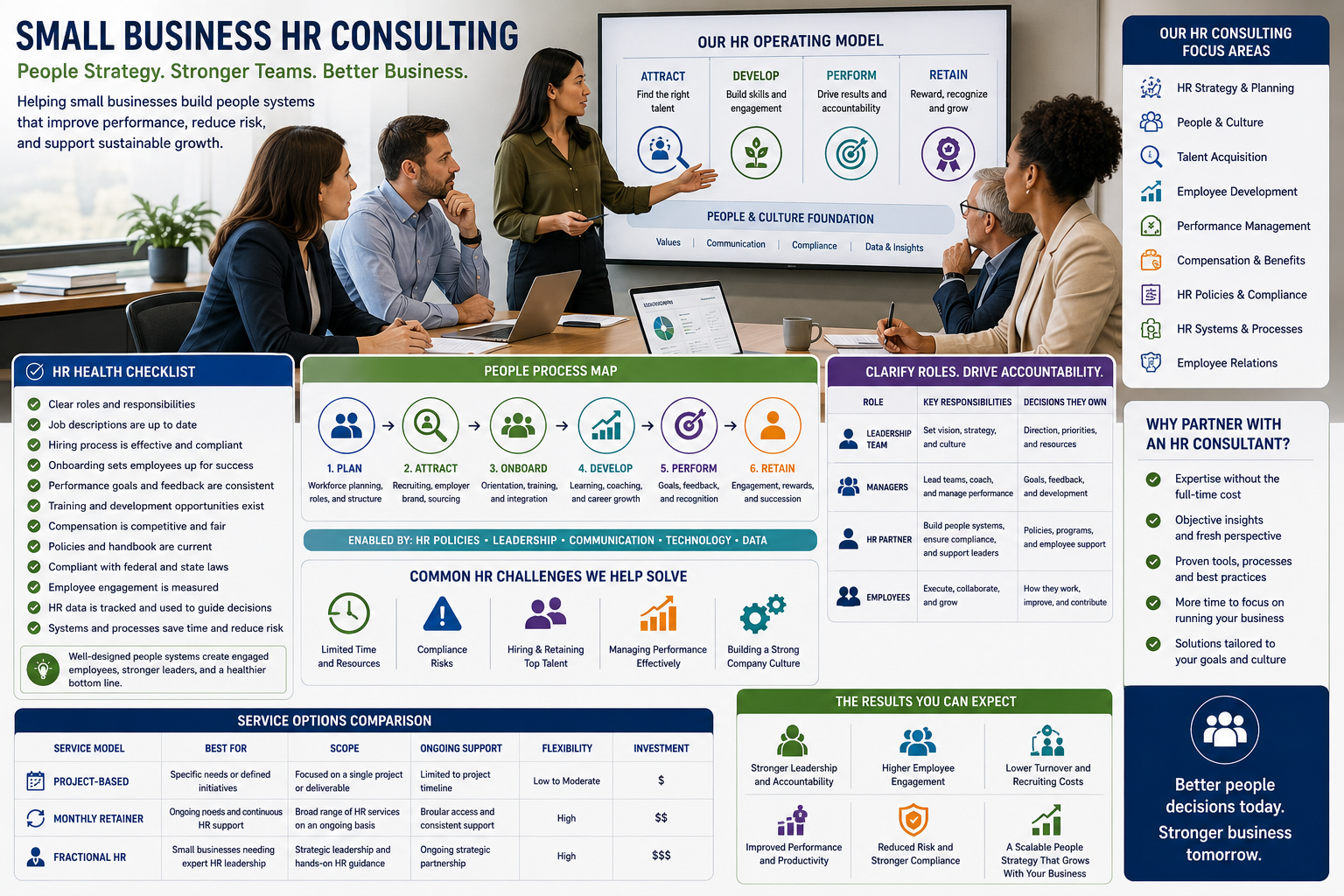
Small business HR consulting gives growing companies professional support to build consistent people systems before they have a full in-house HR department. That can include employee policies, employee handbooks, onboarding, clear role definitions, manager support, employee training, performance management, and goal setting, along with the HR functions and administrative tasks that shape how the business runs day to day.
Masterly Consulting Group works with businesses that need practical support around employees, managers, policies, training, and organizational processes. If you are weighing consulting against hiring internally, this page explains where outside HR support can enhance consistency, improve effectiveness and productivity, and reduce the cost of informal people management as growth continues.
The goal is not to make a growing company feel like a large corporation. It is to create HR practices that better fit the business it has become.
Growth Changes What Your Business Needs From HR Consulting
A small team can often operate successfully with informal communication, but this page is for small business owners whose human resources needs are growing faster than their current systems.
The owner knows every employee. Questions are answered directly. New employees learn by working beside experienced team members. Problems can be addressed as they appear.
Growth changes that environment.
As more employees and managers join the company, informal systems can become inconsistent. One manager may explain a policy differently from another. New employees may receive different onboarding experiences. Important responsibilities can become unclear as jobs evolve. Those gaps create an administrative burden and more administrative tasks for the owner or leadership team.
What worked with five people may not work the same way with a larger and more complex team, especially as the company scales from 10 to 100 employees and more essential processes need clearer structure.
This is where HR consulting for small business can provide value. Instead of waiting until every HR responsibility reaches a critical point or justifies a dedicated internal department, the business can get professional help building the systems and strategies it needs now while still keeping control over employee decisions.
Small Business HR Consulting Creates Structure Before Problems Multiply
Effective small business HR consulting should begin with the company itself.
A growing professional firm may have different needs from a retailer, service company, creative business, or other employer. Team size, management structure, hiring plans, existing documents, and current HR practices can all affect the appropriate scope of an engagement. For example, one company may need help formalizing core human resources responsibilities, while another may need outside support for specific hr functions. A practical starting point is often an analysis of current practices, reporting lines, and compliance exposure before changes are made. This kind of support is often especially useful for businesses with 10 to 100 employees, where complexity and cost both start to rise.
The objective is not to add paperwork simply because a company is growing.
It is to create useful structure where informal practices are no longer enough, especially when leadership needs clearer strategies as the company scales.
That can include examining employee policies, onboarding systems, manager training, and other HR processes that affect how employees experience the organization, whether those systems are handled internally or combined with outside guidance.
Clear Roles Help Employees and Managers
Growth often changes jobs faster than job expectations are updated.
An employee may begin with one set of responsibilities and gradually take on several others. A strong employee may become a manager without a clear definition of the new role. Different team members may assume they own the same responsibility, while other tasks have no clear owner. In this kind of engagement, the work usually starts by evaluating human resources needs and analyzing current practices before any new structure is recommended.
These issues can affect more than efficiency.
Role confusion can make communication harder and create frustration for employees and managers. It is to create useful structure where informal practices are no longer enough. Unmanaged HR administrative costs typically represent 3%-12% of payroll costs, which is one reason companies review which HR functions need support.
HR consulting can help a company examine how roles, responsibilities, reporting relationships, and expectations are communicated. For example, a consultant may look at performance management, goal setting, and who is accountable for making sure key outcomes are clearly defined and achieved. Greater clarity gives employees a better understanding of their work and helps managers know what they are responsible for leading.
Employee Policies Should Reflect a More Established Workplace
Informal expectations become harder to manage as a company grows.
An owner may know what the company expects regarding attendance, workplace conduct, time away, communication, or other employment matters. That does not mean every manager or employee has the same understanding.
Clear employee policies help create greater consistency.
Policies also give managers a common reference point when employees have questions. Instead of each supervisor developing a separate answer, the company can establish clearer expectations across the organization. Well-written employee handbooks can also make onboarding more consistent and reduce day-to-day administrative confusion. Clearer role definitions also support performance management and more consistent goal setting.
The specific policies a business needs depend on its workforce, operations, location, and circumstances. Businesses should obtain appropriate legal guidance when legal compliance questions are involved. Good policy frameworks also help managers and employees respect the boundaries of each role.
HR consulting can support the operational side by helping a growing organization examine how policies fit within its broader people systems so employees and managers understand not only responsibilities, but also the outcomes expected in each role.
Onboarding Systems Shape the Beginning of the Employee Experience
Hiring someone is only the beginning.
What happens after the employee accepts the position can influence how quickly that person understands the company, their responsibilities, and the expectations surrounding their role.
Without consistent onboarding systems, the experience may depend almost entirely on the manager, even though some onboarding steps are essential to getting people started the right way.
One new employee receives detailed guidance. Another receives a few documents and starts working. A third learns important expectations weeks after joining, which can reduce early productivity.
That inconsistency becomes harder to manage as hiring increases, making it harder to measure the effectiveness of the process or enhance it over time.
Onboarding Should Connect People to Their Roles
A structured onboarding experience can help organize the information new employees need when entering the business, and the right implementation may include simple software or other tools that give them access to key resources without confusion.
This may include understanding the company, workplace expectations, the employee's role, internal communication, management relationships, and relevant processes. What happens after the employee accepts the position can influence how well the employee starts in the role; effective onboarding also improves employee satisfaction and retention and can reduce early turnover for new hires.
The exact system should fit the organization.
The objective is not to overwhelm a new employee with information. It is to create a more consistent transition into the company so employees and managers are not starting from scratch with every hire, while making collaboration clearer for everyone involved and giving stakeholders a simple way to track progress and gather valuable insights.
For growing companies, stronger onboarding can also reduce dependence on the owner as the only person capable of explaining how the organization works. A more structured process, supported where appropriate by technology, can help automate parts of onboarding so new hires become productive faster.
Manager Training and Performance Management Matter When Employees Become Leaders
Promoting a capable employee does not automatically prepare that person to manage others.
The skills that make someone successful in an individual role may be different from those required to supervise employees.
New managers may suddenly be responsible for communication, feedback, workplace expectations, performance conversations, employee questions, team coordination, and even supporting recruiting efforts.
Without manager training, they may rely on personal judgment or repeat the management practices they have experienced elsewhere.
This may include understanding the company, and onboarding implementation may also involve giving new hires clear access to the right resources and tools from the start.
Strong employee training helps new supervisors gain practical skills they can apply with their teams.
When a company uses onboarding software or related technology, it can reduce time spent on administrative tasks and improve the quality of employee data.
That can create major differences between teams.
Managers Need Consistent Expectations Too
Employees are not the only people who need clarity.
Managers should understand what the organization expects from them as leaders.
Professional training can support clearer expectations around communication, supervision, accountability, the manager's role within established company processes, and collaboration across teams. Managers often also need employee training in supervision and hiring-related responsibilities, including parts of recruiting or selection when those duties are delegated.
This becomes increasingly important as the owner delegates more responsibility.
A company cannot scale management effectively if every important employee issue still needs to return to the owner for a decision.
Building manager capability can help create a more organized leadership structure as the business grows, so new managers are better prepared to make sound day-to-day decisions, handle people issues appropriately, and lead with more consistency.
HR Processes Should Reduce Confusion, Not Create More of It
Small businesses sometimes avoid formal HR practices because they assume structure means bureaucracy.
It does not have to.
Useful HR processes should make recurring responsibilities easier to understand and manage, especially around the everyday things HR teams and business owners have to keep moving.
Hiring, onboarding, employee documentation, manager responsibilities, training, workplace communication, payroll, and benefits all involve repeated activities. If the company handles them differently every time, managers may spend unnecessary effort deciding what happens next.
Consistent processes can provide a clearer framework, reduce administrative cost, and support better productivity.
The right level of structure depends on the business. A company should not copy complicated systems designed for a much larger organization simply because those systems exist.
Practical HR consulting often means leveraging existing technology and simple tools, while giving managers the resources to handle day-to-day collaboration as well as supervision. Managers should understand what the organization expects from them as leaders. Consultants can also support collaboration by helping leadership address employee or manager conflicts as a neutral third party.
Practical HR consulting focuses on what the growing business actually needs.
Your People Systems Affect Your Business Reputation
HR may operate behind the scenes, but employees experience its effects directly.
A candidate notices whether the hiring process feels organized.
A new employee notices whether the company is prepared for their arrival.
Team members notice when managers communicate different expectations.
Managers notice when they are given responsibilities without enough guidance.
These experiences contribute to how employees view the organization.
That matters because a company's reputation is not shaped only by customers. Employees, candidates, managers, and former team members also form opinions about how professionally the business operates.
As a company grows, stronger people systems can help its internal experience better reflect the professional image it presents to customers and clients.
Do You Need an HR Consultant or a Full HR Department?
Many growing businesses eventually reach a stage where informal HR management is no longer comfortable, but building a complete internal HR function may not yet make sense for their needs.
That middle stage can be difficult.
The owner knows something needs to change but may not know what should be addressed first. Managers need more support. Documents may need attention. Hiring is becoming more frequent. Employee questions are becoming more complex.
HR consulting for small business can provide outside professional support without assuming that the company needs to immediately create an entire internal department.
The appropriate solution depends on the company.
Consulting can help leadership identify the people systems that need attention now and develop a clearer foundation for future growth. For example, a smaller team may need targeted consulting, while a business with a higher combined employee count may decide broader ongoing HR support makes more sense.
These experiences contribute to how employees view the organization. Effective HR consulting can also improve employee retention by creating a more consistent day-to-day work experience.
Consultants may also help leadership clarify company culture and core values so internal practices better match the business's public reputation.
Build the HR Foundation Before Growth Makes It Harder
People systems are easier to examine when leadership has time to make thoughtful decisions.
Waiting until the company is overwhelmed can make the process more difficult.
If managers already follow different practices, employees have different expectations, onboarding changes with every hire, and the owner remains the default HR contact, growth can add another layer of complexity.
Building structure earlier creates an opportunity to establish clearer practices before inconsistent habits become deeply established.
That does not mean predicting every HR need the company will ever have.
It means creating a stronger foundation for the workforce the business has today while considering where the organization is going.
Masterly Consulting Group Provides Practical HR Consulting for Growing Businesses
Business owners should be able to focus on leading their companies without personally designing every employee process from the ground up.
Masterly Consulting Group provides consulting support for organizations that need greater structure around people, management, training, and business operations.
With small business HR consulting, the engagement can focus on the specific issues creating friction inside the organization.
That may include evaluating existing people practices, clarifying roles, strengthening employee processes, identifying training needs, or helping leadership create greater consistency as the organization expands.
The work should fit the company rather than forcing the company into a generic HR model.
For a growing business that is not ready for a full internal HR function, this provides a practical way to begin addressing important people-system needs.
Stronger People Systems Support a Stronger Business
Growth changes more than revenue, customers, and workload.
It changes the way people need to work together.
Employees need clearer expectations. Managers need greater consistency. New hires need an organized introduction to the company. Leadership needs processes that do not depend entirely on the owner's memory or availability.
Those systems become part of the infrastructure supporting the business.
Professional small business HR consulting can help leadership address these needs before people-related confusion becomes a larger barrier to growth.
The goal is simple: build practical structure around the people who help the company operate.
Stronger People Systems Help Businesses Manage Change With Greater Consistency
As a company grows, investing time and energy in clear people systems becomes crucial for maintaining consistent expectations across the workplace. Employees may move between projects, use company equipment, work under different managers, or have responsibilities connected to a client contract, which makes clear policies and management practices increasingly important.
When workplace behavior or performance concerns arise, businesses may also need established processes for addressing them, including progressive discipline when appropriate for the circumstances and the company's policies. Growing companies may eventually face other workforce decisions, including staffing reductions, that require careful planning and appropriate professional guidance. Rather than relying on a generic complete guide or one-size-fits-all HR template, Masterly Consulting Group helps businesses evaluate the people systems that fit their actual workforce, management structure, and operational needs.
Frequently Asked Questions About Small Business HR Consulting
What is small business HR consulting?
Small business HR consulting provides professional support to businesses that need help strengthening people-related practices and processes without necessarily maintaining a full internal HR department.
What can HR consulting for small business address?
HR consulting for small business means outside support for selected human resources needs or HR functions, while the business retains control over employee and management decisions. It can address areas such as employee processes, roles, policies, onboarding, management practices, recruiting, performance management, employee training, and employee handbooks. The appropriate scope depends on the organization.
Can an HR consultant help with employee policies?
HR consulting can help a business review how employee policies fit within its people systems and workplace practices. Questions requiring legal advice or legal conclusions should be addressed with appropriate legal counsel.
Why are onboarding systems important for a growing business?
Onboarding systems create greater consistency in how new employees are introduced to their roles, workplace expectations, and the organization.
Can HR consulting include manager training?
Manager development can be an important part of strengthening a growing company's people systems. The specific manager training needed depends on the responsibilities and experience of the company's managers, including how they handle onboarding, expectations, and goal setting. Stronger onboarding also helps new employees become productive sooner and supports better retention.
What HR processes should a growing company consider?
The appropriate HR processes depend on the company. Common areas that may require greater structure as a workforce grows include hiring, onboarding, employee documentation, management responsibilities, training, workplace communication, payroll, benefits, and the administrative tasks that often pull owners away from day-to-day operations. Manager training may also cover goal setting and day-to-day people leadership expectations.
Do we need a full HR department before improving our HR systems?
No. A growing business can seek professional HR consulting before deciding whether or when a full internal HR function is appropriate.
How do I know if my company needs small business HR consulting?
It may be time to consider small business HR consulting when employee questions increasingly depend on the owner, managers follow inconsistent practices, roles are unclear, onboarding varies between hires, or growth is exposing weaknesses in existing people systems.
Does Masterly Consulting Group work with growing small businesses?
Masterly Consulting Group provides consulting services for businesses and organizations. Contact the firm to discuss your workforce, current people systems, and the specific HR or operational challenges your business wants to address.
Request a Small-Business Operations and People-Systems Consultation With Masterly Consulting Group
Your company does not need to wait for a full internal HR department before creating stronger systems for employees and managers, whether you run a business or organization in office, nonprofit, professional service, or manufacturing settings.
If growth is exposing gaps in roles, employee policies, onboarding systems, manager training, or other HR processes, Masterly Consulting Group can help you evaluate what your organization needs and determine an appropriate consulting approach.
Our small business HR consulting is designed for companies seeking professional support as they build greater structure around their people and operations.
Request a small-business operations and people-systems consultation with Masterly Consulting Group for practical analysis and support through implementation.
Call: (972) 236-5051
Website: https://www.masterlygroup.com/