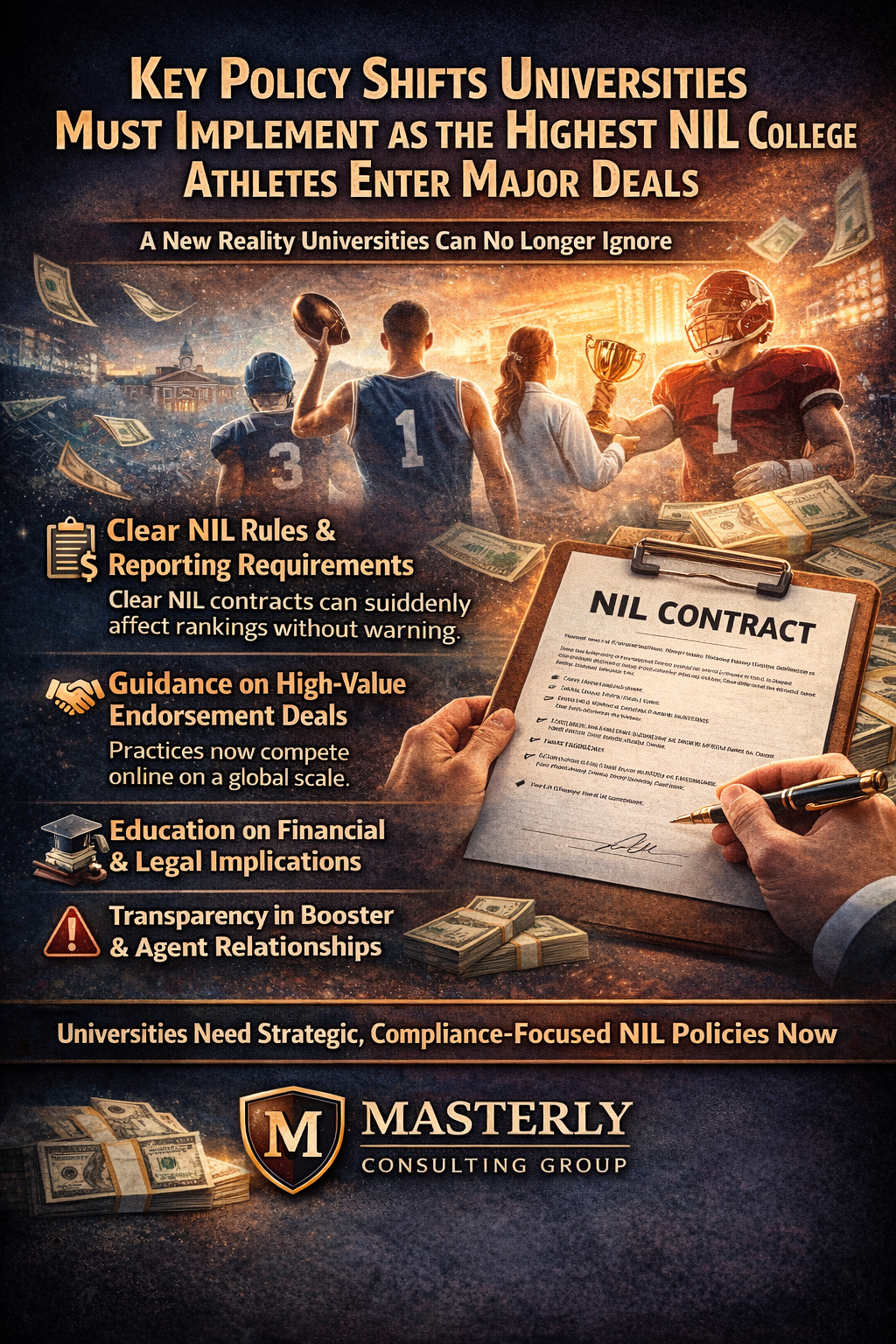
Key Policy Shifts Universities Must Implement as the Highest NIL College Athletes Enter Major Deals
A New Reality Universities Can No Longer Ignore
The rise of major NIL deals has changed college athletics faster than most universities anticipated. What once felt theoretical is now operational, with student athletes signing agreements that rival professional endorsements. Administrators who delay updating policies risk falling out of compliance with nil laws and institutional expectations. The current NIL landscape rewards preparation and punishes hesitation.
Universities are no longer managing small exceptions. They are managing a full-scale economic system built around name image and likeness. Institutions that fail to act decisively expose themselves to legal challenges, reputational damage, and loss of competitive balance.
How Name Image and Likeness Reshaped College Sports
Name image and likeness fundamentally altered how college athletes participate in college sports. Student athletes can now monetize their personal brand while remaining enrolled. This shift disrupted decades of amateur athletics assumptions.
The national collegiate athletic association responded with interim guidance, but much responsibility shifted to member schools. Each institution now must interpret and apply nil rules within the framework of state law. This decentralization increased complexity across college athletics.
The Supreme Court’s Role in Accelerating Change
Several supreme court decisions reshaped how universities approach compensation. The court repeatedly signaled skepticism toward NCAA's restrictions that limit athlete earning potential. These rulings emboldened college athletes and opened the door to broader nil opportunities.
District court opinions reinforced that universities must align policies with evolving legal standards. Ignoring these signals creates exposure to class action lawsuit risks. Administrators must treat NIL compliance as a core governance issue.
Why Delayed Policies Put Institutions at Risk
Universities that delay updating nil policy face immediate operational gaps. Student athletes often sign deals faster than compliance systems can track them. Without updated protocols, institutions struggle to report nil activities consistent with school and conference requirements.
Delays also create uneven enforcement. Current student athletes receive mixed guidance, while prospective student athletes receive incomplete information. This inconsistency undermines trust and invites scrutiny.
The Growth of High-Value NIL Deals
Nil money is no longer limited to small sponsorships. Athlete deals now include six- and seven-figure agreements tied to name image and likeness. College football and other high-revenue sports lead this shift.
These large agreements raise questions about fair market rate and professional service providers. Universities must define oversight without restricting nil rights. Failure to do so increases compliance exposure.
Understanding the Current NIL Market
The current nil market is sophisticated and fast-moving. Brands, agents, and platforms approach student athletes directly. Universities must respond with equally modern compliance structures.
Administrators can no longer rely on outdated manuals. Policies must reflect how nil activities actually occur. Without alignment, schools risk violating ncaa rules related to disclosure and oversight.
NIL Laws Are Not Uniform Across States
State nil laws vary widely, creating uneven obligations across i schools and athletic conferences. Some states impose strict disclosure rules, while others allow broad freedom. Universities must reconcile state law with ncaa rules.
Such laws require institutions to monitor legislative changes continuously. Treating nil laws as static invites noncompliance. Institutions need adaptable frameworks.
Federal Legislation Remains Uncertain
Despite ongoing discussion, federal legislation has not yet unified the nil game. Universities cannot wait for congressional clarity. Interim decision-making remains essential.
Administrators must plan for multiple regulatory outcomes. Preparing flexible policies protects institutions regardless of future changes.
Name Image and Likeness Affects Recruiting Directly
Prospective student athletes now evaluate schools based on nil opportunities. Policies that limit engagement can deter top talent. Recruiting conversations increasingly include education about nil activities.
High school athletes expect transparency before committing. Schools without clear guidelines lose credibility. Recruitment now depends on policy readiness.
Balancing Compliance With Competitive Balance
Universities must protect competitive balance while allowing student athlete compensation. Overly restrictive rules push talent elsewhere. Overly lax systems invite violations.
This balance requires thoughtful governance. Clear processes support both institutional integrity and athlete opportunity.
Why One-Size Policies No Longer Work
Institutions once relied on uniform ncaa pointed guidance. That approach no longer fits today’s environment. Each school must develop own nil rules tailored to state law and conference requirements.
Rigid policies create confusion. Adaptive frameworks allow compliance offices to respond quickly. Flexibility is now a necessity.
The Role of Compliance Offices Has Expanded
The compliance office is now central to NIL governance. Staff must review nil contracts, track nil payments, and educate student athletes. This workload far exceeds traditional compliance functions.
Without expanded resources, offices fall behind. Universities must invest accordingly.
Reporting NIL Activities Is Now Mandatory
Many policies require athletes to report nil activities consistent with institutional standards. Failure to track agreements creates audit risks. Reporting protects both athletes and schools.
Clear timelines and platforms reduce confusion. Ambiguity increases violations.
Protecting Amateur Status While Allowing Earnings
Maintaining amateur status remains critical for eligibility. Universities must educate athletes on activities that could jeopardize participation. Nil refers only to permissible compensation tied to name image.
Preventing student athletes from unintentionally crossing lines protects careers. Education is as important as enforcement.
NIL Agreements Require Oversight
Nil agreements often involve complex terms. Without review, athletes may sign unfavorable deals. Universities must offer guidance without acting as agents.
Policies should define review boundaries clearly. This protects all parties.
Managing Relationships With Professional Service Providers
Professional service providers now play a major role in NIL. Universities must regulate access while respecting athlete autonomy. Clear boundaries reduce conflicts.
Policies should outline approved interactions. Transparency reduces risk.
Endorsement Deals Bring New Risks
Endorsement deals raise brand alignment and ethical concerns. Universities must define prohibited categories. Without clarity, disputes arise quickly.
Clear guidelines protect institutional reputation. Ambiguity invites controversy.
NIL Payments and Financial Education
Many student athletes receive financial compensation for the first time. Universities should provide education on taxes and budgeting. This supports long-term athlete welfare.
Financial literacy reduces downstream issues. Prepared athletes make better decisions.
Addressing Equity Across Athletic Programs
NIL impacts different athletic programs unevenly. Revenue sports dominate attention. Universities must consider broader equity implications.
Policies should address general student body concerns. Transparency builds institutional trust.
The Risk of Violating NCAA Rules Related to NIL
Violating ncaa rules related to inducements or pay-for-play carries consequences. Universities must monitor booster involvement carefully. Clear separation is essential.
Compliance systems must detect red flags early. Delayed responses escalate risk.
Class Action Exposure Is Increasing
Institutions face growing class action lawsuit risk tied to compensation and access. Courts increasingly scrutinize restrictive policies. Universities must document fairness.
Legal challenges often focus on inconsistency. Strong policies reduce exposure.
The Play Act and Other Emerging Proposals
The play act and similar proposals signal continued change. Universities must monitor developments closely. Waiting creates vulnerability.
Prepared institutions adapt faster. Others scramble.
Revenue Sharing Conversations Are Accelerating
Revenue sharing discussions are no longer hypothetical. Some conferences explore athletes directly receiving funds. Universities must plan now.
Policies should anticipate these models. Delay limits options.
College Coaches Need Clear Guidance
College coaches often serve as frontline advisors. Without clear policy, they risk missteps. Training is essential.
Consistent messaging protects programs. Uncertainty undermines trust.
Athletic Scholarships Are No Longer the Only Incentive
Athletic scholarships once dominated recruiting value. Now nil opportunities weigh heavily. Universities must adjust messaging.
Policies should reflect this reality. Ignoring it weakens positioning.
Managing Personal Brand Development
Name image and likeness centers on personal brand. Universities should support brand education without controlling outcomes. This balance matters.
Empowered athletes represent institutions positively. Neglected athletes create risk.
Preventing Improper Influence
Preventing student athletes from improper inducement remains critical. Universities must monitor third-party involvement. Clear reporting helps.
Early detection prevents violations. Delay compounds damage.
District Court Trends Signal Continued Scrutiny
District court decisions increasingly favor athlete rights. Universities must track these trends. Policy updates should reflect judicial direction.
Ignoring precedent invites challenge.
NCAA Settled Positions Continue to Evolve
The ncaa settled certain disputes, but guidance remains fluid. Institutions cannot rely solely on national updates. Local adaptation is essential.
Active governance outperforms passive compliance.
Athletic Conferences Add Another Layer
Athletic conferences impose additional obligations. Universities must align conference requirements with state law. Misalignment causes confusion.
Central coordination is essential.
Education Related Benefits Are Under Review
Education related benefits intersect with nil policy. Universities must define boundaries carefully. Overreach risks violation.
Clarity protects eligibility.
NIL Guidelines Must Be Documented Clearly
Nil guidelines should be accessible and current. Students should not rely on verbal advice. Documentation reduces disputes.
Clear policies empower compliance offices.
Competitive Advantage Now Depends on Governance
Governance quality now influences recruiting and reputation. Universities with strong nil policy attract talent. Others lose ground.
Preparedness is competitive advantage.
The Cost of Waiting Is Rising
Delaying updates increases operational risk. Early adopters refine systems while others react. The gap widens quickly.
Waiting costs more than acting.
Strategic Consulting Is No Longer Optional
Universities need outside perspective. Complex legal, operational, and reputational factors intersect. Internal teams cannot manage alone.
Strategic guidance accelerates readiness.
How Masterly Consulting Group Supports Universities
Masterly Consulting Group helps institutions navigate name image and likeness complexity. We work with administrators to align nil policy, state law, and ncaa rules. Our approach emphasizes clarity, compliance, and sustainability.
We focus on real-world application, not theory. Our goal is to protect institutions while empowering student athletes.
Preparing for the Next Phase of College Athletics
The NIL era will continue evolving. Universities that prepare now remain competitive. Those that delay face disruption.
Proactive policy is leadership.
Clarifying Name Image Likeness in the Modern College Environment
Name image likeness refers to a student athlete’s right to control and profit from their personal identity, including their name, image, and public persona. As NIL activity grows, universities must clearly define how name image likeness fits within institutional expectations and compliance frameworks. Ambiguity creates confusion for athletes and administrators alike. Clear guidance helps align opportunity with responsibility.
How NCAA Athletes Navigate a Rapidly Changing Landscape
NCAA athletes now operate in an environment that blends education, branding, and commerce. They are expected to understand rules that evolve faster than traditional compliance structures. Without institutional support, many athletes struggle to interpret what is allowed. Universities play a key role in helping ncaa athletes navigate this complexity responsibly.
The Role of School Rules in NIL Compliance
School rules determine how NIL activity is disclosed, reviewed, and monitored on campus. When these rules are outdated, enforcement becomes inconsistent. Clear school rules protect both the institution and student athletes. Consistency ensures fairness across programs and avoids confusion.
Comparing College NIL With Professional Athletes’ Compensation Models
Professional athletes have long received compensation tied to performance and branding. College systems now mirror some of these dynamics without fully adopting professional structures. Universities must understand where college athletics diverges from professional sports. Drawing this distinction protects amateur eligibility while allowing lawful earnings.
NIL Legislation Continues to Shift Expectations
NIL legislation remains in flux at both the state and federal levels. Universities must track these developments closely. Relying on outdated interpretations exposes institutions to compliance risk. Proactive monitoring ensures policies remain aligned with current law.
Understanding the Interim NIL Policy Framework
The interim nil policy created a temporary structure during a period of rapid change. While helpful initially, it was never intended to be permanent. Universities must now build more durable systems. Treating interim guidance as final creates long-term risk.
Guidance and Perspective From the American Bar Association
The american bar association has contributed insight on NIL compliance, governance, and athlete rights. Its analysis emphasizes clarity, consistency, and legal alignment. Universities benefit from incorporating these perspectives into policy development. Legal scholarship helps institutions anticipate challenges.
Why Universities Need Strategic Business Advice
NIL is not only a legal issue but also a business issue. Universities must evaluate risk, branding, and operational impact. Sound business advice supports sustainable decision-making. Strategic planning reduces reactive policy changes.
Drawing Clear Lines Between College and Professional Sports
College athletics increasingly resembles professional sports, but the distinction still matters. Universities must ensure policies reflect educational priorities. Borrowing selectively from professional sports models helps without overreaching. Balance remains essential.
Monetary Compensation and Institutional Oversight
Monetary compensation is now part of the student athlete experience. Universities must define how earnings are disclosed and reviewed. Oversight protects against abuse while respecting athlete autonomy. Transparency supports trust.
Interpreting NCAA's Definition of Permissible Activity
NCAA's definition of allowable NIL activity shapes enforcement. Misinterpretation creates unnecessary violations. Universities should clearly translate ncaa's definition into practical guidance. Clear interpretation reduces compliance errors.
Ensuring Athletes Are Fairly Compensated Within the Rules
Ensuring athletes are fairly compensated requires understanding fair market value and permissible activity. Universities should avoid policies that artificially suppress earnings. Fair systems protect athlete welfare and institutional integrity. Balance is key to long-term success.
Speak With an NIL Strategy Advisor
If your institution is uncertain whether its policies reflect today’s nil landscape, now is the time to assess. Masterly Consulting Group offers a free consultation to review your current approach to name image and likeness, identify gaps, and recommend strategic improvements.
Call (888) 209-4055 to book a free consultation and learn how proactive NIL governance can protect your university, support student athletes, and position your athletic programs for long-term success.