How Executive Coaching Drives Brand Development for Startups and Entrepreneurs
The early stage of a startup can feel like a sprint that never ends. You’re building a product, finding customers, pitching, hiring, and trying to sound confident even when you’re still testing the basics. In the middle of that pressure, brand development often gets pushed to the side until “later,” but later rarely shows up.
That is where executive coaching becomes a practical advantage, not a luxury. The right coaching helps entrepreneurs turn messy ideas into a clear brand story, turn scattered marketing into a focused message, and turn inconsistent leadership into a stable voice people can trust. A strong brand is not just a logo or a website—it is the way your executive decisions show up in the market every day.
At Masterly Consulting Group, our executive coaching services help startups and entrepreneurs shape a brand that resonates with a target market and stands out in competitive industries. We approach coaching as a business-building discipline that aligns leadership, messaging, customer experience, and team behavior. When you create a brand from the inside out, you don’t just look legitimate—you become the kind of business customers prefer to follow.
Brand Development Starts With the Founder’s Leadership
A startup brand often mirrors the founder’s leadership style. If the founder is reactive, the brand feels inconsistent. If the founder is clear, the brand feels confident and stable. Executive coaching helps founders understand this connection and start leading with intention instead of stress.
This is not about copying what other organizations do. It is about finding your distinctive strengths and building a market identity around what you do best. With coaching, founders learn how to communicate value clearly and make decisions that match the brand promise.
Brand development also depends on your ability to lead under pressure. Leadership coaching strengthens decision-making, messaging discipline, and the habits that create a brand people recognize. Over time, coaching becomes the engine that keeps your brand consistent even as your company changes.
Executive Coaching Helps You Define a Brand That Isn’t Generic
Many startups sound the same because they use the same phrases and the same claims. “Innovative,” “customer-first,” and “industry-leading” are not brand strategy—they are placeholders. Executive coaching helps entrepreneurs replace generic language with a message that feels real and specific.
A strong brand is a clear point of view, not a collection of buzzwords. In coaching engagements, we help executive founders clarify the real problem they solve, the people they serve, and the results customers can expect. That becomes the foundation for storytelling, sales scripts, and marketing content.
When brand development is guided by coaching, it becomes easier to stand out in multiple industries. Your brand voice becomes consistent across your website, your pitch, and your product experience. That consistency builds trust and creates momentum.
The Fastest Brand Growth Comes From Focused Positioning
Startups often try to appeal to everyone because they fear missing opportunities. But broad positioning usually weakens your message and makes your marketing expensive. Executive coaching helps you choose focus without feeling trapped.
In coaching, we use proven frameworks to narrow your brand positioning to a specific audience and a clear promise. The goal is not to shrink your market—it is to grow faster by becoming memorable. A focused brand attracts the right customers and repels confusion.
This is one reason research shows that clarity in messaging improves conversion and retention. When your executive leadership is aligned with your positioning, your team can sell, market, and build with less friction. Coaching turns focus into measurable performance.
Your Brand Voice Depends on Self Awareness
A brand voice is not just a copywriting style. It is how the business communicates in real interactions, especially when there is pressure. Executive coaching strengthens self awareness, which helps founders notice how their tone, timing, and decision-making shape the customer experience.
A founder who lacks self awareness can unintentionally create a brand that feels defensive, scattered, or inconsistent. With coaching, entrepreneurs learn to recognize patterns and shift them. That creates a stronger leadership presence and a more stable brand message.
Self awareness also helps founders lead teams better. When your leadership is predictable and grounded, your team performs with more confidence. Coaching builds that internal stability so the brand looks stable externally.
Emotional Intelligence Builds Trust in Competitive Markets
Customers do not only buy products. They buy confidence, safety, and clarity. Emotional intelligence plays a big role in how founders build relationships with customers, investors, and partners. Executive coaching helps founders develop emotional control and better interpersonal communication.
In a startup environment, high stress can cause short tempers, rushed decisions, and unclear communication. That behavior becomes part of the brand. With coaching, leaders practice calm communication, better listening, and stronger boundary-setting.
This shift creates a measurable brand advantage. Strong emotional intelligence improves negotiation outcomes, team cohesion, and customer retention. In coaching engagements, founders learn how to lead with composure and build trust.
Executive Leadership Coaching Aligns the Brand With Business Outcomes
If your brand does not support revenue, growth, and customer retention, it becomes a decorative asset instead of a business tool. Executive leadership coaching connects brand development to business outcomes. That means your brand strategy matches your product strategy, your pricing strategy, and your go-to-market plan.
In executive coaching, we map what the brand promises and what the business delivers. We identify gaps that could create disappointment or confusion. Then we build a plan that aligns messaging and delivery.
This alignment improves organizational goals and helps your team lead with clarity. When customers experience what your brand promises, they come back and refer others. Coaching helps you create that alignment consistently.
A Coaching Conversation Can Reframe Your Entire Brand Strategy
Most brand confusion is not caused by lack of effort. It is caused by unclear thinking. A single structured coaching conversation can help a founder identify what is actually blocking brand progress.
Sometimes the issue is positioning. Sometimes it is fear of being specific. Sometimes it is internal conflict between founders or a misaligned team. Executive coaching helps founders name these issues and take action.
This is why coaching is so effective for startups. It creates clarity and commitment quickly. Once the founder is clear, the brand becomes easier to build and easier to scale.
Leadership Coaching Creates New Behaviors That Support Brand Consistency
Brand consistency is not only visual. It is behavioral. It is how your team speaks to customers, how support handles problems, how sales follows up, and how leadership handles pressure. Leadership coaching helps founders and teams create new behaviors that support brand consistency.
In coaching, we identify the behaviors that are currently creating mixed signals. Then we build habits and scripts that reinforce a consistent experience. This process becomes part of leadership development and team training.
When leaders build consistent behaviors, customers feel the difference immediately. The brand becomes more trustworthy because it is experienced, not just advertised. Coaching turns consistency into a competitive advantage.
Coaching Engagements Help Startups Build a Stronger Leadership Pipeline
Startups grow fast, and leadership gaps show up quickly. A founder cannot carry every decision forever. Strong brand development requires developing leaders inside the company who can represent the brand without confusion.
Coaching engagements can be designed to build a leadership pipeline that supports growth. We help founders identify emerging leaders, clarify roles, and build leadership capabilities that match the company’s mission. This makes scaling feel less chaotic.
A stronger pipeline also improves succession planning and long-term stability. When your organization has leaders who can communicate the brand clearly, the brand becomes durable. Executive coaching supports that durability through structured development.
Senior Leaders Shape the Brand Through Daily Choices
As a startup grows, senior leaders become the visible carriers of the brand. They decide how customers are treated, how marketing is approved, and how priorities are communicated. If senior leaders are misaligned, your brand becomes inconsistent.
Executive coaching helps senior leaders align around a shared story and shared standards. We use coaching to clarify what the brand stands for and how leaders should represent it. That builds confidence and consistency.
When senior leaders are aligned, the team feels safer and more focused. That improves performance and reduces mixed messaging. Coaching makes alignment practical, not theoretical.
Executive Leadership Requires an External Perspective
Founders and executives often operate inside a bubble of urgency. They move fast, respond to pressure, and don’t always see how they are perceived. External coaches provide an external perspective that helps leaders see blind spots.
This perspective is especially useful for brand development. A founder might think the brand is clear, but customers may be confused. A coach helps bridge that gap through structured feedback and practical adjustments.
With the right external perspective, leaders can make changes without losing momentum. Executive coaching services help leaders stay in motion while improving clarity, confidence, and control.
Change Management Is Brand Management for Startups
Startups change constantly, and every change affects the brand. Pricing changes, product changes, leadership changes, and team changes all impact how the market perceives you. Change management is not only internal—it is part of brand trust.
Executive coaching helps founders lead change with clarity and calm communication. In coaching, leaders learn how to explain changes, protect customer trust, and keep the team aligned. This protects the brand during growth.
Effective change management reduces internal confusion and external doubt. It also builds credibility because customers see stable leadership. Coaching helps leaders communicate change in a way that feels intentional.
Transformational Change Requires Systemic and Sustainable Change
Brand development is not a one-week marketing task. It is a long-term identity that requires transformational change inside the business. That means your processes, decisions, and leadership behaviors must match your brand.
Executive coaching supports systemic and sustainable change by focusing on habits, routines, and leadership standards. We help leaders design repeatable systems that make the brand real. This is how startups move from “promising” to “trusted.”
When the change is systemic and sustainable, it lasts beyond one leader or one marketing campaign. The brand becomes part of the organization’s identity. Coaching makes that change possible without chaos.
Cultural Intelligence Helps Startups Communicate Across Markets
Many startups sell beyond one region, especially when they scale online. That means your brand must communicate well across different customer expectations. Cultural intelligence and cross cultural communication help founders avoid brand mistakes that confuse or offend new markets.
In executive coaching, we help founders adjust messaging while staying authentic. The goal is not to dilute your identity—it is to communicate it in a way different audiences can understand. This becomes critical when scaling internationally or targeting diverse communities.
Cultural intelligence also improves internal leadership, especially with distributed teams. Strong cross cultural communication reduces conflict and increases trust. Coaching helps leaders build these capabilities as part of brand growth.
A Global Network Mindset Strengthens Brand Authority
Startups that think globally often build stronger brands. They design messaging that fits broader markets and build partnerships that expand reach. Executive coaching can support this by helping leaders develop a global network mindset.
A strong global network helps you learn faster and connect to new opportunities. It also supports brand authority because your business feels bigger than a local startup. In coaching, leaders develop relationship-building skills that support partnerships and credibility.
This matters for entrepreneurs who want to grow beyond a single market. With coaching, your leadership expands in perspective and capability. That expansion shows up in brand presence.
Coaching Practice Standards and the Gold Standard of Credibility
Not all coaching is equal. The best results come from structured methods and ethical standards. Many entrepreneurs prefer coaches aligned with the international coaching federation because it represents widely recognized standards in the coaching profession.
At Masterly Consulting Group, our approach to coaching is structured, measurable, and practical. We bring proven methodologies and a deep understanding of leadership development in fast-moving environments. We design coaching engagements that support both the founder and the organization.
When leaders experience high-quality coaching, they operate with more confidence and control. That improves leadership effectiveness and strengthens the brand message. Coaching becomes a growth tool, not a motivational speech.
International Coaching Federation ICF and Coaching Experience That Matters
The phrase international coaching federation icf often signals a commitment to professional standards. For many entrepreneurs, that matters because they need real results. They want coaching that improves decision-making, leadership clarity, and performance.
Strong coaching experience includes working with founders, senior leaders, and teams across multiple industries. It also includes building systems, not just offering advice. That is how coaching becomes useful for brand development.
When your coach brings real coaching experience, your business gains traction faster. You see progress in communication, positioning, and team alignment. Executive coaching becomes a multiplier.
Executive Coaching Services for Startups Need to Be Practical
Startups do not need abstract leadership theory. They need coaching that helps them move forward this week. Executive coaching services should be tied to outcomes like clearer messaging, stronger positioning, better team leadership, and improved sales confidence.
In our coaching process, we focus on decisions and actions. We help leaders prioritize what matters most and stop wasting energy on scattered initiatives. That improves productivity and brand consistency.
When coaching is practical, it reduces stress and increases momentum. It also strengthens the founder’s voice, which strengthens the brand. Coaching becomes a weekly advantage, not an occasional check-in.
Key Stakeholders Influence Brand Development More Than You Think
Startups often focus on customers and forget the other audiences shaping the brand. Investors, advisors, partners, and employees are also key stakeholders. Their perception influences credibility and opportunity.
Executive coaching helps leaders manage stakeholder communication and align expectations. In coaching, we build messaging that is consistent across audiences. This reduces confusion and strengthens trust.
When stakeholders hear the same clear story, confidence grows. That confidence creates more support, better partnerships, and more referrals. Coaching helps leaders communicate with precision.
Leadership Skills That Turn Brand Values Into Action
Brand values are only useful when leaders act on them. Your leadership skills determine whether values become real behavior. In coaching, leaders learn to translate values into hiring standards, customer service standards, and decision filters.
This matters because customers experience the brand through actions. They notice how you respond to problems, how you deliver promises, and how you treat people. Strong leadership skills create consistency.
With coaching, leaders learn to lead in their own way while staying aligned with the brand. This produces authentic leadership and stronger customer trust. Coaching makes values operational.
Leadership Effectiveness Drives Organizational Effectiveness
A brand is only as strong as the leadership behind it. Leadership effectiveness improves execution, morale, and customer experience. That directly impacts brand reputation.
In executive coaching, we focus on how leaders communicate, make decisions, and build teams. We identify friction points and redesign behaviors that reduce clarity. This improves leadership effectiveness and boosts performance.
As leadership improves, organizational effectiveness improves. The team becomes more aligned, customer experience becomes more consistent, and the brand becomes more credible. Coaching creates that chain reaction.
Developing Leaders at Different Organizational Levels
As your company grows, leadership must exist at multiple organizational levels. A startup cannot rely on one founder to carry every customer and team decision. Coaching helps develop managers, team leads, and functional leaders who can represent the brand consistently.
In coaching engagements, we work with founders and emerging leaders to build shared language and shared standards. This supports leadership development and creates consistency across departments. The brand becomes stable as the company expands.
Developing leaders is also part of sustainable change. When leadership grows, the business becomes less dependent on one person. Coaching helps build that resilience.
Mentoring and Coaching Work Better Together Than Most Founders Expect
Many founders seek mentoring for advice and coaching for growth. Both are useful, but they work best together. Mentoring can provide direction, while coaching helps the leader build the internal capability to execute.
In leadership coaching, we use structured questions and accountability to create progress. We also help leaders apply new skills in real scenarios. Over time, leaders become more confident and independent.
This is how founders reach full potential. They stop relying on outside answers and start building their own internal clarity. Coaching supports that personal growth while protecting business outcomes.
Coaching Helps Entrepreneurs Lead Teams Through Challenges
Startups face constant challenges: competitive markets, hiring problems, cash flow decisions, product pivots, and customer churn. These challenges can pull a leader into reactive mode and weaken brand consistency. Coaching helps leaders stay grounded and strategic.
In executive coaching, leaders learn to respond instead of react. They build a process for decision-making that protects focus and reduces chaos. They also develop communication skills that keep the team aligned.
When leaders handle challenges well, teams trust them more. That trust becomes part of the brand internally and externally. Coaching becomes a stabilizing force during growth.
Executive Coaching Strengthens Team Performance and Brand Delivery
Your brand promise is delivered by your team, not just your marketing. If the team is confused, misaligned, or stressed, customers feel it. Executive coaching helps leaders build a high-performing team that delivers consistent service.
In coaching engagements, we focus on team communication, role clarity, and leadership routines. We also address decision bottlenecks and conflict patterns that slow execution. This improves performance and customer experience.
When team performance improves, brand perception improves. Customers experience reliability, clarity, and care. Coaching helps leaders build that reliability as a daily practice.
Supporting Clients With Coaching That Fits Startup Reality
Startups need coaching that respects time and urgency. Our coaching engagements are designed to create progress without overwhelming leaders. We focus on what will move the business forward and strengthen the brand.
We support clients by building practical tools: messaging frameworks, leadership routines, stakeholder communication plans, and execution priorities. This is not theory—it is implementation. Coaching becomes a working system.
As clients apply what they learn, confidence increases. They lead with more clarity, and the brand becomes more consistent. Coaching supports success by creating momentum.
Executive Leadership for Startups Includes Brand Protection
Brand development is not only creative—it is protective. Leaders must protect the brand from inconsistent messaging, rushed decisions, and internal misalignment. Executive leadership means guarding clarity even when things change quickly.
Coaching helps leaders recognize the risks that weaken brand trust. It also helps leaders build systems to prevent those risks. This includes customer experience standards and internal communication standards.
Brand protection becomes easier when leadership is consistent. Customers trust what they can predict. Coaching helps leaders create that predictability without becoming rigid.
Business Coach Support and the Value of Accountability
A strong business coach provides structure, accountability, and an outside perspective. Entrepreneurs often know what they should do, but they struggle to execute consistently under stress. Coaching provides a system for follow-through.
In coaching, we help leaders define priorities, commit to actions, and track progress. This improves performance and reduces overwhelm. It also builds confidence because leaders see real wins over time.
Accountability improves success because it turns intention into execution. Coaching turns brand goals into actions the team can deliver. That is how brands grow stronger week after week.
Building Trust With Customers Starts Inside the Organization
You cannot fake trust. Customers sense authenticity through delivery, consistency, and tone. Coaching helps leaders build trust internally so it shows up externally.
When leaders communicate clearly, teams feel safer. When teams feel safer, they perform better. When performance improves, customers trust the brand more. Coaching creates this upward spiral.
This is why brand development is a leadership job, not only a marketing job. Executive coaching makes leadership strong enough to carry the brand through growth. Trust becomes a real asset.
Coaching Supports Sustainable Change and Long-Term Success
Startups often chase short-term wins and forget long-term stability. Coaching supports sustainable change by focusing on systems, habits, and leadership maturity. That creates stability while still supporting growth.
We help leaders build routines that protect focus and prevent burnout. We also help teams build communication systems that reduce conflict. This supports long-term success because it reduces chaos.
Sustainable change also protects the brand during growth. Customers trust brands that stay consistent even as they evolve. Coaching makes that consistency possible.
Executive Coaching for C Suite Executives and Growth-Stage Startups
Not every startup stays small. When companies grow, leadership complexity increases. Leaders move into c suite roles and become responsible for scaling operations and culture. Executive coaching supports this shift.
For c suite executives, coaching often focuses on leadership communication, alignment across departments, and managing organizational change. It also supports executive leadership as the company grows across markets. Coaching helps executives lead with clarity.
This matters because growth-stage startups face new pressures. They must maintain the brand while scaling the product and team. Coaching helps leaders manage that complexity with confidence.
Experience Coaching Across Multiple Industries Helps Startups Stand Out
Competitive industries require a strong brand identity and sharp execution. Coaching that draws on experience across multiple industries helps founders avoid predictable mistakes. It also helps leaders see new strategies and perspectives.
In coaching, we help leaders compare industry norms and decide where to differentiate. We also help them choose which practices to adopt and which to reject. This strengthens the brand because it becomes intentional.
When leaders learn from multiple industries, they can create more original positioning. That originality attracts customers and investors. Coaching helps leaders develop that strategic thinking.
A Deep Understanding of Your Market Creates Better Brand Resonance
Brand development works best when it is tied to customer reality. A deep understanding of your market helps you craft messaging that resonates. Coaching helps leaders gain that understanding through structured research and reflection.
We help leaders listen to customer feedback, analyze competitor messaging, and identify unmet needs. Then we translate that into brand language and business priorities. This creates a brand that fits the market, not just the founder’s preference.
When your brand resonates, growth becomes easier. Marketing becomes clearer and sales becomes more confident. Coaching helps leaders build that resonance with focus.
Coaching Helps You Build New Skills Without Losing Your Own Way
Many entrepreneurs resist coaching because they fear becoming someone else. Good coaching does the opposite. It helps you lead in your own way while building new skills that improve performance.
In coaching, leaders practice new behaviors that match their personality and values. They learn communication strategies, decision frameworks, and leadership tools that feel natural. This builds confidence because it is authentic.
When leaders grow authentically, the brand grows authentically. Customers respond to real leadership, not performance. Coaching helps you improve without losing yourself.
Executive Coaching Creates Positive Impact on People and Performance
A strong brand should create a positive impact on customers and employees. Coaching helps leaders build the culture and systems that make that impact real. It improves performance by improving leadership.
Leaders learn to communicate clearly, manage conflict, and prioritize effectively. Teams become more aligned and productive. Customers experience better service and more consistent delivery.
This is how coaching influences brand development. It strengthens the internal engine that produces the external brand experience. Coaching becomes a driver of success.
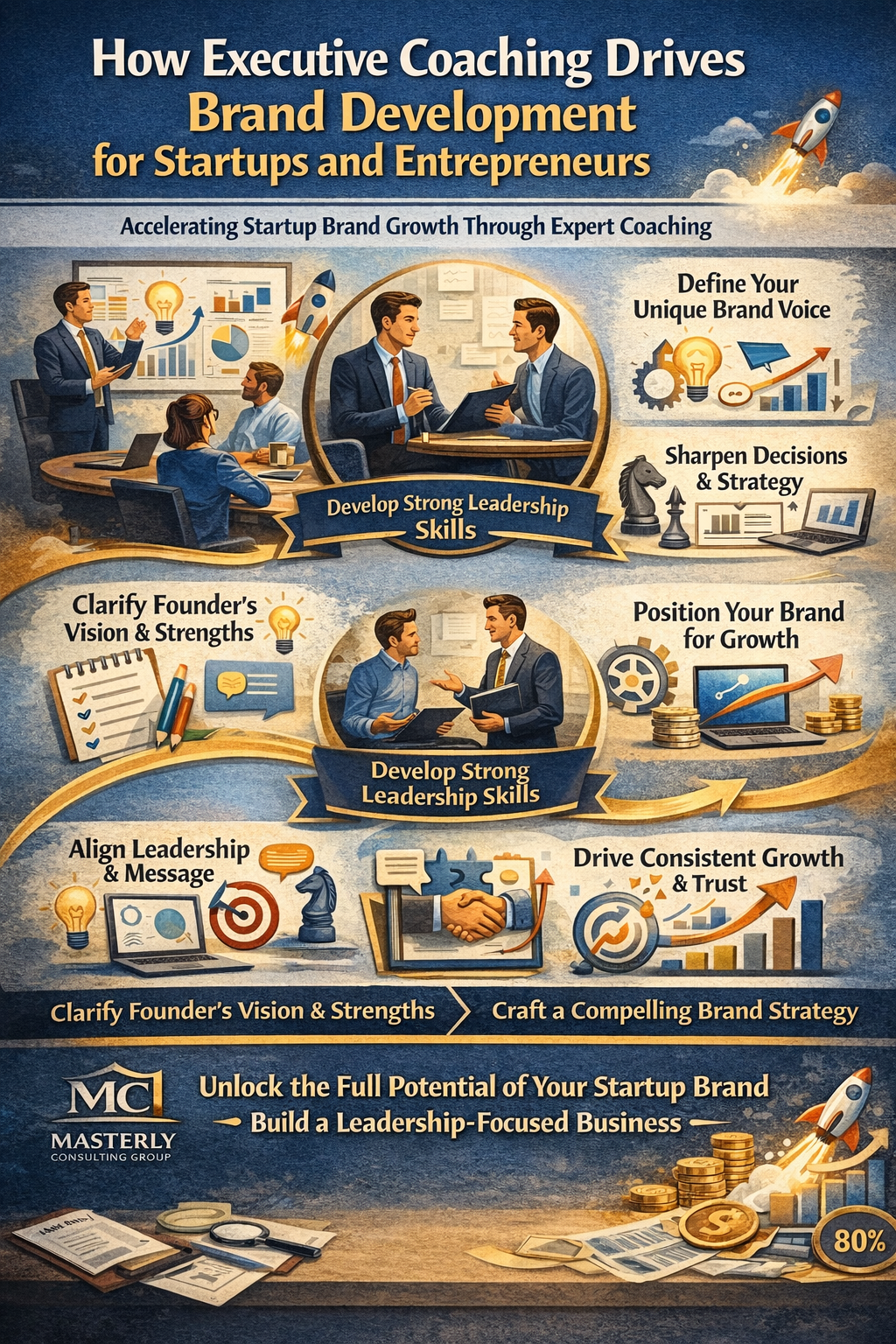
Masterly Consulting Group Approach to Executive Coaching
At Masterly Consulting Group, we design executive coaching engagements for entrepreneurs who want measurable growth. We help leaders connect brand development to leadership development, team performance, and market clarity. Our executive coaching services are structured, practical, and designed for fast-moving businesses.
We work closely with clients to clarify their brand promise, strengthen their leadership presence, and build systems that support consistent delivery. We support founders, senior leaders, and growing teams across multiple industries. Our coaching focuses on clarity, confidence, and sustainable execution.
When you invest in coaching, you invest in the foundation of your brand. You build leadership maturity, stronger communication, and a brand people trust. That is what creates long-term differentiation.
Contact Masterly Consulting Group for Executive Coaching
If you are building a startup and you want a brand that stands out without feeling forced, executive coaching can help you get there faster. Coaching gives entrepreneurs a clear process to shape brand identity, lead teams confidently, and communicate value in a way the market understands. It is also one of the most practical ways to move from scattered effort to focused execution.
Call (888) 209-4055 to book a free consultation with Masterly Consulting Group. We will talk through your goals, your market challenges, and how our executive coaching services can support leadership growth and brand development. If you are ready to lead with clarity and build a brand that earns trust from the start, we are ready to support you.