Navigating Clery Act and Title IX Obligations with a Higher Education Lawyer
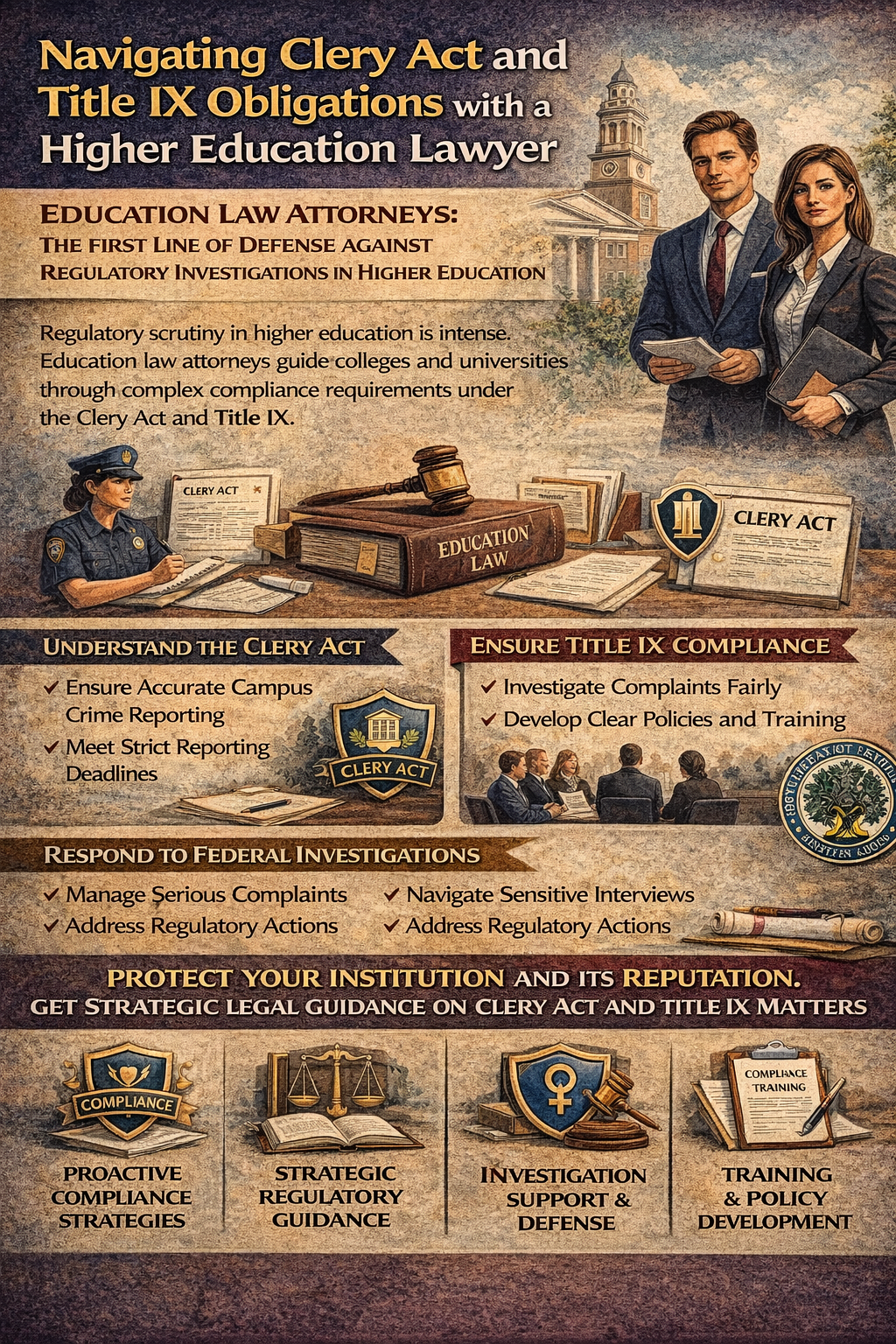
Education Law Attorneys: The First Line of Defense Against Regulatory Investigations in Higher Education
Colleges, universities, and schools today operate under intense scrutiny. Regulatory expectations continue to evolve, enforcement actions are increasing, and even well-intentioned institutions can find themselves under investigation with little warning. For leaders in higher education, compliance with the Clery Act and Title IX is no longer just a legal obligation—it is a defining part of institutional trust, accountability, and long-term success. At Masterly Consulting Group, we work alongside educational institutions to navigate these challenges with clarity, strategy, and confidence.
Many organizations only seek help after a complaint or investigation begins. By that point, options may already be limited. A proactive approach—supported by education law attorneys and informed educational consulting—can make the difference between disruption and stability. Understanding how Clery Act and Title IX obligations intersect with institutional operations is essential for protecting students, staff, and the future of the institution.
Why Compliance Has Become Central to Higher Education Leadership
Higher education institutions are expected to demonstrate transparency, fairness, and accountability. Federal oversight has expanded, and reporting requirements are more complex than ever. Schools that fail to meet these standards face reputational harm, financial penalties, and loss of trust.
Compliance is not separate from mission. It directly impacts student success, student learning outcomes, and the ability of institutions to provide high quality education. Strong compliance frameworks support safer campuses and stronger educational systems.
Understanding the Clery Act in Today’s Regulatory Climate
The Clery Act requires colleges and universities to disclose campus crime statistics and security policies. While the law itself is longstanding, enforcement has become more aggressive. Investigations often examine not just reports, but institutional processes and decision-making.
Schools must ensure accuracy, consistency, and timely disclosure. Errors—whether intentional or accidental—can trigger serious consequences. This is where deep expertise and legal guidance become critical.
Title IX Obligations Beyond the Basics
Title IX governs how educational institutions respond to sex-based discrimination and misconduct. Recent regulatory changes have added complexity, especially around investigations, hearings, and due process. Institutions must balance fairness, safety, and compliance.
Missteps in Title IX cases often stem from unclear procedures or inconsistent training. These issues can undermine student confidence and expose schools to legal risk. Strategic oversight helps institutions maintain integrity while meeting federal expectations.
How Clery Act and Title IX Intersect
Clery Act and Title IX obligations often overlap, particularly in cases involving sexual misconduct. Institutions must coordinate reporting, investigations, and communication carefully. Failure to align these processes can lead to conflicting outcomes.
A higher education lawyer helps ensure that obligations under both frameworks are met without contradiction. Alignment supports accountability and protects institutional credibility.
The Role of Education Law Attorneys During Investigations
When a regulatory investigation begins, time and precision matter. Education law attorneys serve as the first line of defense, guiding institutions through complex inquiries. They help manage document production, interviews, and communication with regulators.
Their role is not just defensive. Attorneys help institutions understand root causes, identify gaps, and implement corrective strategies that reduce future risk.
Why Educational Consulting Strengthens Legal Compliance
Educational consulting complements legal guidance by addressing operational and cultural factors. Policies alone are not enough if staff lack training or clarity. Consulting helps institutions embed compliance into daily practice.
At Masterly Consulting Group, we integrate education consulting with legal insight. This approach supports sustainable solutions rather than temporary fixes.
Protecting Students While Preserving Institutional Integrity
Compliance frameworks exist to protect students, but they also safeguard institutions. When implemented correctly, they promote fairness, transparency, and trust. This balance is essential for student success and community confidence.
Institutions that prioritize student needs while maintaining due process are better positioned to achieve positive outcomes. This alignment reinforces high quality education and institutional values.
The Impact of Compliance on Student Outcomes
Effective compliance systems directly influence student outcomes. Clear reporting mechanisms and fair processes create safer learning environments. Students are more likely to engage and succeed when they feel protected and heard.
Improving education through compliance is not abstract. It shapes daily experiences, student performance, and long-term success.
Building Systems That Support Student Learning Outcomes
Clery Act and Title IX compliance should support—not hinder—student learning outcomes. When systems are clear and trusted, disruptions are minimized. This allows institutions to focus on teaching, learning, and innovation.
Educational systems designed with compliance in mind foster consistency and resilience. They support both academic and institutional goals.
Leadership Responsibilities in Higher Education Compliance
Organizational leadership plays a central role in compliance. Leaders set tone, allocate resources, and establish accountability. Without leadership commitment, even strong policies fail.
Education leaders must understand their responsibilities and act decisively. Strategic planning ensures that compliance aligns with broader institutional priorities.
Accountability as a Foundation for Trust
Accountability is essential in education institutions. Regulators expect it, students demand it, and communities rely on it. Transparent processes demonstrate responsibility and care.
Strong accountability frameworks reduce risk and enhance credibility. They also support long-term financial sustainability.
Supporting Teachers and Educators Through Change
Teachers and educators are often on the front lines of compliance implementation. Clear guidance and training help them navigate complex responsibilities. Without support, confusion and burnout increase.
Educational consulting helps bridge gaps between policy and practice. This empowers educators to focus on teaching and student success.
Training as a Preventive Strategy
Regular training reduces compliance failures. It equips staff with knowledge, skills, and confidence. Training also promotes consistency across departments and programs.
Institutions that invest in training see fewer errors and stronger outcomes. This proactive approach supports sustainable growth.
Addressing the Needs of Young People
Every young person deserves a safe and supportive educational environment. Compliance frameworks are designed to protect children and students at all levels. This includes early childhood education through higher education.
Meeting these obligations supports educational opportunities and long-term success for students.
Early Childhood and K-12 Considerations
While this article focuses on higher education, early childhood and K-12 schools also face compliance pressures. Systems developed in higher education often influence school systems more broadly.
Lessons learned at the college level can inform best practices across educational institutions. This continuity strengthens educational systems overall.
Expanding Access and Economic Mobility
Strong compliance frameworks support economic mobility by protecting access to education. When institutions operate fairly and transparently, underserved communities benefit. Trust enables participation and engagement.
Education remains a powerful driver of opportunity. Compliance supports that mission.
Workforce Development and Institutional Stability
Compliance impacts workforce development by shaping institutional reputation. Schools that manage risk effectively attract talent and partners. This supports sustainable solutions and long-term growth.
Institutions with strong compliance cultures are better positioned to drive growth and innovation.
Innovation Within Regulatory Boundaries
Innovation and compliance are not opposites. With the right strategy, institutions can innovate responsibly. Legal and consulting partners help identify pathways that support creativity while meeting obligations.
Innovation grounded in compliance protects future opportunities.
Using Insights to Improve Systems
Data, audits, and reviews generate insights that drive improvement. Institutions that learn from investigations become stronger. They address root causes rather than symptoms.
Continuous improvement supports meaningful change and institutional resilience.
Partnering for Long-Term Success
No institution should navigate regulatory complexity alone. Partnering with experienced advisors brings perspective and expertise. Collaboration leads to better outcomes.
At Masterly Consulting Group, we act as a partner, not just a service provider.
How Masterly Consulting Group Supports Institutions
Masterly Consulting Group provides education consulting informed by legal awareness and sector knowledge. Our team includes former teachers and experienced professionals with deep expertise across education.
We help organizations develop strategies that align compliance, mission, and growth.
Serving Educational Institutions at All Levels
We work with schools, colleges, and universities across the education spectrum. From early childhood programs to higher education institutions, our services adapt to institutional needs.
Our clients benefit from tailored guidance and practical solutions.
Creating Sustainable Compliance Frameworks
Sustainable compliance requires more than policies. It requires systems, training, and leadership alignment. We help institutions create frameworks that endure.
These frameworks support accountability, innovation, and success.
Focusing on the Future of Education
Education is constantly evolving. Institutions must prepare for future regulatory shifts while meeting current obligations. Forward-looking strategies protect institutional life and mission.
Preparation today reduces disruption tomorrow.
Achieving Balance Between Risk and Opportunity
Every institution faces risk, but also opportunity. With the right guidance, schools can manage both. Compliance becomes a foundation for confidence rather than fear.
This balance supports institutional success and student trust.
Using Compliance to Improve Student Outcomes
Strong compliance frameworks do more than satisfy regulations—they help improve student outcomes across institutions. When policies are clear and consistently applied, students experience safer, more supportive learning environments. This stability allows institutions to focus on academic quality and engagement. Over time, compliance-driven clarity supports better retention and completion rates. Ultimately, compliance becomes a tool for improving education, not just managing risk.
Supporting Educational Organizations Through Change
Educational organizations face constant pressure to adapt to regulatory, social, and technological shifts. Navigating these changes requires coordinated leadership and informed decision-making. Institutions that proactively address compliance challenges are better positioned to remain stable and competitive. External guidance helps organizations align policy, culture, and operations. This alignment strengthens institutional resilience.
Strategy Development for Long-Term Institutional Health
Effective strategy development integrates compliance, mission, and growth goals. Institutions that treat compliance as part of their strategic framework avoid reactive decision-making. Strategic planning ensures that Clery Act and Title IX obligations support, rather than disrupt, institutional priorities. This approach reduces risk while promoting sustainability. Clear strategy supports confident leadership.
Managing Online Growth in Higher Education
Online growth has expanded access to education while introducing new compliance considerations. Virtual learning environments still fall under federal reporting and conduct requirements. Institutions must adapt policies to reflect online student experiences. Failure to do so can create compliance gaps. Thoughtful planning ensures that growth does not outpace oversight.
Becoming a Global Leader Through Accountability
Institutions that demonstrate accountability and transparency are more likely to be viewed as a global leader in education. Compliance plays a key role in shaping international reputation. Global partners and students expect consistent standards at global levels. Meeting these expectations builds trust and credibility. Strong governance supports international engagement.
Aligning Talent Strategy With Compliance Goals
A thoughtful talent strategy ensures that staff are prepared to meet regulatory responsibilities. Hiring, training, and retention practices must support compliance objectives. Institutions that invest in talent development reduce errors and improve responsiveness. Skilled teams strengthen institutional confidence during investigations. Talent strategy directly impacts outcomes.
Compliance as a Tool to Increase Enrollment
Trust and transparency influence enrollment decisions. Institutions known for accountability are more attractive to students and families. Compliance failures can quickly undermine recruitment efforts. By maintaining strong systems, schools increase enrollment through credibility. Reputation remains a powerful enrollment driver.
Operating Effectively at Global Levels
Institutions operating at global levels face layered compliance expectations. International programs must align with U.S. regulations and local standards. Coordination across borders requires clarity and oversight. Institutions that manage this complexity effectively reduce risk. Global consistency strengthens institutional identity.
Compliance Challenges Unique to Higher Ed
Higher ed institutions face distinct regulatory pressures due to size, diversity, and public scrutiny. The complexity of campuses increases exposure to compliance risk. Navigating these challenges requires specialized knowledge. Institutions benefit from advisors who understand higher ed environments. Targeted guidance supports better decision-making.
Contact Masterly Consulting Group for a Free Consultation
Navigating Clery Act and Title IX obligations does not have to be overwhelming. At Masterly Consulting Group, we provide educational consulting that helps institutions respond to regulatory challenges with clarity and confidence. We partner with education leaders to strengthen compliance, protect students, and support sustainable growth. If your institution is facing regulatory questions or wants to prepare proactively, contact us today.
Call (888) 209-4055 to book a free consultation and discover how our team can support your goals.