Risk Management Consultant: Building Practical Controls Before a Business Problem Becomes a Crisis
Many business risks do not begin as major crises.
They begin as a missed approval. An important task depends on one employee. A vendor problem has no clear response plan. A manager handles an issue differently from another manager. A process exists, but no one has documented who owns it or what happens when it fails.
Individually, these problems may seem manageable. Together, they can expose weaknesses in the way a company operates.
A risk management consultant helps leadership identify and organize business risks before those weaknesses become harder to manage. The goal is not to convince a company that every possible problem is around the corner. It is to help leaders understand meaningful risks, establish practical business controls, assign responsibility, and make informed decisions about what deserves attention.
Masterly Consulting Group provides business consulting that includes risk and compliance management, process optimization, strategic planning, and operational improvement. For companies that have grown faster than their internal controls, professional risk consulting can help bring greater structure to the business.
Growth Can Create Risk Faster Than Leadership Realizes
A process that worked when a company had five employees may become unreliable when it has fifty.
A business owner who once approved every major decision personally may no longer have time to do so. In larger organizations, new managers gain responsibility, including regional managers coordinating added locations. More vendors become involved. Customer volume grows. Technology changes. Additional locations or departments may create new handoffs across human resources and other functions within an organization.
The company has grown, but its controls may still reflect an earlier version of the business.
That creates operational risk.
Operational risk can arise from weaknesses or failures involving people, processes, systems, vendors, or other parts of day to day operations. For leadership, the practical concern is whether important operations depend too heavily on assumptions, informal knowledge, or inconsistent decisions that affect the company's ability to use resources well.
A growing company needs more than good intentions. The goal is not to convince a company that risk can be eliminated, but to support development and prepare for future uncertainty. It is to help leaders understand meaningful risks in a way that supports business management, aligns with organizational goals, and fits the practical realities of the business.
What a Risk Management Consultant Helps Leadership See
Business leaders are often very close to their operations.
That experience is valuable, but familiarity can also make certain weaknesses feel normal.
"We have always handled it that way."
"Only one person knows that system."
"The manager will catch it."
"We will deal with that if it happens."
Those statements may point to risks worth evaluating.
A risk management consultant provides an outside perspective that can help leadership examine where the business depends on undocumented knowledge, unclear ownership, weak controls, inconsistent processes, or limited contingency planning, and help identify risks across operations, corporate governance, and corporate strategy.
As organizations grow, day-to-day operations often change faster than the systems around them, and in larger organizations new locations, departments, and regional managers can create additional handoffs that senior management does not fully see. A proactive review helps leadership understand the current risk landscape instead of relying on a reactive approach after issues surface.
The objective is not to eliminate all risk. Business involves risk, including strategic risk shaped by internal decisions and external factors such as external events or natural disasters.
The objective is to make important risks more visible so leadership can decide how they should be managed, protect the company's ability to use people and resources effectively, and support broader business management development and organizational goals.
Risk Assessment Should Lead to Business Decisions
A risk assessment should do more than create a long list of things that could go wrong.
A practical assessment connects risks with decisions and improves the decision making process.
One useful framework is:
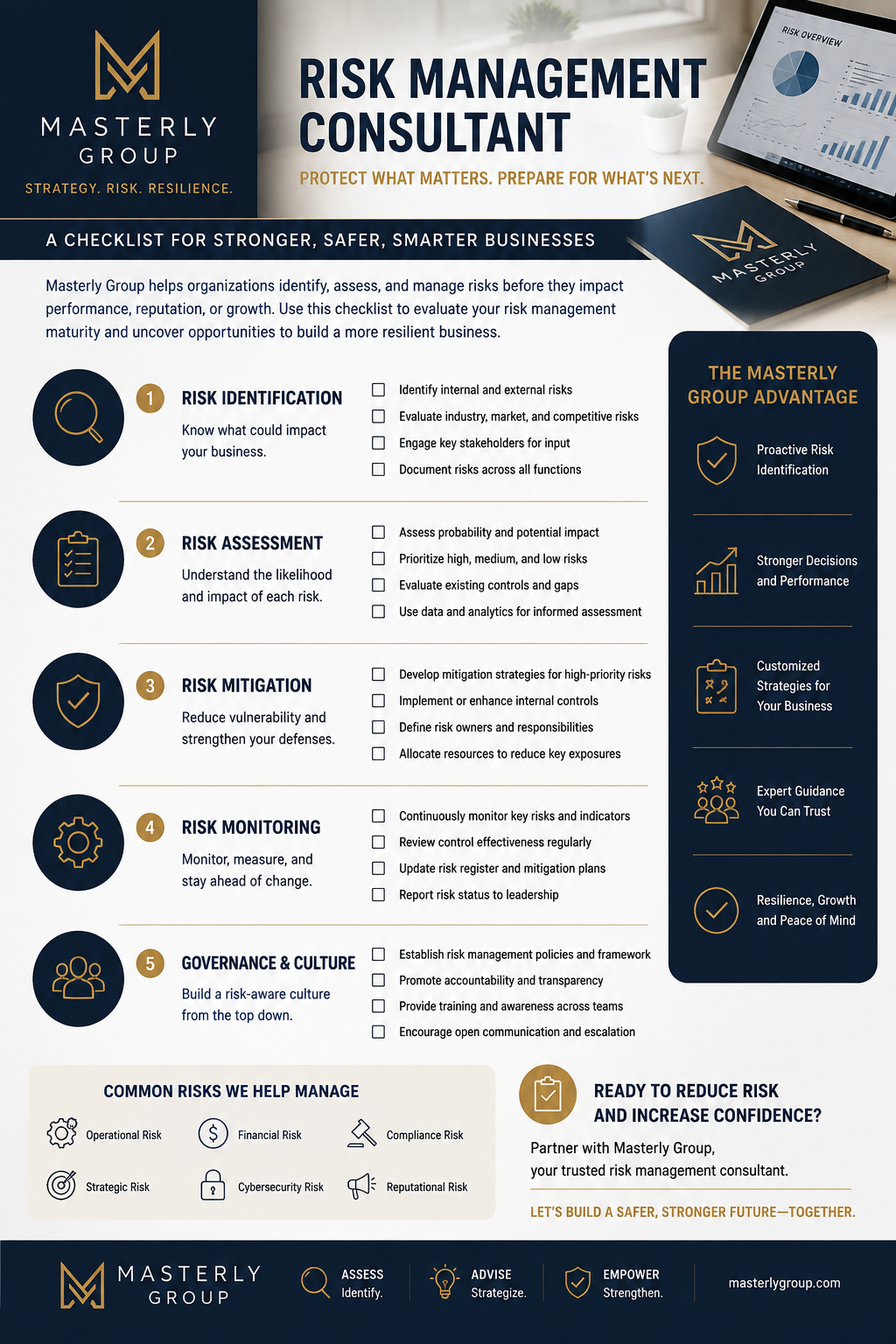
Identify. Evaluate. Control. Assign. Review.
This is not a do-it-yourself checklist. It illustrates what leadership should expect from a structured risk-management engagement: risk management processes that help leadership identify risks across operations and the current risk landscape, supported by risk analysis and clear strategies. The four main types of business risk are strategic, compliance, operational, and reputational. Some risks come from external factors or external events such as natural disasters, while others relate to corporate strategy or corporate governance. A reactive approach leaves senior management dealing with issues after they occur rather than earlier. This is an ongoing process, not a one-time exercise.
Identify the Risk in Business Terms
A useful risk statement should explain the actual business concern.
For example, "employee turnover" is broad.
A more meaningful concern might be that one employee controls a critical process and the organization has no documented backup procedure.
Now leadership can understand what is exposed and what the decision making process needs to address. Structured assessments often start with risk identification and may use qualitative and quantitative analysis to assess risks and inform response strategies.
The same principle applies to vendor relationships, customer processes, financial controls, data access, operational procedures, staffing, and related areas of the business. A practical assessment connects risks with decisions by creating clearer priorities through risk analysis. This is an ongoing process, not a one-time exercise.
Evaluate What Deserves Attention
Not every risk deserves the same response, and risk identification in business terms starts by clarifying which events could occur and why they matter.
A minor inconvenience should not receive the same leadership attention as a problem that could seriously disrupt operations.
A risk assessment helps organize those differences.
Leadership can consider factors such as how likely a problem appears to be, how serious the potential impact could be, what controls already exist across related business functions, and where additional attention may be appropriate.
This creates a clearer risk statement leadership can act on, because effective prioritization involves evaluating each concern instead of treating every issue as equally urgent.
A Risk Register Turns Concerns Into Something Leadership Can Manage
When risks live only in conversations, they can be forgotten.
A risk register provides a structured way to document identified business risks and relevant information about them, helping teams manage risks across the current risk landscape.
Depending on the engagement and organization, that may include the nature of the risk, business area affected, existing controls, responsible owner, planned response, status, review considerations, and risk mitigation strategies.
The value is accountability, but also the effectiveness of decisions when the register is reviewed and updated as an ongoing process.
Consider a company that recognizes a major vendor dependency.
Without structure, leadership discusses the concern during a meeting and moves to the next issue.
With an organized risk-management process, the concern can be documented, ownership established, existing safeguards reviewed, and appropriate mitigation considered based on likelihood, potential impact, and whether the event could occur under current conditions.
The risk has not magically disappeared.
Leadership is simply managing it deliberately instead of relying on memory.
Business Controls Should Address Real Weaknesses
Business controls are measures designed to help leadership reduce, detect, or manage identified risks.
A control might involve an approval process, separation of responsibilities, documented procedures, access restrictions, review requirements, backup processes, reporting, or another safeguard appropriate to the operation. A risk register may also include the risk owner, existing controls, planned actions, due dates, and escalation notes, and it should act as a living document that needs constant updates as the current risk landscape changes.
More controls are not automatically better.
Poorly designed controls can create unnecessary work while doing little to address the actual risk.
For example, requiring three approvals for every routine decision may slow operations without meaningfully protecting the company.
A better control is tied to a defined problem.
That distinction matters.
Risk management should help the business operate with greater discipline, not bury employees in procedures that have no clear purpose. The value is accountability, and the register should be reviewed during regular risk meetings to monitor ownership, mitigation, and control effectiveness, with internal audit supporting ongoing review where appropriate.
Mitigation Planning Answers the Question: What Are We Going to Do About It?
Identifying a risk is only the beginning.
Mitigation planning addresses the response.
Some risks may justify additional controls. Others may require process changes, training, clearer ownership, stronger documentation, vendor planning, technology changes, policy and procedure creation, or another business response.
Effective plans also consider the people, tools, and other resources needed to carry them out. Some controls are designed to mitigate compliance risk, including the risk of fines for noncompliance with regulations, and policy and procedure creation can help ensure compliance with regulations.
Leadership may also determine that certain risks can be accepted after considering their significance and existing safeguards. Leadership may also review control effectiveness through internal audit or a similar review activity as these strategies are adjusted.
The important point is that the decision should be intentional and aligned with broader financial goals.
A company should be able to move from:
"We know this could be a problem"
to:
"We understand the risk, who owns it, what controls exist, and what action we have decided to take."
That is a much stronger management position.
Operational Risk Often Appears at the Handoffs
Many problems happen between departments rather than inside one department.
Sales believes operations owns the next step.
Operations believes finance is responsible.
Finance assumes the manager approved it.
The manager assumes the system handled it automatically.
No individual process looks obviously broken, but the handoff between processes creates the weakness.
This is why business risk management should consider how work moves across the organization.
Who owns the next action?
What information must transfer?
What happens when information is missing?
Who notices when a step is skipped?
What happens when the normal person is unavailable?
These questions can reveal vulnerabilities that are easy to miss when departments are reviewed separately.
Business Risk Management Also Protects the Customer Experience
Operational problems do not always remain internal.
Customers can experience them.
They notice when one employee gives a different answer from another. They notice missed follow-ups, billing errors, delayed work, lost information, inconsistent service, and unclear responsibility.
Those experiences can affect trust in the company.
That makes business risk management relevant to brand and reputation as well as internal operations.
A strong brand promise is difficult to maintain when the processes behind that promise are inconsistent.
Practical risk management helps connect what a company says it will deliver with the operational structure needed to support that commitment.
Risk Management Should Not Be Confused With Legal Advice
Business risk and legal risk can overlap, but they are not identical.
A business consultant may help leadership evaluate operational processes, accountability, business controls, strategic risks, and organizational weaknesses.
Questions about specific legal obligations, regulatory interpretations, contracts, liability, or legal conclusions may require qualified legal counsel.
Keeping those roles clear is important.
The purpose of business risk consulting is not to promise that a company will never experience a problem or to declare it legally protected. It is to help leadership make more structured decisions about business operations and identified risks.
When Outside Risk Management Support Makes Sense
Businesses often seek help after a problem has already occurred.
There can be greater value in reviewing operations earlier.
Professional support may be worth considering when the organization is growing, adding employees or locations, changing leadership responsibilities, relying heavily on key individuals, introducing new systems, experiencing repeated operational problems, or struggling to determine who owns important processes.
Another warning sign is inconsistency.
If leadership knows that the company has policies or procedures but cannot tell whether they are followed consistently, the issue may deserve closer examination.
The same applies when risk discussions happen repeatedly but rarely lead to documented decisions or assigned responsibility.
Masterly Consulting Group Provides Business and Risk Management Support
Risk does not exist in a separate department from the rest of the company.
It connects with operations, strategy, employees, leadership, compliance, vendors, processes, and growth.
That is why risk management benefits from a broader business perspective.
Masterly Consulting Group currently provides tailored business consulting for companies seeking help with strategic planning, process optimization, efficiency improvement, risk and compliance management, market expansion, and digital transformation. The firm's stated consulting process includes understanding business challenges, developing a customized plan, supporting implementation, and evaluating progress.
Businesses evaluating operational weaknesses can explore Masterly Consulting Group's business consulting services. This is the most relevant existing internal destination because risk and compliance management is currently identified as part of the firm's broader business-consulting offering.
The purpose is not to hand leadership a generic risk template.
It is to understand how the organization operates and where greater structure may be needed.
Risk Management Consultant FAQ
What does a risk management consultant do?
A risk management consultant helps organizations identify, assess, organize, and respond to business risks. The work may include reviewing operational weaknesses, existing controls, responsibilities, and mitigation priorities.
What is a risk assessment?
A risk assessment is a structured evaluation that helps organizations identify risks, support risk management processes, and understand their potential impact, existing controls, and areas that may require further attention. It also includes risk analysis and involves evaluating likelihood, consequences, and developing response strategies. Depending on the engagement, this may also include regulatory compliance assurance to help organizations stay updated on regulatory changes, or cybersecurity and technology risk assessments that review IT infrastructure and data security.
What is operational risk?
Operational risk involves potential problems connected with normal business operations, including people, processes, systems, vendors, and internal procedures in day-to-day operations. A risk assessment, or risk analysis, evaluates the likelihood, potential impact, existing controls, and priorities for further action, while also considering external factors and external events such as natural disasters that can disrupt the business.
What are business controls?
Business controls are safeguards or procedures designed to help prevent, detect, reduce, or manage identified business risks.
What is a risk register?
A risk register is an organized record of identified risks and relevant management information, which may include ownership, controls, response plans, and status.
What is mitigation planning?
Mitigation planning involves deciding what actions should be taken to reduce or manage an identified risk.
Can a business eliminate all risk?
No. Every business faces risk. Effective business risk management is about understanding significant risks and making informed decisions about how they should be managed.
Is risk management consulting the same as legal advice?
No. Business risk consulting may address operations, processes, controls, and management decisions. Specific questions about laws, legal obligations, liability, or regulatory interpretation should be addressed by appropriately qualified legal counsel.
When should a business hire a risk management consultant?
A company may consider a consultant when growth, operational changes, repeated process failures, unclear accountability, vendor dependence, leadership changes, or other concerns reveal weaknesses that require a more structured review.
Does Masterly Consulting Group provide risk management consulting?
Masterly Consulting Group currently lists Risk and Compliance Management among the key services within its business-consulting practice, along with strategic planning and process optimization. Contact the firm to discuss the specific needs and scope of your organization.
Request a business risk and operations consultation
A business does not have to wait for an operational weakness to become an expensive disruption before examining it.
If leadership is concerned about unclear responsibilities, inconsistent processes, weak controls, key-person dependencies, recurring operational problems, or risks that have never been formally organized, a risk management consultant can help bring those concerns into a more structured business process.
Masterly Consulting Group provides customized business consulting that includes risk and compliance management, operational improvement, process optimization, and strategic planning.
The objective is practical: understand the important risks, determine where stronger business controls may be appropriate, assign accountability, and develop a clearer path forward.
Call Masterly Consulting Group at (972) 236-5051 or visit MasterlyGroup.com to request a business risk and operations consultation.