Leadership Retreat: Turning Time Away From the Office Into Decisions and Follow-Through
A leadership team can spend an entire day away from the office and still return with the same unresolved problems.
The room may be comfortable. The conversation may be thoughtful. Everyone may agree that communication needs to improve, priorities need to become clearer, and the company needs stronger alignment.
Then Monday arrives.
Urgent work takes over. Different leaders interpret the discussion differently. Important decisions remain unfinished. No one is completely sure who owns the next step.
A professionally facilitated leadership retreat is a focused session that brings executives, senior leaders, or a full leadership team together away from normal operational demands to work through important business, strategy, alignment, and leadership issues. It should do more than create time to talk. It should help leadership move from discussion to decisions, clarify the issues on the table, establish ownership, connect strategy to operations, and create a clearer path for follow-through and measurable outcomes.
Masterly Consulting Group works with organizations on strategic planning, leadership development, decision-making, and business operations. For leadership teams that need protected time to address strategic priorities, leadership alignment, and the decisions that shape both current performance and the future, a structured retreat creates space for the conversations routine meetings often leave unresolved—and gives those conversations a structure that supports commitment, accountability, stronger culture, and execution.
A Leadership Retreat Should Solve a Business Problem
The retreat itself is not the goal.
The business problem is the reason for bringing leaders together.
A company may have several departments moving in different directions. Executives may agree on the overall vision but disagree about priorities. A growing organization may need decisions about structure, accountability, resources, or the next stage of growth.
Those are leadership problems.
Booking a meeting room and asking everyone to share ideas does not automatically solve them.
A useful retreat starts with clarity about what leadership needs to accomplish and how that connects to the organization's mission.
For example:
A leadership team debating ten possible initiatives may need to identify the three priorities that deserve attention first.
A company going through rapid growth may need clearer roles and decision rights to create clear direction.
A senior team experiencing repeated conflict may need agreement about how major decisions will be handled.
A leadership planning session becomes valuable when it is built around these real business needs rather than a generic list of retreat activities.
Leadership Offsite Time Should Be Different From Another Management Meeting
Executives already attend meetings.
That means a leadership offsite should not simply recreate the weekly leadership meeting in another location.
Routine meetings are usually dominated by immediate, day to day management work rather than retreat-level discussion.
Sales numbers need discussion.
A hiring decision needs approval.
A customer situation needs attention.
A deadline is approaching.
Those issues matter, but they can crowd out longer-term questions.
Where is the organization going?
Which priorities deserve leadership attention?
What is no longer working?
Where are responsibilities unclear?
Which decisions have been postponed?
What does the leadership team need from one another?
An offsite creates protected space and designated time for those questions.
The value comes from using that space intentionally.
A Practical Framework for a Leadership Retreat
A productive retreat can be viewed through four stages — the key to a more productive retreat:
Clarify. Decide. Assign. Follow Through.
This is not a do-it-yourself retreat formula. It is a practical way to understand what a facilitated engagement should help leadership achieve in follow-through, not just discussion.
Clarify the Real Issues
Many leadership teams begin retreats with symptoms.
"We need better communication."
"We need more accountability."
"We need to work together."
Those statements may be true, but they are broad.
A facilitator helps leadership move toward more specific questions and creates enough safety for leaders to share openly.
Where is communication breaking down?
What decisions lack ownership?
Which priorities are competing with one another?
Where do leaders have different assumptions?
Greater clarity makes the discussion more useful.
Psychological safety supports team learning and performance during the retreat.
Instead of spending an hour agreeing that communication matters, the team can focus on the actual business situations creating the concern.
Make the Decisions That Keep Getting Delayed
Leadership teams can become very good at discussing difficult issues without resolving them.
The same topic appears at several meetings.
Different opinions are expressed.
Someone promises to gather more information.
Then the subject returns weeks later.
A strategic retreat creates an opportunity to move some of those conversations toward decisions that clarify shared outcomes.
Not every complex issue can be resolved in one session.
Psychological safety promotes team learning and performance during retreats.
The purpose is to identify which questions can be decided, which need more information, and who owns what happens next.
That prevents the retreat from ending with another collection of unfinished conversations instead of agreed next steps.
Leadership Alignment Does Not Mean Everyone Thinks the Same Way
Leadership alignment is sometimes misunderstood as complete agreement.
Strong leadership teams can disagree.
Different executives may see risks, opportunities, or priorities differently because they are responsible for different parts of the organization.
Those differences can be useful when different leader ability and perspectives strengthen the discussion around a shared direction.
The problem appears when leaders leave a discussion with different understandings of what was decided.
For example, a CEO may believe the company agreed to prioritize customer retention.
The sales leader may leave believing new customer acquisition is still the main objective.
The operations leader may assume efficiency is the priority.
Everyone attended the same meeting.
Everyone heard the same conversation.
The organization still has three directions.
Leadership alignment means creating enough clarity and more clarity where needed so leaders understand the final decision, the reasoning behind it, and their responsibility for carrying it forward.
The Retreat Agenda Should Serve the Decisions
A retreat agenda matters because executive attention is limited, so clear focus areas should shape what gets discussed.
Trying to solve every organizational problem in one day can produce shallow discussion across too many subjects.
A focused agenda creates room to address fewer issues with greater depth.
The sequence also matters.
A team may need to clarify strategic priorities before discussing departmental goals.
It may need to discuss organizational challenges before deciding where resources should go.
It may need to identify decisions before assigning action items.
The agenda should support the purpose of the retreat.
Done well, pre-work helps set the stage for a successful retreat experience.
That is different from filling time with exercises simply because they are common at corporate retreats.
Every significant section should contribute to the business outcome the leadership team needs.
Executive Retreats Can Reveal Problems That Normal Meetings Hide
An executive retreat can bring important differences to the surface while also strengthening relationships among leaders.
That can feel uncomfortable.
One leader believes the organization is expanding too quickly.
Another thinks leadership has become too cautious.
One department believes another team is creating delays.
Several executives may have different views about the company's most important customer segment.
These disagreements are not necessarily signs that the retreat is failing.
They may be the reason the retreat is needed.
Trust building often happens through shared personal experiences in retreats.
A facilitated environment can help leadership examine disagreements without allowing the conversation to become personal or unfocused.
The objective is not to avoid tension.
It is to turn useful tension into clearer decisions.
Strategic Planning Sessions Should Connect Strategy With Operations
A strategy that never affects what leaders do next is only a plan unless it translates into action.
A strategic retreat should create a bridge between larger direction and operational action.
Imagine that the leadership team agrees that improving customer retention is the next major priority.
That decision creates additional questions.
Which leader owns the initiative?
What departments are involved?
What needs to change?
What information should leadership review?
Which current priorities may need to receive less attention?
When will progress be discussed again?
These questions convert a strategic idea into management activity.
Management is about efficiency; leadership is about effectiveness, and strong leaders lead by influencing and inspiring others.
Without that connection, leaders may agree on the destination but return to the same daily behavior.
Follow-Through Determines Whether the Retreat Was Useful
Many retreats feel productive while they are happening.
The real test begins afterward.
If decisions are not documented, leaders may remember them differently.
If ownership is unclear, action slows.
If deadlines or checkpoints are missing, urgent work takes priority.
A retreat therefore needs a clear transition back into normal operations, because its success depends on what gets executed once the team is back at work.
The leadership team should know:
What was decided?
What remains unresolved?
Who owns each next action?
What needs to happen first?
When will progress be reviewed?
This is where the value of a leadership planning session becomes visible.
The session should produce movement after the meeting, not simply positive feelings during it.
Leadership Retreats and Self Awareness Also Affect Company Culture
Employees often experience the consequences of leadership alignment long before they know a retreat happened.
When senior leaders communicate different priorities, teams become confused.
When decisions are unclear, managers hesitate.
When accountability is inconsistent, employees may receive mixed messages.
Leadership behaviors spread through the organization and shape culture over time.
That means the quality of executive decision-making can affect company culture, employee confidence, and operational consistency.
A retreat gives leadership an opportunity to address these issues at the level where many of them begin.
The stronger the alignment among leaders, the easier it becomes for team members to understand and act on direction.
A Facilitator Helps Leaders Participate Instead of Running the Meeting
One challenge with an internally led retreat is that the person facilitating is also a participant.
The CEO may need to guide the conversation while also sharing an opinion.
An executive may be responsible for keeping the agenda moving while defending a department's priorities.
That creates competing roles.
An outside facilitator can provide more structure and facilitate the session without carrying those internal stakes.
The facilitator can help frame questions, manage time, keep discussion connected to the purpose, clarify decisions, and make room for different perspectives.
This allows senior leaders to participate more fully in the conversation.
For teams dealing with strategic growth, leadership alignment, or difficult organizational questions, that separation and outside perspective can be especially helpful.
Masterly Consulting Group Connects Leadership Team Retreats to the Larger Business
A retreat should not sit apart from the organization's strategy.
Leadership discussions connect with growth, operations, culture, accountability, change, and decision-making.
Masterly Consulting Group currently provides business consulting services focused on strategic planning, process optimization, growth, and risk management. Its executive coaching work also addresses leadership development, decision-making, change management, conflict resolution, and employee relations.
That broader consulting perspective is important when facilitating executive conversations, including a strategic planning session.
A leadership team may enter a retreat discussing communication and discover that the deeper issue involves unclear responsibilities.
Another may begin with strategic priorities and uncover misalignment around values.
Another may realize its growth goals require stronger leadership capability.
These issues are connected.
Organizations looking for related strategic support can explore Masterly Consulting Group's business consulting and executive coaching services. This is the most relevant existing internal destination because it supports the broader strategic planning and leadership work behind a facilitated retreat.
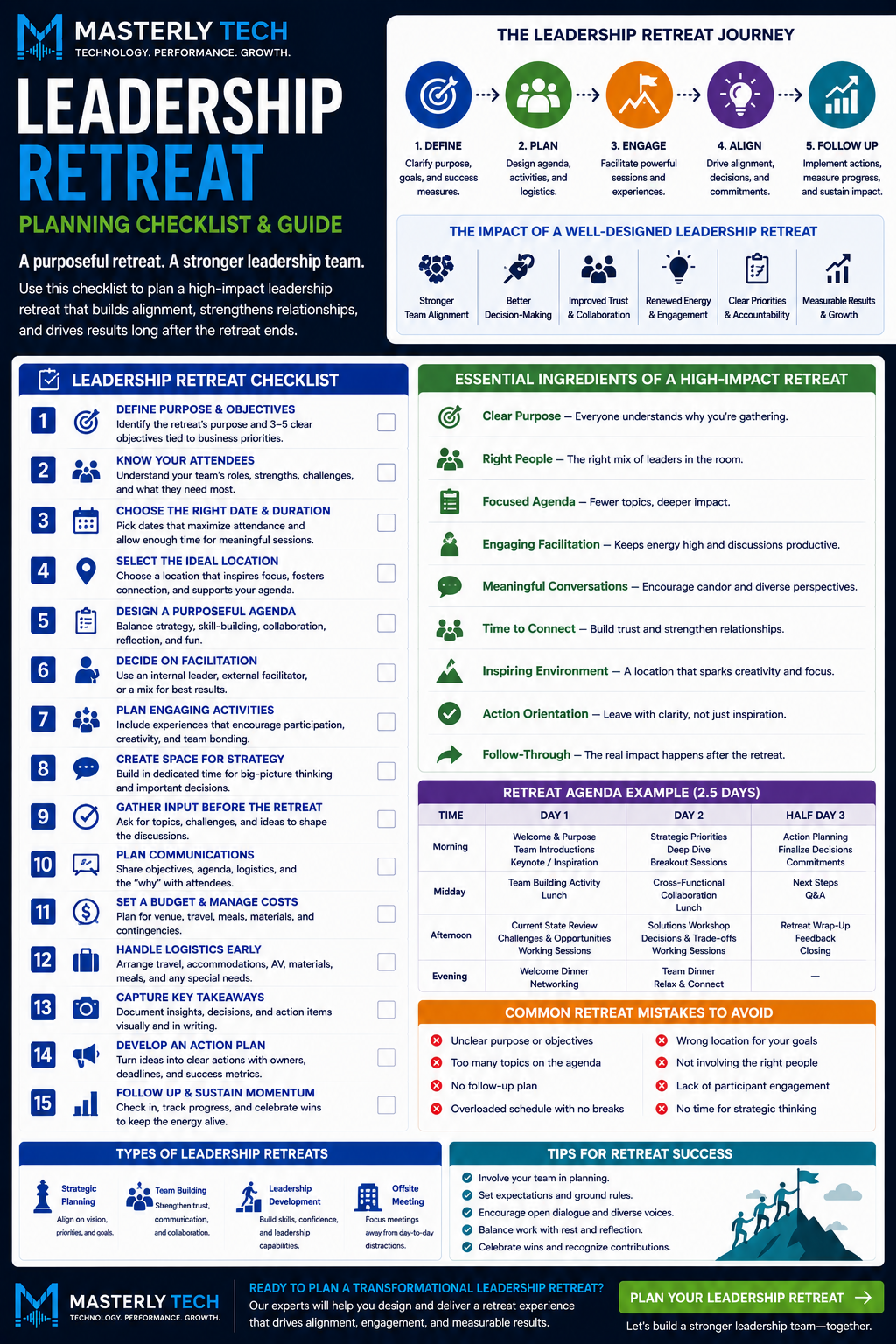
Leadership Retreat FAQ
What is a leadership retreat?
A leadership retreat is a focused session that brings leaders together away from normal operational demands to address important business, strategy, alignment, or leadership issues.
What is a leadership offsite?
A leadership offsite is a leadership meeting held outside the normal work environment to create focused time for discussion, planning, and decision-making.
What is the purpose of an executive retreat?
An executive retreat can help senior leaders address strategic priorities, difficult decisions, leadership alignment, organizational challenges, team effectiveness, and follow-through.
What should a retreat agenda focus on?
A retreat agenda should focus on the most important decisions and discussions the leadership team needs to complete. It should serve the business purpose of the retreat rather than simply fill available time, with agenda research and prep completed in advance to keep the discussion productive. Pre-work also helps set the stage for a successful retreat experience.
What is leadership alignment?
Leadership alignment means senior leaders have a shared understanding of important priorities, decisions, responsibilities, and direction, with a clear sense of shared responsibility, even when they initially have different views.
What is a strategic retreat?
A strategic retreat creates focused time for leaders to address a small number of critical priorities, make key decisions, and define the actions needed to move strategy forward. If the retreat design includes mindfulness practices, they can also reduce cognitive fatigue.
How is a leadership retreat different from a regular meeting?
A retreat usually provides more focused time for larger strategic or leadership issues that are difficult to address during routine operational meetings.
Does everyone need to agree during a leadership retreat?
No. Useful disagreement can improve decision-making. The important outcome is clarity about the final decision and what leaders are responsible for afterward.
Why use an outside facilitator for a leadership retreat?
An outside facilitator can help structure the conversation, manage the agenda, clarify decisions, and allow senior leaders to participate without also having to run the meeting. This is especially essential when the group needs structure around difficult discussions.
Does Masterly Consulting Group work with leadership teams?
Yes. Masterly Consulting Group currently provides executive coaching and business consulting services that include leadership development, decision-making, strategic planning, change management, and process improvement. Contact the firm to discuss the specific scope of your organization.
Discuss a facilitated leadership retreat
If your leadership team keeps discussing the same strategic issues without reaching clear decisions, or if executives are leaving meetings with different priorities and expectations, another routine meeting may not solve the problem.
A professionally facilitated leadership retreat can create protected time to address the issues that normal operations keep pushing aside.
Masterly Consulting Group can help leadership teams structure important conversations around strategic priorities, alignment, decision-making, accountability, and follow-through.
The objective is not simply to spend a day away from the office. It is to return with greater clarity about what was decided, who owns the next step, and what happens afterward.
Call Masterly Consulting Group at (972) 236-5051 or visit MasterlyGroup.com to discuss a facilitated leadership retreat