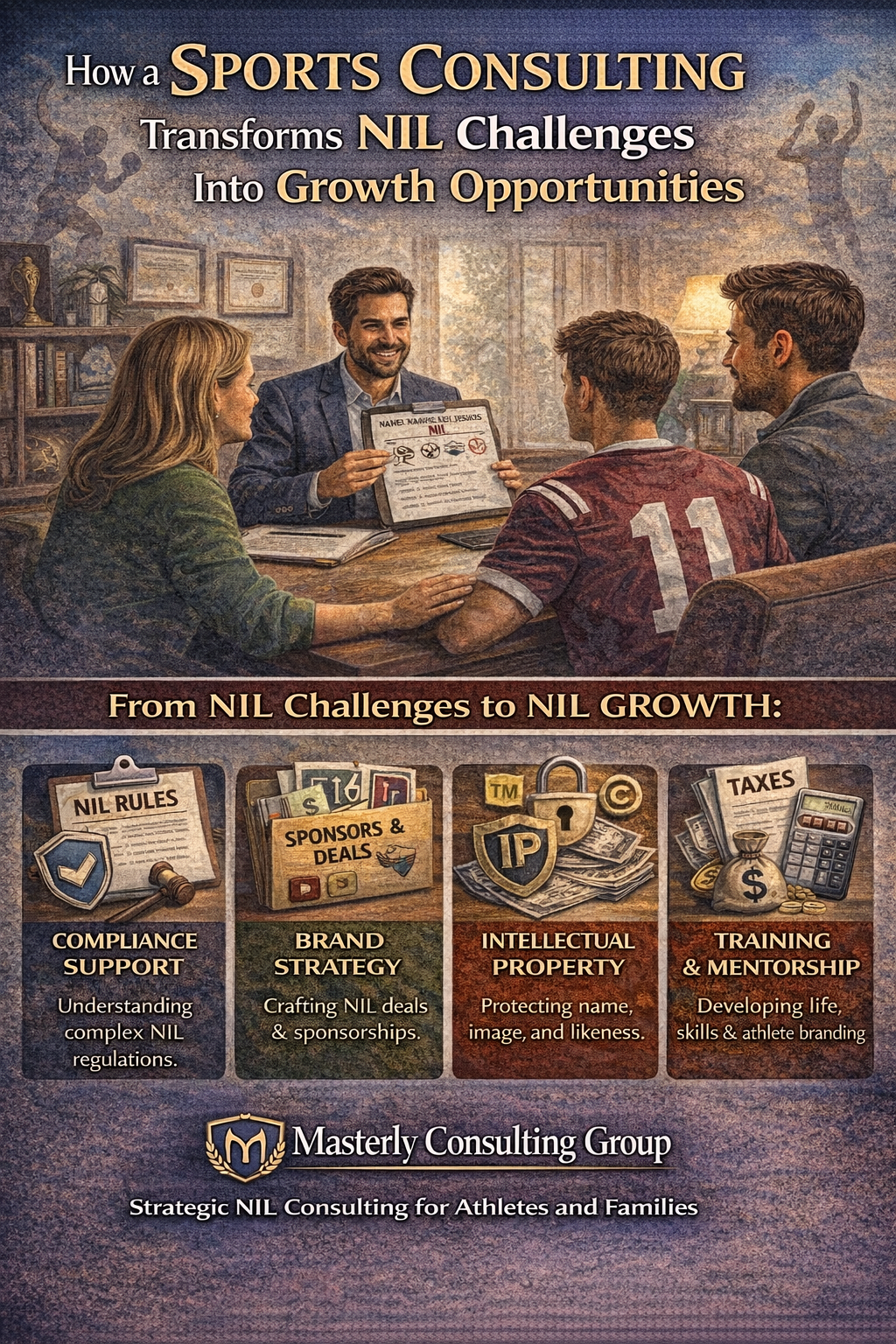
How Sports Consulting Transforms NIL Challenges Into Growth Opportunities
The introduction of name, image, and likeness rights has created a major shift in college sports and youth athletics. What was once a closed system has opened into a fast-moving marketplace where athletes can earn money, build brands, and secure opportunities far beyond the field. While this change has created excitement, it has also introduced confusion, compliance risks, and uneven access to opportunity.
For high school athletes and student athletes alike, NIL opportunities can feel overwhelming. Rules vary by state, school, and association, and the consequences of missteps can be severe. Losing eligibility, violating amateurism rules, or entering prohibited NIL activities can derail a promising career before it truly begins.
At Masterly Consulting Group, we help athletes, families, and organizations turn NIL complexity into sustainable growth. Through strategic sports consulting, education, and compliance support, NIL challenges become opportunities to build lasting value, protect eligibility, and create long-term success.
Understanding the NIL Landscape After a Major Shift
Name image and likeness rights have reshaped the relationship between athletes, institutions, and commerce. This major shift allows student athletes to profit from their image and likeness while maintaining amateur status—if rules are followed correctly.
For high school students and college athletes, NIL stands at the intersection of athletics, business, and law. Understanding where opportunities exist and where boundaries lie is essential. Without guidance, athletes may unknowingly violate NIL rules.
Why NIL Is Especially Complex for High School Athletes
High school athletes face stricter limitations than their college counterparts. High school NIL rules often differ by state and high school association, making compliance challenging.
High school student athletes must navigate school-specific policies, state laws, and association regulations. Unlike college sports, high school NIL does not operate under a single national framework. This fragmented system increases risk.
High School NIL Rules Are Not Uniform
High school NIL rules vary significantly across states such as South Carolina, Rhode Island, North Dakota, South Dakota, and West Virginia. Each state sets its own parameters for allowed student athletes.
Some states permit limited NIL activities, while others impose stricter controls. Understanding state NIL rules is essential for protecting eligibility and future opportunities.
The Role of State Laws in NIL Compliance
State laws determine what NIL activities are permitted for high school students and student athletes. These laws may regulate contract approval, disclosures, and payment structures.
In some states, NIL income is permitted only under certain categories or conditions. Sports consulting ensures athletes understand how state laws apply to their specific situation.
Why Student Athletes Need Strategic Guidance
Student athletes are now expected to act like entrepreneurs while still focusing on academic and athletic performance. This dual role creates pressure and risk.
Sports consulting bridges this gap by providing structure, education, and planning. Athletes learn how to earn NIL money responsibly while preserving eligibility.
NIL Opportunities Beyond College Sports
While NIL is often associated with college athletes, high school athletes increasingly receive NIL opportunities. Social media posts, local advertising campaigns, and community endorsements are becoming more common.
However, high school NIL opportunities must be approached carefully. Consulting helps athletes assess whether opportunities are appropriate and compliant.
Understanding NIL Deals and Their Risks
NIL deals can take many forms, including commercial endorsements, athlete marketing campaigns, and promotional appearances. Not all deals are created equal.
Some NIL deals may appear attractive but violate NIL policy or amateurism rules. Consulting helps athletes evaluate offers within a reasonable range and with a valid business purpose.
Prohibited NIL Activities Athletes Must Avoid
Certain categories are commonly restricted, including adult entertainment, prescription drugs, and gambling-related promotions. Prohibited NIL activities can lead to losing eligibility.
Sports consulting helps athletes identify restricted industries and avoid agreements that jeopardize their status.
Pay for Play Remains Prohibited
Despite NIL freedoms, pay for play remains prohibited. NIL compensation cannot be payment tied directly to athletic performance or team activities.
Consultants help athletes distinguish between legitimate NIL income and arrangements that violate NIL laws or NCAA rules.
NIL Compliance for High School Students
High school students face additional scrutiny regarding school logos, school facilities, and school employees. Use of these assets is often restricted.
A high school athletic director or compliance office may need to approve certain NIL activities. Consulting ensures communication and documentation are handled correctly.
Why NIL Consulting Protects Amateur Status
Amateur status remains a cornerstone of athletic eligibility. NIL agreements must be structured carefully to avoid reclassification.
Sports consulting helps athletes protect amateur status while still earning money legally.
NIL Activities and Athletic Performance Balance
Athletic performance should not suffer due to NIL obligations. Overcommitment to NIL activities can affect training, recovery, and focus.
Consultants help athletes balance NIL opportunities with performance demands and academic responsibilities.
The Role of NIL Collectives in College Sports
NIL collectives have emerged as a major force in college sports. These organizations pool resources to support NIL opportunities for college athletes.
Understanding how NIL collectives operate—and their compliance requirements—is essential for student athletes.
NCAA Rules and Conference Rules Still Matter
While NIL has changed the landscape, NCAA rules and conference rules still apply. Athletes must understand how NIL intersects with existing regulations.
Consulting ensures athletes remain NCAA approved and aligned with conference expectations.
High School Athletes Planning for College NIL
Prospective student athletes must consider how high school NIL activities affect college recruiting. Missteps can impact the recruiting process and national letter opportunities.
Sports consulting helps athletes plan a compliant NIL start that supports long-term goals.
NIL Agreements and Contract Awareness
NIL agreements are binding contracts. Athletes must understand terms related to payment, duration, and obligations.
Consultants work alongside legal professionals, including a name image and likeness lawyer when needed, to ensure clarity and protection.
Why NIL Contracts Require Careful Review
A poorly structured NIL contract can limit future opportunities or create tax issues. NIL income is generally taxable and must be managed properly.
Sports consulting helps athletes understand financial implications and long-term impact.
Revenue Sharing and NIL Income Management
Revenue sharing models are emerging in some NIL arrangements. Athletes must understand how earnings are distributed and reported.
Consulting helps athletes track NIL income and maintain transparency.
Protecting NIL Rights Through Strategy
NIL rights extend beyond immediate deals. Protecting name image and likeness long-term builds brand value.
Consultants help athletes develop strategies that grow personal brand without overexposure.
The Importance of a NIL Compliance Checklist
A NIL compliance checklist ensures athletes meet disclosure requirements, approvals, and documentation standards.
This proactive approach reduces risk and builds confidence.
Role of School Facilities and School Logos
Use of school facilities and school logos is often restricted in NIL activities. Violations can trigger disciplinary action.
Consulting ensures athletes understand where boundaries exist.
Third Party Review and Oversight
Some schools require third party review of NIL agreements. Understanding this process avoids delays and denials.
Consultants manage these reviews efficiently.
NIL Activities and Social Media Posts
Social media posts are a common NIL activity. However, content must comply with NIL policy and platform rules.
Guidance helps athletes post responsibly and strategically.
NIL Opportunities for High School Athletes
High school athletes now access NIL opportunities previously unavailable. These include local sponsorships and digital content.
Consulting helps athletes assess which opportunities align with rules and goals.
Athletic Departments and NIL Education
Athletic departments play a role in educating athletes. However, resources vary widely.
Independent consulting fills gaps and provides personalized guidance.
Compliance Offices and Communication
Compliance offices oversee NIL adherence. Clear communication with these offices is essential.
Consultants act as a bridge between athletes and compliance teams.
Championship Rings and NIL Restrictions
Items like championship rings or awards cannot be tied to NIL compensation. Understanding these nuances prevents violations.
NIL Laws Continue to Evolve
NIL laws are evolving rapidly. What is allowed today may change tomorrow.
Ongoing consulting ensures athletes stay informed.
Rules Vary Across Jurisdictions
Rules vary by state, association, and institution. Athletes competing nationally face added complexity.
Consulting provides clarity across jurisdictions.
Supporting High School Associations
High school association policies shape NIL rules. Understanding these frameworks is critical.
Consultants help interpret association guidance.
The Role of Parents and Families
Families often help manage NIL decisions for high school athletes. Education and support are essential.
Consulting empowers families to make informed choices.
Protecting Athletes From Exploitation
Young athletes are vulnerable to unfair deals. Consulting helps identify red flags and protect interests.
Why Consulting Creates Growth Opportunities
When done correctly, NIL becomes a platform for growth. Athletes build brands, gain experience, and earn income responsibly.
Sports consulting transforms uncertainty into strategy.
How Masterly Consulting Group Supports NIL Success
Masterly Consulting Group provides education, compliance support, and strategic planning for NIL participants. Our team understands the intersection of sports, business, and regulation.
We help high school athletes, student athletes, and families navigate NIL confidently.
How School-Specific NIL Rules Shape Long-Term Opportunities
Every specific school and governing body maintains its own NIL rules, which directly affect when and how athletes can sign NIL deals. What may be permitted at one institution within higher education could be restricted at another, making careful planning essential for athletes seeking life changing income through NIL opportunities. These rules also influence how college coaches approach recruiting and evaluate prospects who are already engaged in NIL activities. Recent developments, including the NCAA settlement, have further highlighted the importance of understanding institution-level policies before committing to any agreement. Strategic guidance helps athletes align NIL decisions with school expectations while preserving eligibility and long-term growth.
Contact Masterly Consulting Group for a Free Consultation
If you or your child are navigating name, image, and likeness opportunities and want to avoid costly mistakes, professional guidance can make all the difference. NIL challenges do not have to limit growth—they can become stepping stones when approached strategically.
At Masterly Consulting Group, we work alongside athletes, families, and organizations to build compliant, sustainable NIL strategies. Whether you are evaluating NIL deals, understanding high school NIL rules, or coordinating with a name image and likeness lawyer, our team is here to help.
Call (888) 209-4055 to book a free consultation and start turning NIL opportunities into long-term success.