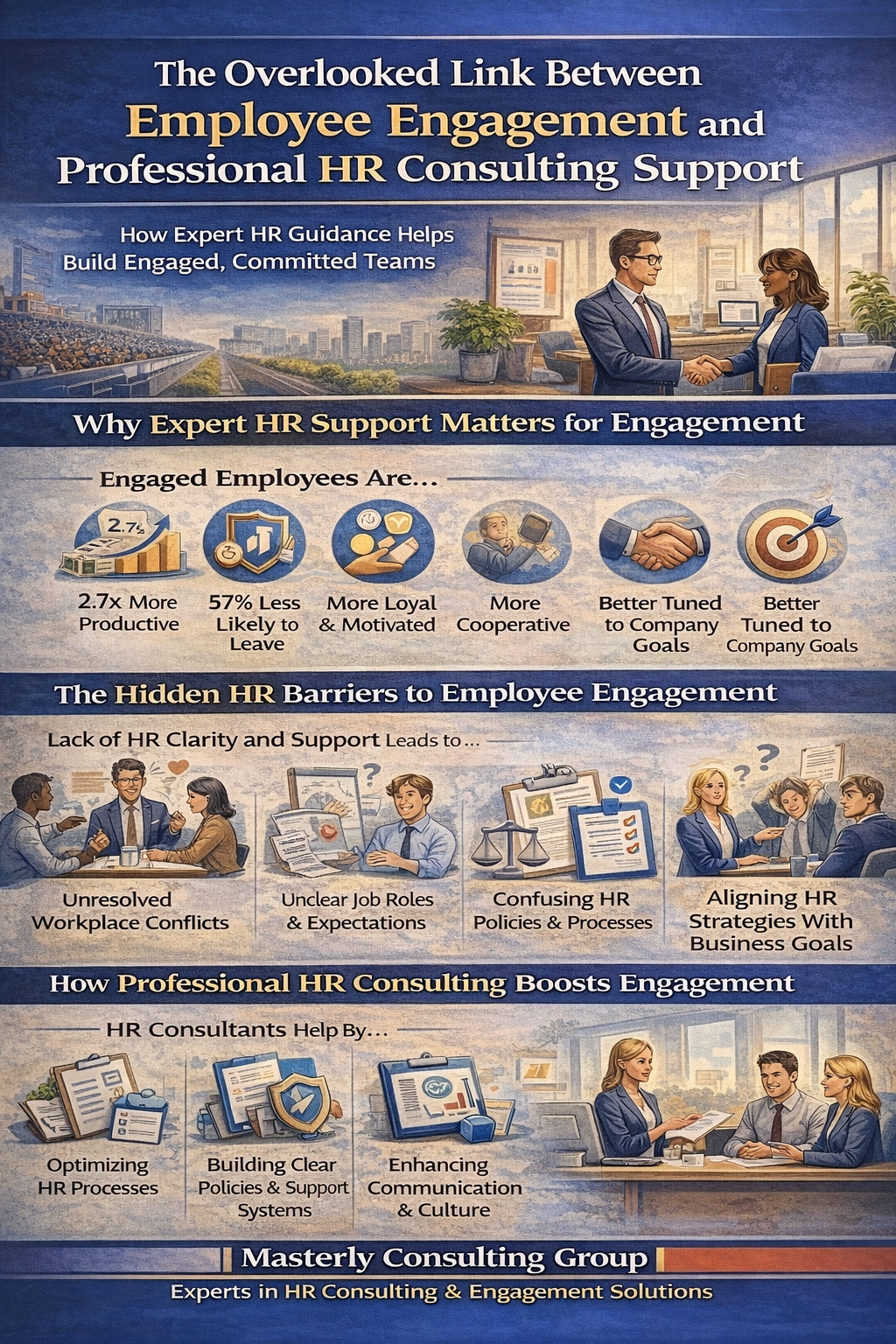
The Overlooked Link Between Employee Engagement and Professional HR Consulting Support
Employee engagement is often treated as a morale issue or a leadership challenge, but the reality is far more complex. Engagement is shaped by how supported employees feel across every stage of their work experience, from onboarding to career advancement. When businesses struggle with disengaged teams, the root cause is often hidden inside fragmented HR processes and inconsistent support systems. At Masterly Consulting Group, we help organizations uncover how professional HR consulting support directly influences engagement, performance, and long-term stability.
Many companies invest heavily in motivation initiatives without addressing the infrastructure behind them. Engagement does not improve simply because leadership asks employees to “do better.” It improves when human resources systems function clearly, fairly, and consistently. Professional HR consulting creates the foundation that allows engagement to grow organically instead of being forced.
Rethinking Employee Engagement as a Structural Issue
Engagement Is Built Through Systems, Not Slogans
Employee engagement grows when people trust the systems that govern their work. Clear HR policies, consistent enforcement, and accessible HR support reduce frustration and uncertainty. Employees are far more likely to stay engaged when expectations are defined and applied fairly.
Without professional HR consulting, these systems often evolve reactively. Over time, gaps emerge that quietly erode engagement and confidence.
Why Engagement Declines Without Support
Disengagement rarely happens overnight. It develops when employees feel ignored, unsupported, or confused about how decisions are made. Weak HR operations often lead to unresolved conflicts, unclear job roles, and inconsistent leadership responses.
Professional HR consultants help organizations identify and correct these issues before disengagement becomes widespread.
The Role of HR Consulting in Employee Experience
HR Consulting as a Strategic Partner
HR consulting is no longer just about compliance or paperwork. Modern HR consulting services focus on aligning people strategies with business goals. When done well, HR consulting becomes a strategic partner rather than a reactive function.
This partnership strengthens engagement by ensuring that employees experience consistency across policies, communication, and leadership behavior.
How HR Consultants Support Engagement
HR consultants bring perspective and structure that internal teams may lack. They help businesses design HR strategies that reflect organizational values while supporting operational needs. This balance is essential for maintaining engagement across the entire workforce.
Dedicated HR experts also provide guidance during moments of uncertainty, which helps employees feel secure and supported.
How HR Consulting Firms Shape Workplace Culture
Culture Is Reinforced Through HR Practices
Workplace culture is not defined by mission statements alone. It is reinforced daily through HR policies, performance management, and employee relations. When these elements are inconsistent, culture suffers.
HR consulting firms help organizations align their HR functions with the culture they want to create. This alignment supports engagement by ensuring that stated values are reflected in real decisions.
Preventing Cultural Drift
As organizations grow, culture can drift unintentionally. New managers, new policies, and rapid hiring often create inconsistencies. HR consultants help maintain cultural integrity by standardizing processes and communication.
This consistency builds trust, which is essential for sustained employee engagement.
The Connection Between Engagement and HR Compliance
Compliance as a Trust Builder
HR compliance is often viewed as a legal obligation, but it also plays a role in engagement. Employees feel safer and more respected when organizations ensure compliance with employment laws and regulations. Compliance signals professionalism and fairness.
HR consulting services help ensure compliance while minimizing disruption to daily operations.
Reducing Risk While Supporting Employees
Professional HR consulting helps organizations mitigate risks without creating fear-based environments. Clear policies and transparent enforcement reduce confusion and anxiety. This balance supports both compliance and employee satisfaction.
Reducing risk through structured HR solutions also protects long-term business success.
Talent Management and Engagement Alignment
Talent Management Beyond Hiring
Talent management extends far beyond recruitment. It includes development, retention, and performance management throughout the employee lifecycle. Engagement improves when employees see clear paths for growth and advancement.
HR consultants help design talent management frameworks that support both individual and organizational goals.
Retaining Top Talent Through Structure
Top talent is more likely to stay when expectations are clear and opportunities are visible. Disorganized HR systems often drive high performers away. Professional HR consulting helps organizations retain talent by creating stability and transparency.
Retention strengthens engagement across teams and reduces costly turnover.
HR Strategy as a Driver of Engagement
Aligning HR Strategy With Business Goals
HR strategy should support the broader direction of the business. When HR goals align with business goals, employees understand how their work contributes to success. This clarity improves motivation and engagement.
HR consultants bring strategic guidance that helps leadership connect people initiatives with long-term objectives.
Avoiding Reactive HR Management
Reactive HR management often leads to inconsistent decisions and employee frustration. Strategic HR consulting helps organizations move from reaction to planning. This shift improves engagement by reducing uncertainty.
Proactive HR strategies also support sustainable business growth.
HR Operations and Daily Employee Experience
The Impact of HR Operations on Engagement
HR operations shape daily interactions employees have with the organization. Payroll accuracy, benefits management, and timely communication all influence trust. When HR operations fail, engagement suffers.
Professional HR consultants help optimize HR processes to improve reliability and efficiency.
Supporting Operational Efficiency
Operational efficiency in HR reduces friction across the organization. Streamlined processes free managers to focus on leadership rather than administrative tasks. This efficiency improves employee experience and engagement.
HR consulting services play a critical role in improving these systems.
Employee Relations and Engagement Stability
Managing Employee Relations Effectively
Employee relations issues are inevitable in any organization. How they are handled determines whether engagement is preserved or damaged. Poor handling creates resentment and disengagement.
HR consultants provide neutral, structured approaches to employee relations that protect both the employee and the organization.
Building Confidence Through Fair Processes
Employees are more engaged when they trust that concerns will be handled fairly. Consistent HR support reinforces this trust. Professional HR consulting ensures that employee relations are managed consistently and professionally.
This consistency strengthens workplace culture.
Performance Management as an Engagement Tool
Performance Management Beyond Evaluation
Performance management should support growth, not just evaluation. When employees receive clear feedback and development support, engagement improves. Vague or inconsistent performance systems undermine motivation.
HR consultants help design performance management systems that support continuous improvement.
Connecting Feedback to Career Advancement
Employees engage more deeply when they see how feedback supports career advancement. Structured performance management provides this connection. HR consulting services help align evaluations with development opportunities.
This alignment encourages long-term commitment.
Change Management and Engagement Resilience
Navigating Organizational Change
Change management is one of the most challenging aspects of leadership. Poorly managed change often leads to disengagement and resistance. Employees need clarity and reassurance during transitions.
HR consulting provides frameworks that support communication and stability during organizational change.
Supporting Employees Through Transitions
Whether restructuring, growth, or leadership changes, employees rely on HR support. Professional HR consultants guide organizations through transitions while protecting employee well being. This support preserves engagement during uncertainty.
Effective change management strengthens organizational resilience.
Benefits Packages and Employee Satisfaction
The Role of Benefits in Engagement
Benefits packages influence employee satisfaction and perception of value. Competitive, well-managed benefits show that organizations invest in their people. Confusing or poorly administered benefits create frustration.
HR consultants help design benefits packages that align with business needs and employee expectations.
Benefits Management as a Retention Tool
Benefits management plays a role in employee retention. When benefits are communicated clearly and administered smoothly, trust increases. Professional HR consulting ensures benefits management supports engagement rather than undermines it.
This clarity contributes to business success.
HR Support as an Engagement Anchor
The Value of Ongoing HR Support
Ongoing HR support provides stability for employees and managers alike. Knowing that expert support is available reduces stress and uncertainty. This reassurance supports engagement at all levels.
HR consulting firms offer scalable HR solutions that adapt as organizations grow.
Dedicated HR Experts and Consistency
A dedicated HR expert provides continuity that internal teams may struggle to maintain. This consistency improves communication and trust. Employees feel more confident when HR guidance is reliable.
Professional HR consulting bridges gaps in internal capacity.
Organizational Design and Engagement Outcomes
Structuring Teams for Engagement
Organizational design affects how employees collaborate and communicate. Poor design creates silos and confusion. HR consultants help organizations design structures that support collaboration and engagement.
Clear roles and responsibilities reduce frustration.
Supporting Organizational Success
Well-designed organizations support both operational efficiency and engagement. HR consulting services align structure with strategy, supporting organizational success.
This alignment strengthens long-term performance.
Risk Management and Employee Confidence
Managing Risk Without Creating Fear
Risk management is essential, but fear-based approaches harm engagement. HR consultants help organizations mitigate risks while maintaining positive workplace culture. Transparent policies reduce anxiety.
This balance supports trust and engagement.
Protecting the Entire Workforce
Professional HR consulting helps protect the entire workforce through consistent policies and compliance practices. Employees feel safer when risks are managed responsibly. This security supports engagement and retention.
Trust grows when protection is visible.
The Strategic Value of HR Consulting Firms
Deep Expertise Across HR Functions
HR consulting firms bring deep expertise across HR functions that internal teams may lack. This expertise strengthens decision-making and consistency. Employees benefit from clearer processes and expectations.
Professional guidance improves engagement outcomes.
Supporting Business Needs at Every Stage
As business needs evolve, HR consulting adapts. Whether supporting startups or established organizations, consulting services scale with growth. This adaptability supports strategic growth and engagement.
HR consulting becomes a long-term partner.
HR Consulting and Business Growth
Engagement as a Growth Driver
Employee engagement directly supports business growth. Engaged employees contribute more, innovate more, and stay longer. HR consulting strengthens engagement by addressing structural issues.
This connection supports competitive edge in the market.
Transforming Businesses Through People Strategy
Organizations transform when people strategies align with business goals. HR consulting helps transform businesses by strengthening human capital systems. Engagement becomes a natural outcome of strong HR foundations.
This transformation supports long-term success.
Why Masterly Consulting Group Focuses on Engagement
Extensive Experience in HR Consulting
At Masterly Consulting Group, we bring extensive experience across HR consulting services, HR compliance, and strategic guidance. We understand how HR systems influence engagement at every level. Our approach focuses on clarity, consistency, and support.
We work closely with leadership to align HR needs with business goals.
A Partner in Organizational Success
We believe employee engagement is built, not demanded. Through tailored HR solutions and ongoing support, we help organizations foster growth and stability. Our consulting firm supports businesses through change, expansion, and complexity.
Our mission is to strengthen engagement by strengthening HR foundations.
Strengthening HR Infrastructure With Expert Support
Experienced hr professionals play a critical role in guiding organizations through complex people challenges, but many internal teams are stretched thin. Comprehensive hr services and human resources consulting services provide the added capacity and expertise needed to support daily operations while planning for growth. By working alongside a knowledgeable hr department, businesses gain access to innovative solutions that align leadership development, talent acquisition, and compliance efforts under one cohesive strategy. This partnership allows organizations to business enhance performance while keeping their workforce supported and aligned.
Aligning Leadership, Administration, and Workforce Strategy
Effective organizations understand that leadership development and strong hr administration go hand in hand. Skilled hr specialists and a coordinated hr team help define core responsibilities, update job descriptions, and ensure leaders are equipped to manage people confidently. With guidance from management consultants, businesses can implement unique hr approaches that fit their culture while still meeting regulatory expectations. This structure becomes especially important during organizational transitions, when clarity and consistency protect employee trust.
Scalable Support for Complex Business Environments
As companies grow, HR demands often extend beyond traditional functions. For federal contractors or organizations operating alongside a complex supply chain, specialized HR oversight is essential. Solutions such as peo services help provide resources, manage compliance, and support workforce needs without overwhelming internal teams. With expert guidance, businesses can focus on protecting their most valuable asset—their people—while navigating change, growth, and evolving operational demands with confidence.
Contact Us for a Free Consultation
Employee engagement does not improve by chance. It improves when organizations invest in professional HR consulting support that addresses systems, structure, and strategy. If your organization is struggling with engagement, retention, or consistency, expert guidance can make a meaningful difference.
Contact Masterly Consulting Group at (888) 209-4055 to book a free consultation. We work with clients nationwide and are ready to discuss how HR consulting services can support your business goals and employee engagement.