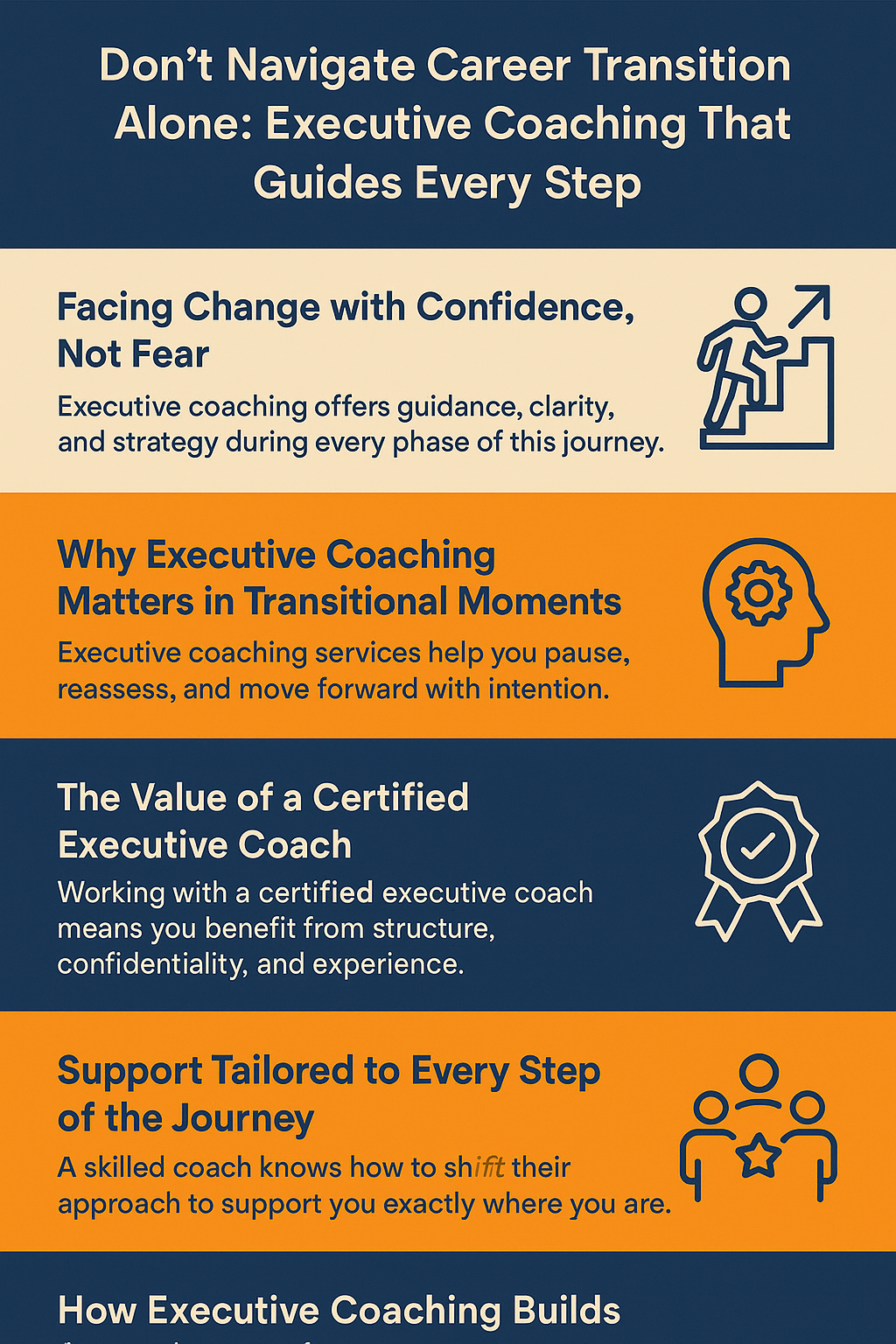
Don’t Navigate Career Transition Alone: Executive Coaching That Guides Every Step

August 6, 2025


Facing Change with Confidence, Not Fear

Career transitions can be some of the most emotionally and mentally taxing periods in a professional's life. Whether you're stepping into a new leadership role, exiting a long-term position, or reevaluating your career direction altogether, one thing is clear: you don't have to do it alone. Executive coaching offers guidance, clarity, and strategy during every phase of this journey.


Why Executive Coaching Matters in Transitional Moments

During a career shift, your confidence may fluctuate, your identity might feel challenged, and your goals could seem unclear. Executive coaching services help you pause, reassess, and move forward with intention. Through a structured coaching relationship, professionals develop the self-awareness and skills needed to lead themselves—and others—effectively.


The Value of a Certified Executive Coach

Working with a certified executive coach means you benefit from someone who brings structure, confidentiality, and experience to your situation. They aren't there to tell you what to do—they're there to help you uncover your own answers. Coaches with executive coaching certification or those trained through an ICF-accredited program understand how to navigate deep personal and professional transformation.


Support Tailored to Every Step of the Journey

Each career transition is unique. A coaching conversation early in the process might focus on building self-awareness, while later sessions may zero in on skill development, job search strategies, or behavior change that aligns with your new path. A skilled coach knows how to shift their approach to support you exactly where you are.


How Executive Coaching Builds Stronger Leaders

The cornerstone of effective leadership is the ability to adapt and lead through change. During a career shift, executive and leadership coaching develops the confidence to make decisions, manage ambiguity, and inspire teams. Senior leaders especially benefit from this support as they reframe their leadership identity and strengthen their impact.


Gaining Perspective and Clarity

A career transition can cause tunnel vision. A certified professional coach provides an external perspective that opens up new possibilities. With the right coaching experience, leaders discover distinctive strengths they may have previously overlooked, allowing them to move forward with renewed clarity and purpose.


The Link Between Emotional Intelligence and Leadership Success

Strong emotional intelligence is what separates good leaders from great ones. During coaching engagements, clients often learn how to better regulate emotions, listen with empathy, and receive feedback with openness. These are not just soft skills—they're the building blocks of long-term leadership development.


Understanding the Role of the International Coaching Federation

The International Coaching Federation (ICF) sets global standards for coaching excellence. Coaches with an ICF credential or affiliation with the International Coaching Federation ICF demonstrate a commitment to ethical practices and proven techniques. This ensures you're getting support grounded in proven methodologies.


Leadership Coaching for C-Suite Leaders

Transitions don’t end when you land a new role. In fact, many C-suite leaders find that their real transformation begins when they start leading in a new environment. Executive leadership coaching helps them navigate unfamiliar dynamics, build credibility, and align with organizational goals quickly and effectively.


Building Sustainable Change Through Coaching

True success isn’t about short-term wins. It’s about sustainable change that allows leaders to grow over time. Executive coaches help clients develop new habits, practice new behaviors, and build resilience that lasts beyond the transition period.


Coaching Is Not Therapy—It’s Forward-Focused Development

While coaching may feel therapeutic at times, it is future-oriented. A coaching practice is designed to help you reach goals, unlock unrealized potential, and take actionable steps. Coaching isn’t about exploring the past; it’s about building a stronger future.


Common Triggers for Career Transitions

There are many reasons why leaders seek coaching support:

  • Voluntary career shifts
  • Layoffs or restructuring
  • Retirement planning or phased exits
  • Entrepreneurial ventures
  • Promotions or lateral leadership moves


Personalized Coaching Engagements for Real Growth

Every leader is different. That’s why impactful coaching engagements are tailored to your personality, career stage, and goals. This individualized focus ensures that coaching skills and tools are relevant, actionable, and impactful.


Coaching Creates Clarity in Uncertainty

When you're in the midst of a transition, things can feel overwhelming. A successful executive coach helps you break down big challenges into manageable steps. Through regular sessions, you gain focus, create strategies, and track measurable development.


Elevating Your Career with Executive Coaching Services

If you’re considering a job change, business shift, or stepping into a higher role, don’t do it alone. Executive coaching services give you a strategic partner to guide, challenge, and support you. These services aren’t just about career moves—they’re about personal evolution.


How Coaching Aligns You with Organizational Goals

Transitions aren’t just personal; they also impact your organizations. Through coaching, leaders align their vision with company expectations, ensuring their efforts have real organizational impact. Coaching creates harmony between personal aspirations and professional responsibilities.


Developing Leaders for the Future

In times of transition, organizations look for adaptable, self-aware leaders. Coaching helps cultivate the skills needed to thrive in modern workplaces. Whether it’s cross-cultural communication, cultural intelligence, or strategic influence, coaching brings out your full potential.


Why Coaching is Crucial for Senior Leaders

Senior leaders face immense pressure to lead change and model resilience. Coaching supports their personal growth and empowers them to build teams that thrive through uncertainty. With the right coaching partner, senior executives turn challenges into growth opportunities.


More Than Advice: A Coaching Relationship Built on Trust

A powerful coaching relationship is based on trust, confidentiality, and accountability. Coaches don’t just give advice; they ask the right questions, challenge assumptions, and create space for self-awareness and reflection. This is what fuels authentic leadership.


Coaching for Tangible Results, Not Fluff

The best coaching produces tangible results. From increased confidence to faster onboarding in a new role, clients walk away with real progress. Metrics matter—but so does the internal shift that comes with personal growth.


Working with Professional Coaches Who Understand Business

Unlike mentors or therapists, professional coaches bring a hybrid lens of business coaching and leadership strategy. Many also have backgrounds in management consulting or operations, providing insight into complex corporate dynamics.


The Coaching Experience That Drives Change

What makes the coaching experience powerful is its structure, intention, and outcome focus. You’re not just having a conversation—you’re taking action, reflecting, and growing every step of the way. With coaching, progress is both personal and professional.


Our Commitment to Your Development

At Masterly Consulting Group, our mission is to help leaders thrive during moments that matter most. Our coaches offer a deep understanding of what it takes to navigate transitions successfully. Whether you're climbing the ladder or pivoting to something entirely new, we’re here to guide you.


Coaching That Elevates Leaders Across Organizational Levels

Our clients range from mid-career professionals to executives managing global teams. Coaching is just as effective for rising stars as it is for seasoned industry leaders. We meet leaders where they are and help them go further.


Supported by a Global Network of Coaches

Masterly Consulting Group works with a global network of ICF-trained coaches who bring cultural sensitivity, business acumen, and experience across industries. Whether your goals are local or international, our team supports you with world-class expertise.


A Look at the Coaching Skills You’ll Build

Through executive coaching, clients strengthen:

  • Communication and influence
  • Strategic decision-making
  • Conflict resolution
  • Personal branding
  • Leadership presence and confidence


Facing Change with Confidence, Not Fear – Emphasizes that executive coaching provides guidance and strategy during transitions.


Coaching Helps Leaders Reach Their Next Level

Every leader has untapped potential. Coaching helps leaders reach that next level by providing insight, accountability, and support. When you invest in coaching, you invest in your success.


We Guide Clients Through Sustainable Development

Our coaches don’t chase quick fixes. We focus on sustainable change and long-term growth. That means identifying blind spots, testing new habits, and helping clients lead with purpose at every stage.


Coaching That Drives Organizational Change and Personal Growth

With more than twenty five years of combined experience, our team brings both depth and perspective to every coaching engagement. Whether you're working with a board certified coach or participating in mentor coaching, the goal remains the same: to assist clients in unlocking their full leadership potential. Our approach emphasizes organizational effectiveness by aligning leaders with key stakeholders, fostering developmental opportunities, and equipping them with new skills that improve performance across teams. As organizations face inevitable organizational change, we help leaders find their own way to adapt, influence, and lead with confidence.


Elevating Executive Leadership Through Certified Coaching Support

In high-stakes environments, executive leadership coaching is more than just a tool—it’s a strategic advantage. Through structured executive and leadership coaching, professionals refine their leadership style, strengthen influence, and navigate change with clarity. Our coaching practice is rooted in an ICF-accredited program, ensuring each session delivers measurable growth. Every certified professional coach on our team holds advanced credentials, including executive coaching certification, and brings real-world insight from working with industry leaders. Whether you’re looking to enhance your executive leadership or prepare for a major transition, this level of coaching ensures you’re guided by the highest standards in the industry.


Ready to Take the Next Step in Your Career?

You don’t have to navigate your career transition alone. Masterly Consulting Group provides expert executive coaching tailored to your unique challenges and aspirations. Let our coaches help you move forward with clarity, confidence, and purpose.


Call us at (888) 209-4055 to book your free consultation today. We’ll answer your questions and explain how our coaching approach can help you thrive through any professional transition.
By Angelie Te August 8, 2026
Picture this: your organization invests in a two-day leadership offsite. Participants leave energized, rate the session highly, and talk about it at lunch for a week. Thirty days later, nothing has changed. Managers still default to old habits, team dynamics stay the same, and the binder from the retreat collects dust. This "training high, no behavior change" pattern is one of the most expensive problems in workforce development today. Corporate training refers to structured learning experiences designed for employees and leaders, tied directly to business goals. It is not a generic workshop or a motivational keynote. It is a deliberate program built around specific performance outcomes: reducing risk, improving decision-making, building leadership capabilities, or strengthening organizational culture.  This article is written for companies, associations, universities, and organizations planning professional development training or compliance-related programs for staff, faculty, or executives. Masterly Consulting Group's point of view is straightforward: training must be designed for on-the-job application, not event satisfaction scores. What follows is a practical guide to designing, buying, or improving corporate training programs that deliver measurable results and help you retain talent.
Employee engagement consultant identifying causes of low commitment.
By Amber Aniston August 7, 2026
An employee engagement consultant finds operational root causes behind low commitment. Masterly Consulting Group offers employee engagement consulting tied to retention and execution. Schedule a consultation.
Organizational culture consultant aligning leadership and team behavior.
By Amber Aniston August 7, 2026
Meta Description: Masterly Consulting Group offers organizational culture consulting to align leadership behavior with values and strategy, boosting engagement, accountability, and business success. Request a consultation today.
Business leaders planning organizational transformation strategy
By Amber Aniston August 6, 2026
Masterly Consulting Group turns transformation strategy into an executable operating model with governance, sequencing, and measurable adoption. Request a consultation today.
By Angelie Te August 5, 2026
Why Brand Portfolio Strategy Matters for Multi-Company Founders A founder launches a marketing agency in 2015. By 2019, she spins up a productized service for a specific niche. In 2023, she ships a SaaS product. Three companies, three websites, three logos. Clients ask which company they should hire. Her own team isn't sure which brand to recommend for a given project. The websites overlap. Referrals get lost. This is what happens when a founder builds multiple companies without a brand portfolio strategy. The brands grow, but they grow without a plan for how they relate, who each one serves, and how they move customers between them. A brand portfolio strategy is the deliberate system that decides how all the brands in a company's portfolio work together: which audiences each brand targets, what role each brand plays, and how the set of brands creates more overall value than any single brand could alone. The central tension is real: keep brands distinct enough that customers aren't confused, but connected enough that cross-referrals, trust transfer, and upsell paths still function. This article covers brand portfolio management (how you govern and allocate resources across brands), brand architecture (the structural relationships between brands), and brand roles (the job each brand does). The focus is on roles, clarity, naming, and growth. You'll walk away knowing how to choose between a branded house, house of brands, or hybrid; how to define brand roles; how to avoid brand complexity; and how to set up a governance model that keeps your portfolio sharp. What Is a Brand Portfolio Strategy? (and How It Differs from Just Owning a Bunch of Brands) A brand portfolio strategy is the structured management and organization of a company's brands. It defines how brands relate to each other and target market segments, assigns each brand a unique role, and ensures the portfolio as a whole aims to cover more of the market and drive growth without wasting resources. Owning multiple LLCs, having several logos, or running separate websites is not a strategy. Strategy answers: why does each brand exist? What audience does it serve that the other brands do not? How does the set perform financially? Each brand within a portfolio should have a clear purpose to prevent overlap. For a founder running a core consultancy, a separate training company, and a niche product brand, a brand portfolio strategy defines each brand's unique role and ensures the three entities serve different customer segments rather than competing for the same buyers with similar promises. This differs from product portfolio strategy, which focuses on SKUs and product categories within one brand. It also differs from generic "multi-business group" thinking, which tends to focus on operations and finance. Brand portfolio strategy zeros in on identity, positioning, and market perception. That includes company portfolio positioning: how the parent company is perceived (or whether it is visible at all) relative to its specialist brands. Brand Portfolio, Brand Architecture, and Brand Identity: How the Pieces Fit Founders often blur three concepts that serve different functions. Separating them saves time and prevents misaligned decisions. A brand portfolio is the full set of brands under common ownership. Alphabet owns Google, YouTube, and Waymo. Marriott managed 30 hotel brands after acquiring Starwood in 2016. A founder with an agency, a staffing firm, and a coaching brand has a three-brand portfolio. Brand architecture defines the relationships between brands in a portfolio. It's the structural pattern that determines who endorses whom, what's visible to customers, and how brand names and logos coordinate. There are two main types of brand architecture: mono-brand (one name covers everything) and multi-brand (distinct brands coexist). Brand architecture helps consumers understand product offerings and their relationships, and a well-defined brand architecture enhances brand equity and consumer navigation. It also clarifies brand roles and minimizes internal competition. Brand identity operates at the individual brand level: the name, visuals, tone, promise, and distinctive assets that make one brand recognizable. Brand positioning clarifies how each brand should be perceived in the marketplace. Portfolio management sits above identity work. It decides which brands exist, how they relate, and where investment goes. Architecture and identity then express those decisions in ways customers can see and navigate. Core Brand Portfolio Strategies: Branded House, House of Brands, and Hybrids Most multi-brand ecosystems fall along a spectrum. At one end sits the branded house. At the other, the house of brands. Between them are hybrids and endorsed models. Branded house. A branded house uses a single master brand across all products and services. FedEx (FedEx Express, FedEx Office, FedEx Ground) is a textbook example. A branded house communicates a single identity across all brands, which means equity built in one area transfers to others. The trade-off: if one offering fails publicly, the entire brand absorbs the reputational cost. House of brands. A house of brands consists of distinct standalone brands targeting specific niches. Procter & Gamble owns Tide, Pampers, and Gillette, but most consumers never think about P&G when buying shampoo. A house of brands allows each brand to operate independently, with tailored positioning and flexibility. The cost is real: P&G invests roughly 13% of annual sales into R&D and marketing to sustain its portfolio of powerful brands. Hybrid and endorsed models. A hybrid portfolio combines elements of multiple brand structures. Endorsed brands have sub brands supported by a parent corporate brand for credibility. Marriott operates distinct hotel brands (Ritz-Carlton, Courtyard, W Hotels) while the Marriott Bonvoy loyalty system ties the ecosystem together. Meta keeps Instagram and WhatsApp as different brands with their own audiences, connected by a visible parent.  For founders managing 3-8 companies, a lean hybrid is often the most practical choice: a credible parent brand plus a handful of clearly positioned specialist brands that share some elements but maintain distinct faces to market.
Business continuity consultant leading crisis planning workshop
By Amber Aniston August 5, 2026
Partner with a business continuity consultant to build practical, resilient continuity plans that protect critical operations from disruptions. Learn how expert consulting enhances operational resilience, supply chain management, and crisis response for growing companies and multi-location organizations.
Performance management consultant reviewing KPI dashboard with team
By Amber Aniston August 5, 2026
Masterly Consulting Group offers expert performance management consulting to help organizations set measurable expectations, improve feedback cadence, and enhance leadership accountability for better employee performance and business outcomes.
By Angelie Te August 5, 2026
Introduction: Why Shared Services Matter for Multi-Brand Entrepreneurs Between 2018 and 2024, one founder grew from a single digital marketing agency to a portfolio of five brands spanning creative services, e-commerce, staffing, and consulting. Revenue was climbing. But by year four, she was managing five separate bookkeepers, three different CRM platforms, inconsistent onboarding workflows, and a customer experience that varied wildly depending on which brand someone contacted. Growth had stalled - not because of demand, but because the back office couldn't keep up. This is the exact scenario where a shared services business model becomes essential. In its simplest form, it means creating a centralized support unit that serves multiple brands, entities, or divisions as internal customers - handling functions like finance, HR, marketing operations, and IT under one roof. Why does this matter now? Labor costs have surged since 2020. Remote teams have multiplied complexity. And artificial intelligence tooling has made centralization more feasible than ever. Entrepreneurs are increasingly running ecosystems of brands, and shared services reduce operational costs by eliminating redundancy while enabling scalability so organizations can expand without rebuilding administrative infrastructure each time. This article is written for entrepreneurs and operators managing multiple companies - not Fortune 500 executives. Here's what we'll cover: How the shared services business model works and what it actually includes When centralization makes sense (and when it doesn't) How to design, govern, and implement a shared services unit Risks, trade-offs, and a practical roadmap