SWOT Analysis: How Leadership Teams Turn It into Decisions
SWOT Analysis: The Short Answer
A SWOT analysis is a structured meeting where your leadership team maps strengths, weaknesses, opportunities, and threats against a specific objective, then converts findings into five to seven priorities with owners and dates. The process is straightforward: define what you are deciding, gather evidence, fill each quadrant of the grid, and leave the room with a short action list. This is strategic planning at its most practical - whether during an annual offsite or ahead of a major pivot, a SWOT analysis helps identify internal and external factors that shape your next move.
What Is a SWOT Analysis? (For Leadership Teams)
A SWOT analysis is a strategic planning tool that evaluates your company's strengths, weaknesses, opportunities, and threats inside a simple 2×2 grid. SWOT stands for those four categories, and together they give leadership a comprehensive view of where the business stands today and what the external environment looks like ahead.
Strengths and weaknesses are internal factors - your culture, capital, capabilities, talent, and processes. Opportunities and threats are external factors - market trends, regulation, competition, and technological factors reshaping your industry.
SWOT analysis was first used in the 1960s at the Stanford Research Institute, where it evolved from an earlier framework called SOFT. The core idea has not changed: match what you control with what is happening around you, then make choices. A SWOT analysis can be conducted individually or in a group, but for executive teams the group format surfaces blind spots faster. It requires careful thought and consideration - not because the grid is complex, but because honest answers about weaknesses and threats demand discipline.
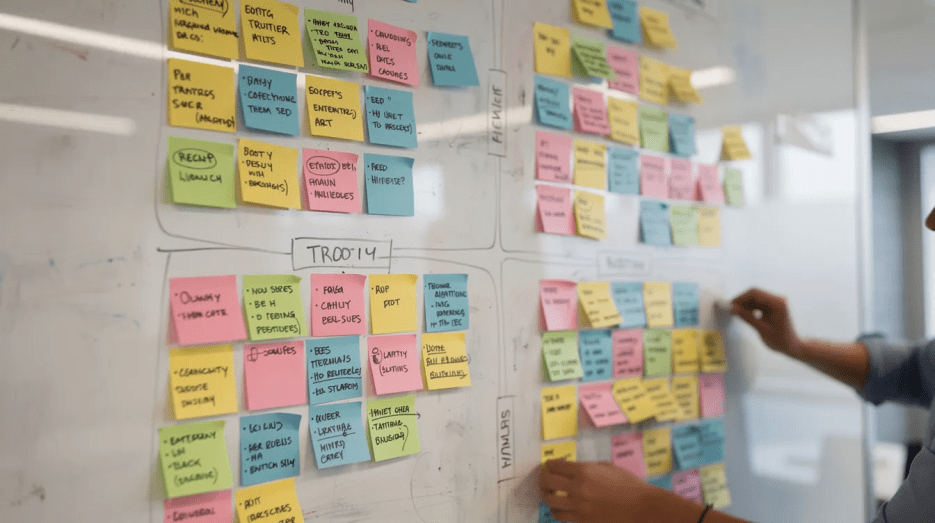
In practice, picture a whiteboard or digital canvas divided into four boxes. Leadership teams often use this setup ahead of annual planning, major investments, or significant pivots. For a small business scaling up, it can be the difference between chasing every opportunity and choosing the right ones.

Strengths, Weaknesses, Opportunities, and Threats Defined with Business Examples
Clear definitions reduce confusion in the room and keep debates focused on facts, not opinions. Here is what each quadrant means, with mid-market SWOT analysis examples that leadership teams can relate to.
Strengths are the internal advantages your organization controls. SWOT analysis identifies strengths as internal advantages - things competitors cannot easily replicate. Strong customer loyalty can extend product lines and premium pricing. Financial stability allows businesses to take risks without jeopardizing stability. A strong brand reputation is a key competitive advantage, and innovative products can differentiate a business in the market.
A few concrete examples: a regional healthcare provider with 20-plus-year patient relationships and a recognizable brand in its metro area; a SaaS company sitting on 14 months of cash reserves; a manufacturer whose proprietary tooling process cuts lead times by 30%. These are internal strengths that shape a company's strengths in negotiations, hiring, and pricing.
Weaknesses are internal gaps that limit performance. Weaknesses can include skill shortages or outdated systems. Poor communication across departments can be a significant internal weakness. Limited resources can hinder a business's ability to compete, high costs can create obstacles for business progress, and weak customer service can be a critical internal weakness.
Examples: a services firm with no documented sales process, a manufacturer with single-threaded dependence on one supplier, or a growing company with limited brand recognition outside its home market. The goal is not to shame the team but to address weaknesses with specifics so you can fix them.
Opportunities sit outside the organization's control but can be seized. Low competition in an adjacent market allows businesses to increase their customer base. Emerging partnerships can enhance business growth and market reach. Market changes - like new 2025 regulations favoring sustainable packaging - can create new demand for products or services. Technological advancements can provide new opportunities for innovation, from AI-driven analytics to automation.
Threats are external factors that can harm a business. Competition is a common threat to business success. Economic downturns can negatively impact business performance, as many firms experienced during the rate hikes since 2022. Changes in regulations can pose threats to businesses, and new competitors entering the market can threaten existing businesses. Supply chain disruptions, rising input costs, and shifts in customer behavior all sit in this quadrant.
The control boundary matters: strengths and weaknesses are internal factors within the organization's control; opportunities and threats come from the internal and external environment. Getting this classification right keeps the analysis sharp.
Preparing to Run a SWOT Session: Objectives, People, and Evidence
Preparation is what separates a useful SWOT analysis from a vague brainstorming session. Three things matter most: a tight objective, the right people, and real evidence.
Define the objective. A broad goal like "plan for growth" leads to broad lists. A focused question like "Decide whether to open a U.K. office by Q1 2027" or "Clarify priorities for our 2025–2027 strategic plan" keeps everyone pointed in the same direction. To conduct a SWOT analysis well, define a specific goal and gather input from a cross-functional team.
Select participants. Include the CEO or business owner, two to three functional leaders (finance, operations, sales/marketing, people), and one or two frontline managers who see daily realities. Keep the group under ten. Involve diverse participants for a comprehensive SWOT analysis - diverse perspectives from various departments help in identifying operational bottlenecks and market shifts that executives alone might miss.
Bring evidence. Gather data to support insights in SWOT analysis. That means last three years of financials, pipeline data, customer feedback (NPS or CSAT), churn metrics, employee engagement surveys, and external market research. Assign someone as "data advocate" - their job is to ask, "What number supports that claim?" This keeps the room honest and prevents purely subjective lists. Research shows that leadership teams generating SWOT factors from primary and secondary data produce sharper results than those relying on opinion alone.
Set up the room or virtual space with a visible SWOT matrix, a time-boxed agenda on screen, and clear roles: facilitator, scribe, and decision owner.
Facilitating the SWOT Discussion Step by Step
Think of this as a step by step guide you can follow during a half-day meeting. Here is a realistic schedule for a three- to four-hour session:
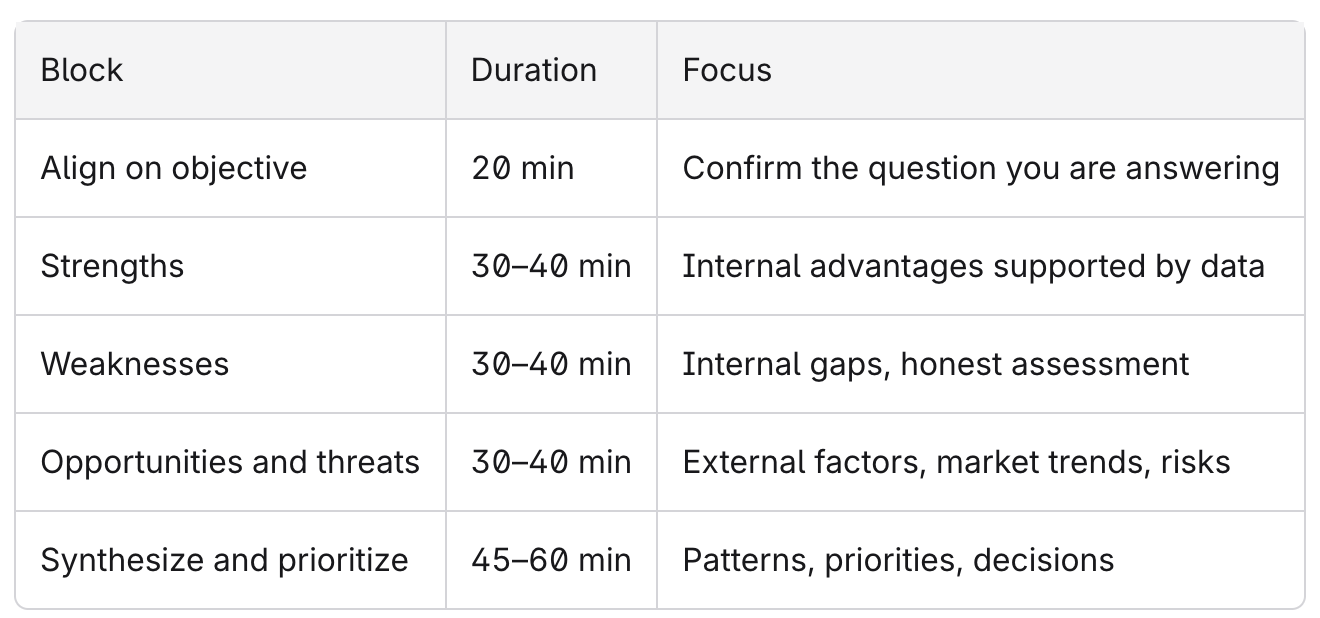
During the analysis, brainstorm internal factors first before evaluating external factors. Starting with what you know (strengths and weaknesses) grounds the team before the conversation moves to external opportunities and threats, where opinions tend to run hotter.
Facilitation tips that work:
- Start each quadrant with two minutes of silent brainstorming. Everyone writes before anyone talks.
- Use round-robin sharing so dominant voices do not crowd out key areas of insight.
- Keep a parking lot for off-topic items. Good ideas that do not fit the objective still deserve a home.
- Ask two questions constantly: "What evidence supports this point?" and "Is this truly internal or external?"
- Limit each quadrant to five to seven items. Long lists dilute focus - many businesses leave SWOT sessions with twenty-plus bullet points and zero priorities.
Involving diverse input from various departments can help in identifying operational bottlenecks and market shifts. A sales leader sees competitive threats the CFO does not; an operations manager spots supply chain weaknesses the CEO underestimates.

From SWOT to Strategy: Turning the Grid into Decisions
A SWOT grid by itself is descriptive. It tells you where the business stands, but it does not move the business forward. Leaders must convert findings into a small set of strategic choices that shape business strategy for the next twelve to thirty-six months.
Look for patterns and connections. Which internal strengths unlock specific external opportunities? Which weaknesses amplify potential threats? Where is there a mismatch between ambition and capability?
A simple SO/WO/ST/WT mapping helps without overcomplicating things:
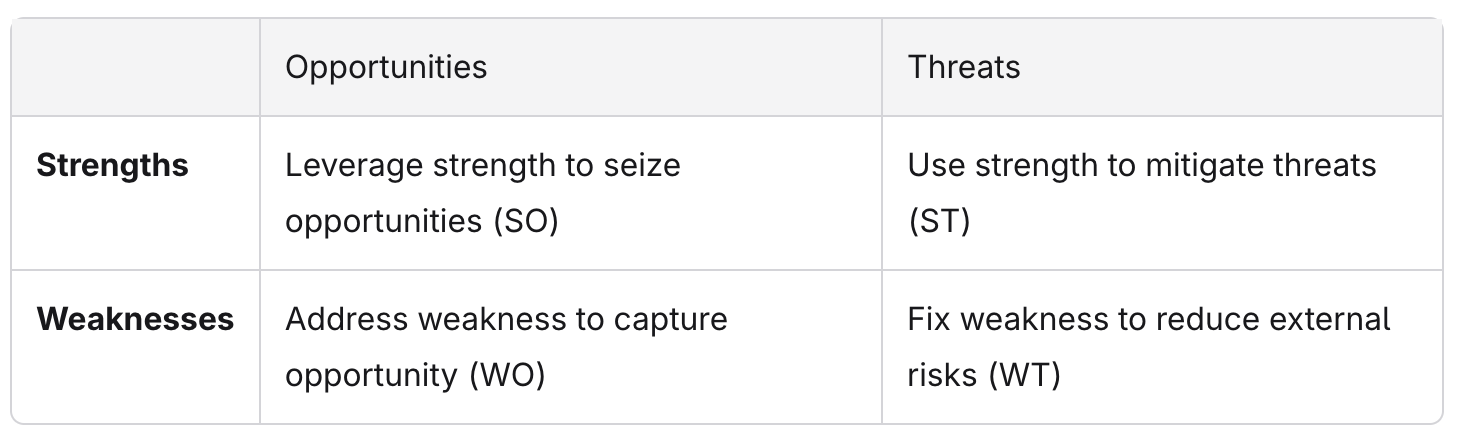
From this mapping, leadership teams can develop strategies that fit into five to seven strategic priorities - not a long wish list. It is important to prioritize the three to five most significant factors in each SWOT category so the team walks away with a clearer understanding of what matters most.
Prioritize insights from SWOT analysis for effective decision making. This includes explicitly deciding what not to do this year. Practical language works best: "Pause European expansion until we fix customer onboarding" beats "Explore international growth opportunities." The first is a decision; the second is a slide.
Building an Actionable Plan: Owners, Timelines, and Contingency Plans
Priorities without owners are wishes. This section turns each priority into a concrete work stream leadership can monitor.
For each chosen priority, write a short action statement with a single accountable owner, key milestones, and a target date. Example: "Reduce customer churn from 14% to 9% by December 2026 - Owner: VP Customer Success." Developing an implementation plan is crucial after completing a SWOT analysis to ensure accountability.
Use the SWOT findings to develop contingency plans around your top external threats. For each major threat, define a trigger, an early warning indicator, and a predefined response. If a key supplier faces disruption, the contingency might be: "If lead times exceed 45 days for two consecutive months, activate secondary supplier contract." This is how leaders mitigate threats and develop contingency plans instead of reacting in crisis mode.
Pair each major threat with a mitigation step - diversify the supply chain, lock in key talent with retention packages, or build a cash reserve to weather economic downturns.
Keep the documentation lean. A one-page summary per initiative works better than a fifty-page strategic planning document. Attach the original SWOT grid to the action plan so the rationale for each initiative stays visible. If your team needs a longer-form plan, use a strategic plan template rather than recreating the wheel.
SWOT Analysis Examples for Leadership Teams
Practical SWOT analysis examples help leaders see how the framework supports real decisions, not just fills a whiteboard.
Example 1: B2B SaaS company deciding on European expansion (2025). A 120-person U.S. software company considers whether to double down on its niche or open a London office. Strengths: 92% customer retention, $8M ARR, and a product line with competitive edge in healthcare compliance. Weaknesses: no GDPR-ready infrastructure, zero European brand presence, stretched engineering team. Opportunities: EU healthcare digitization funding, low competition in its niche across the U.K. Threats: currency risk, unfamiliar regulatory landscape. The leadership team used this analysis to decide: invest in GDPR readiness this year, delay the London office to 2027, and partner with a U.K. reseller to test market position without heavy capital outlay. Three priorities, each with an owner.
Example 2: Professional services firm protecting margins during a slowdown (2024). A 60-person consulting firm faced declining demand. Strengths: deep client relationships, strong brand reputation in its region. Weaknesses: over-reliance on two large clients, limited market research capability. Opportunities: competitors pulling back from mid-market, growing demand for fractional leadership. Threats: clients cutting discretionary spend, rising labor costs. The firm used SWOT to refocus on its most profitable service lines, invest in a leadership development plan for senior consultants, and launch a fractional-CFO offering. The online store for digital training materials became a secondary revenue stream within six months.
Example 3: Owner-led manufacturer evaluating automation. A family-owned manufacturer with $22M revenue explored robotics for its assembly line. Strengths: skilled workforce, 40-year customer base. Weaknesses: aging equipment, high costs per unit vs. competitors. Opportunities: state tax credits for automation, market opportunities in reshoring. Threats: labor shortages projected through 2028, new competitors from overseas. The business owner chose to automate two of seven lines, retrain affected workers, and use cost savings to fund R&D on a new product line. The SWOT kept the team on the same page about what they could afford and what they could not.
Common Mistakes Leadership Teams Make with SWOT
Avoiding a few common mistakes often makes the difference between a slide deck and real change.
- Long wish lists. When every quadrant has fifteen items, nothing gets prioritized. Limit each box to five to seven items that demand immediate attention.
- Confusing internal and external factors. "Our competitors are better at marketing" is a threat, not a weakness. The weakness is your own marketing capability. Misclassifying factors weakens actionable insights.
- Ignoring data. Opinions feel true in the room but collapse under scrutiny. Ground every claim in customer feedback, financial data, or market research.
- Overestimating strengths. The organization's strengths look impressive until you compare them to competitors. Competitive analysis keeps confidence honest.
- Downplaying cultural weaknesses. Leadership teams often skip people-related issues like poor communication or personal development gaps because they feel uncomfortable.
- Skipping the action phase. A SWOT analysis should not be a one-time task but revisited regularly as market conditions change. Leaving the session with no owners, no timelines, and no follow-up rhythm is the most expensive mistake.
- Copying competitors' moves. A small business that mirrors a larger rival's strategy without examining its own capabilities usually wastes resources.
For each mistake, there is a simple fix. Cap each quadrant at five items. Require one data point per claim. Assign an owner to every priority before the meeting ends.
Best Practices to Make SWOT a Standing Leadership Habit
SWOT works best as a recurring leadership discipline, not a kickoff exercise every few years. Use SWOT analysis as a living document, revisiting regularly as your business environment shifts.
Cadence: Run a full SWOT annually as part of strategic planning. Add lighter check-ins quarterly or after major external shocks - a new competitor, a regulatory change, a shift in market conditions. Update SWOT analysis at least once a year for relevance. Research on strategic tool usage found that SWOT was the top tool cited by 32.6% of executives in the strategy analysis stage, suggesting it earns its place on the calendar when done right.
Integration: Fold SWOT into existing forums - quarterly business reviews, annual offsites - instead of adding more meetings. Document each cycle's top three to five shifts in strengths, weaknesses, opportunities, and threats to spot longer-term trends.
Templates and tools: Use a simple SWOT analysis template or shared document so updates are easy and comparable across years. A free template with the four quadrants and a priority summary section is enough. You do not need specialized software - a SWOT template in a shared drive keeps everyone on the same page.
Connecting to execution: Link the output of SWOT to other methods and leadership tools such as a team charter for role clarity and a leadership development plan for capability gaps. SWOT analysis is important not because it fills a framework, but because it feeds informed decisions that drive the business forward. When SWOT connects to budgets, headcount, and performance dashboards, it stops being a poster and starts being a management system.
SWOT Analysis FAQs for Leadership Teams
These answers address the questions leadership teams ask most often when preparing to run or improve a SWOT analysis.
How often should a company do a SWOT analysis? At minimum, once a year as part of your strategic planning cycle. If your industry moves fast or you experience a significant external shock - a new regulation, a competitor acquisition, an economic shift - run a focused SWOT on that issue as it arises. The goal is relevance: a SWOT analysis should be updated at least once a year so your priorities reflect current market conditions, not last year's assumptions.
Who should take part in a SWOT session? Keep the group cross-functional and under ten people. Include the owner or CEO, functional leaders from finance, operations, sales, and people, plus one or two frontline managers. For a small business, four to six participants may be enough. Avoid two extremes: a room so narrow it misses blind spots, and a room so large it cannot reach a decision. SWOT analysis helps most when participants bring diverse perspectives and real data.
What comes after a SWOT analysis? The sequence is: identify opportunities and threats, set five to seven priorities, build an action plan with owners and dates, allocate resources (budget and headcount), and track progress quarterly. Many businesses use the completed SWOT as input to a strategic plan template that structures execution. PEST analysis, competitive analysis, and market research can deepen specific quadrants if needed.
Can we use SWOT for a single product line? Yes. SWOT is flexible enough to apply at the company level, a business unit, a product line, or even a single project. Narrow the objective to match the scope - "Evaluate the competitive position of Product X in the mid-market segment" - and select participants who know that product well.
How do we keep opinions from overpowering data? Assign a data advocate whose role is to challenge unsupported claims. Require at least one data point for every item on the grid. Bring prepared evidence - financials, customer feedback, churn metrics - so the conversation starts from facts rather than feelings. This is what turns a SWOT from a brainstorming exercise into actionable strategies.
Next Steps: Put Your SWOT into Motion
A well-run SWOT analysis gives your leadership team a shared, honest view of where the company stands and where to move next. It surfaces market opportunities, clarifies external challenges, and reveals the internal work required to seize opportunities and build a competitive advantage. The value is not in the grid - it is in the decisions and contingency plans that follow.
Translate your latest SWOT into an updated short list of priorities with assigned owners and dates. Share the summarized findings and resulting action plan with your broader team to build alignment and transparency. If you already have a strategic plan template, use the SWOT as direct input rather than starting from scratch.
If your leadership team is preparing for a strategy session and wants a facilitator who keeps the conversation focused on decisions, reach out to Masterly Consulting Group. Schedule a consultation or call (888) 209-4055.