
Core Values Examples: How Leadership Teams Define Values People Use
Most leadership teams know they need core values. Few write values that actually change how their company operates. This article gives you practical core values examples, a process for writing values as behaviors, and a framework for putting them to work in hiring, reviews, and daily decisions.
Opening Answer: Core Values Examples for a Company
Core values are fundamental beliefs guiding company operations. They are a small set of three to seven specific, non-negotiable behaviors that shape company culture and decision making. Strong examples sound like actions, not slogans: "We default to transparency with customers and team," "We respond to every customer inquiry within one business day," "We disagree directly and commit fully once a decision is made." Core values create a framework for consistent decision-making across every level of the organization. The examples below show how to write values people actually use.
What Are Core Values? (And Why They Matter to Company Culture)
Core values define how an organization operates and guide behavior across all levels. They are a small set of shared commitments that shape company culture, employee engagement, and everyday behavior. Unlike perks or personality traits, core values establish principles that guide organizational decisions and actions. They are the standards that justify hiring, promotion, and firing decisions.
Core values influence behavior, decision-making, and company culture simultaneously. Organizations adopt core values to guide daily decisions and shape company culture, not to decorate a lobby wall. Clearly defined core values help employees understand what matters most and how to act when rules don't cover the situation. Core values serve as a decision-making compass that shapes daily workplace behavior, reducing the number of judgment calls leaders need to escalate.
Core values are not the same as a company's mission, vision, or business strategy. A mission defines what you do. A vision defines where you're going. A strategic plan lays out how you'll get there. Core values define how everyone behaves along the way. Well-written company values reduce decision fatigue by giving teams a consistent filter for tradeoffs.
Core Values vs. Mission, Vision, and Core Beliefs
Leadership teams frequently confuse these concepts, and that confusion leads to documents that overlap, contradict, or sit unused. Clarity on what each tool does makes all of them more useful.
- Mission answers "What do we do?" It describes the organization's purpose in the present.
- Vision answers "Where are we going?" It describes a future state the company aims to reach.
- Core values answer "How do we behave?" They govern daily conduct, relationships, and choices.
- Core beliefs answer "What do we assume about the world?" These are underlying assumptions about people, markets, or customers that inform culture but often go unstated.
Effective core values should align with an organization's mission and identity, but they serve a different function. Your mission might stay the same for decades. Your strategy will shift every few years. Your company core values should be stable for five to ten years, providing continuity when goals and tactics change. Organizations should define three to five core values for clarity, though some companies go up to seven. Core values prevent panicked decisions that could damage a company's long-term mission by giving teams a reliable standard to fall back on under pressure.
Here is a quick example. Two companies share the same mission: "Help small businesses manage their finances." Company A's core values emphasize speed, experimentation, and radical transparency. Company B's core values emphasize accuracy, compliance, and client confidentiality. Same mission, very different cultures, very different hiring profiles, very different daily decisions.

Core Values Examples by Type: Customer, Team, Quality, and Integrity
Leaders often find it easier to start from "families" of core values: customer, team, quality, integrity, and growth. Each example below is written as a behavior statement, not a single word. These are generic templates for leadership teams to adapt. Values become real when they are observable and testable in interviews, one-on-ones, and performance reviews.
Customer-Focused Core Value Examples
Customer-focused values shape how the company stands in front of clients and how frontline teams make decisions when policies are unclear. Shared values ensure a consistent customer experience across all branches, locations, and channels. Amazon prioritizes customer obsession and operational excellence, and that orientation shows up in everything from return policies to warehouse design.
- We respond to every customer inquiry within one business day.
- We call customers before they have to call us about bad news.
- We design policies assuming customers are acting in good faith.
- We measure customer success by outcomes, not by tickets closed.
- We share customer feedback with the full team weekly, not just support staff.
Team and Collaboration Core Value Examples
Team-oriented values create psychological safety, which directly drives higher employee engagement. Core values enhance collaboration and trust among team members by making expectations explicit. Values-based organizations manage conflicts more effectively because people have shared language for disagreements.
- We disagree directly and commit fully once a decision is made.
- We share information broadly by default; hoarding information crosses the line.
- We coach peers in the moment rather than complain later.
- We give credit publicly and give feedback privately.
- We treat every voice on the team as worth hearing, regardless of title.
Quality, Craft, and Continuous Improvement Core Value Examples
Quality-focused values are common in product, operations, and professional services firms where rework is expensive and reputation is fragile. Core values encourage accountability, quality, and continuous improvement at every stage of the process.
- We do today's work so it won't need to be redone next quarter.
- We ship small improvements every week rather than waiting for a perfect release.
- We measure quality from the customer's perspective, not our internal effort.
- We document what we learn so the next person doesn't start from scratch.
- We treat every defect as a process problem, not a people problem.
Integrity, Ethics, and Transparency Core Value Examples
Integrity and transparency act as guardrails for ethical decision making and healthy relationships with customers, partners, and regulators. These values matter most when there is pressure to compromise. Core values help employees resolve gray-area dilemmas quickly and core values guide decision-making and reduce internal conflicts.
- We tell the truth, even when it costs us revenue.
- We never retaliate against someone who raises a concern in good faith.
- We publish our decision criteria before we use them.
- We own our mistakes publicly and fix them fast.
- We protect confidential information as if our reputation depends on it, because it does.
Learning, Growth, and Innovation Core Value Examples
Growth-oriented core values help companies adapt to new markets, technologies, and customer expectations. Google emphasizes innovation and user focus in its core values, treating experimentation as a daily practice rather than an annual event. Nike's core values include passion and innovation, reinforcing that personal growth and company growth go hand in hand.
- We run experiments with clear hypotheses and share what we learn.
- We budget time and money for professional development every quarter.
- We celebrate thoughtful failures, not reckless ones.
- We ask "What did we learn?" before we ask "Who made the mistake?"
- We actively seek perspectives from people outside our immediate team.
These values support employee engagement and retention for high-potential talent who want an inclusive environment where they can bring their true selves to work.
Company Core Values Examples by Business Model and Industry
While key words change by industry, the underlying themes show up everywhere. Here are four fictionalized mini-profiles showing how the same common values translate into different daily behaviors depending on context.
SaaS Startup (Early-Stage, Fast Growth)
- We ship incremental improvements weekly and learn from every release.
- We default to transparency with customers and the team.
- We embrace experimentation and share failures as openly as wins.
- We work as one team across functions; no silos.
Professional Services Firm (Consulting, Legal, Accounting)
- We put the client's long-term interest above short-term billing.
- We deliver work we are proud of, even under tight deadlines.
- We mentor colleagues and share knowledge openly.
- We hold ourselves accountable for both process and outcome.
Manufacturing and Operations
- We ensure safety is never optional, regardless of schedule pressure.
- We respect process and prevent defects proactively.
- We escalate issues immediately rather than hoping they resolve.
- We act responsibly toward the environment and community in every facility.
Patagonia integrates environmental responsibility into its core values, showing how manufacturing-adjacent companies can make sustainability a lived commitment rather than a tagline. Netflix centers its culture on freedom and responsibility, demonstrating that even entertainment companies need values with teeth. Ben & Jerry's ties core values to social and economic justice, proving that a successful business can align profit with purpose.
Nonprofit or Social Enterprise
- We treat every person we serve with dignity and respect.
- We steward resources for maximum impact, not maximum spend.
- We include voices of those affected in every decision.
- We measure success by social outcomes, not just inputs.
How to Write Core Values: Behaviors, Not Slogans
If people can't tell whether a behavior matches your value, it's not written clearly enough. A single word like "Innovation" leaves too much room for interpretation. A behavior statement like "We test at least two new ideas with customers every month" gives everyone the same target.
Before and after examples:
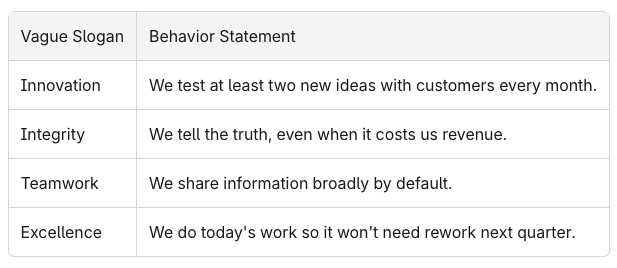
Core values should be demonstrated through leadership decisions and daily employee behavior. Diversity and inclusion are important elements of core values for organizations building a culture where everyone can contribute.
A simple process for leadership teams:
- Gather real stories. Ask employees to describe moments when they saw the culture at its best and worst.
- Surface patterns. Look for recurring themes across the stories.
- Cluster themes. Group similar behaviors into candidate values.
- Draft behavior statements. Write each value as "We…" followed by an observable action.
- Test for clarity. Run each draft value against real dilemmas the company faced in the last year.
Limit the company's core values to three to seven items so employees can remember and use them. Involve a cross-section of employees in wordsmithing to avoid purely executive language that doesn't reflect reality.
Criteria for Strong Core Value Statements
- Specific enough to guide a tough choice.
- Observable in a 90-day period.
- Easy to understand without training or a glossary.
- Action-oriented, not aspirational or abstract.
- Distinct from every other value on the list.
- Stable enough to remain meaningful for five or more years.
Test each draft against a real dilemma. If the value "We prioritize quality" doesn't help you decide whether to delay a launch, revise it to "We do not ship features that fail our internal quality checklist, even if the deadline passes."

Putting Values to Work in Hiring, Reviews, and Decisions
Core values are only real when they show up in structured people processes and day-to-day decision making. Consistency is what makes core values important. Posters and onboarding slides alone do not change organizational culture.
Hiring and Selection
Translate each core value into two or three behavioral interview questions. Core values attract candidates who share similar priorities to the organization. Companies with strong values attract job seekers 72% more effectively, and 72% of job seekers prefer companies with transparent core values.
- For integrity: "Tell me about a time you raised an unpopular concern. What happened?"
- For teamwork: "Describe a project where you collaborated across departments without clear authority."
- For customer focus: "Walk me through a time you went beyond policy to solve a customer problem."
Use a simple rubric that rates how clearly a candidate's past behavior aligns with your company's core values, separate from skills and experience.
Performance Reviews and Promotions
Leaders must model core values to influence employee behavior. If promotions go to people who deliver results but violate values, the values lose credibility overnight. Add a "How" section alongside the "What" section in every performance review.
Sample feedback phrases:
- "Your decision to escalate the quality issue immediately reflects our value of transparency. Keep doing that."
- "The way you handled that client call didn't align with our value of treating customers in good faith. Let's talk about what you'd do differently."
Regular feedback helps assess adherence to core values and keeps alignment visible.
Day-to-Day and Strategic Decision Making
Core values act as decision filters when tradeoffs appear: speed versus quality, growth versus ethics, revenue versus employee wellbeing. When a leadership team turns down a large client because the engagement would compromise quality standards, that decision tells every employee the values are real. When leaders name the relevant value out loud during visible decisions, they model behavior for the entire company.
Why Core Values Are Important for Employee Engagement and Company Culture
The data is clear. Companies with high employee engagement outperform others by 202%, and organizations with aligned values see 202% higher employee engagement. Companies with strong core values attract 72% more job seekers because personal values and company values align before the first interview. Employees aligned with core values feel a sense of belonging, which drives higher employee satisfaction and reduces turnover.
Organizations with aligned values experience lower turnover rates. Clear core values improve employee satisfaction and productivity levels. Organizations with strong core values see higher employee engagement because people know what will be rewarded and what will not be tolerated. That clarity creates fairness.
Shared values support collaboration across teams and geographies, reducing conflicts in hybrid and remote environments. A strong culture retains happy employees and high performers while making it easier to respectfully move on those who are not a culture fit, even when their results look good. Consider a company that enforces "no-blame" postmortems after incidents. Within six to twelve months, teams start reporting problems earlier, web works more reliably, and the sense of psychological safety becomes self-reinforcing. That is what long term success looks like when values are lived, not just listed.
Common Mistakes Companies Make with Core Values (and How to Avoid Them)
Many leadership teams have "values fatigue" from generic lists that changed nothing. Here are the most frequent mistakes and how to correct them:
- Too many values. If employees can't recall them, they aren't useful. Cut to three to seven and test recall in 30 days.
- Vague slogans instead of behavior statements. Replace single words with observable actions within the next quarter.
- Copying other companies. Your values must reflect your actual culture and the tradeoffs your business stands for. Write original statements.
- Values as marketing only. According to research on values credibility, 94% of executives say culture matters, but nearly half of workers report their employer professes values and doesn't live them.
- Leadership doesn't model values. Schedule a quarterly leadership review where executives share specific examples of values-driven decisions.
- Never updating values. Review lightly every year, deeply every three to five years or after a major strategic shift.
- No enforcement mechanism. Integrate values into hiring rubrics, review templates, and promotion criteria within 90 days.
The biggest risk is misalignment between stated values and lived company culture. That gap erodes trust faster than having no values at all.
When an Outside Facilitator Helps
An external facilitator helps leadership teams move faster, go deeper, and avoid internal politics when defining company core values. A facilitator brings tested core values examples, decision tools, and templates but tailors outcomes to your specific culture.
Outside help is especially valuable during:
- Mergers and acquisitions where two cultures must align
- Rapid scaling when the original culture starts to drift
- Founder or CEO transitions
- Low trust between executives or between leadership and staff
- Repeated failures to implement past values initiatives
- Expansion across geographies or into remote and hybrid work
A typical facilitated process runs four to eight weeks: stakeholder interviews, listening sessions, leadership workshops, drafting and testing candidate values, and launch planning that connects values to hiring, reviews, and strategic goals.
Frequently Asked Questions About Company Core Values
How many core values should a company have? Most successful companies keep three to seven. Fewer than three may not cover enough ground. More than seven makes memorization and consistent application difficult. Focus on the values that define real tradeoffs for your business, not aspirations everyone would agree with.
What is the difference between core values and a mission statement? A mission statement describes what the organization does and why it exists. Core values describe how everyone in the organization behaves while pursuing that mission. Both matter, but they answer different questions and belong in different parts of your strategic plan.
How often should core values be reviewed? Do a light review annually to check whether values still reflect how the company operates. Conduct a deeper review every three to five years or after major events like a merger, leadership change, or significant strategic pivot. Values should be stable, but not fossilized.
Can core values change? Yes. As a company grows and its market shifts, some values may need to evolve. The goal is stability, not permanence. Personal core values and personal responsibility toward the organization's culture should inform how leadership approaches any revision.
Next Steps: Turn Core Value Examples into a Living Culture
Choose a few values. Write them as specific behaviors. Embed them into hiring, reviews, and decisions. That is the difference between a successful business with a strong culture and one with a nicely designed poster no one remembers.
Review or create your strategic plan, vision statement, and team charter as companion tools. Each one reinforces the others and gives your top talent a clear picture of what the company stands for and where it's headed.
Ready to define core values your team will actually use? Bring your current or draft values to a conversation with Masterly Consulting Group. Schedule a consultation or call (888) 209-4055 so the work focuses on real decisions and culture challenges, not abstract theory.