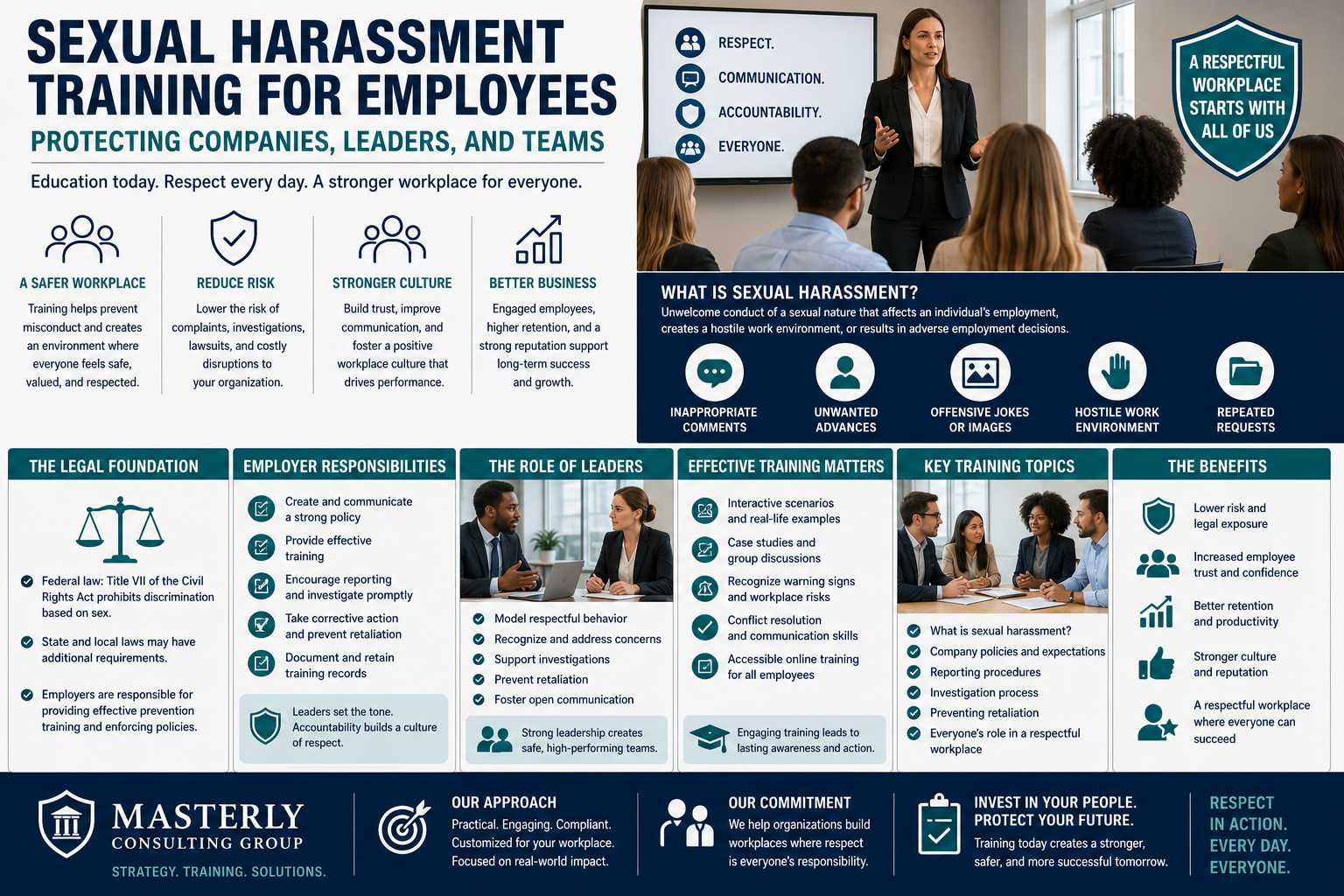
Sexual Harassment Training for Employees: Protecting Companies, Leaders, and Teams
Why Sexual Harassment Prevention Training Matters More Than Ever
Every organization wants a workplace where employees feel safe, respected, and able to do their best work. Yet creating that type of environment does not happen automatically. It requires leadership, communication, accountability, and ongoing education. One of the most important tools available to employers is sexual harassment prevention training for employees.
Workplace expectations continue to evolve, and organizations face increasing pressure to maintain professional environments that promote respect and inclusion. Employees expect clear standards of conduct, while employers must comply with federal, state, and local laws regarding workplace behavior. Effective sexual harassment training helps bridge that gap by providing practical guidance and helping employees understand their responsibilities.
Many organizations mistakenly view workplace harassment training as a simple compliance requirement. In reality, it serves a much larger purpose. Quality training helps employees recognize inappropriate behavior, understand reporting procedures, and contribute to a respectful workplace culture. It also helps managers and supervisors respond appropriately when concerns arise.
At Masterly Consulting Group, we believe that sexual harassment prevention training should do more than satisfy legal requirements. It should empower employees, strengthen leadership, reduce organizational risk, and create healthier workplaces where people can succeed.
Understanding Sexual Harassment in Today's Workplace
Sexual harassment can occur in organizations of every size and across every industry. While many people associate harassment with obvious misconduct, workplace situations are often more complex than they appear at first glance.
Employees may experience inappropriate comments, unwelcome advances, offensive jokes, visual materials, repeated requests for dates, or other behavior that creates a hostile work environment. In some cases, employees may not even realize that certain conduct violates workplace standards or applicable laws.
This is one reason why sexual harassment prevention training remains so important. Education helps employees understand what constitutes inappropriate behavior and how to address concerns before they escalate.
A strong training program also reinforces the idea that everyone plays a role in maintaining a professional and respectful environment.
The Difference Between Intent and Impact
One of the most valuable lessons taught during harassment prevention training involves understanding the difference between intent and impact.
An employee may believe a comment or action was harmless. However, if the behavior makes another person uncomfortable or contributes to a hostile workplace environment, the impact may still be significant.
Training helps employees recognize that workplace conduct should be evaluated not only by intention but also by how it affects others.
This awareness often improves communication and reduces the likelihood of misunderstandings.
Why Early Education Prevents Bigger Problems
Many workplace conflicts begin with small incidents that go unaddressed.
Without proper training, employees may not know how to respond when inappropriate behavior occurs. They may remain silent, fail to report concerns, or inadvertently contribute to situations becoming more serious.
Early education creates awareness and provides employees with practical tools for handling difficult situations.
Organizations that invest in prevention training often experience fewer workplace disputes and stronger employee confidence.
The Legal Foundation Behind Harassment Prevention
Workplace harassment laws exist to protect employees and establish standards for acceptable conduct.
At the federal level, Title VII of the Civil Rights Act prohibits discrimination based on protected characteristics, including sex. The Equal Employment Opportunity Commission plays a significant role in enforcing these protections and investigating complaints.
Many states have adopted additional requirements that expand upon federal law. Employers must understand how these regulations apply to their workforce and ensure that training programs align with applicable standards.
Compliance is important, but the ultimate goal extends beyond avoiding penalties. Organizations should strive to create environments where respect and professionalism become part of everyday operations.
How Federal Law Shapes Workplace Expectations
Federal law establishes baseline protections for employees throughout the country.
Title VII addresses workplace discrimination and harassment while providing a framework for employer responsibilities. These protections apply to many organizations regardless of industry.
Sexual harassment prevention training helps employees understand these standards while providing guidance regarding workplace expectations.
Employees who understand the law are often better equipped to recognize inappropriate behavior and respond appropriately.
State Laws Continue to Expand Requirements
While federal law provides foundational protections, many state laws introduce additional obligations.
New York State, California, and several other states have established specific training requirements for employers. These laws often address training frequency, recordkeeping requirements, training content, and employee participation standards.
Organizations operating in multiple states must pay careful attention to these differences.
Compliance strategies that work in one location may not fully satisfy requirements elsewhere.
Understanding NYC Requirements and Local Regulations
Certain jurisdictions have adopted even more specific workplace training mandates.
For example, York City employers may face additional obligations beyond broader New York State regulations. Local rules can affect training content, documentation practices, and implementation procedures.
Organizations should regularly review applicable laws and ensure that their workplace training programs remain current.
Keeping pace with changing regulations helps reduce compliance risks and demonstrates a commitment to responsible leadership.
Sexual Harassment Employer Responsibilities Extend Beyond Compliance
Employers play a central role in workplace culture.
While training is important, it represents only one component of a broader harassment prevention strategy. Leaders must establish expectations, enforce policies, investigate complaints, and take corrective measures when necessary.
Employees look to leadership for guidance regarding acceptable behaviors. When leaders consistently model professional conduct, employees are more likely to follow those examples.
Organizations that prioritize accountability often experience stronger workplace relationships and lower risk levels.
Establishing a Strong Sexual Harassment Prevention Policy
Every organization should maintain a clear sexual harassment prevention policy.
This policy serves as a foundation for workplace expectations and provides employees with guidance regarding reporting procedures, investigative processes, and disciplinary actions.
An effective policy should be written in accessible language and distributed to all employees.
Training programs should reinforce policy provisions while helping employees understand how the policy applies to real-life situations.
Communicating Expectations Clearly
Policies are most effective when supported by consistent communication.
Employees should understand not only what behaviors are prohibited but also what behaviors are encouraged.
Training can reinforce expectations regarding professionalism, respect, communication, and accountability.
Clear communication reduces confusion and helps create a more positive workplace environment.
Addressing Problems Promptly
Organizations that respond quickly to concerns often prevent larger problems from developing.
When employees report concerns, employers should follow established procedures and conduct appropriate investigations.
Prompt responses demonstrate that leadership takes complaints seriously.
This approach helps build trust while reducing the likelihood of future issues.
The Role of Managers and Supervisors in Harassment Prevention
Managers and supervisors often serve as the first point of contact when workplace concerns arise.
Because of their leadership positions, they frequently have additional responsibilities regarding harassment prevention.
Employees may approach supervisors with questions, concerns, or complaints long before formal reports are submitted.
Proper training helps leaders understand how to respond appropriately and consistently.
Why Leadership Training Matters
Supervisors influence workplace culture every day.
Their actions, decisions, and communication styles can shape employee perceptions regarding organizational values.
Leadership-focused harassment training helps managers recognize warning signs, respond to concerns effectively, and model professional behavior.
When leaders demonstrate accountability, employees are more likely to trust reporting processes.
Understanding Additional Responsibilities
Managers often have responsibilities that extend beyond those of other employees.
These responsibilities may include:
- Receiving complaints
- Documenting concerns
- Reporting incidents
- Supporting investigations
- Enforcing policies
- Monitoring workplace behavior
Training helps supervisors understand these obligations and fulfill them effectively.
Clear guidance reduces uncertainty during challenging situations.
Preventing Retaliation Concerns
Retaliation remains a significant issue in many workplace harassment cases.
Employees must feel comfortable reporting concerns without fear of negative consequences.
Managers play a critical role in preventing retaliation and protecting reporting employees.
Training helps leaders recognize retaliation risks and respond appropriately.
Organizations that address retaliation proactively often create stronger cultures of trust and accountability.
Creating a Respectful Workplace Through Education
Respectful workplaces do not happen by accident.
They are built through intentional effort, ongoing communication, and consistent reinforcement of organizational values.
Sexual harassment prevention training contributes to this process by helping employees understand expectations and develop practical workplace skills.
The goal extends beyond avoiding misconduct. It involves creating environments where individuals feel valued, supported, and respected.
When employees feel respected, organizations often experience improvements in morale, collaboration, productivity, and retention.
Training Employees to Recognize Workplace Harassment
Many employees are surprised to learn how broad workplace harassment definitions can be.
Training helps employees recognize behaviors that may contribute to hostile environments.
Examples and case studies provide practical context that makes training more relatable.
Real-world scenarios often help employees identify issues they might otherwise overlook.
Building Awareness Through Real-Life Situations
The most effective harassment prevention training includes realistic examples.
Real-life situations help employees connect training concepts to everyday workplace interactions.
Rather than focusing solely on legal definitions, practical scenarios demonstrate how issues may arise and how employees can respond appropriately.
This approach improves engagement while supporting long-term learning outcomes.
Encouraging Respectful Communication
Communication plays a major role in workplace culture.
Training encourages employees to consider how their words and actions affect others.
Respectful communication reduces misunderstandings and strengthens workplace relationships.
Organizations that emphasize respect often experience fewer conflicts and stronger team dynamics.
Designing a Harassment Prevention Training Program That Employees Will Actually Remember
Many organizations invest in workplace training but struggle to achieve lasting results. Employees may complete a course, check a box for compliance purposes, and then forget much of the information shortly afterward.
Effective sexual harassment prevention training takes a different approach. Instead of focusing solely on legal terminology, it emphasizes practical learning experiences that employees can apply in real workplace situations.
The best programs engage participants, encourage discussion, and provide meaningful examples that reflect the challenges employees may encounter.
When training feels relevant and useful, employees are more likely to retain the information and apply it in their daily interactions.
Interactive Learning Improves Engagement
Employees learn more effectively when they actively participate in the training process.
Interactive exercises encourage critical thinking and allow participants to explore workplace situations in a safe environment.
Rather than simply reading materials or watching presentations, employees can engage with realistic scenarios that reinforce key concepts.
Interactive training often results in stronger retention and greater confidence.
Employees who understand how to respond in difficult situations are better prepared when challenges arise.
The Value of Case Studies
Case studies provide practical examples that help employees understand workplace expectations.
These examples demonstrate how certain behaviors can affect coworkers, teams, and organizational culture.
Case studies also encourage discussion and help participants examine situations from multiple perspectives.
This deeper understanding supports better decision-making and stronger workplace relationships.
Organizations frequently find that employees connect more strongly with real-world examples than with purely theoretical information.
Helping Employees Recognize Warning Signs
One goal of harassment prevention training is helping employees recognize issues before they escalate.
Early warning signs may include inappropriate comments, repeated unwanted interactions, exclusionary behavior, or conduct that makes others uncomfortable.
Employees who understand these indicators are often more likely to address concerns promptly.
Early intervention can reduce conflict while helping organizations maintain respectful workplaces.
Online Training Creates Flexibility for Modern Workforces
Work environments continue to evolve.
Many organizations now operate across multiple locations, support remote employees, or utilize hybrid work arrangements. These changes create new challenges when implementing workplace training programs.
Online training offers a practical solution by providing employees with convenient access to educational resources regardless of location.
Organizations can deliver consistent messaging while ensuring broader participation.
This flexibility has made online training an increasingly popular option for harassment prevention initiatives.
Making Training Accessible
Accessibility plays an important role in employee participation.
Workers should be able to access training materials through a computer or other approved devices without unnecessary barriers.
When training is easy to access, employees are more likely to complete required coursework on time.
Convenience also helps organizations maintain compliance with applicable training requirements.
An accessible learning experience supports both employee engagement and organizational goals.
Supporting Individual Learners
Every employee learns differently.
Some individuals prefer reading materials, while others benefit from visual presentations or interactive exercises.
Modern online training programs can accommodate a variety of learning styles.
This flexibility helps individual learners engage more effectively with course content.
Providing multiple learning formats often leads to stronger educational outcomes.
Technical Support Encourages Completion
Even well-designed programs can encounter technical challenges.
Organizations should ensure that employees have access to technical support when questions or issues arise.
Prompt assistance helps prevent delays and reduces frustration.
Employees who can easily resolve technical issues are more likely to complete training requirements successfully.
Reliable support contributes to a smoother overall learning experience.
Why Training Must Reflect Real Workplace Situations
Employees often disengage when training feels disconnected from reality.
Generic examples may satisfy minimum requirements, but they rarely inspire meaningful learning.
Training becomes more effective when it reflects situations employees may actually encounter in the workplace.
Realistic scenarios help participants understand how policies apply in everyday interactions.
This practical focus often improves both engagement and retention.
Addressing Everyday Workplace Conduct
Not every workplace issue involves extreme behavior.
Many concerns arise from routine interactions that gradually create discomfort or tension.
Training should address common situations involving communication, workplace relationships, humor, personal boundaries, and professional conduct.
Employees who understand these everyday dynamics are often better equipped to maintain respectful interactions.
Small improvements in workplace behavior can have a significant impact over time.
Teaching Conflict Resolution Skills
Conflict resolution plays an important role in harassment prevention.
Not every workplace disagreement constitutes harassment, but unresolved conflicts can contribute to larger issues.
Training can provide employees with tools for addressing concerns constructively and respectfully.
These skills help improve communication while reducing misunderstandings.
Organizations that encourage healthy conflict resolution often experience stronger workplace relationships.
Encouraging Employees to Speak Up
Many workplace issues persist because employees hesitate to report concerns.
Fear, uncertainty, or lack of confidence may discourage individuals from coming forward.
Training should explain reporting procedures clearly and reinforce the importance of addressing concerns promptly.
Employees who understand available resources are more likely to seek assistance when needed.
Open communication contributes to healthier workplace cultures.
Documentation and Recordkeeping Support Compliance Efforts
Training is only one aspect of compliance.
Organizations must also maintain appropriate records demonstrating that employees completed required coursework.
Documentation requirements vary depending on applicable laws and regulations.
Maintaining accurate records helps organizations respond effectively during audits, investigations, or legal proceedings.
Strong documentation practices also demonstrate organizational commitment to workplace safety and compliance.
Tracking Completion Status
Organizations should maintain records showing when employees completed training.
These records often include participant names, completion dates, course information, and attendance details.
Accurate tracking helps ensure compliance with training requirements.
It also makes it easier to schedule refresher training when necessary.
Consistent recordkeeping reduces administrative challenges over time.
Understanding Retention Requirements
Some jurisdictions require employers to maintain training records for specific periods.
For example, certain state regulations may require records to be retained for multiple years following completion.
Organizations should understand applicable retention requirements and develop systems for managing documentation accordingly.
Proper record maintenance supports compliance while reducing organizational risk.
Strong administrative practices help ensure important information remains accessible when needed.
Preparing for Investigations
Investigations can occur for many reasons.
When complaints arise, organizations may need to demonstrate that employees received appropriate training and policy information.
Detailed records help support these efforts.
Documentation alone cannot prevent workplace issues, but it can provide valuable evidence that the organization took reasonable steps to educate employees.
Prepared organizations are often better positioned to address challenges effectively.
How Harassment Prevention Training Protects Organizations
Many employers initially focus on compliance when implementing training programs.
While compliance is certainly important, the benefits of sexual harassment prevention training extend much further.
Strong programs can reduce risk, improve workplace culture, strengthen employee trust, and support organizational performance.
These advantages often produce long-term value that goes well beyond legal requirements.
Reducing Organizational Risk
Workplace harassment complaints can create significant challenges.
Organizations may face investigations, litigation, reputational damage, employee turnover, and operational disruptions.
Effective prevention training helps reduce these risks by increasing awareness and encouraging appropriate workplace behavior.
Prevention efforts are often less costly than responding to problems after they occur.
Organizations that invest in education frequently experience stronger long-term outcomes.
Strengthening Employee Confidence
Employees perform better when they feel safe and respected.
Training demonstrates that the organization takes workplace concerns seriously and values employee well-being.
This commitment can increase trust and confidence throughout the workforce.
Employees who trust their organization are often more engaged and productive.
A positive workplace culture supports both employee satisfaction and organizational success.
Supporting Business Growth
Workplace culture influences many aspects of business performance.
Organizations with strong cultures often attract and retain talented employees more effectively.
Positive environments can also improve collaboration, communication, and customer experiences.
Harassment prevention training contributes to these outcomes by helping create respectful and professional workplaces.
A healthy workplace culture supports sustainable growth and long-term success.
Building a Culture That Goes Beyond Compliance
Compliance should never be the final goal.
Organizations that achieve the greatest success view harassment prevention as part of a larger commitment to workplace excellence.
They invest in education, leadership development, communication, and accountability.
These efforts help create environments where employees feel respected and valued.
When respect becomes part of organizational culture, many workplace challenges become easier to prevent.
Reinforcing Expectations Throughout the Year
Training should not occur only once.
Regular communication helps reinforce key messages and keep workplace expectations visible.
Organizations can support ongoing learning through meetings, policy reviews, leadership discussions, and educational resources.
Continuous reinforcement strengthens awareness while encouraging consistent behavior.
Employees benefit when expectations remain clear throughout the year.
Encouraging Leadership Accountability
Employees pay close attention to leadership behavior.
Leaders who model professionalism and accountability help establish positive workplace norms.
Training should encourage managers and supervisors to lead by example.
Visible leadership commitment strengthens organizational credibility.
Employees are more likely to embrace workplace values when leaders consistently demonstrate them.
Creating Long-Term Positive Change
The most effective organizations view harassment prevention as an ongoing process rather than a one-time event.
Long-term success requires commitment, consistency, and continuous improvement.
Training serves as a foundation for broader cultural development efforts.
Over time, these efforts can strengthen relationships, reduce risk, and improve organizational performance.
A respectful workplace benefits employees, leaders, and the organization as a whole.
Understanding How Workplace Harassment Affects Teams and Performance
Workplace harassment impacts much more than the individuals directly involved. Even when incidents appear isolated, their effects can spread throughout an organization and influence morale, productivity, and employee confidence.
Employees who witness inappropriate behavior may become less engaged or hesitant to speak openly. Team members may question whether concerns will be addressed fairly or whether leadership is committed to maintaining a respectful environment.
Over time, unresolved issues can damage workplace culture and create unnecessary distractions. Sexual harassment prevention training helps organizations address these risks proactively by establishing clear expectations and encouraging accountability.
When employees understand acceptable behaviors and reporting procedures, organizations are better positioned to maintain healthy and productive workplaces.
The Hidden Costs of Workplace Harassment
Many employers focus on the direct costs associated with investigations or legal matters. However, the indirect costs can be equally significant.
Workplace harassment can contribute to reduced productivity, increased absenteeism, higher turnover, and lower employee satisfaction.
Employees who feel uncomfortable or unsupported may struggle to perform at their highest level.
Prevention training helps organizations reduce these risks while supporting stronger workplace relationships.
How Culture Influences Employee Retention
Employees are more likely to remain with organizations where they feel respected and valued.
Workplace culture plays a major role in retention decisions, particularly among high-performing employees.
When organizations invest in workplace harassment training and demonstrate a commitment to respectful conduct, employees often develop greater trust in leadership.
That trust can improve loyalty and reduce turnover.
A positive workplace culture frequently becomes a competitive advantage in attracting and retaining talent.
Building Stronger Team Relationships
Healthy workplace relationships contribute to collaboration, innovation, and overall organizational success.
Training helps employees understand how their actions affect coworkers and team dynamics.
By promoting awareness and respectful communication, organizations can strengthen professional relationships across departments and leadership levels.
These improvements often support better teamwork and more effective problem-solving.
Respect serves as a foundation for productive workplace interactions.
Why Harassment Prevention Training Must Include Managers
While all employees benefit from education, managers require additional instruction because of their leadership responsibilities.
Supervisors are often responsible for recognizing concerns, responding appropriately, and initiating organizational procedures when necessary.
Without proper training, managers may unintentionally mishandle situations or fail to follow established protocols.
Specialized workplace harassment training helps leaders understand their obligations while providing practical guidance for handling sensitive issues.
This preparation supports both compliance and organizational effectiveness.
Recognizing Problems Before They Escalate
Managers frequently observe workplace interactions that other leaders may not see.
Their position allows them to identify behavioral patterns, communication concerns, and emerging conflicts.
Training helps supervisors recognize warning signs early.
Early intervention often prevents minor concerns from becoming major organizational challenges.
Proactive leadership can significantly reduce workplace risk.
Responding Professionally to Complaints
Employees who raise concerns deserve thoughtful and professional responses.
Managers should understand how to receive complaints, document information, maintain confidentiality when appropriate, and follow organizational procedures.
Training helps leaders navigate these responsibilities with confidence.
Consistent responses also strengthen employee trust in reporting systems.
Employees are more likely to report concerns when they believe leadership will handle them appropriately.
Understanding Investigation Responsibilities
Certain workplace complaints may require formal investigation.
Managers should understand their role within that process and know when concerns should be elevated to human resources or other designated personnel.
Training provides guidance regarding documentation, communication, and procedural expectations.
This knowledge helps organizations respond effectively while maintaining fairness and professionalism.
Well-informed leaders contribute to stronger organizational outcomes.
The Importance of Clear Reporting Processes
Even the most comprehensive training program will be less effective if employees do not understand how to report concerns.
Reporting procedures should be easy to understand, accessible, and communicated consistently throughout the organization.
Employees need confidence that concerns will be taken seriously and handled appropriately.
Clear reporting systems support both prevention and resolution efforts.
Organizations that simplify the reporting process often experience greater employee trust.
Eliminating Uncertainty for Employees
Many employees hesitate to report concerns because they are unsure what will happen next.
Training can remove uncertainty by explaining each step of the process.
Employees should understand who to contact, what information may be needed, and how complaints are typically handled.
Transparency helps reduce anxiety and encourages timely reporting.
When employees know what to expect, they often feel more comfortable seeking assistance.
Encouraging Early Reporting
The earlier concerns are reported, the easier they may be to address.
Employees should not feel pressured to wait until situations become severe before speaking up.
Training can emphasize the value of addressing concerns promptly.
Early reporting often allows organizations to intervene before issues affect larger groups of employees.
This proactive approach supports healthier workplace environments.
Maintaining Fairness Throughout the Process
Every complaint deserves careful consideration.
Organizations should follow consistent procedures that respect the rights of all parties involved.
Training can help employees understand how investigations are conducted and why fairness matters.
Maintaining procedural consistency strengthens credibility and trust.
Employees are more likely to support organizational processes when they perceive them as fair and impartial.
Adapting Training for Different Workplace Environments
No two organizations are exactly alike.
Industry requirements, workforce demographics, operational structures, and organizational culture can all influence training needs.
Effective harassment prevention training should be flexible enough to address these differences while maintaining compliance with applicable laws.
Customized approaches often produce stronger engagement and better learning outcomes.
Organizations benefit when training reflects their unique environment.
Training for Office-Based Organizations
Office environments present their own workplace challenges.
Frequent collaboration, shared workspaces, meetings, and digital communication all create opportunities for misunderstandings or inappropriate conduct.
Training should address these realities using relevant examples and practical guidance.
Employees are more likely to engage with content that reflects their daily experiences.
Relevant training often leads to stronger retention.
Addressing Remote and Hybrid Workplaces
Remote work has changed how employees interact with one another.
Video meetings, messaging platforms, email communication, and virtual collaboration introduce new considerations.
Harassment prevention training should address online interactions and digital workplace conduct.
Employees need guidance regarding professional communication regardless of physical location.
Organizations that address remote workplace dynamics are better prepared for modern workforce challenges.
Supporting Diverse Workforces
Today's organizations often include employees from different backgrounds, cultures, and experiences.
Training should promote inclusion while reinforcing respectful workplace behavior.
Diverse perspectives can strengthen organizations, but they also require thoughtful communication and mutual understanding.
Harassment prevention programs help establish shared expectations that support positive interactions.
Respectful workplaces benefit everyone.
Why Ongoing Education Matters
Workplace culture is not created through a single training session.
Organizations achieve lasting results when education becomes an ongoing priority.
Refresher courses, policy updates, leadership discussions, and supplemental learning opportunities help reinforce key concepts over time.
Continuous learning supports awareness while keeping expectations visible.
Employees benefit from regular reminders and opportunities to strengthen their understanding.
Keeping Information Current
Workplace laws and regulations can change.
Organizations should periodically review training materials to ensure accuracy and relevance.
Updated content helps employees stay informed about evolving requirements and expectations.
Current information supports compliance while improving educational value.
Keeping materials up to date demonstrates organizational commitment to responsible workplace practices.
Reinforcing Organizational Values
Training provides an opportunity to reinforce organizational values regularly.
Employees should hear consistent messages about professionalism, respect, accountability, and inclusion.
These messages become more meaningful when supported by leadership actions and workplace policies.
Consistency helps strengthen workplace culture.
Employees are more likely to embrace organizational values when they see them reinforced throughout the year.
Supporting Long-Term Behavioral Change
The ultimate goal of harassment prevention training is not simply knowledge acquisition.
Organizations want employees to apply what they learn in everyday workplace interactions.
Behavioral change occurs through repetition, reinforcement, and consistent expectations.
Ongoing education supports this process by helping employees retain information and develop practical skills.
Long-term success depends on continuous effort rather than one-time events.
Training Creates Opportunities for Positive Workplace Growth
Organizations often focus on risk reduction when discussing harassment prevention.
While risk management is important, training also creates opportunities for growth.
Employees who understand workplace expectations are often better communicators, stronger collaborators, and more effective team members.
Respectful workplace cultures encourage innovation, engagement, and professional development.
Training supports these outcomes by helping employees build stronger interpersonal skills.
When organizations invest in education, they invest in both people and performance.
Creating a Sustainable Harassment Prevention Strategy
Organizations that achieve long-term success with harassment prevention understand that training is only one part of a broader strategy. While education provides employees with important knowledge, sustainable results require ongoing commitment from leadership and active participation throughout the organization.
A successful strategy combines training, policy development, communication, accountability, and continuous improvement. Each component supports the others and contributes to a workplace culture built on respect and professionalism.
When these efforts work together, organizations are better positioned to prevent harassment, address concerns effectively, and strengthen employee confidence.
The result is a workplace where employees feel supported and leadership demonstrates a genuine commitment to maintaining a respectful environment.
Aligning Policies With Training Programs
Training and policy development should always work together.
Employees may receive valuable education during a harassment prevention course, but that information becomes much more effective when reinforced by clear organizational policies.
A strong sexual harassment prevention policy provides guidance regarding conduct expectations, reporting procedures, investigations, corrective measures, and employee responsibilities.
Training helps employees understand how those policies apply to everyday workplace situations.
Consistency between policies and training strengthens both compliance efforts and workplace culture.
Reinforcing Expectations Through Leadership
Leadership commitment remains one of the strongest predictors of training success.
Employees pay close attention to how leaders communicate, respond to concerns, and model workplace behavior.
When leaders consistently reinforce expectations regarding respect, professionalism, and accountability, employees are more likely to embrace those standards.
Training programs become more meaningful when supported by visible leadership actions.
Organizations often see stronger outcomes when leaders actively participate in workplace culture initiatives.
Evaluating Program Effectiveness
Training should not be viewed as a one-time event that never requires review.
Organizations should periodically evaluate whether training objectives are being achieved.
Feedback from employees, managers, and supervisors can provide valuable insight into areas for improvement.
Regular evaluation helps organizations identify opportunities to strengthen content, improve delivery methods, and address emerging workplace challenges.
Continuous improvement supports long-term effectiveness.
Meeting Compliance Requirements While Supporting Workplace Culture
Compliance remains an important consideration for employers.
Federal law, state regulations, and local requirements may all influence workplace training obligations.
Organizations must understand the law that applies to their workforce and ensure that their programs satisfy applicable standards.
However, the most successful organizations view compliance as a starting point rather than the final destination.
They use training as an opportunity to strengthen workplace culture while fulfilling legal obligations.
Understanding Training Requirements
Training requirements vary depending on location and organizational structure.
Certain state laws require periodic sexual harassment prevention training for employees, managers, and supervisors.
Some jurisdictions establish specific content requirements, documentation standards, and completion deadlines.
Organizations should regularly review applicable regulations to ensure continued compliance.
A proactive approach reduces risk while supporting responsible workplace management.
Managing Completion and Documentation
Training completion records play an important role in compliance efforts.
Organizations should maintain documentation showing participation, completion dates, course materials, and related information.
These records may become important during audits, investigations, or legal proceedings.
Strong recordkeeping practices help demonstrate organizational commitment to workplace training and compliance.
Well-organized documentation supports both operational efficiency and risk management.
Preparing for Regulatory Changes
Workplace regulations continue to evolve.
Organizations that monitor legal developments are often better positioned to adapt quickly when requirements change.
Regular reviews of training materials, policies, and procedures help ensure ongoing compliance.
Remaining informed also allows organizations to identify opportunities for improvement before challenges arise.
Preparation often reduces uncertainty and supports more effective decision-making.
Why Respectful Workplaces Benefit Everyone
A respectful workplace benefits employees, managers, leaders, and the organization as a whole.
Employees are more likely to engage fully in their work when they feel valued and supported.
Managers often experience fewer conflicts and stronger team dynamics.
Organizations benefit from improved morale, increased productivity, and enhanced employee retention.
These positive outcomes demonstrate why harassment prevention should be viewed as both a compliance initiative and a business strategy.
Improving Employee Engagement
Employees who feel respected often develop stronger connections to their work and their organization.
Respectful environments encourage participation, collaboration, and open communication.
Training helps reinforce these values while providing practical guidance regarding workplace behavior.
Employees who understand expectations are often more confident in their interactions with coworkers and supervisors.
Engagement frequently improves when workplace culture supports respect and inclusion.
Supporting Stronger Leadership
Effective leadership depends on trust.
Employees are more likely to trust leaders who respond consistently, communicate clearly, and uphold organizational values.
Harassment prevention training helps managers and supervisors develop these skills.
Leadership development contributes to stronger workplace relationships and improved organizational performance.
Well-trained leaders help create environments where employees feel comfortable raising concerns and sharing ideas.
Strengthening Organizational Reputation
Workplace culture influences how organizations are perceived by employees, clients, and business partners.
Companies known for professionalism and respect often attract stronger talent and build more positive reputations.
Training demonstrates a commitment to maintaining high standards.
This commitment can strengthen organizational credibility and support long-term growth objectives.
A positive reputation provides value both internally and externally.
The Future of Workplace Harassment Prevention
Workplaces continue to evolve.
Advances in technology, changing workforce expectations, and new forms of communication create both opportunities and challenges for employers.
Harassment prevention programs must evolve as well.
Organizations should remain flexible and willing to adapt training approaches to meet changing needs.
Continuous learning and improvement will remain essential components of successful prevention efforts.
Addressing Digital Workplace Interactions
Technology plays a larger role in workplace communication than ever before.
Email, messaging platforms, video conferencing tools, and collaboration software have become standard components of modern work environments.
Training should address appropriate conduct within these digital spaces.
Employees need guidance regarding professional communication regardless of whether interactions occur in person or online.
Addressing digital conduct helps organizations maintain consistent expectations across all workplace settings.
Supporting Modern Workforce Needs
Today's workforce includes employees from a wide range of backgrounds, experiences, and perspectives.
Training programs should reflect this diversity while reinforcing shared expectations regarding workplace conduct.
Inclusive educational approaches often produce stronger engagement and learning outcomes.
Organizations benefit when employees feel represented and respected throughout the training process.
Thoughtful program design supports broader workplace goals.
Investing in Long-Term Success
Harassment prevention is ultimately an investment in organizational health.
Companies that prioritize education, accountability, and respect often experience stronger workplace cultures and better business outcomes.
Training helps establish the foundation for these efforts.
Over time, organizations that invest consistently in workplace culture are often better positioned to attract talent, retain employees, and achieve long-term success.
The benefits extend far beyond compliance alone.
Addressing Sexual Harassment Complaints Through Effective Training and Compliance
Organizations that take sexual harassment complaints seriously are better positioned to create safe, respectful workplaces and reduce legal risk. While many employers choose to use established programs, some may develop their own training to address industry-specific concerns, provided the content meets applicable requirements. Understanding how the law applies is essential, as workplace protections are rooted in both labor regulations and broader human rights principles designed to protect employees from discrimination and harassment. To support diverse workforces, many organizations also offer training materials in Spanish and other languages to improve accessibility and participation. In some jurisdictions, employers may be required to maintain training records for up to three years, making proper documentation an important part of compliance efforts. By combining effective education, clear reporting procedures, and consistent enforcement, organizations can strengthen workplace culture while helping prevent future complaints.
Protecting Companies, Leaders, and Teams Through Education
Sexual harassment prevention training for employees serves an important purpose in today's workplace. It helps employees recognize inappropriate conduct, understand reporting procedures, and contribute to a culture of professionalism and respect.
For leaders, training provides guidance regarding responsibilities, complaint management, investigations, and workplace expectations. For organizations, it supports compliance, reduces risk, and strengthens workplace culture.
Most importantly, effective workplace harassment training helps create environments where employees can focus on their work without fear of harassment, discrimination, or retaliation.
Organizations that prioritize prevention demonstrate a commitment to both employee well-being and organizational excellence.
By combining education, accountability, leadership involvement, and continuous improvement, companies can build stronger workplaces that benefit everyone involved.
Contact Masterly Consulting Group for a Free Consultation
Creating an effective sexual harassment prevention training program requires more than checking a compliance box. It requires thoughtful planning, engaging content, clear policies, and a commitment to building a respectful workplace culture.
At Masterly Consulting Group, we help organizations develop and implement sexual harassment prevention training for employees that supports compliance, strengthens leadership, reduces workplace risk, and promotes positive employee experiences. Whether your organization needs workplace harassment training, online training solutions, policy guidance, management education, or support navigating evolving training requirements, our team is ready to assist.
We understand that every organization faces unique challenges. That is why we work closely with employers, managers, supervisors, and human resources professionals to develop practical solutions that align with organizational goals and workplace realities.
Contact Masterly Consulting Group today at (888) 209-4055 to book a free consultation. We would be happy to answer your questions, discuss your training objectives, and help you create a comprehensive harassment prevention strategy that protects your employees, leaders, and organization for years to come.