The Urgent Need for Clear NIL Policies as Highest NIL College Athletes Push Institutional Boundaries
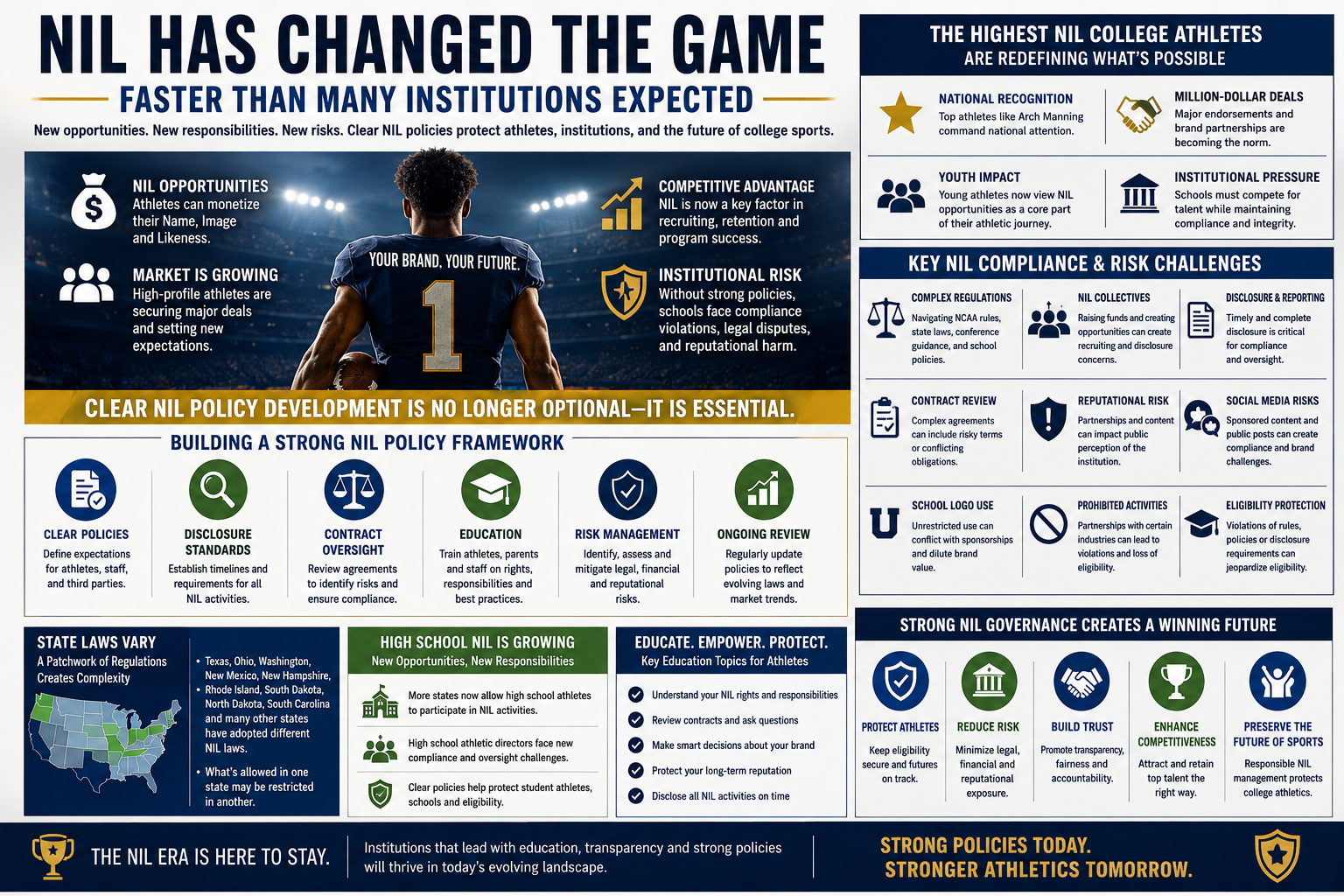
NIL Has Changed the Game Faster Than Many Institutions Expected
The landscape of college athletics has changed dramatically in a short period of time. Since student athletes gained the ability to profit from their name image and likeness rights, schools, conferences, compliance officers, and risk management professionals have faced challenges that did not exist just a few years ago. What began as a movement designed to provide fair compensation opportunities for athletes has evolved into a complex system involving major endorsements, brand partnerships, NIL collectives, and multi-million-dollar agreements.
Today, some of the highest earning college athletes generate significant NIL earnings that rival salaries found in professional sports. As NIL money continues to increase, institutions must address growing concerns regarding compliance, oversight, eligibility, disclosure requirements, and reputational risks. The absence of a consistent national framework has created an environment where schools often rely on state laws, conference guidance, and their own NIL rules.
For compliance officers and risk management personnel, this uncertainty creates substantial challenges. The rapid growth of NIL opportunities has exposed weaknesses in many school policies and has forced institutions to reconsider how they manage risk within college sports. Clear NIL policy development is no longer optional. It has become a critical component of responsible governance.
As athletes continue pushing institutional boundaries, schools that fail to implement comprehensive NIL policies may expose themselves to legal disputes, compliance violations, public criticism, and competitive disadvantages.
Understanding the Evolution of NIL
The concept of NIL centers on allowing athletes to monetize their personal brand. This includes the use of their name image and likeness in advertising campaigns, social media promotions, sponsorships, appearances, autograph signings, merchandise sales, and other approved NIL activities.
Prior to modern NIL laws, NCAA rules largely prohibited student athletes from receiving compensation related to their athletic reputation. These restrictions were rooted in amateurism rules that sought to preserve amateur status within college athletics.
The legal environment shifted significantly after numerous court challenges questioned the fairness and legality of restricting athletes from benefiting financially from their own brand. As state laws began emerging across the country, the NCAA was forced to adjust its position.
Today, NIL opportunities have become a central part of athlete recruitment, retention, and competitive strategy. The result is a rapidly evolving marketplace where schools must continuously adapt to changing expectations and regulations.
How Highest NIL College Athletes Are Reshaping Expectations
Some college athletes have become national celebrities before ever entering professional sports. High-profile football players, basketball stars, gymnasts, and social media influencers have demonstrated the tremendous profit potential associated with NIL.
Athletes such as Arch Manning have attracted national attention not only because of athletic performance but also because of their marketability. Their ability to secure significant signed deals illustrates the growing value of a strong personal brand.
The visibility of these athletes creates a ripple effect throughout college sports. Younger athletes increasingly view NIL as a core component of their athletic journey. Prospective student athletes frequently evaluate NIL opportunities alongside academic offerings, facilities, coaching staffs, and competitive programs.
This shift has created pressure on institutions to establish frameworks that support athlete success while maintaining compliance with applicable rules.
The Growing Compliance Challenge
The increasing complexity of NIL deals presents numerous compliance concerns. Institutions must monitor activities that may trigger violations of NCAA rules, conference policies, state laws, or internal school policies.
A compliance office may be required to review:
- NIL agreement submissions
- Required disclosure documentation
- Brand partnerships
- Promotional appearances
- Social media content
- Third-party marketing arrangements
- Potential recruiting inducements
- Conflicts involving school logos
Each transaction carries unique legal and regulatory considerations. Without clear policies, institutions may struggle to determine whether specific activities are permissible.
The challenge becomes even greater when athletes work with agents, marketing firms, collectives, sponsors, and outside advisors.
Why Institutional Boundaries Are Being Tested
Many of the most controversial NIL questions arise when athletes seek opportunities that fall into gray areas. These situations often push beyond traditional compliance frameworks.
Athletes may seek partnerships involving industries that create reputational concerns. Others may pursue compensation structures that raise questions about recruiting incentives or pay-for-play arrangements.
The rapid growth of NIL collectives has further complicated oversight efforts. While many collectives support athletes through legitimate NIL opportunities, some arrangements have raised concerns about whether compensation is tied directly to athletic participation.
As the market matures, institutions increasingly encounter situations that were never anticipated when early NIL policies were drafted.
NIL Collectives and Emerging Risk Factors
NIL collectives have become powerful participants in the NIL ecosystem. These organizations often raise funds from donors and supporters to facilitate NIL opportunities for athletes.
While many collectives operate within legal boundaries, the lack of consistent regulation creates uncertainty.
Compliance teams frequently evaluate:
Recruiting Concerns
Compensation promises made before enrollment may raise concerns regarding recruiting inducements.
Disclosure Issues
Incomplete reporting can create compliance vulnerabilities.
Contract Review Challenges
Complex contracts may contain provisions that conflict with institutional expectations.
Reputational Exposure
Collective activities can impact public perception of a school even when the institution does not directly control the organization.
Risk management personnel must remain aware of how collective activities may affect institutional interests.
The Importance of Clear NIL Policy Development
A strong NIL policy provides structure and consistency. It helps athletes understand expectations while giving administrators a framework for evaluating compliance issues.
An effective NIL policy should address both legal obligations and institutional values.
Clear policies help reduce confusion, improve transparency, and support proactive risk management. They also create a consistent process for handling NIL questions before problems arise.
When policies are vague, athletes may unintentionally violate rules. Institutions may also struggle to enforce standards fairly.
Required Disclosure Standards Matter
One of the most important aspects of NIL compliance involves required disclosure procedures.
Institutions should establish clear timelines and reporting requirements for all NIL activities. Early disclosure allows compliance personnel to identify potential concerns before agreements are finalized.
Disclosure systems should capture information regarding:
- Contract parties
- Compensation amounts
- Duration of agreements
- Promotional obligations
- Brand involvement
- Use of school marks
- Potential conflicts of interest
Comprehensive reporting enhances institutional oversight and strengthens compliance efforts.
State Laws Create a Complex Regulatory Environment
The NIL landscape remains fragmented because state laws vary significantly.
States such as Texas have developed NIL frameworks that differ from those found elsewhere. Other states including Ohio, Washington, New Mexico, New Hampshire, Rhode Island, South Dakota, North Dakota, and South Carolina have adopted their own approaches.
This patchwork system creates challenges for institutions operating across multiple jurisdictions.
Compliance personnel must continuously monitor legislative developments and adjust policies accordingly. What may be permitted in one state could create concerns in another.
The lack of uniformity increases administrative burdens and legal uncertainty.
School Policies Must Fill Regulatory Gaps
Because national standards remain limited, many institutions have adopted their own NIL rules.
These school policies often address areas not fully covered by state laws or NCAA guidance.
Institutions commonly regulate:
- Use of school logos
- Conflicts with existing sponsorship agreements
- Restricted industries
- Disclosure requirements
- Agent interactions
- Social media promotions
- Institutional branding concerns
Well-crafted school policies help establish predictable expectations while protecting institutional interests.
Managing Risks Associated With School Logos
The use of school logos presents unique challenges.
Athletes often wish to incorporate institutional branding into promotional materials. However, unrestricted use may create confusion regarding sponsorship relationships.
Institutions should establish licensing standards that clearly define permissible and prohibited uses.
Clear guidelines protect intellectual property rights while reducing the risk of unauthorized endorsements.
Without such protections, schools may face brand dilution or legal disputes involving third-party sponsors.
High School NIL Expands the Compliance Conversation
The growth of high school NIL has introduced additional complexity.
Many states now permit high school athletes to engage in certain NIL activities. However, the rules governing high school NIL frequently differ from those applicable to college athletes.
High school student athletes often require guidance from parents, administrators, and compliance professionals.
Questions surrounding eligibility, sponsorships, and disclosure requirements have become increasingly common.
The expansion of NIL into secondary education underscores the need for clear governance at every level.
Challenges Facing High School Athletic Directors
The high school athletic director now faces responsibilities that were largely nonexistent just a few years ago.
Many administrators must interpret evolving NIL laws while balancing educational priorities and athletic programs.
A high school athletic director may encounter questions regarding:
- Sponsored appearances
- Social media content
- Local businesses seeking endorsements
- Brand partnerships
- Athlete compensation
- Use of school intellectual property
Clear policies help schools manage these situations consistently and fairly.
Protecting Eligibility in a Rapidly Changing Environment
One of the primary concerns for athletes and institutions is losing eligibility.
Violations may occur when athletes enter prohibited arrangements, fail to provide disclosure information, or participate in prohibited NIL activities.
Compliance teams should focus on education and prevention rather than simply enforcement.
Athletes who understand the rules are better equipped to protect their opportunities and avoid unintended consequences.
Eligibility protection remains a central objective of effective NIL governance.
The Impact of Social Media Promotions
Social media platforms have become a primary source of NIL earnings.
Athletes can leverage large audiences to attract sponsorships and partnerships with brands across multiple industries.
While social media promotions create valuable opportunities, they also create compliance risks.
Institutions must address issues involving disclosure, intellectual property, advertising standards, and reputational concerns.
A comprehensive policy should include guidance regarding sponsored content and platform-specific obligations.
NIL Valuations Continue to Raise Questions
Determining fair market value remains one of the most debated aspects of NIL.
NIL valuations often vary significantly based on audience size, marketability, sport, geography, and engagement metrics.
The absence of standardized valuation methods creates uncertainty.
Institutions should avoid direct involvement in assigning values while ensuring that compensation arrangements do not raise concerns regarding improper inducements.
Transparency remains essential when evaluating NIL earnings.
Understanding Prohibited NIL Activities
Every institution should clearly define prohibited NIL activities.
Examples may include partnerships involving:
- Adult entertainment
- Illegal products
- Gambling enterprises
- Controlled substances
- Activities inconsistent with institutional values
Clearly identifying prohibited NIL activities reduces confusion and supports consistent enforcement.
Athletes benefit when expectations are communicated before agreements are signed.
Balancing Athlete Freedom and Institutional Protection
The NIL era requires institutions to balance competing priorities.
Athletes deserve opportunities to benefit from their own brand and entrepreneurial efforts. At the same time, schools must protect institutional interests and maintain compliance obligations.
Successful NIL programs recognize that athlete empowerment and risk management are not mutually exclusive.
Thoughtful policies can support both objectives simultaneously.
The most effective institutions approach NIL as a partnership rather than an adversarial process.
Educating Student Athletes About NIL Responsibilities
Education remains one of the most effective compliance tools.
Student athletes should receive training regarding:
Contract Review
Understanding key contract provisions reduces legal risks.
Disclosure Obligations
Timely reporting supports compliance oversight.
Brand Management
Building an own brand requires strategic decision-making.
Long-Term Reputation
Actions taken today may affect future opportunities.
Ongoing education helps athletes make informed decisions throughout their careers.
The Role of Parents in NIL Decision-Making
Parents often play a significant role in NIL discussions, particularly when dealing with younger athletes.
Parents may assist with contract review, financial planning, and opportunity evaluation.
Educational resources should be available to help families understand NIL rights and responsibilities.
Strong communication between institutions and families can reduce misunderstandings and improve compliance outcomes.
This is especially important as high school NIL continues expanding nationwide.
Developing Effective Contract Review Procedures
Every NIL agreement should undergo careful review.
Contract evaluation may identify concerns involving exclusivity provisions, intellectual property rights, disclosure obligations, compensation structures, and termination clauses.
Institutions should encourage athletes to seek qualified legal guidance before signing agreements.
A proactive review process helps identify potential issues before they become significant problems.
Strong oversight reduces both athlete and institutional risk.
The Future of Amateurism Rules
Traditional amateurism rules continue evolving.
Many observers believe further changes are inevitable as courts, legislators, and regulatory bodies continue examining athlete compensation issues.
Institutions should remain adaptable and prepared for future developments.
Policies created today should include mechanisms for revision as NIL laws and regulations change.
Flexibility is essential in a rapidly developing environment.
Why Risk Management Professionals Must Lead the Conversation
Risk management teams are uniquely positioned to address NIL challenges.
These professionals understand how legal, financial, operational, and reputational risks intersect.
Effective risk management requires proactive planning rather than reactive responses.
Institutions that wait for problems to emerge may face costly consequences.
A comprehensive NIL strategy should involve collaboration among compliance officers, legal counsel, athletics administrators, and risk management personnel.
Creating Sustainable NIL Governance Frameworks
Long-term success requires more than isolated policy updates.
Institutions should establish governance frameworks that support ongoing evaluation and improvement.
Key components include:
- Regular policy reviews
- Stakeholder education
- Disclosure monitoring
- Contract review procedures
- Risk assessments
- Compliance audits
- Documentation protocols
Sustainable governance promotes consistency and accountability.
As NIL continues evolving, institutions with strong frameworks will be better positioned to adapt.
Protecting the Future of College Athletics
The future of college athletics depends on responsible NIL management.
The opportunities created by name image and likeness rights have transformed the athlete experience. However, those opportunities also introduce substantial compliance and governance challenges.
Institutions that embrace proactive oversight can support athlete success while protecting organizational interests.
Clear NIL policies provide the foundation for responsible growth. They help schools manage risk, preserve integrity, and maintain public trust.
As earning college athletes continue pushing institutional boundaries, the need for comprehensive NIL governance becomes increasingly urgent. Schools that invest in education, transparency, and compliance today will be better prepared for the challenges and opportunities that lie ahead.
Understanding Industry Changes and New Opportunities
The insurance and financial industries continue to evolve as regulations, technology, and consumer expectations change. Businesses that stay informed about emerging trends are often better positioned to serve their clients effectively. Understanding how different industries adapt to regulatory updates can provide valuable lessons for insurance agencies seeking growth. Staying current helps organizations remain competitive while continuing to meet the needs of their communities.
Lessons From Markets Where Participants Can Earn NIL Money
In recent years, industries connected to collegiate athletics have changed significantly as athletes gained opportunities to earn NIL money through approved endorsement and sponsorship agreements. This shift demonstrates how rapidly markets can evolve when regulations change. For businesses, including insurance agencies, the lesson is clear: organizations that adapt quickly to new opportunities are often able to strengthen their position in the marketplace. Remaining flexible and forward-thinking can create long-term advantages.
How Rules Affect Allowed Student Athletes
The changing landscape surrounding allowed student athletes illustrates the importance of understanding regulatory requirements. Organizations must remain informed about evolving guidelines to ensure compliance while maximizing opportunities. Similarly, insurance agencies must stay current with industry regulations, coverage requirements, and market developments. Knowledge and adaptability help businesses provide better guidance to their clients.
The Importance of Working Within State Association Guidelines
Many industries operate under oversight from a state association or governing body that establishes standards and best practices. Following these guidelines helps maintain professionalism, consistency, and public trust. Insurance agencies can benefit from applying the same principles by emphasizing transparency, ethical business practices, and ongoing education. Trust grows when consumers see a commitment to professionalism.
Building a Strong Team Requires Every Position to Work Together
A successful organization resembles a high-performing sports team where every role contributes to the overall outcome. Whether it is a quarterback, a wide receiver, or another key contributor, teamwork is essential for success. The same principle applies to insurance agencies. Agents, customer service representatives, marketers, and leadership teams must work together to create exceptional client experiences and sustainable growth.
Why Consumers Often Focus on Cash Savings
Many insurance shoppers begin their search focused on saving cash. While affordability is important, consumers also need to understand the value of proper protection. Agencies that educate clients about balancing cost and coverage often build stronger relationships and improve customer satisfaction. Helping clients make informed decisions creates trust and long-term loyalty.
Why Timing and the Right Date Matter in Insurance Planning
Insurance decisions are often influenced by timing. Policy renewals, life changes, business expansions, and major purchases can all create opportunities to review coverage. Scheduling regular policy reviews and keeping important renewal date information organized helps clients stay protected. Agencies that proactively communicate during these key moments often strengthen client relationships and uncover additional service opportunities.
Understanding NIL and the Changing Landscape of College Athletics
The introduction of NIL opportunities has transformed the world of amateur athletics. Athletes now have more opportunities to benefit from their personal brands while continuing their athletic careers. As regulations continue to evolve, schools, athletes, families, and organizations must stay informed about the latest developments. Understanding these changes is essential for anyone involved in modern athletics.
How NIL Deals Are Reshaping Opportunities
NIL deals have created new opportunities for athletes to monetize their personal brands through endorsements, sponsorships, appearances, and promotional activities. These agreements allow athletes to leverage their popularity while maintaining eligibility under current regulations. As the market continues to grow, athletes and their families must carefully evaluate opportunities to ensure they align with long-term goals. Professional guidance can help athletes navigate these evolving opportunities successfully.
The Impact of NIL Laws on Modern Athletics
NIL laws vary by state and continue to evolve as lawmakers respond to changes within collegiate athletics. These regulations establish the framework that governs how athletes can participate in endorsement and sponsorship activities. Understanding applicable laws is critical for maintaining compliance and avoiding unintended violations. As rules continue to develop, staying informed remains a top priority for athletes, schools, and athletic programs.
Why Name Image and Likeness Matters
The concept of name image and likeness allows athletes to profit from their personal identity and public recognition. This includes opportunities related to social media promotions, advertising campaigns, autograph signings, merchandise, and other business ventures. The ability to benefit from name image and likeness rights has significantly changed the relationship between athletics and business. These opportunities continue to shape the future of sports at multiple levels.
Opportunities and Challenges for College Sports
The introduction of NIL opportunities has had a major impact on college sports. Athletic departments, coaches, compliance professionals, and student-athletes must now navigate a more complex environment that combines athletics, business, and regulatory compliance. While these opportunities create new earning potential, they also introduce additional responsibilities. Proper education and planning help ensure athletes maximize opportunities while remaining compliant.
What Earning College Athletes Need to Consider
Earning college athletes often face important decisions regarding contracts, taxes, branding, sponsorship agreements, and long-term financial planning. While NIL opportunities can provide substantial benefits, athletes should approach these arrangements carefully. Professional guidance can help identify risks, protect future opportunities, and support informed decision-making. Strategic planning often plays a significant role in long-term success.
How High School Athletes Are Entering the NIL Conversation
In some states, high school athletes are beginning to gain access to NIL-related opportunities as regulations continue to evolve. These developments have created new discussions among schools, parents, athletic associations, and lawmakers. As participation expands, education becomes increasingly important to ensure young athletes understand both the opportunities and responsibilities involved. Families should stay informed about current rules applicable within their state.
Common NIL Questions Athletes and Families Ask
Many athletes and parents have NIL questions regarding eligibility, sponsorship agreements, tax obligations, social media activities, and compliance requirements. Because regulations can vary by jurisdiction and athletic organization, obtaining accurate information is essential. Athletes who seek guidance early are often better prepared to take advantage of opportunities while avoiding potential pitfalls. Understanding the rules helps create a stronger foundation for long-term success.
Speak With Masterly Consulting Group About NIL Compliance and Risk Management
Navigating NIL rules, NIL agreements, disclosure requirements, eligibility concerns, and evolving state laws can be overwhelming for schools, athletic departments, compliance officers, and risk management professionals. Whether your institution is developing a new NIL policy, updating existing school policies, addressing high school NIL concerns, or responding to complex NIL questions, having experienced guidance can make a significant difference.
At Masterly Consulting Group, we help organizations evaluate compliance risks, strengthen governance frameworks, develop practical policies, and implement strategies designed to protect both institutions and athletes. Our team understands the unique challenges facing modern college athletics and educational organizations as NIL continues to evolve across the country.
If you have questions regarding NIL opportunities, NIL collectives, required disclosure procedures, eligibility protection, contract review processes, or institutional risk management, we invite you to speak with our team.
Contact Masterly Consulting Group at (888) 209-4055 to schedule a free consultation. We would be happy to discuss your concerns, answer your questions, and help your organization build a stronger and more effective NIL compliance strategy.