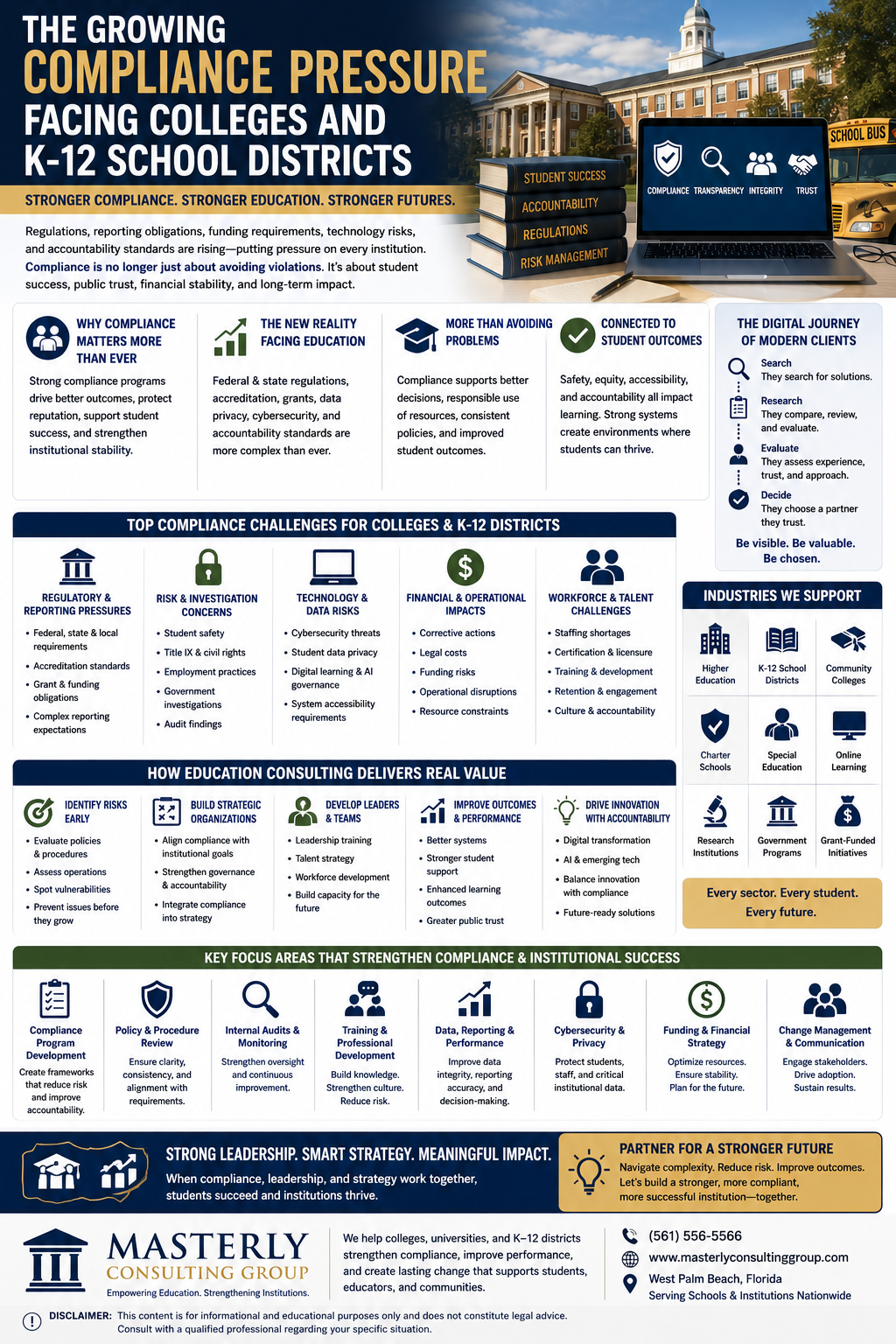
The Growing Compliance Pressure Facing Colleges and K-12 School Districts
Why Compliance Has Become a Major Concern for Educational Leaders
A generation ago, many school administrators spent most of their time focused on curriculum, student achievement, staffing, and community engagement. While those priorities remain essential today, educational leaders now face an additional challenge that continues to grow in complexity: compliance.
Colleges, universities, and K-12 districts are operating in an environment where regulations, reporting obligations, investigations, funding requirements, technology concerns, and accountability standards seem to increase every year. What was once considered an administrative responsibility has become a strategic issue that can directly affect institutional stability.
The reality is that compliance is no longer limited to avoiding violations. It has become closely tied to student outcomes, public trust, financial sustainability, and long-term organizational success.
Institutions that fail to adapt often discover that compliance issues can quickly evolve into operational, financial, and reputational challenges.
The New Reality Facing Educational Institutions
Educational institutions today face pressures that extend far beyond the classroom.
Federal requirements, state regulations, accreditation standards, grant obligations, cybersecurity concerns, and student support expectations create a complicated environment for administrators. These responsibilities affect both higher education institutions and K-12 districts.
Many leaders entered education because they wanted to improve education and support students. Few anticipated the growing volume of compliance responsibilities that now consume significant portions of their time.
As expectations continue to increase, educational organizations must find ways to remain compliant while maintaining focus on teaching and learning.
Why Compliance Is About More Than Avoiding Problems
Many people think compliance is simply about preventing violations.
In reality, effective compliance programs support organizational stability, improve accountability, and strengthen decision-making. They help schools and universities identify risks before those risks become major issues.
Strong compliance systems also contribute to improved student outcomes by creating environments where policies, procedures, and expectations are consistently applied.
When institutions treat compliance as a strategic function rather than a regulatory burden, they often position themselves for greater success.
How Student Outcomes Are Connected to Compliance
Compliance and student outcomes may seem unrelated at first glance.
However, many compliance requirements are directly connected to educational quality, student safety, accessibility, equity, and institutional accountability. When schools effectively manage these responsibilities, students often benefit from more consistent support systems.
Well-designed compliance frameworks help ensure that resources are used appropriately and that educational opportunities remain accessible.
Ultimately, the goal is not simply regulatory adherence but creating conditions that support student success.
The Growing Complexity of Higher Education Compliance
Higher education institutions face particularly complex challenges.
Universities must navigate accreditation standards, financial aid regulations, research requirements, Title IX obligations, student privacy concerns, and various reporting requirements. Each area carries its own expectations and potential consequences.
As regulations become more detailed, many colleges find themselves dedicating additional personnel and resources to compliance efforts.
This growing complexity has increased demand for specialized education consulting services.
Why K-12 Districts Are Feeling the Pressure
K-12 districts face their own unique compliance challenges.
Student safety requirements, special education obligations, educator certification standards, employment regulations, public records requirements, and funding accountability measures all require ongoing attention.
District leaders are often expected to balance these responsibilities while managing budgets, staffing shortages, and evolving educational needs.
The result is an environment where administrators must constantly evaluate risks while maintaining focus on student learning outcomes.
The Financial Impact of Compliance Challenges
Compliance issues often carry significant financial implications.
Investigations, corrective actions, legal disputes, funding concerns, and operational disruptions can create unexpected costs. For institutions already facing budget constraints, these expenses can place additional strain on available resources.
Financial sustainability increasingly depends on effective risk management.
Organizations that proactively address compliance concerns often avoid the higher costs associated with reactive responses.
Why Strategic Planning Matters More Than Ever
Compliance cannot be managed effectively through isolated decisions.
Educational organizations benefit from strategic planning that integrates compliance considerations into broader institutional objectives. This approach allows leaders to anticipate challenges rather than constantly reacting to them.
Strategic planning helps identify priorities, allocate resources, and align compliance efforts with organizational goals.
Institutions that plan proactively often experience stronger outcomes and fewer disruptions.
Understanding the Role of Education Consulting
Many institutions recognize that internal resources alone may not be enough.
Education consulting provides access to specialized expertise that helps organizations evaluate risks, improve systems, and strengthen compliance frameworks. Consultants often bring perspectives gained from working with multiple schools, colleges, and districts.
This outside perspective can reveal opportunities that internal teams may overlook.
As compliance requirements continue to evolve, education consulting has become an increasingly valuable resource.
Why Education Consulting Services Continue to Grow
The demand for education consulting services has expanded significantly in recent years.
Educational institutions face challenges involving technology, compliance, workforce development, strategic planning, student performance, and organizational change. These issues often require specialized knowledge that extends beyond traditional educational administration.
Consultants help leaders navigate these challenges while maintaining focus on their core mission.
The growing complexity of education has made external expertise more valuable than ever.
How Education Consultants Help Organizations Identify Risks
One of the most important roles education consultants play is helping organizations identify risks.
Many compliance problems develop gradually. Small issues often go unnoticed until they become larger challenges that require significant resources to address.
Consultants evaluate policies, procedures, operations, reporting systems, and organizational practices to identify potential vulnerabilities.
This proactive approach helps institutions address concerns before they escalate.
The Importance of Organizational Strategy
Compliance should not operate separately from institutional strategy.
An effective organizational strategy aligns compliance efforts with broader educational objectives. This creates greater consistency and improves decision-making throughout the organization.
When compliance is integrated into strategic planning, institutions often become more resilient and adaptable.
This alignment supports both operational effectiveness and long-term success.
Why Educational Leaders Need Strategic Expertise
Today's educational leaders are expected to manage increasingly complex organizations.
They must oversee academics, finance, technology, staffing, compliance, student support services, and community relationships. These responsibilities require both leadership skills and strategic expertise.
Many institutions seek support from consultants because leaders recognize that outside perspectives can strengthen decision-making.
Strategic guidance often helps organizations navigate uncertainty more effectively.
Addressing Root Causes Instead of Symptoms
Many compliance issues are symptoms of larger organizational challenges.
For example, reporting failures may reflect inadequate training. Policy violations may result from communication gaps. Resource shortages may contribute to operational inconsistencies.
Effective education consulting focuses on identifying root causes rather than simply treating symptoms.
This approach often produces more meaningful and lasting change.
Why Digital Transformation Creates New Compliance Challenges
Technology has transformed nearly every aspect of education.
Digital learning platforms, student information systems, data analytics tools, and online communication methods offer significant benefits. However, they also create new compliance responsibilities.
Institutions must address cybersecurity, privacy, data protection, accessibility, and technology governance concerns.
Digital transformation requires thoughtful planning to balance innovation with compliance obligations.
Artificial Intelligence and the Future of Compliance
Artificial intelligence is becoming increasingly relevant in education.
Schools and universities are exploring how AI can support learning, improve administrative efficiency, and enhance decision-making. At the same time, new questions are emerging regarding privacy, ethics, accountability, and oversight.
Educational leaders must evaluate how artificial intelligence fits within existing compliance frameworks.
The rapid pace of technological change makes this an important area of focus.
Supporting Student Success Through Strong Systems
Student success depends on more than academic instruction.
Support services, accessibility initiatives, safety protocols, mental health resources, and operational effectiveness all influence student experiences. Compliance frameworks often help ensure these systems function properly.
Institutions that strengthen organizational systems frequently see improvements in student outcomes.
Strong systems create environments where students can thrive.
Why Student Needs Continue to Evolve
The needs of today's students differ significantly from previous generations.
Students face changing workforce expectations, technological advancements, economic pressures, and social challenges. Educational institutions must adapt to meet these evolving needs.
Compliance requirements often reflect these changing expectations.
Understanding student needs helps organizations create more responsive and effective strategies.
Expanding Access to Educational Opportunities
One of the most important goals in modern education is expanding access.
Educational institutions strive to create opportunities for diverse populations of students. Access involves more than enrollment; it includes support systems that help students succeed after they arrive.
Compliance initiatives frequently support efforts to expand access and reduce barriers.
These efforts contribute to broader educational and social outcomes.
The Connection Between Compliance and Economic Mobility
Education has long been viewed as a pathway to economic mobility.
When institutions operate effectively and provide high quality education, students gain opportunities to develop skills that support future success. Compliance frameworks help maintain the standards necessary to support these outcomes.
Strong institutions create stronger opportunities for students.
This connection makes compliance a matter of public importance as well as organizational responsibility.
Why High Quality Education Requires Strong Leadership
Leadership influences every aspect of institutional performance.
Educational leaders establish priorities, allocate resources, shape culture, and guide organizational change. Their decisions affect compliance, student performance, employee engagement, and long-term sustainability.
Strong leadership is essential for managing the growing complexity facing schools and universities.
Institutions with effective leadership often navigate challenges more successfully than those without it.
Creating Meaningful Change in Education
Meaningful change rarely occurs through isolated initiatives.
Lasting improvement requires coordinated efforts involving leadership, educators, staff, students, and community stakeholders. Successful organizations focus on building systems that support continuous improvement.
Education consulting can help facilitate this process by providing structure, insights, and strategic guidance.
The most effective changes are those that align with institutional goals while supporting long-term growth.
Why Talent Strategy Is Becoming a Compliance Priority
Many educational institutions focus heavily on policies and procedures when discussing compliance.
However, people remain one of the most important factors influencing organizational success. A strong talent strategy helps schools and universities recruit, develop, and retain professionals who understand institutional expectations and compliance responsibilities.
When organizations invest in their workforce, they often reduce operational risks while improving consistency across departments.
The ability to attract and retain qualified professionals has become a critical component of long-term institutional success.
The Growing Challenge of Workforce Development
Educational institutions across the country continue to face staffing challenges.
Teacher shortages, leadership vacancies, increased workloads, and changing workforce expectations have created pressure on schools and universities alike. These issues affect both operational effectiveness and compliance management.
Organizations that prioritize workforce development often position themselves more effectively for future challenges.
Investing in people remains one of the most reliable strategies for long-term growth.
Why Former Teachers Bring Valuable Perspectives
Many successful education consultants began their careers as educators.
Former teachers often possess firsthand knowledge of classroom realities, instructional challenges, student needs, and school operations. This experience allows them to provide practical recommendations grounded in real-world understanding.
Educational leaders frequently appreciate guidance from professionals who understand both strategic goals and day-to-day educational realities.
That balance often leads to more effective solutions.
Leadership Development as a Long-Term Investment
Strong institutions rarely happen by accident.
They are often guided by leaders who understand how to navigate challenges while maintaining focus on student success. Leadership development helps prepare current and future administrators to manage increasingly complex educational environments.
Investing in leadership development strengthens organizational resilience.
It also helps institutions prepare for future transitions and evolving expectations.
Why Educational Leaders Need Ongoing Training
The responsibilities of educational leaders continue to expand.
Today's administrators must understand compliance requirements, organizational strategy, technology, workforce management, financial planning, and student support systems. These demands require continuous learning.
Ongoing training helps leaders remain informed about changing expectations and emerging challenges.
Professional development is no longer optional for many educational organizations.
Funding Strategies and Institutional Stability
Financial pressures continue to affect educational institutions at every level.
Many schools, colleges, and universities must balance rising costs with limited resources. Effective funding strategies help organizations align financial decisions with long-term priorities.
Strategic financial planning supports both compliance and operational effectiveness.
Institutions that manage resources carefully often create greater stability for students and staff.
Financial Sustainability in a Changing Environment
Financial sustainability has become a major concern throughout education.
Enrollment fluctuations, economic conditions, technology investments, and workforce expenses all influence institutional budgets. Leaders must make decisions that support both immediate needs and future viability.
Strong planning helps organizations maintain flexibility during periods of uncertainty.
Financial sustainability is increasingly connected to strategic decision-making.
Why Educational Institutions Must Balance Growth and Risk
Growth is often viewed as a positive development.
However, expansion can create new compliance obligations, operational complexities, and resource demands. Educational institutions must carefully evaluate how growth affects existing systems and processes.
Balancing growth with risk management helps organizations remain stable
.
Sustainable growth requires thoughtful planning and effective leadership.
How Universities Face Unique Compliance Pressures
Universities operate in highly complex environments.
They must manage research initiatives, student services, academic programs, financial aid requirements, technology systems, and regulatory obligations. Each area presents distinct challenges.
The scale of university operations often increases compliance complexity.
As a result, many institutions seek specialized consulting support to address evolving demands.
Why K-12 Districts Need Strategic Support
K-12 districts face a different set of challenges.
Student populations, staffing concerns, funding requirements, technology initiatives, and accountability expectations all require ongoing attention. District leaders must balance these responsibilities while supporting students, teachers, and communities.
Strategic support helps districts identify priorities and allocate resources effectively.
This guidance often improves both operational performance and educational outcomes.
Improving Student Learning Outcomes Through Better Systems
Educational success depends on more than individual classroom performance.
Institutional systems influence instruction, support services, professional development, and resource allocation. When these systems function effectively, student learning outcomes often improve.
Strong organizational practices create environments where educators can focus on teaching and students can focus on learning.
Systemic improvement frequently leads to stronger results.
Why Student Performance Reflects Organizational Health
Student performance is often viewed as a measure of educational effectiveness.
While many factors influence outcomes, organizational health plays a significant role. Leadership, staffing, training, resources, and strategic planning all affect student experiences.
Schools that strengthen internal systems often create better conditions for learning.
This connection highlights the importance of comprehensive institutional improvement efforts.
Supporting Educators Through Organizational Change
Change can be difficult for any organization.
Teachers, administrators, and support staff often face new expectations, technologies, and procedures. Successful implementation requires communication, training, and support.
Organizations that involve educators in the change process frequently experience better outcomes.
Engagement helps build trust and strengthen implementation efforts.
Why Community Partnerships Matter
Educational institutions do not operate in isolation.
They are deeply connected to the communities they serve. Strong partnerships help schools and universities better understand local needs while creating additional educational opportunities.
Community engagement often strengthens support for institutional initiatives.
Collaboration can also help expand access to valuable resources.
Expanding Access Through Strategic Initiatives
Many institutions are working to expand access to educational opportunities.
This includes efforts focused on affordability, student support, technology access, workforce readiness, and inclusive learning environments. Strategic initiatives often require coordination across multiple departments.
Effective planning helps ensure these efforts remain sustainable.
The goal is to create opportunities that support long-term success for students.
Why Innovation Must Be Balanced With Accountability
Innovation continues to shape the future of education.
New teaching methods, technology platforms, data systems, and instructional models create exciting opportunities. However, innovation must be balanced with accountability and compliance considerations.
Organizations that evaluate risks alongside opportunities often make stronger decisions.
Responsible innovation supports both progress and stability.
Creating Lasting Change Rather Than Temporary Improvements
Many educational initiatives produce short-term results.
The greater challenge is creating lasting change that continues benefiting students and institutions over time. Sustainable improvement requires commitment, leadership, and strategic alignment.
Organizations that focus on long-term outcomes often achieve greater success than those pursuing quick fixes.
Meaningful change requires patience and consistency.
Why Deep Expertise Matters in Education Consulting
Education is a specialized field with unique challenges.
Consultants must understand regulations, governance structures, instructional practices, organizational dynamics, and student support systems. This deep expertise allows consultants to provide guidance that reflects the realities facing educational institutions.
Effective recommendations are grounded in both knowledge and experience.
Institutions benefit from working with professionals who understand the complexity of modern education.
The Role of Education Strategy Consulting
Education strategy consulting helps institutions align goals, resources, and operations.
Rather than focusing solely on compliance, consultants evaluate how organizational decisions influence long-term performance. This includes strategic planning, leadership development, operational improvement, and workforce strategies.
The objective is to help institutions build stronger foundations.
A well-defined education strategy supports both compliance and student success.
How Education Consulting Creates Positive Change
The most effective consulting engagements focus on creating positive change.
Consultants work alongside educational leaders to identify opportunities, develop strategies, and implement improvements. This collaborative approach helps organizations build internal capacity while addressing current challenges.
The ultimate goal is not dependency but empowerment.
Successful consulting helps institutions become stronger, more effective, and better prepared for the future.
Why Masterly Consulting Group Supports Educational Institutions
At Masterly Consulting Group, we understand the growing pressures facing colleges, universities, and K-12 districts. Compliance obligations, technology changes, workforce challenges, funding concerns, and student expectations continue to evolve.
Our team provides education consulting services designed to help educational institutions strengthen operations, improve organizational effectiveness, and navigate complex challenges. We partner with educational leaders to develop strategies that support compliance, student success, financial sustainability, and long-term growth.
Whether your organization needs assistance with strategic planning, leadership development, organizational strategy, talent strategy, digital transformation, or compliance-related initiatives, our team brings the expertise necessary to help guide meaningful progress.
Helping Schools and Universities Build Stronger Futures
Educational institutions play a vital role in shaping the future of communities, industries, and individual lives.
The challenges facing education today are significant, but they also create opportunities for innovation, growth, and improvement. Organizations that approach these challenges strategically often emerge stronger and more resilient.
Masterly Consulting Group is committed to helping schools, districts, colleges, and universities create lasting change that benefits students, educators, and communities.
We believe that thoughtful planning, strong leadership, and effective support systems are essential to long-term success.
Building a Growth Strategy That Supports Students, Institutions, and Communities
Educational institutions today must think beyond immediate challenges and focus on long-term sustainability. Whether serving students in early childhood education, K-12 programs, or higher education environments, organizations benefit from a clear growth strategy that aligns resources, leadership, and institutional goals. Effective education services help schools and universities identify opportunities to improve performance, strengthen operations, and create better outcomes for learners at every stage of their educational journey. When leaders focus on sustainable growth, they are often better positioned to support innovation while maintaining high standards of accountability and educational quality.
Many successful consulting engagements are guided by experienced professionals, including a senior partner with extensive knowledge of educational systems, organizational strategy, and institutional development. Drawing from insights used by organizations recognized as a global leader in education improvement, consultants help institutions create environments where every young person has greater access to meaningful educational opportunities. These efforts often extend beyond academics and include initiatives focused on student well being, workforce readiness, and long-term success. At Masterly Consulting Group, our clients include schools, districts, colleges, and universities seeking practical strategies that support growth, strengthen compliance, and create lasting positive outcomes for students, educators, and communities.
How an Education Consulting Firm Helps Improve Education Across Every Level
An experienced education consulting firm can play an important role in helping schools, districts, colleges, and universities navigate complex challenges while focusing on long-term success. Educational leaders are often responsible for balancing compliance requirements, student achievement goals, workforce development, and financial pressures all at the same time. Through strategic planning, operational assessments, and customized education services, consultants help organizations identify opportunities for improvement and develop practical solutions. The ultimate objective is to improve education by creating stronger systems that support both students and educators.
The need for strategic guidance begins early in the educational journey. Programs focused on early childhood education establish the foundation for future learning, making it critical for institutions to implement effective policies, support services, and instructional practices from the very beginning. An experienced senior partner with extensive knowledge of educational systems can help leaders evaluate existing programs, identify gaps, and implement strategies designed to strengthen outcomes. By combining experience, research, and practical expertise, education consultants help institutions create sustainable improvements that benefit students, staff, and communities for years to come.
Contact Masterly Consulting Group for a Free Consultation
Every educational institution faces challenges, but those challenges do not have to become barriers to progress. Whether your organization is navigating compliance concerns, seeking improved student outcomes, evaluating funding strategies, planning for growth, or implementing new systems, having the right partner can make a meaningful difference.
At Masterly Consulting Group, we work closely with educational leaders, educators, districts, schools, colleges, and universities to develop practical solutions that support long-term success. Our consulting services are designed to help organizations identify opportunities, address risks, strengthen operations, and create sustainable improvement.
If your institution is looking for strategic guidance from an experienced education consulting firm, contact Masterly Consulting Group today at (888) 209-4055 to book a free consultation. We would welcome the opportunity to learn more about your goals, answer your questions, and discuss how our team can help your organization build a stronger future while continuing to serve students and communities effectively.