Operations Consultant: Fixing Process Gaps That Slow Growth
An operations consultant diagnoses and repairs the process gaps, ownership confusion, and accountability breakdowns that keep growing companies from scaling predictably. If your business has the right strategy but inconsistent execution, this article will show you what to look for, what to expect, and how to take the next step.
Key takeaways for busy founders and operations leaders
An operations consultant works inside your business to fix how work actually gets done. They focus on the gap between your plans and your results: the missed handoffs, the unclear owners, the processes that exist only in someone's head. For growing companies with delivery bottlenecks and accountability gaps, this role is often the difference between scaling and stalling.
- What they do: An operations consultant analyzes business processes to identify inefficiencies, then redesigns workflows, builds accountability systems, and implements changes. Think of it as business operations consulting with hands-on execution, not a stack of slides.
- When you need one: Companies between $3M and $50M in revenue, typically 15 to 250 employees, hit the point where informal processes break. Businesses lose 20-30% of revenue due to poorly designed workflows at this stage.
- What results to expect: Faster delivery cycles, fewer errors, clearer ownership of metrics, and stronger margins. Operations consultants help businesses grow without spiraling costs.
- How Masterly Consulting Group helps: We pair operations strategy consultation with hands-on implementation, tailored to your operating model; not generic templates.
What is an operations consultant (and how they differ from strategy consulting)?
An operations consultant is a professional who improves efficiency and reduces costs for businesses by reworking how daily operations actually function. Their objective is to close the distance between what leadership decides and what the organization delivers. Consider a B2B services firm where invoices take 45 days to go out because approvals bounce between three departments with no defined owner. Or a growing ecommerce company where fulfillment errors spike every time order volume climbs. Operations consulting solves these kinds of problems.
Strategy consulting decides "where to play" and "how to win" through market research, competitive positioning, and business strategy. Operations consulting makes the business run better, faster, and more predictably day to day. Operations consulting aims to improve efficiency and reduce unnecessary costs, while strategy work frames long-term direction. Here's how the two compare:
- Strategy consulting: 4-12 week engagements, C-suite focus, deliverables are roadmaps and market analyses
- Operations consulting: 3-18 month engagements, cross-functional focus, deliverables are implemented workflows, operating procedures, and accountability systems
- Core focus areas of an operations consultant: process design and redesign, accountability systems, technology enablement, performance measurement, and workflow optimization
- Where they overlap: Many organizations now expect consultants to bridge both, moving from recommendation to implementation in a single engagement

Common operational symptoms that signal you need help
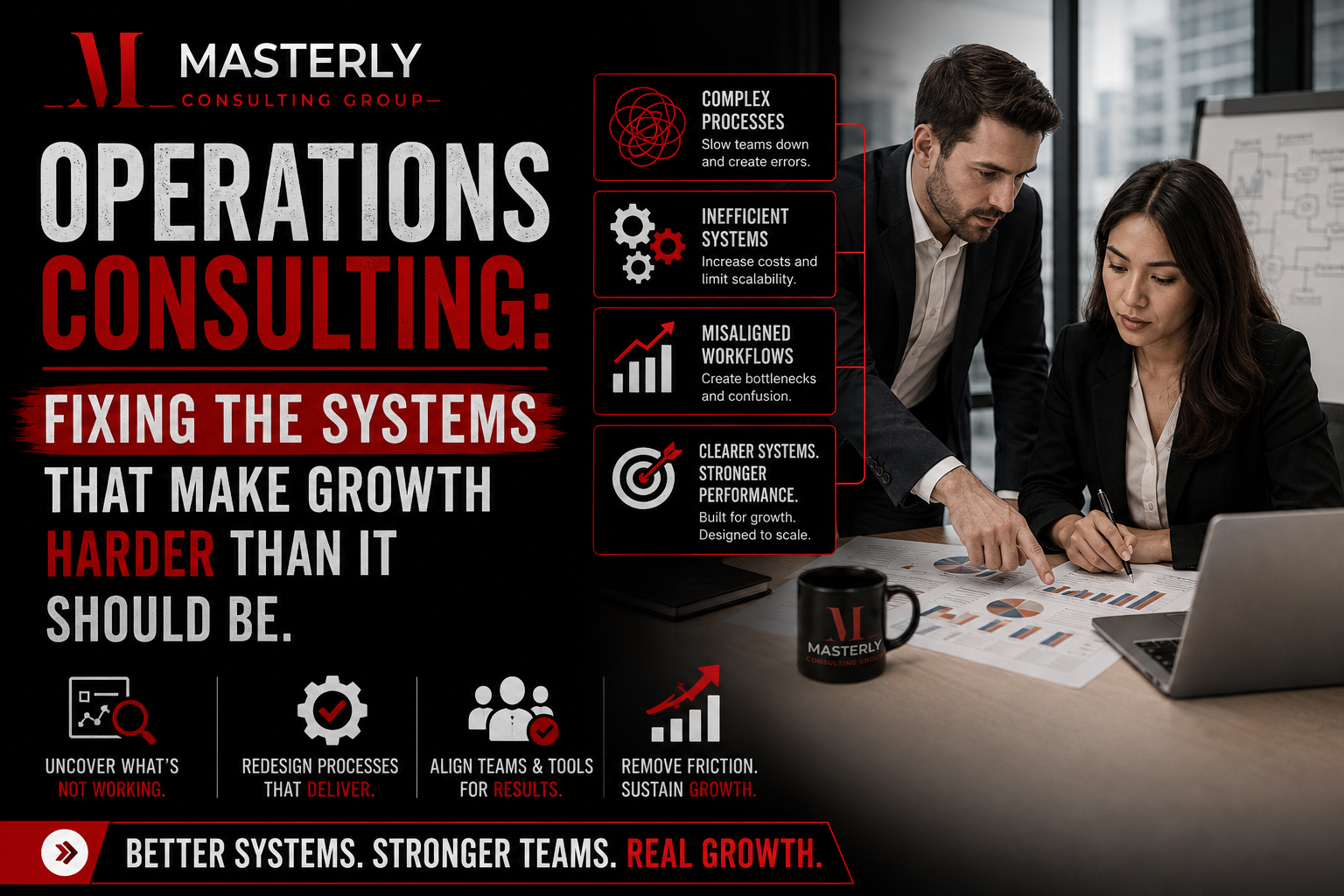
Use this list as a quick diagnostic. If you recognize three or more of these symptoms, your company has likely outgrown its current operating model.
- Revenue has grown 30-100% since 2022, but profit margins and cash flow are flat or declining. Growth is masking inefficiencies rather than compounding returns.
- Customer delivery dates are missed at least once a week, often because of handoff breakdowns between departments. These delivery bottlenecks compound when volume increases.
- Managers spend more time chasing status updates and firefighting than coaching their teams or improving performance.
- No single source of truth exists for operating procedures. Tribal knowledge lives in people's heads; when someone leaves, the process leaves with them.
- Unclear ownership of metrics and decisions creates accountability gaps. Problems get escalated because nobody knows whose job it is to fix them.
- Workloads are uneven: some teams run over capacity while others sit underutilized, with no visibility into the mismatch.
- Leaders solve the same problems repeatedly instead of eliminating root causes. Recurring issues signal missing feedback loops and absent process controls.
- 79% of companies rely on operations consultants to optimize costs. If your costs are climbing faster than your revenue, an operations strategy consultation is a practical next step.
What an operations consultant actually does day to day
Effective operations consultants blend analysis with hands-on implementation. Core responsibilities include process analysis and strategic recommendations, but the work extends well beyond diagnosis. A successful operations consultant blends analytical capabilities with interpersonal skills, spending as much time coaching managers as reviewing data.
- Business process analysis and redesign: Interviewing teams across departments, mapping workflows end to end, and pinpointing where handoffs break down. Operations consultants use Six Sigma and Lean methodologies to structure this analysis.
- Workflow optimization and automation: Removing manual rework, consolidating redundant steps, and configuring tools your team already owns. 94% of small business owners say technology improves operational efficiency, yet many companies underuse the systems they've already purchased.
- Operating procedures and playbooks: Documenting "this is how we do it here" in practical SOPs that new hires can follow on day one. This converts tribal knowledge into organizational knowledge.
- Accountability systems: Clarifying who owns which metrics and decisions, from department-level KPIs to cross-functional handoff points. Consultants implement key performance indicators for tracking progress across every major workflow.
- Technology and systems implementation: Selecting and configuring project management, CRM, inventory, or ticketing systems. Operations consultants help implement technology solutions for efficiency, and technical skills in data tools and ERP systems are increasingly valuable in this work.
Masterly Consulting Group delivers both design and implementation support. We avoid generic "best practices" without first tailoring them to the client's industry, scale, and operating model.
Inside a typical operations consulting engagement
Picture a professional services firm that doubled headcount between 2023 and 2025. Proposals take too long, project onboarding is inconsistent, and finance can't close books until week three of the following month. A 3-6 month operations consulting engagement for this firm would follow a clear arc. Operations consultants complete over 4,000 operations programs annually across the industry, and each follows a similar phased structure.
- Discovery and diagnostic (weeks 1-3): Data review, stakeholder interviews, and process mapping across sales, delivery, finance, and support. The consultant builds a baseline of cycle times, error rates, and capacity utilization.
- Design and prioritization (weeks 3-5): Defining the target operating model, ranking initiatives by impact and effort, and aligning with leadership on scope. This is where the consultant and the leadership team agree on success metrics.
- Implementation sprints (weeks 5-16): Running 2-4 week cycles to pilot new workflows, SOPs, and tools. Managers get coached on new routines and operating rhythms. This is where most performance gains take root.
- Stabilization and handoff (weeks 16-24): Codifying changes, training teams, and setting up dashboards and cadence meetings so improvements stick after the consultant leaves.
Masterly Consulting Group builds in quick wins within the first 30-45 days to generate visible momentum and internal buy-in before tackling larger structural changes.

Where operations consultants focus: from supply chain to service delivery
Every business is different, but most operational challenges cluster into a few repeatable domains. Common areas of improvement include supply chain management and customer service processes, though the specifics vary by industry.
- Supply chain and fulfillment: Inventory accuracy, lead times, vendor performance, and logistics coordination. Consultants can cut logistics costs by up to 10%, and businesses using supply chain consulting report a 14% profit margin increase. IBM saved USD 160 million annually through supply chain consulting in its own operations.
- Service delivery and project execution: Standardizing how client work moves from kickoff to completion, with clear checkpoints, resource allocation rules, and escalation paths.
- Customer support and success: Queue management, escalation paths, and feedback loops that reduce repeat issues and improve resolution times across the value chain.
- Finance operations: Order-to-cash workflows, billing accuracy, and collections processes that protect cash flow and reduce days sales outstanding.
- Cross-functional coordination: Aligning sales promises with delivery capacity and support realities so departments stop working against each other.
- Procurement and vendor management: Consolidating spend, renegotiating terms, and reducing costs across the supply chain.
Masterly Consulting Group tailors its approach to the client's industry, whether SaaS, professional services, light manufacturing, or ecommerce, drawing on direct industry expertise rather than a one-size-fits-all playbook.
Measurable results you should expect from business operations consulting
Operations consulting must translate into measurable results, not binders of documentation that sit on a shelf. An objective perspective from consultants can help identify blind spots in operations that internal teams have normalized.
- ROI: Operations consultants achieve an average ROI of 17x on projects. While numbers vary by company and scope, this return typically materializes within 12-18 months of engagement completion.
- Cycle time reductions: Cutting proposal-to-signature time, shrinking fulfillment lead times, or accelerating order-to-cash by removing unnecessary steps and clarifying ownership.
- Error and rework reduction: Fewer order corrections, refund requests, or escalated tickets. Each correction avoided saves both direct cost and team attention.
- Improved capacity and throughput: Serving more customers per month with the same or smaller team by improving productivity and eliminating waste across workflows.
- Stronger accountability systems: Clear owners for each critical KPI and decision, replacing the "who's responsible?" conversations that slow daily operations.
- Team engagement: Engaged teams see 21% higher profits according to Gallup research. When people understand their roles and see their work connect to outcomes, retention and output both climb.
- Better visibility and control: Dashboards and recurring reviews that highlight issues before they become crises, giving operations leaders early warning instead of late surprises.
Masterly Consulting Group agrees on success metrics up front and revisits them with clients during regular check-ins, so improvement is tracked rather than assumed.
How to choose the right operations consulting firm for your business
The global operations consulting market reached NZD 119.39 billion in 2021, which means there are thousands of consulting firms competing for your business. Choosing the right one requires looking beyond credentials to fit, methodology, and discipline.
- Relevant experience: Look for depth in your industry or with your specific operational challenges. Employers may require a few years of relevant experience from their consultants; you should too. Ask for case references in scaling service delivery, stabilizing a supply chain, or formalizing operating procedures at your scale.
- Methodology and work style: Prefer consulting services that emphasize hands-on implementation over advisory-only slide decks. The best operations consulting firms work closely with your teams, not above them.
- Scale comfort: Make sure the firm operates at your size. A consultancy built for Fortune 500 manufacturing clients may not fit a 40-person professional services company, and vice versa.
- Measurement discipline: The firm should define metrics, surface measurable results, and leave you with tools and capabilities, not dependency.
- Credentials and qualifications: A bachelor's degree in business administration is typically required for consultants. Certifications like Certified Management Consultant or Certified Business Consultant can enhance credibility. Advanced degrees can enhance credibility and client appeal.
- Cultural and communication fit: Clarity, transparency, and the ability to challenge constructively without disrupting your culture. The best consultants boost efficiency by working with your people, not around them.
Masterly Consulting Group emphasizes practical, sustainable changes and close collaboration with internal teams. We focus on helping you develop internal problem solving capabilities that outlast the engagement.
What it's like to work with Masterly Consulting Group
We approach operations consulting as educators and collaborators, not outside experts who hand down prescriptions. Our work centers on building durable operational excellence with your team so the improvements survive long after we leave. We work with growing companies that have outgrown founder-managed workflows and informal processes but don't need a massive consulting deployment.
- We co-create operating procedures and accountability systems with your team so they own and sustain the changes. This is not advice from the sideline; it is hands on experience embedded in your daily operations.
- We blend remote analysis with targeted on-site working sessions where they add the most value, adapting to hybrid and multi-location teams.
- Our communication rhythm includes weekly progress reviews, transparent issue logs, and milestone-based updates to leadership. You will always know where we are.
- An initial operations strategy consultation is a structured 60-90 minute conversation that results in a prioritized view of your biggest operational constraints and 2-3 options for moving forward.

FAQs about hiring an operations consultant
What is an operations consultant and how are they different from a fractional COO? An operations consultant focuses on diagnosing specific process gaps, designing solutions, and implementing changes across business operations. A fractional COO fills an ongoing leadership seat. Consultants solve defined problems; fractional COOs manage ongoing complexity.
How long does a typical engagement last before we see results? Most engagements run 3-6 months, with quick wins visible in the first 30-45 days. Full stabilization of workflow optimization and accountability systems typically takes 4-6 months.
How involved will our internal team need to be? Your team will be actively involved. Consultants work closely with department leads and managers during discovery, piloting, and training. Expect 3-5 hours per week from key employees during active implementation phases.
Can we start small with a diagnostic before committing to a full engagement? Yes. Many consulting demand situations begin with a scoped diagnostic that maps 2-3 critical workflows and identifies the top constraints before broader work begins.
What parts of our business operations usually change first? Handoff points between departments, accountability for recurring metrics, and undocumented operating procedures are the most common early targets. These changes create immediate relief and build confidence for larger efforts.
How do we know if now is the right time to talk to Masterly Consulting Group? If you recognized multiple symptoms from the diagnostic list above, it is time. The next section explains how to start.
Next steps: request an operations strategy consultation
If your company's growth has exposed process gaps, unclear ownership, or delivery bottlenecks, the fix is not another hire or another tool. It is structured operations work that addresses root causes.
- Request an operations strategy consultation with Masterly Consulting Group. This is a focused conversation, not a sales pitch.
- During the consultation, we review 2-3 of your critical workflows, identify your top constraints, and outline pragmatic options for moving forward.
- To get the most from the session, prepare any process maps, metrics, or documented pain points your team has already captured.
- If you want to explore how Masterly Consulting Group approaches process improvement and operations consulting across industries, visit our operations consulting services page for additional context.
The goal is not a report. It is a business that delivers more predictably next quarter than it did this one. Request your operations strategy consultation to start building that foundation.

Contact Masterly Consulting Group today:
Phone: (972) 236-5051
Website:
https://www.masterlygroup.com/
Take the first step toward fixing your process gaps and scaling your business with confidence. Reach out now to schedule your operations strategy consultation.