Facing Low Productivity? Design Employee Development Programs That Deliver Immediate Impact

July 31, 2025


Why Employee Development Is a Quick Win for Business Growth

When a company experiences low productivity, the instinct may be to restructure teams or introduce stricter oversight. But often, the fastest route to results lies in equipping your employees with better tools and targeted learning. At Masterly Consulting Group, our hr services consultants specialize in crafting employee development programs that show measurable ROI within weeks, not months.


These aren't just training sessions; they are customized solutions aligned with your organization's goals, employee strengths, and operational weaknesses.


The Hidden Cost of Low Productivity

Low productivity doesn’t just affect your bottom line—it slows innovation, strains employee relations, and increases burnout. In many cases, unclear hr policies, weak performance management, or outdated hr processes are to blame. For small businesses, the impact is even greater because every hire carries more weight.

Improving productivity starts with developing internal talent. A focused development plan helps employees feel invested, skilled, and ready to contribute.


HR Consulting Services That Focus on Fast Results

Our hr consulting services are built around the need for quick wins. We help companies identify productivity bottlenecks and design tailored solutions to address them immediately.


With the right hr infrastructure, even simple updates to onboarding, payroll services, or benefits management can reduce distractions and boost engagement. Our hr consultants work with your hr team or leadership to prioritize what's needed most.


Fast-Track Learning with Measurable Outcomes

Not all learning programs are created equal. Ours are designed to:

  • Increase employee engagement
  • Improve time-to-performance for new hires
  • Reduce friction across hr functions
  • Support leadership development initiatives


The result? Higher morale, quicker output, and more aligned teams ready to meet the next challenge.


The Role of HR Infrastructure in Supporting Development

A weak hr department can stall even the best intentions. That’s why we assess your hr infrastructure before recommending development tracks. Our audits often uncover:

  • Unclear or outdated hr policies
  • Gaps in hr compliance
  • Inefficient hr operations


Fixing these foundational issues makes training more effective and scalable across the employee lifecycle.


Real Development for Real People

We believe in development programs that reflect real workplace challenges. That means addressing topics like labor relations, workplace safety, and physical health within our plans.


By grounding learning in actual roles and business realities, we create better buy-in from employees and produce faster behavioral shifts.


A Personal Touch That Delivers Big Results

As a leading consulting firm, we understand that companies want more than templates. Our consulting services come with a personal touch, adapting every program to your team's needs and culture. Whether you're an in house HR leader or working with outsourced hr services, we meet you where you are.


This approach is especially useful for nonprofit hr departments and social impact organizations with unique mission-driven priorities.


Supporting Compliance While Building Capability

Training programs should do more than teach soft skills. Ours ensure compliance requirements are met by integrating modules on:

  • Navigating labor regulations
  • Handling employee relations challenges
  • Managing payroll taxes and legal filings


This dual-focus approach prevents compliance issues while building employee capability.


A Better Way to Onboard New Employees

First impressions matter. We work with you to redesign onboarding workflows that turn new employees into confident contributors. Clear orientation, integrated hr solutions, and fast-track learning reduce time to productivity.


That means fewer early exits, lower training costs, and faster engagement.


Sustainable Growth Through Smart HR Management

Development programs that work also support sustainable growth. They reduce your dependency on external hiring by nurturing internal potential and optimizing your talent management strategy.


Your team becomes a pipeline of opportunity, reducing turnover and enhancing employee retention over time.


The ROI of Targeted Development Programs

Development doesn’t have to be expensive. With our help, clients often see gains such as:

  • A 20% increase in output within 60 days
  • Reduced absenteeism from higher employee engagement
  • Fewer mistakes due to better-trained teams
  • Stronger internal promotions and reduced recruiting costs


Every dollar you invest in your people comes back in performance.


Specialized Support for the Nonprofit Sector

Nonprofit sector leaders often face tight budgets, yet they require highly capable teams to fulfill their missions. Our programs are designed to deliver rapid impact, even with leaner staff sizes.


Whether you're running a shelter, educational foundation, or advocacy center, our hr services support your goals.


Managing Complex Compliance Requirements

Navigating today's complex compliance requirements demands more than just legal awareness. It requires proactive training that informs and empowers your team.

We integrate compliance lessons into every development track to keep your hr professional staff and leadership confident and protected.


Aligning Talent with Organizational Goals

A great training program aligns learning with purpose. We design initiatives that ensure every participant knows how their growth contributes to the organization's goals.


This alignment increases commitment and gives employees a reason to engage with their development plan.


Outsourced HR Services with a Strategic Edge

Need to expand your HR capacity fast? Our hr outsourcing solutions come with built-in development tools, making it easy to support your team without building an entire hr department from scratch.


Perfect for growing companies and small businesses, our packages scale as your needs evolve.


Training That Supports Every Stage of the Employee Lifecycle

From hiring to retirement, our programs support the full employee lifecycle. We help your HR staff:

  • Launch onboarding and orientation
  • Provide ongoing development
  • Facilitate upward mobility
  • Prepare for succession planning


This continuity builds stability and trust across your organization.


Integrated Solutions for Faster Implementation

We understand that delays hurt progress. That’s why our integrated solutions combine training, policy updates, and hr functions into one launch-ready package.

No guesswork. No multiple vendors. Just one clear path to better productivity.


Talent Acquisition with a Training Focus

Too often, talent acquisition and employee development are treated separately. Our programs close this gap by designing recruitment pipelines that include development expectations from day one.


This gives new hires clarity and accelerates their growth within the company.


Supporting Employee Experience From Every Angle

People stay where they feel valued. Our programs enhance the employee experience with:

  • Clear role expectations
  • Opportunities for growth
  • Support for mental and physical health


This holistic approach helps build a culture where productivity isn’t forced—it’s inspired.
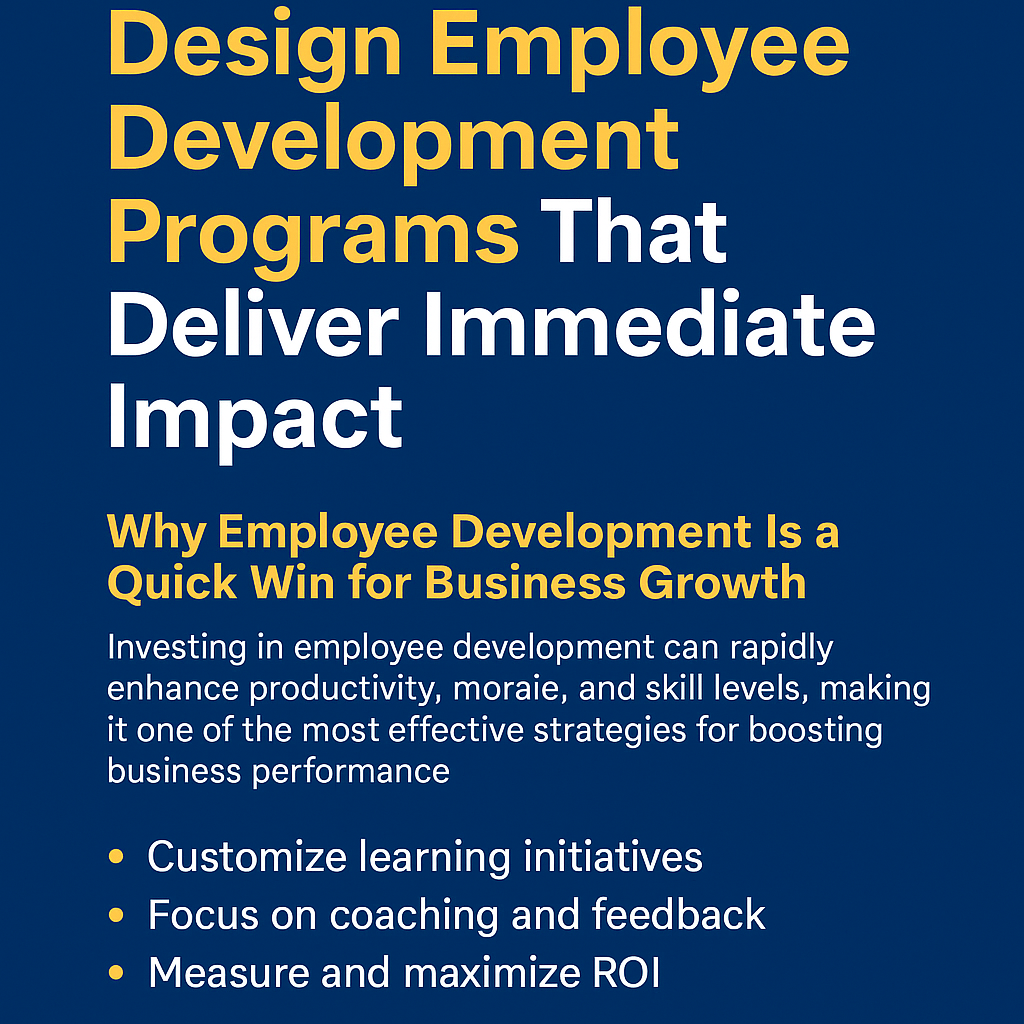
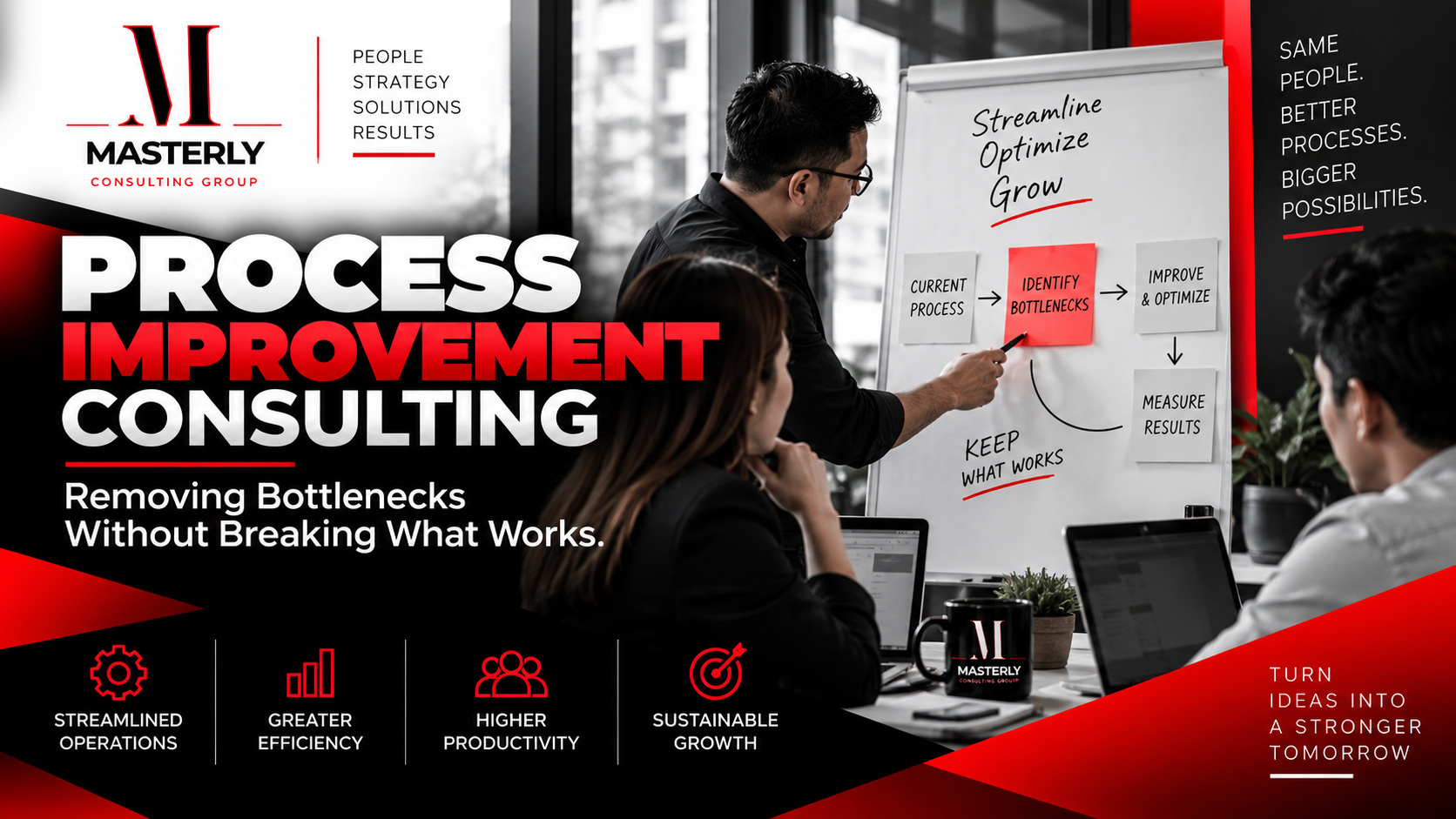
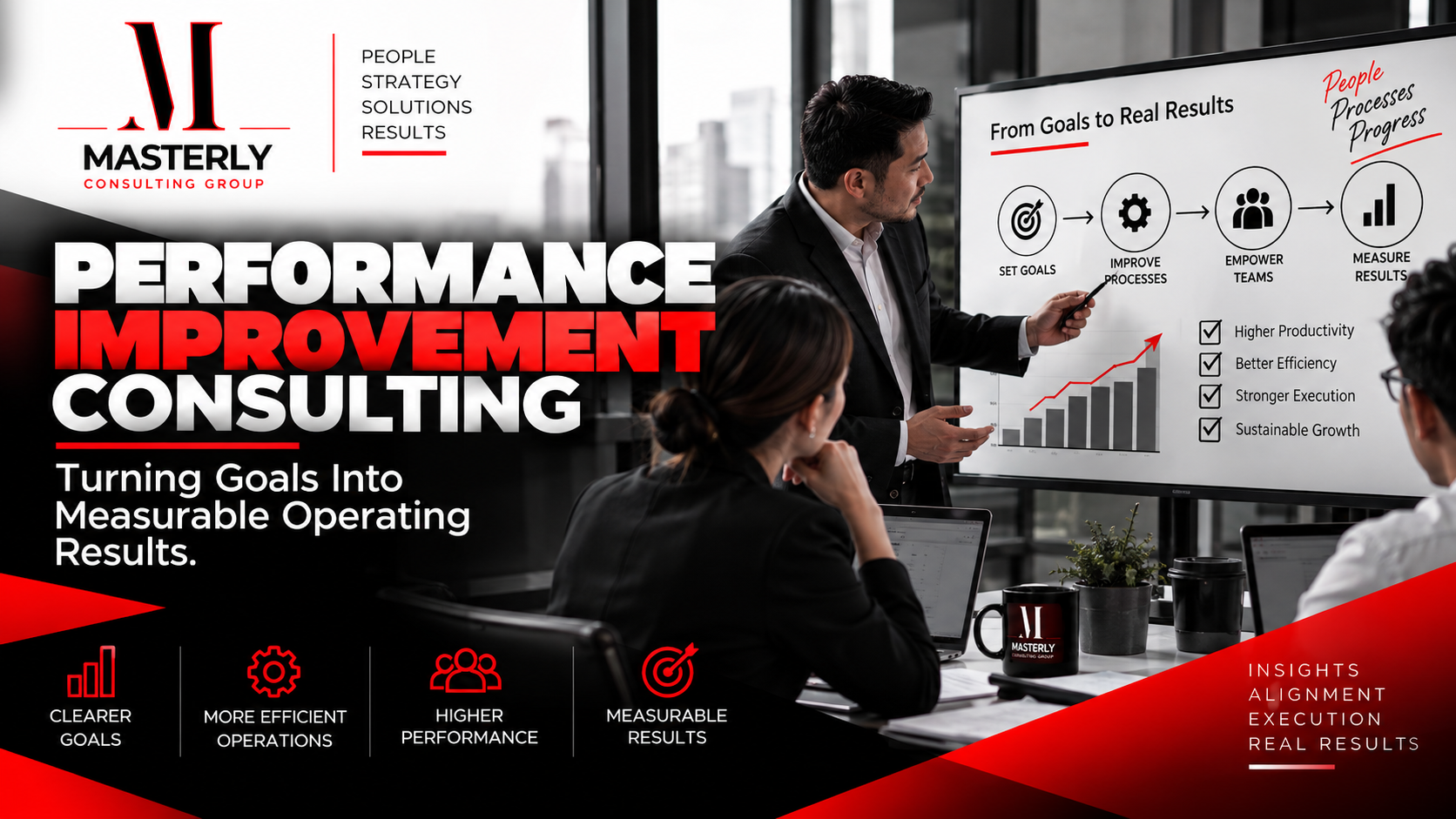
Digital banner with a deep blue background featuring bold yellow and white text. The headline reads: “Design Employee Development Programs That Deliver Immediate Impact.” Below it, a subheading states, “Why Employee Development Is a Quick Win for Business Growth,” followed by a paragraph explaining that investing in employee development enhances productivity, morale, and skill levels. Bullet points highlight key strategies: customizing learning initiatives, focusing on coaching and feedback, and measuring ROI. Designed by Masterly Consulting Group, the layout emphasizes clarity and strategic HR improvement.


Solving Employee Relations Challenges Quickly

When employee relations challenges pop up, training is one of the fastest fixes. We develop scenario-based learning modules that teach communication, conflict resolution, and emotional intelligence.


As a result, issues are resolved before they escalate, saving time, money, and morale.


Why Businesses Turn to HR Consulting Firms Like Ours

Whether you run a mid-sized business, lead a nonprofit, or operate a fast-scaling startup, our hr consulting firms provide the guidance you need to move forward. With industry expertise and a reputation for results, we bring clarity and action to your most pressing hr tasks.


Your people deserve the best support. And your company deserves the best return.


Customized HR Solutions That Boost Compliance and Retention

When productivity lags, the solution often lies in rethinking how you support and develop your workforce. Our HR services consultants and expert HR consultants specialize in crafting customized solutions that not only address immediate performance issues but also strengthen long-term employee retention. We help ensure your organization stays ahead of evolving HR compliance demands, while building programs that align with both business objectives and employee needs. The result? Smarter people strategies, a stronger culture, and measurable improvement across the board.


Unlocking the Pivotal Role of Human Resources in Driving Performance and Mitigating Risk

In every organization, human resources plays a pivotal role in solving unique challenges that hinder productivity and growth. Whether you're managing a lean team or scaling operations, aligning human resources management with development strategies helps drive performance while reducing potential risks like turnover or compliance missteps. Our firm offers both on-site and remote HR support, making it easy to implement training programs that fit your operational model. By pairing these efforts with a well-structured total rewards system, your team becomes more motivated and better equipped to contribute to your company’s long-term economic development. At Masterly Consulting Group, we believe every client deserves unique HR strategies that are as dynamic as their business goals.


Contact Us for Tailored HR Consulting That Drives Results

If you're struggling with low productivity and unsure where to start, you're not alone. Masterly Consulting Group offers hr consulting services designed to deliver fast results through smart, focused employee development programs. From compliance to culture, we help businesses move from frustration to progress.


Contact us at (888) 209-4055 to book a free consultation. Let's build a plan that strengthens your team and delivers measurable impact.
By Angelie Te August 8, 2026
Picture this: your organization invests in a two-day leadership offsite. Participants leave energized, rate the session highly, and talk about it at lunch for a week. Thirty days later, nothing has changed. Managers still default to old habits, team dynamics stay the same, and the binder from the retreat collects dust. This "training high, no behavior change" pattern is one of the most expensive problems in workforce development today. Corporate training refers to structured learning experiences designed for employees and leaders, tied directly to business goals. It is not a generic workshop or a motivational keynote. It is a deliberate program built around specific performance outcomes: reducing risk, improving decision-making, building leadership capabilities, or strengthening organizational culture.  This article is written for companies, associations, universities, and organizations planning professional development training or compliance-related programs for staff, faculty, or executives. Masterly Consulting Group's point of view is straightforward: training must be designed for on-the-job application, not event satisfaction scores. What follows is a practical guide to designing, buying, or improving corporate training programs that deliver measurable results and help you retain talent.
Employee engagement consultant identifying causes of low commitment.
By Amber Aniston August 7, 2026
An employee engagement consultant finds operational root causes behind low commitment. Masterly Consulting Group offers employee engagement consulting tied to retention and execution. Schedule a consultation.
Organizational culture consultant aligning leadership and team behavior.
By Amber Aniston August 7, 2026
Meta Description: Masterly Consulting Group offers organizational culture consulting to align leadership behavior with values and strategy, boosting engagement, accountability, and business success. Request a consultation today.
Business leaders planning organizational transformation strategy
By Amber Aniston August 6, 2026
Masterly Consulting Group turns transformation strategy into an executable operating model with governance, sequencing, and measurable adoption. Request a consultation today.
By Angelie Te August 5, 2026
Why Brand Portfolio Strategy Matters for Multi-Company Founders A founder launches a marketing agency in 2015. By 2019, she spins up a productized service for a specific niche. In 2023, she ships a SaaS product. Three companies, three websites, three logos. Clients ask which company they should hire. Her own team isn't sure which brand to recommend for a given project. The websites overlap. Referrals get lost. This is what happens when a founder builds multiple companies without a brand portfolio strategy. The brands grow, but they grow without a plan for how they relate, who each one serves, and how they move customers between them. A brand portfolio strategy is the deliberate system that decides how all the brands in a company's portfolio work together: which audiences each brand targets, what role each brand plays, and how the set of brands creates more overall value than any single brand could alone. The central tension is real: keep brands distinct enough that customers aren't confused, but connected enough that cross-referrals, trust transfer, and upsell paths still function. This article covers brand portfolio management (how you govern and allocate resources across brands), brand architecture (the structural relationships between brands), and brand roles (the job each brand does). The focus is on roles, clarity, naming, and growth. You'll walk away knowing how to choose between a branded house, house of brands, or hybrid; how to define brand roles; how to avoid brand complexity; and how to set up a governance model that keeps your portfolio sharp. What Is a Brand Portfolio Strategy? (and How It Differs from Just Owning a Bunch of Brands) A brand portfolio strategy is the structured management and organization of a company's brands. It defines how brands relate to each other and target market segments, assigns each brand a unique role, and ensures the portfolio as a whole aims to cover more of the market and drive growth without wasting resources. Owning multiple LLCs, having several logos, or running separate websites is not a strategy. Strategy answers: why does each brand exist? What audience does it serve that the other brands do not? How does the set perform financially? Each brand within a portfolio should have a clear purpose to prevent overlap. For a founder running a core consultancy, a separate training company, and a niche product brand, a brand portfolio strategy defines each brand's unique role and ensures the three entities serve different customer segments rather than competing for the same buyers with similar promises. This differs from product portfolio strategy, which focuses on SKUs and product categories within one brand. It also differs from generic "multi-business group" thinking, which tends to focus on operations and finance. Brand portfolio strategy zeros in on identity, positioning, and market perception. That includes company portfolio positioning: how the parent company is perceived (or whether it is visible at all) relative to its specialist brands. Brand Portfolio, Brand Architecture, and Brand Identity: How the Pieces Fit Founders often blur three concepts that serve different functions. Separating them saves time and prevents misaligned decisions. A brand portfolio is the full set of brands under common ownership. Alphabet owns Google, YouTube, and Waymo. Marriott managed 30 hotel brands after acquiring Starwood in 2016. A founder with an agency, a staffing firm, and a coaching brand has a three-brand portfolio. Brand architecture defines the relationships between brands in a portfolio. It's the structural pattern that determines who endorses whom, what's visible to customers, and how brand names and logos coordinate. There are two main types of brand architecture: mono-brand (one name covers everything) and multi-brand (distinct brands coexist). Brand architecture helps consumers understand product offerings and their relationships, and a well-defined brand architecture enhances brand equity and consumer navigation. It also clarifies brand roles and minimizes internal competition. Brand identity operates at the individual brand level: the name, visuals, tone, promise, and distinctive assets that make one brand recognizable. Brand positioning clarifies how each brand should be perceived in the marketplace. Portfolio management sits above identity work. It decides which brands exist, how they relate, and where investment goes. Architecture and identity then express those decisions in ways customers can see and navigate. Core Brand Portfolio Strategies: Branded House, House of Brands, and Hybrids Most multi-brand ecosystems fall along a spectrum. At one end sits the branded house. At the other, the house of brands. Between them are hybrids and endorsed models. Branded house. A branded house uses a single master brand across all products and services. FedEx (FedEx Express, FedEx Office, FedEx Ground) is a textbook example. A branded house communicates a single identity across all brands, which means equity built in one area transfers to others. The trade-off: if one offering fails publicly, the entire brand absorbs the reputational cost. House of brands. A house of brands consists of distinct standalone brands targeting specific niches. Procter & Gamble owns Tide, Pampers, and Gillette, but most consumers never think about P&G when buying shampoo. A house of brands allows each brand to operate independently, with tailored positioning and flexibility. The cost is real: P&G invests roughly 13% of annual sales into R&D and marketing to sustain its portfolio of powerful brands. Hybrid and endorsed models. A hybrid portfolio combines elements of multiple brand structures. Endorsed brands have sub brands supported by a parent corporate brand for credibility. Marriott operates distinct hotel brands (Ritz-Carlton, Courtyard, W Hotels) while the Marriott Bonvoy loyalty system ties the ecosystem together. Meta keeps Instagram and WhatsApp as different brands with their own audiences, connected by a visible parent.  For founders managing 3-8 companies, a lean hybrid is often the most practical choice: a credible parent brand plus a handful of clearly positioned specialist brands that share some elements but maintain distinct faces to market.
Business continuity consultant leading crisis planning workshop
By Amber Aniston August 5, 2026
Partner with a business continuity consultant to build practical, resilient continuity plans that protect critical operations from disruptions. Learn how expert consulting enhances operational resilience, supply chain management, and crisis response for growing companies and multi-location organizations.
Performance management consultant reviewing KPI dashboard with team
By Amber Aniston August 5, 2026
Masterly Consulting Group offers expert performance management consulting to help organizations set measurable expectations, improve feedback cadence, and enhance leadership accountability for better employee performance and business outcomes.
By Angelie Te August 5, 2026
Introduction: Why Shared Services Matter for Multi-Brand Entrepreneurs Between 2018 and 2024, one founder grew from a single digital marketing agency to a portfolio of five brands spanning creative services, e-commerce, staffing, and consulting. Revenue was climbing. But by year four, she was managing five separate bookkeepers, three different CRM platforms, inconsistent onboarding workflows, and a customer experience that varied wildly depending on which brand someone contacted. Growth had stalled - not because of demand, but because the back office couldn't keep up. This is the exact scenario where a shared services business model becomes essential. In its simplest form, it means creating a centralized support unit that serves multiple brands, entities, or divisions as internal customers - handling functions like finance, HR, marketing operations, and IT under one roof. Why does this matter now? Labor costs have surged since 2020. Remote teams have multiplied complexity. And artificial intelligence tooling has made centralization more feasible than ever. Entrepreneurs are increasingly running ecosystems of brands, and shared services reduce operational costs by eliminating redundancy while enabling scalability so organizations can expand without rebuilding administrative infrastructure each time. This article is written for entrepreneurs and operators managing multiple companies - not Fortune 500 executives. Here's what we'll cover: How the shared services business model works and what it actually includes When centralization makes sense (and when it doesn't) How to design, govern, and implement a shared services unit Risks, trade-offs, and a practical roadmap