Taking Charge of Your Career with Executive Coaching Support
Leadership becomes harder when the decisions become bigger.
As an executive, founder, or senior leader, you may be responsible for a growing team, major business decisions, important clients, and the direction of your organization. Yet the higher you move, the fewer people you may have who can give you an honest, objective perspective.
You may be questioning a difficult decision, dealing with leadership challenges, managing conflict, preparing for a new role, or trying to lead with greater confidence and clarity. You do not necessarily need another training course. You need a trusted professional who can help you think clearly, challenge your assumptions, and stay focused on what matters most.
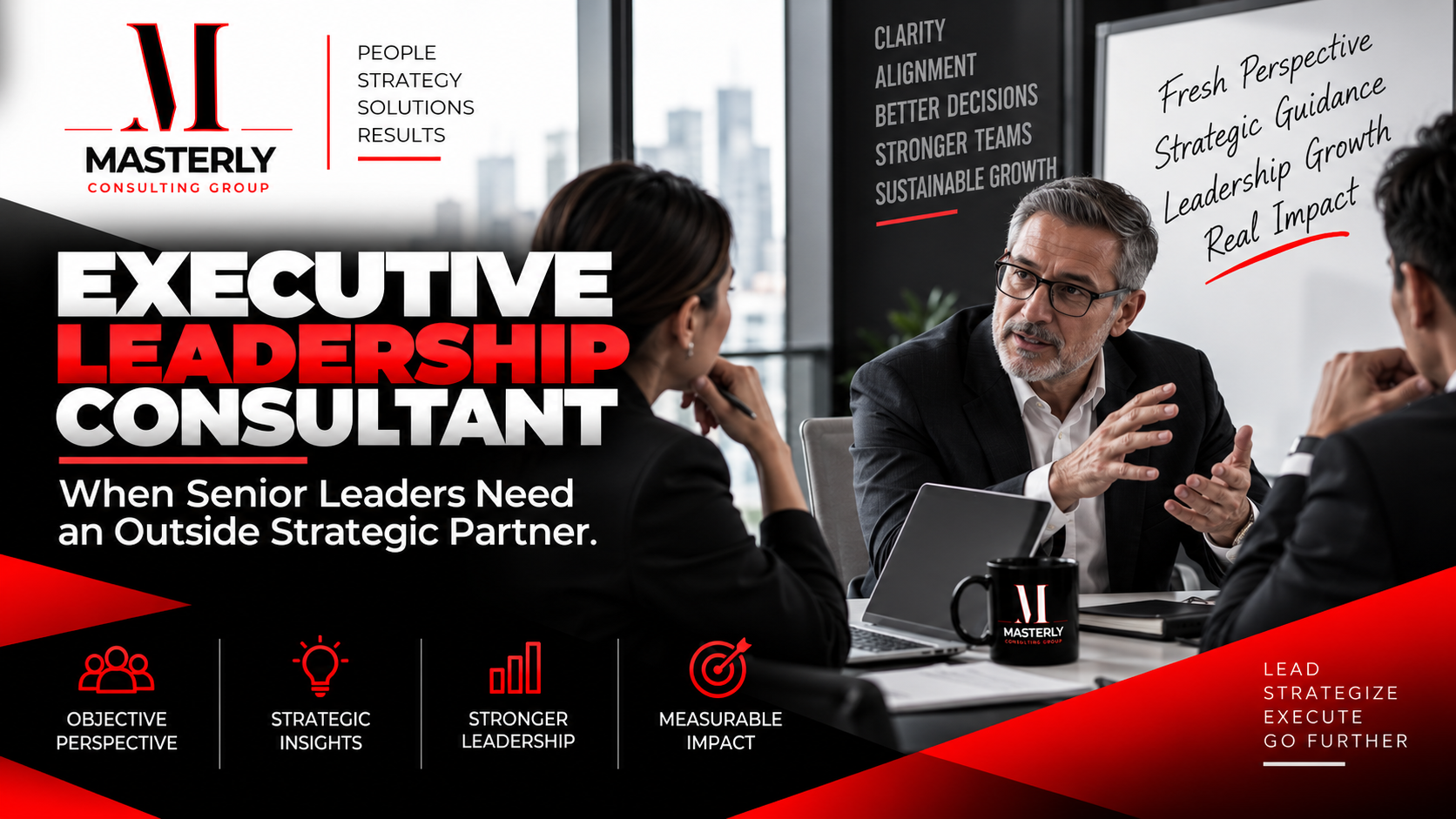
Masterly Consulting Group provides executive coaching services for executives, founders, and senior leaders who want focused support as they navigate complex professional challenges.
When Leadership Responsibility Starts to Outgrow Your Current Approach
Success can create new problems.
The strategies that helped you become a leader may not be enough when your responsibilities expand. As an executive, founder, or senior leader working alongside other executive leaders, you may now be managing people with different expectations, facing organizational challenges, making decisions with greater financial impact, or representing your organization in high-pressure situations.
Common challenges may include:
- Making difficult decisions with limited information
- Managing conflict within a leadership team
- Communicating clearly with employees, partners, or key stakeholders
- Delegating responsibilities without losing control
- Building trust across an organization
- Preparing for a larger leadership role
- Balancing business priorities with people concerns
- Staying effective during periods of change
- Understanding how your leadership style affects others and shapes your organization's culture
These challenges can affect more than your daily work. They can influence team performance, company culture, business relationships, and outcomes across the entire organization.
That is why having an experienced executive coach can provide an external perspective.
Why Executive Coaching Matters at the Senior Level
Executives are often expected to have the answers.
But strong leadership does not mean making every decision alone.
A confidential coaching relationship gives leaders dedicated space to examine challenges, identify patterns, and consider different perspectives before taking action. It can also build self awareness, helping leaders improve how their communication and decisions affect the people around them and across the entire organization.
For a founder, this may mean learning to lead a growing organization without remaining involved in every detail or losing sight of broader organizational challenges.
For an executive, it may mean becoming more effective in a larger role to strengthen leadership at a critical point for the business.
For a senior leader, it may mean handling difficult conversations, strengthening relationships with key stakeholders, understanding how your leadership style affects the organization’s culture, or preparing for the next stage of your personal and professional growth.
The goal is not to change who you are. It is to help you become a more intentional and effective leader.
Executive Coaching Services Built Around Your Leadership Challenges
Generic leadership advice does not always address the problem in front of you.
Your organization, responsibilities, personality, and goals are different from those of another leader. Your coaching should reflect that reality.
Masterly Consulting Group provides executive coaching services centered on your specific leadership needs. This executive leadership coaching approach helps strengthen leadership and build self awareness through a structured coaching engagement aligned with your organizational goals. The goal is not to change who you are. Executive coaching differs from consulting and mentoring because it focuses on developing the leader rather than advising for them. Scheduled coaching sessions give leaders dedicated space to examine the challenges affecting performance and identify practical areas for improvement. It can also help leaders improve communication and make better decisions with greater clarity. For a senior leader, that can support both personal and professional development.
Coaching may support areas such as:
Leadership Effectiveness
Strengthen the way you communicate, make decisions, delegate, and lead your team.
Masterly Consulting Group provides executive leadership coaching centered on your specific leadership needs and aligned with your organizational goals. Coaching sessions can provide a structured setting to build emotional intelligence, strengthen strategic influence, and support improved leadership effectiveness tied to real business outcomes. Each engagement is tailored to the leader’s role and priorities.
Executive Presence
Develop greater confidence and clarity when communicating with employees, boards, clients, partners, and other senior stakeholders, while strengthening communication, decision making, delegation, team leadership, emotional intelligence, and strategic influence for roles that include working with c suite executives. This is the foundation of great leadership, and 56% of leaders report improved leadership effectiveness after coaching, with stronger business outcomes to match.
Decision-Making
Gain an objective perspective when facing complex decisions, competing priorities, or uncertain situations through a focused coaching conversation that helps C-suite executives and leaders communicating at that level challenge assumptions, align decisions with business goals and shared priorities, and use an executive coach as a trusted advisor to lead with more clarity and confidence.
Leadership Transitions
Prepare for a promotion, expanded responsibilities, organizational change, or a new executive position with focused coaching that provides critical support from a trusted advisor during each conversation, including periods of career transition and professional growth. You’ll clarify shared priorities and make decisions aligned with business goals.
Communication and Relationships
Improve difficult conversations, manage conflict, and build stronger professional relationships while supporting career transition, professional growth, cross cultural communication, and cultural intelligence. In a new role or with expanded scope, coaching provides critical support and transition coaching reduces onboarding time from 18-24 months to 6 months.
Founder Leadership
Help founders move from personally managing everything to leading through people, systems, and clear priorities. This often includes talent development so the business can keep top talent, build a stronger leadership pipeline, and support succession planning as it grows.
Leadership Coaching for Executives Who Need an Objective Perspective
At the executive level, feedback can become complicated.
Employees may hesitate to challenge you. Colleagues may have their own interests. Friends and family may understand you personally but not the demands of your role.
Professional leadership coaching creates a different type of conversation.
You can step away from the daily pressure and examine what is happening from a broader perspective. Instead of simply reacting to problems, you can consider what is driving them and what needs to change.
This can be especially useful when a leader knows something needs to improve but has not yet identified the right approach.
The value of coaching is not simply having someone listen. It is having a structured, professional conversation grounded in a deep understanding and a disciplined coaching practice that helps you think more clearly about your leadership and your next decision. Under Founder Leadership, that can include building systems that support top talent and talent development. It also helps create a stronger leadership pipeline, supports succession planning, and connects growth in leadership capability to better organizational outcomes.
Coaching for Executives With More at Stake
The consequences of leadership decisions often grow with your position.
A communication problem can affect employee morale. A leadership conflict can slow a team. A poor delegation decision can create unnecessary pressure. A lack of clarity at the top can spread throughout an organization.
Coaching for executives can provide a dedicated space to address these issues before they become larger problems.
It can also help leaders recognize opportunities that are difficult to see while operating inside the business every day. You can step away from the daily pressure long enough to build a deep understanding of what is driving the issue.
Masterly Consulting Group works with leaders who understand that professional development does not stop after reaching an executive position. In many cases, the higher the responsibility, the more valuable an objective outside perspective becomes. The value of coaching is not simply personal growth; it is a strategic investment in the organization's leaders through a structured coaching practice focused on organizational outcomes, organizational transformation, and the organization's success.
Success in coaching engagements is measured through specific outcomes and accountability.
Why Choose Masterly Consulting Group?
Masterly Consulting Group takes a practical, professional approach to executive development.
We understand that senior leaders do not need generic motivation. They need conversations that connect leadership development to the realities of their roles, organizations, and goals across multiple industries.
Our approach is designed to help you examine the issues that matter most, draw on real leadership experience, define measurable outcomes, and connect your development to your organization's success and broader transformation.
Whether you are leading an established organization, growing a company, or preparing for your next leadership responsibility, coaching can be a strategic investment in the leaders your organization depends on.
The work remains centered on you as a leader and the challenges you need to address. 40% of Fortune 500 companies use executive coaching for leadership development.
Is Executive Coaching Right for You?
Executive coaching may be a good fit if you are successful in your current role but know there is another level of leadership you want to reach, whether you are one of today’s high performing leaders or among emerging leaders preparing for broader responsibility.
It may also be appropriate if you are facing a specific challenge that requires more attention than you can give it on your own.
You do not have to wait for a leadership problem to become a crisis before seeking professional support.
Many leaders use coaching because they want to become more intentional about how they lead, communicate, make decisions, and prepare for what comes next.
The right time to consider coaching is when you recognize that having an objective professional perspective, practical experience across multiple industries, and the right coach could help you move forward in developing leaders.
Building the Best Version of Your Leadership Style
True leadership is about authenticity. Through executive coaching, you gain an understanding of your unique style, learning how to lead with purpose, clarity, and empathy. You learn how to build trust, create alignment, and guide your team toward shared goals.
You also uncover your blind spots and work to improve your impact with every interaction. This heightened self-awareness is what separates strong leaders from extraordinary ones.
The Role of Credentials in Coaching Quality
Working with a board certified coach, associate certified coach, or one with executive coaching certification from the International Coaching Federation ICF means you're investing in high-quality coaching services. These credentials ensure your coach is trained in ethical standards and ongoing education.
Credentialed professional coaches understand how to balance challenge with support, and how to customize their approach based on your background and personality.
Executive Coaching as a Game Changer for Business Owners
For entrepreneurs and business owners, executive coaching can be a game changer. Running a business comes with constant challenges, from managing teams to scaling operations. With the right coaching, business owners gain clarity on priorities, enhance leadership presence, and better navigate uncertainty.
It also helps them develop stronger hiring practices, improve delegation, and build a supportive community of aligned partners and team members.
Creating a Culture of Coaching Inside Organizations
Organizations that prioritize coaching practices create environments where leaders and staff thrive. When coaching is part of the culture, employees feel empowered, valued, and motivated to perform at their best.
This cultural shift also enhances employee retention, strengthens internal talent pipelines, and drives long-term success.
What You Can Expect from Our Executive Coaching Services
Our team delivers a unique program designed to unlock your full potential. Whether you’re preparing for a promotion, entering a new role, or seeking better balance, our executive coaching approach is grounded in best practices and real-world experience.
We help our clients:
- Set clear, realistic goals
- Navigate complex business environments
- Improve their decision-making
- Lead with greater confidence and clarity
- Adapt to shifting organizational demands
Each coaching session is purposeful, focused, and designed to bring out your strengths.
Getting Started on Your Coaching Journey
Every leadership journey is different. That’s why our process begins with understanding who you are, what drives you, and where you want to go. Our goal is to match you with a coach who can help you thrive through every transition, challenge, or new opportunity.
Let us guide you toward measurable success, improved performance, and a clearer sense of purpose in your career.
Empowering Senior Leaders Through Strategic Coaching
For today’s competitive environment, business coaching has become an essential tool for senior leaders who want to grow with purpose. Whether you need to establish your leadership style, improve team performance, or address organizational challenges, executive coaching offers practical, results-driven support. It’s designed to help leaders reach new levels of clarity, impact, and effectiveness. With expert guidance, you can establish a long-term vision while learning how to address immediate barriers to success—turning challenges into opportunities for advancement.
Taking Charge of Your Career with Executive Coaching Support
Executive coaching is a powerful form of business coaching designed to help senior leaders gain clarity, confidence, and direction. Whether you're aiming to establish your presence in a new leadership role or address persistent challenges in team dynamics or strategic planning, executive coaching offers tailored support. With the right coach, leaders reach higher levels of performance, emotional intelligence, and influence. These sessions are more than just career conversations—they help establish actionable goals and address the barriers that may be holding you back from advancement.
Ready to Take the First Step?
Whether you're a rising leader or a seasoned professional, our team is here to help you grow. Executive coaching is more than a service—it’s a strategic partnership designed to unlock your full potential.
Contact Masterly Consulting Group today to speak with one of our certified coaches. We'll answer your questions, learn more about your goals, and show you how our tailored approach can drive real results.
Call (888) 209-4055 to schedule your free consultation.