Porter's Five Forces: How Leadership Teams Use It to Size Up a Market
Porter's Five Forces is a strategic framework that evaluates five competitive pressures shaping any industry: the threat of new entrants, bargaining power of suppliers, bargaining power of buyers, the threat of substitutes, and competitive rivalry among existing competitors. Leadership teams use this five forces analysis to gauge industry profitability and decide whether a market is worth entering, defending, or exiting.
Porter's Five Forces: The Short Answer
Porter's Five Forces model analyzes competitive dynamics in industries by breaking the competitive environment into five distinct pressures. Instead of relying on gut instinct or surface-level market data, leadership teams use it to understand where profit leaks exist, who holds more power in the value chain, and how structural forces will likely shift over the next three to five years.
The model helps determine industry attractiveness and the potential for profitability. When an executive team is weighing whether to enter a new market, raise prices in an existing segment, or redirect capital toward a different business line, a forces analysis provides a structured, fact-based view of the competitive landscape. It answers the question most strategy meetings dance around: given the industry structure, can we realistically earn strong returns here?
The good news is that this doesn't require a months-long consulting engagement. This article walks through how to run a five forces analysis in a single working session and then turn those findings into concrete strategic decisions your team can act on.

Where Porter's Five Forces Came From (and Why It Stuck)
Michael Porter, a Harvard Business School professor, introduced the forces model in his 1979 Harvard Business Review article "How Competitive Forces Shape Strategy." He later refined and updated it in a 2008 HBR piece that addressed common misapplications and extended its relevance to modern markets.
Before Porter developed the framework, strategists largely relied on SWOT analysis, experience curves, and broad market sizing. Porter shifted the conversation from internal capabilities to industry structure - the idea that long-run profitability depends less on what a single firm does and more on the five competitive forces acting on the entire industry.
What made the model stick is its clarity. It gave leadership teams a shared vocabulary for discussing industry competition without drowning in complexity. The forces framework examines external factors rather than internal strengths, which means it complements tools like SWOT rather than replacing them.
A quick historical example: when the U.S. deregulated its airline industry in the late 1970s, barriers to entry dropped overnight. New competitors like Southwest entered, rivalry intensified, buyer power grew as travelers gained more choices, and industry profitability collapsed for many carriers. That structural shift is exactly the kind of change the forces model was built to diagnose.
Key dates:
- 1979: Porter publishes "How Competitive Forces Shape Strategy" in Harvard Business Review.
- 1980: Competitive Strategy: Techniques for Analyzing Industries and Competitors expands on the model.
- 2008: Porter reaffirms the framework's relevance in a follow-up HBR article addressing digital and global markets.
The Five Forces Explained in Plain Language
Porter identified five key forces that determine how profits are created and distributed in a given industry. The model evaluates five distinct pressures in an industry, each representing a different source of competitive pressure on margins and pricing power.
Leadership teams use the five competitive forces to understand where profit leaks out of the system and where a firm can realistically push back. Strong forces squeeze profitability; weak forces improve the odds of earning above-average returns.
The next five sections define each force in practical business terms - no academic jargon, just the language owners, CEOs, and executive teams actually use.
Threat of New Entrants
The threat of new entrants measures how easily new companies can enter the market and compete for your customers. When barriers to entry are low, new market entrants can appear quickly and pressure prices and profitability across the industry.
Key barriers that keep new competitors out:
- Capital requirements (semiconductor fabs cost tens of billions; a coffee cart costs a few thousand)
- Regulation and licensing (banking charters, pharmaceutical approvals)
- Economies of scale that existing firms already enjoy
- Network effects that make a product more valuable as more people use it
- Customer switching costs and brand loyalty
- Access to distribution channels
Low barriers to entry increase the threat of new entrants, which is why industries with low entry barriers often have lower profit margins. Consider local coffee shops: minimal licensing, modest startup costs, and little differentiation mean new competitors open constantly. Compare that to commercial aircraft manufacturing, where capital requirements, decades of engineering expertise, and regulatory certification create barriers few firms can clear. High entry barriers reduce the threat of new competitors in those markets.
Industries with high profitability attract more new entrants, which means success itself can invite competition. New entrants often leverage existing expertise and brand identity from adjacent markets to gain a foothold faster than incumbents expect.
Leadership teams can rate this force by asking: How much capital would a credible competitor need? Are there regulatory hurdles? Do our customers face real switching costs? If the answers suggest entry is easy, the high threat of new entrants may force existing companies to invest in barriers - proprietary technology, long-term contracts, or deeper customer loyalty - to protect their competitive position.
Bargaining Power of Suppliers
Supplier power is the ability of suppliers to raise prices, reduce quality, or constrain availability without losing your business. High supplier power raises costs for companies in an industry, and it often goes unnoticed until a shortage, regulatory shock, or sudden price increase forces the issue.
Conditions that give suppliers more power:
- Limited suppliers increase bargaining power over firms
- Specialized or unique inputs that can't be easily sourced elsewhere
- High costs of switching suppliers
- Your purchases represent a small share of the supplier's total revenue
- Supplier power is high when substitutes for their inputs are few
Suppliers can dictate terms when they are unique. During the global semiconductor shortages from 2020 to 2024, auto manufacturers learned this the hard way. Chipmakers held enormous leverage because there were few alternative sources and switching costs were extreme. Unique resources from suppliers can lower industry profits when companies have no practical alternative.
Leadership teams can reduce suppliers bargaining power through dual sourcing, long-term supply agreements, backward integration, or redesigning products to use more generic inputs. These levers matter most before a crisis hits - not during one.
Bargaining Power of Buyers
Buyer power describes how much customers can push down your prices or demand more value for the same price. Strong buyer power can lower prices and demand higher quality, which directly impacts margins and revenue predictability.
Conditions that increase buyer power:
- Buyer power increases when customers have many alternatives
- Buyer power is higher when buyers are few and concentrated (a single customer representing 25% of revenue has real leverage)
- Low switching costs make it easy for buyers to leave
- Price transparency through comparison tools and online reviews
- Standardized products with little differentiation
Intense competition arises when buyers have numerous alternatives, because those buyers can play competitors against each other. In enterprise software, for example, large buyers often account for 20–30% of a vendor's revenue, giving them significant negotiating power over pricing, features, and contract terms. High buyer power pressures firms to improve products and services continuously or risk losing accounts.
Strategies to reduce buyer power:
- Differentiation that makes your offering harder to compare
- Bundling services to increase switching costs
- Loyalty programs can reduce buyer power in competitive markets
- Targeting segments with lower price sensitivity
- Building ecosystem lock-in through integrations and training
Connect this force directly to what your sales team reports: discount levels, deal cycle length, and churn rates are all symptoms of how much buyer power exists in your market.
Threat of Substitute Products or Services
Substitutes are not just similar products from a different competitor. They are different products or business models that solve the same underlying customer job. Substitutes can emerge from different industries entirely, which makes them easy to miss if your competitive analysis only watches direct rivals.
The threat of substitutes limits pricing power in an industry. High substitute availability caps industry profits because customers have another way to get the job done, even if the substitute looks nothing like your product. Increased substitutes can shrink market demand for existing products over time.
Examples:
- Video conferencing as a substitute for business travel
- Streaming services replacing DVD purchases and rentals
- Health drinks threaten traditional soda market share as consumers shift preferences
- Plant-based meat alternatives competing with traditional meat - a 2025 study found that when plant-based options are priced significantly lower than meat, consumer preference can rise to roughly 38% in certain segments
Substitutes limit pricing power in an industry even when competitive rivalry among existing competitors seems manageable. A leadership team might feel comfortable with three or four direct rivals, only to find that a substitute from a completely different category is quietly eroding demand.
How to manage substitution risk:
- Focus on outcomes and customer experience, not just product features
- Add experiential or service-based value that substitutes can't easily replicate
- Monitor the relative price performance of emerging alternatives
- Track substitute development over a 3–5 year horizon, not just current offerings
Competitive Rivalry Among Existing Competitors
Competitive rivalry is the largest determinant of industry attractiveness. It reflects the intensity of competition among established companies fighting for the same customers - visible in price wars, marketing battles, feature races, and constant pressure on margins.
Factors that intensify rivalry:
- Many similarly sized existing competitors
- High competitive rivalry often occurs in slow-growing industries where firms fight for market share rather than riding industry growth
- Minimal product differentiation increases competitive rivalry intensity
- High fixed costs that push companies to fill capacity at any price
- Low switching costs that let customers move freely between providers
High competitive rivalry leads to price wars and reduced profitability. Rivalries can result in aggressive marketing and product innovation, which can benefit consumers but squeeze the firms involved. Consider fast-food chains: dozens of players, low switching costs, intense price sensitivity, and near-constant promotional battles. Consumer smartphones show similar dynamics - large demand, but intense rivalry among a handful of major players keeps margins under pressure for all but the most differentiated brands with strong brand identities.
Rivalry interacts with the other competitive forces. When strong buyer power combines with many rivals in a competitive industry, profitability almost always suffers.
Strategic responses to intense rivalry:
- Cost leadership to survive on thinner margins
- Differentiation to escape direct price comparison
- Focusing on niche markets where fewer established firms compete
- Changing the basis of competition - service, ecosystem, or customer experience rather than unit price

How Leadership Teams Use Five Forces to Answer "Is This Market Worth It?"
Imagine a mid-market industrial manufacturer evaluating whether to enter the EV battery component space. The executive team runs a five forces analysis and finds: high capital requirements create meaningful barriers to entry, but supplier power is concentrated among a few lithium and cobalt providers. Buyer power is moderate - automakers are large but have limited alternative component sources. Substitute risk is real (solid-state battery technology is advancing). Competitive rivalry is growing as more established firms enter.
Competitive rivalry is the largest determinant of industry attractiveness, so the team pays close attention to how many competitors are scaling up and how fast industry growth can absorb them. A forces analysis clarifies which structural pressures are most likely to squeeze margins or create pricing power over the next three to five years.
A simple decision lens emerges:
- Markets with weak buyer power and supplier power plus high barriers to entry tend to be structurally attractive
- Markets with strong buyer power, intense rivalry, and strong substitutes are structurally challenging
Leadership teams that use this lens can identify factors that signal a "no-go" early, freeing capital and leadership attention for more promising opportunities. This kind of industry analysis turns strategy conversations from opinion-driven debates into informed strategic decisions grounded in market dynamics.
Running a Five Forces Analysis in One Working Session
You don't need a six-month project. A well-prepared team can run a meaningful forces analysis in a single 2–3 hour working session.
Who should be in the room: CEO, CFO, commercial/sales lead, operations or supply chain lead, and someone from strategy or finance to facilitate.
Prep work (assigned 1 week before): Compile 3–5 pages covering market size, main existing competitors, customer segments, high-level cost structure, key suppliers, and any known substitute technologies. This is the minimum context needed for a productive session.
Session flow:
- Define the industry and boundaries (30 minutes)
- Map players for each force (45 minutes)
- Assess force strength and trajectory (45 minutes)
- Summarize implications and next steps (30 minutes)
Step 1: Define the Industry and Boundaries Clearly
Misdefining the industry is the most common failure point. Define it too broadly ("global automotive") and the analysis becomes vague. Define it too narrowly ("left-handed ergonomic keyboards for gamers in Austin") and you miss critical competitive pressures.
Set boundaries along four dimensions:
- Geography (U.S., North America, global?)
- Customer segment (enterprise, SMB, consumer?)
- Product/service scope (SaaS only, or including on-premise?)
- Time horizon (typically 3–5 years for strategic planning)
Diagnostic questions to finalize scope:
- Would our target customer consider these alternatives as direct substitutes?
- Are app-based and on-premise solutions in the same industry from the customer's perspective?
- Do competitive pressures operate differently across geographies?
- Are we analyzing where the industry is today or where it will be in 2030?
Clarifying scope early keeps later debate about buyers, suppliers, and existing competitors grounded in the same reality.
Step 2: Map Players and Assess the Five Forces
For each force, list concrete players:
- Existing competitors: Name the top 5–10 firms and their approximate market share
- Plausible new entrants: Companies in adjacent markets with the capital and expertise to enter
- Major supplier groups: Key input providers and their concentration
- Major buyer groups: Largest customer segments and their purchasing leverage
- Current and emerging substitutes: Alternative products, technologies, or business models
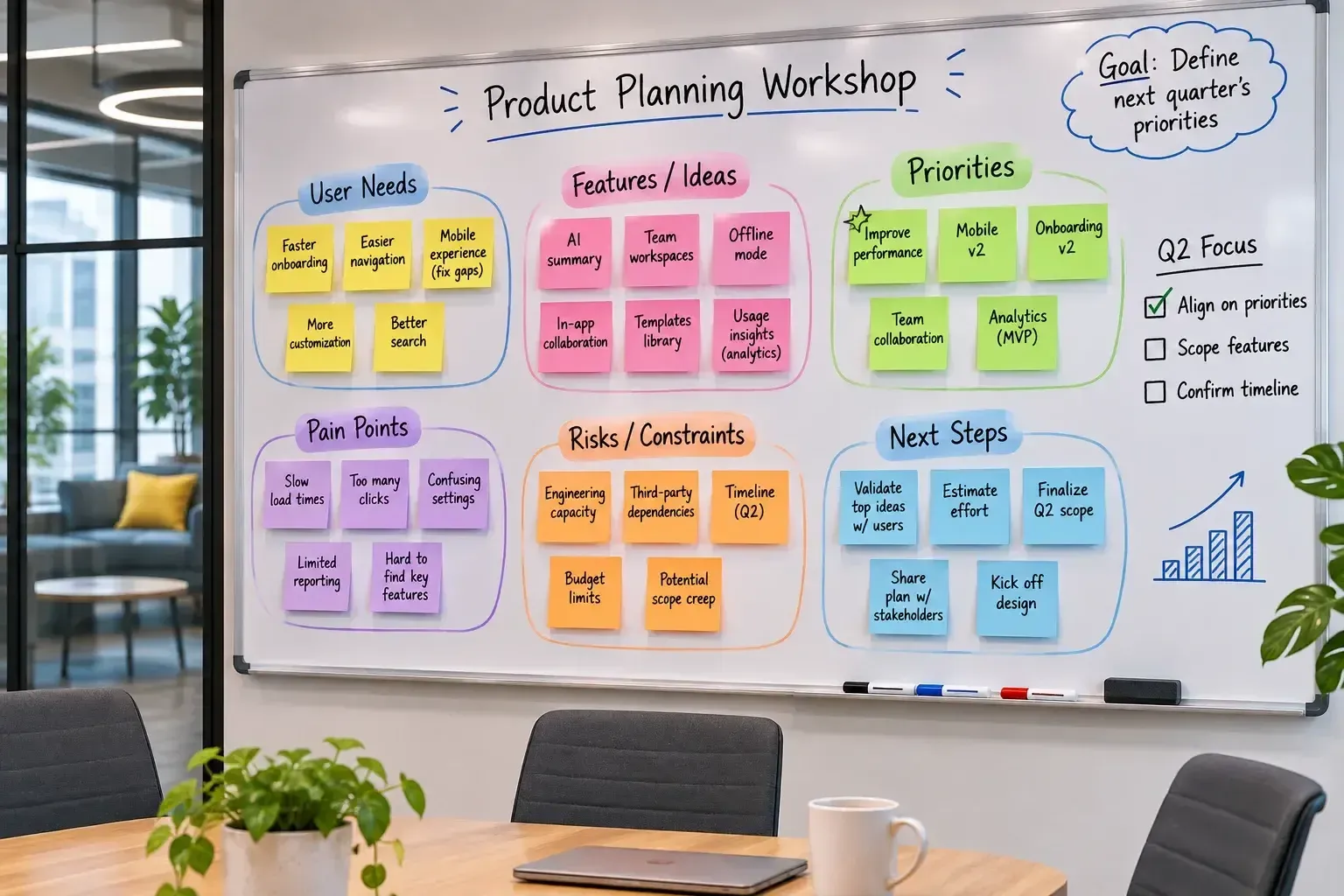
Use a whiteboard or virtual board with five labeled areas. Populate each with specific names, not abstractions.
For each force, discuss:
- Current intensity (low, medium, high)
- Direction of change (strengthening or weakening over your time horizon)
- Main drivers (technology shifts, regulatory changes, capital flows, industry dynamics)
Assign a simple rating with a 1–2 sentence rationale tied to observable facts - concentration ratios, switching costs, or observed pricing behavior. Keep this step purely diagnostic. No strategy brainstorming yet. Separating analysis from response produces clearer thinking.
Step 3: Translate the Five Forces into Strategic Options
Now move from diagnosis to decisions. For each force rated medium or high, list 2–3 practical strategic responses:
- High buyer power → Differentiation, value-added services, moving upmarket to less price-sensitive segments
- High supplier power → Redesigning products to reduce dependency, dual sourcing, strategic alliances with alternative providers
- High threat of new entrants → Strengthening switching costs, investing in proprietary assets, building customer loyalty
- Strong substitutes → Innovating business models (subscriptions, platforms), enhancing experiential value
- Intense rivalry → Cost leadership, niche focus, or changing the basis of competition entirely
Prioritize moves based on feasibility (capital, capabilities, timing) and impact on the most damaging forces. Don't try to "fix" every force. Pick the two or three where your firm can realistically tilt bargaining power or rivalry in its favor. The goal is to develop strategies that reshape the competitive environment rather than just react to it.
Cost leadership helps firms survive price wars when rivalry is fierce. Differentiation softens buyer power because customers can't easily compare your offering to alternatives. Focus lets smaller firms avoid direct competition with established companies that have scale advantages.
The classic warning: being "stuck in the middle" - trying all three - usually leaves a firm with weak positioning against every competitive force. Use your five forces analysis to validate whether your current competitive strategy truly fits the industry structure, or whether a shift is needed to enhance competitive advantage.
Case Example: Applying Five Forces to a Market Entry Decision
A regional bank's leadership team is evaluating entry into digital small-business cash management and lending - a space projected to grow steadily through 2030. Here's how they work through the forces:
Threat of new entrants: Moderate to high. Fintech startups can build digital platforms quickly, but regulatory licensing and deposit-base requirements create real barriers. The bank's existing charter gives it a competitive edge over unlicensed entrants.
Supplier power: Moderate. Core banking technology providers are concentrated (a handful of vendors dominate), and switching costs are high. The team flags this as a constraint requiring long-term contracts.
Buyer power: High. Small businesses use transparent comparison tools, switching between providers is relatively painless, and dozens of alternatives exist. This force will pressure pricing throughout the forecast period.
Threat of substitutes: High. Embedded finance solutions from accounting software providers and fintech platforms serve the same customer job without requiring a traditional banking relationship.
Competitive rivalry: Moderate but rising. Several national banks and digital-only challengers are scaling. Industry growth partially absorbs new capacity, but the bank expects rivalry to intensify as more players chase the same segments.
The decision: The leadership team concludes the market is structurally challenging but selectively attractive. They decide to focus on a niche - owner-operated businesses with $1M–$10M revenue - where their existing relationship network gives them a competitive advantage. They pursue a strategic partnership with a fintech platform to reduce technology supplier dependency. And they set a 12-month checkpoint: if buyer power and substitution trends worsen faster than expected, they'll scale back rather than pour in more capital.
This kind of disciplined industry analysis keeps strategy grounded in structural reality rather than optimism.

How Five Forces Fits with SWOT and the Strategic Plan
Five forces analysis, SWOT analysis, and the strategic plan serve different roles in the same process:
- Five Forces assesses external industry structure and competitive forces - it tells you what the market looks like from the outside.
- SWOT combines internal and external factors - strengths, weaknesses, opportunities, and threats - giving you a fuller picture of your firm's position.
- The strategic plan turns both into priorities, initiatives, timelines, and metrics.
A practical workflow:
- Run a five forces analysis to understand competitive pressures in your target market
- Feed those outputs into the external side of your SWOT analysis
- Use both to shape your 3–5 year strategic plan
How to capture five forces conclusions in your next planning cycle:
- Document the top two or three forces most likely to impact profitability as explicit assumptions
- State what would need to change for each assumption to break (triggers for revisiting strategy)
- Assign owners to monitor each key force between planning cycles
This keeps the analysis from becoming a one-time slide deck that never gets revisited.
Common Pitfalls When Using Porter's Five Forces
Mistakes that undermine the analysis:
- Defining the industry too broadly or vaguely. "Technology" is not an industry. "U.S. enterprise cloud infrastructure, 2027–2030" is.
- Focusing only on today's competitors. Ignoring substitutes or emerging new entrants from adjacent markets creates blind spots that can be costly.
- Treating the model as static. Industry dynamics shift with regulation, technology, and customer behavior. A forces analysis done in 2024 may be outdated by 2027.
- Confusing firm-specific strengths with structural forces. Having strong brand identities or operational excellence doesn't eliminate buyer power if customers still have many alternatives. Internal capabilities affect how well you compete given the forces - they don't change the forces themselves.
- Trying to quantify everything precisely. The forces framework is a qualitative diagnostic. Forcing false precision wastes time. Use low/medium/high ratings backed by observable evidence.
Simple safeguards:
- Include cross-functional perspectives (finance, operations, sales) to avoid blind spots
- Require pre-work with real market data, not assumptions
- Document disagreements as testable hypotheses rather than resolving them by seniority
Five forces analysis is not designed to forecast quarterly results. It's built for 2–5 year strategic decisions about where to compete and how to gain market share.
Keeping Your Five Forces Analysis Current
In today's business world, competitive forces evolve faster than many leadership teams expect. Technology, regulation, globalization, and shifting customer preferences can reshape industry importance and competitive pressures in months rather than years.
Recommended cadence:
- Full refresh every 18–24 months
- Quick check-ins during annual strategic planning
- Ad-hoc reviews triggered by major events: new regulation, disruptive technology (like AI-driven automation reshaping software markets), a large new entrant, or supply chain disruption
A simple monitoring approach:
- Assign an owner for each force to watch leading indicators (startup funding activity for new entrants, supplier consolidation for supplier power, churn data for buyer power)
- Integrate updates into existing leadership rhythms - quarterly business reviews and annual planning - rather than creating a standalone process
This keeps the forces model practical and prevents it from becoming a one-time academic exercise. The positive and negative effects of each force will shift over time, and teams that track those shifts make better strategic decisions than those who set-and-forget.
Frequently Asked Questions About Porter's Five Forces
What is the difference between Five Forces and SWOT?
Five forces analysis examines industry-level competitive pressures - competitive rivalry, buyer power, bargaining power of suppliers, substitutes, and new entrants. It's purely external. SWOT analysis combines internal strengths and weaknesses with external opportunities and threats. Use Five Forces to understand the competitive nature of your industry, then feed those insights into the external half of your SWOT. They work together, not as replacements for each other.
Is Porter's Five Forces still useful today?
Yes. While digital markets, platform ecosystems, and globalization have accelerated the pace of change, the underlying logic of bargaining power and competitive forces remains central. Porter's five forces framework still helps leadership teams identify where margin pressure comes from. The key adaptation is treating the analysis as dynamic rather than static - revisit it regularly, especially as technology and regulation shift the competitive landscape.
How often should a company update a Five Forces analysis?
A full refresh every 18–24 months works well for most industries. Add a lightweight review to your annual strategic planning cycle. Trigger an immediate update when a major regulatory change, disruptive technology, or significant new entrant appears. Forces don't move on a calendar - they move with events.
Can small businesses use Five Forces?
Absolutely. The forces framework scales down. A local services company can use it to assess whether its industry compared to adjacent markets offers better profitability, whether buyer power from a few large clients is too concentrated, or whether new competitors are likely to enter. The session may be shorter and the data simpler, but the strategic framework applies the same way.
Do Five Forces apply to non-profits or public agencies?
The model was designed for competitive, for-profit industries, but the underlying logic translates. Non-profits face competition for funding (rivalry), alternative programs (substitutes), and donor or funder bargaining power (buyers). Applying the lens helps leadership teams think structurally about their competitive position even outside traditional markets.
From Analysis to Action: Next Steps for Your Leadership Team
Here's how to move forward:
- Schedule a working session to run a five forces analysis on your primary market using the process outlined above
- Document the top two or three most threatening forces and how they affect your industry profitability today and over the next 3–5 years
- Decide which strategic levers - cost leadership, differentiation, focus, strategic alliances - best address those forces
- Integrate the results into your next strategic planning cycle, using a strategic plan template to turn analysis into actionable priorities
If your leadership team wants support running a five forces analysis, translating it into strategic decisions, or pressure-testing your business strategy against the competitive environment, schedule a consultation with Masterly Consulting Group or call (888) 209-4055.
Understanding the five forces is only valuable if it leads to concrete decisions - where to compete, how to enhance competitive advantage, and what to walk away from. The teams that treat this as a living discipline, not a one-time exercise, are the ones that consistently outposition their competitors.