Workforce Analytics: Staffing, Turnover & Headcount Planning
Your company may be preparing to hire because everyone feels busy.
But being busy does not always mean the organization needs more people.
One department may truly lack capacity. Another may have the right number of employees but the wrong mix of skills. A third may be experiencing repeated turnover that makes the workload appear larger because positions are constantly being refilled. Leadership may also be adding positions based on last year's structure even though business priorities have changed.
These are the decisions workforce analytics can help clarify.
The goal is not to turn executives into data analysts or buy another HR software platform. It is to help leadership use reliable workforce information when deciding where to hire, where capacity is strained, which skills are missing, and whether the organization's current workforce supports its business priorities.
Masterly Consulting Group provides business consulting, strategic planning, process optimization, executive coaching, and HR consulting support designed around the needs of organizations. Its current services include strategic planning and business growth, process optimization, employee relations, and HR-related consulting.
Hiring Decisions Become Expensive When Leadership Is Working From Assumptions
A department head says the team needs three more employees.
Another executive believes the company should freeze hiring.
Finance sees payroll increasing. Managers say their teams are overloaded. HR reports that several important positions are difficult to retain.
Every viewpoint may contain part of the truth.
The problem is making a major workforce decision without seeing how those pieces fit together.
Workforce analytics gives leadership a more organized way to examine workforce conditions before deciding what needs to change.
That can include workforce metrics related to headcount, turnover, vacancies, capacity, skills, productivity, and organizational needs.
The numbers do not make the decision for leadership.
They give leadership better information for making it.
Workforce Analytics and Workforce Data Should Answer Business Questions
A useful workforce analysis begins with the decisions leaders are trying to make.
Should we add employees?
Do we have enough capacity for planned growth?
Why is one department experiencing constant turnover?
Which capabilities are missing from the organization?
Are we repeatedly hiring for the same positions?
Will next year's strategy require different roles than the ones we have today?
These are business questions.
The purpose of workforce analytics is to connect workforce information with those questions rather than create dashboards simply because data is available.
More Metrics Do Not Automatically Mean Better Decisions
Businesses can collect enormous amounts of employee information.
Not all of it deserves executive attention.
A leadership team trying to evaluate expansion may need different information from a company trying to understand turnover.
A useful analysis identifies the workforce metrics and relevant data points connected to the actual decision instead of dumping every available number.
The goal is actionable insights, not more reporting.
That makes the information easier to use and keeps leadership focused on business needs.
Headcount Planning Requires More Than Counting Employees and Labor Market Trends
Knowing that your company employs 250 people does not tell you whether you have the right workforce.
Headcount planning should consider how employees are distributed across functions and how that distribution relates to current and future business requirements.
Imagine a company growing rapidly in one market.
Overall headcount may appear sufficient. But if most employees support mature operations while the growing business unit lacks critical talent, the total number can hide the real capacity problem.
The opposite can also occur.
A department may request additional employees when a process, structure, or role-design problem is creating unnecessary work.
Hiring another person may temporarily reduce pressure without solving the underlying issue.
Professional workforce analysis helps leadership look beneath the total headcount. Leaders need a complete view of roles, capacity, and future needs, built from reliable workforce data.
Staffing Analysis Helps Separate Capacity Problems From Process Problems
Not every workload problem is a hiring problem.
That distinction can save leadership from making decisions based solely on pressure.
A proper staffing analysis can consider workload, responsibilities, organizational structure, vacancies, workflow, staffing shortages, and other relevant factors.
For example, a team may have eight employees and still lack capacity because two positions are vacant.
Another eight-person team may have enough employees but lose significant time to duplicated approvals and unclear responsibilities.
Both teams may describe themselves as understaffed.
Their solutions may be completely different.
Effective staffing analysis can also reduce overtime costs by 20% in some operations.
Masterly Consulting Group's current business consulting services include process optimization and efficiency improvement as well as strategic planning. Those capabilities can be important when workforce questions overlap with operational design.
Turnover Data Can Reveal Problems Hidden by Hiring Activity
A company that hires frequently may appear to be growing.
It may actually be replacing the same positions repeatedly.
That is why turnover data deserves context.
Leadership should understand where turnover is occurring, which positions are affected, and whether patterns are concentrated in particular departments, roles, or management structures.
Turnover information becomes more useful when leaders connect it with other business information, because workforce analytics identifies early signs of employee disengagement and can surface them weeks before turnover.
For example, repeated departures in one role may create ongoing recruiting demands, reduced experience levels, disrupted customer relationships, and greater pressure on employees who remain.
Declining productivity is one possible early warning sign that deserves attention.
The answer is not always "improve retention."
The organization first needs to understand what the available information is showing.
Professional analysis can help leadership separate isolated departures from patterns that deserve greater attention.
Skills Gaps Can Exist Even When Headcount Looks Healthy
A business can have enough employees and still lack the capabilities required for its strategy.
This is where skills gaps become important.
Suppose a company plans to expand a service that requires specialized technical knowledge.
Current staffing levels might appear comfortable.
But if only one employee has the necessary expertise, the company may have a workforce risk that headcount alone cannot reveal.
SHRM's current workforce-planning guidance specifically identifies mapping roles and skills, using people analytics to identify turnover risks and skills gaps, and identifying future skills needs as important workforce-planning considerations.
Recent research reinforces why this matters now. Global research from the World Economic Forum indicates that 32% of required job skills changed from 2021 to 2024, driven in part by rapidly advancing technology. It also reports that 74% of employers struggle to find skilled talent, while 63% of organizations see skills gaps as a barrier to transformation by 2030 across many organizations and their ability to staff critical jobs. On average, organizations lose 25 days of productivity because of skills gaps, which can limit their ability to develop capabilities, support innovation, and sustain long-term organizational success.
For executives, skills analysis can support decisions about hiring, training, education, role development, succession, and organizational capacity, while moving beyond screening only for formal credentials when requirements shift quickly, including in engineering.
It changes the conversation from:
"Do we have enough employees?"
to:
"Do we have the capabilities our strategy requires?"
Productivity Measures Need Context
Productivity can be one of the most misunderstood areas of workforce analysis.
A single number rarely tells the whole story.
One team may produce more output because its work is highly standardized. Another may handle fewer projects because those projects are more complex.
A department can also appear productive while employees are working at a pace that may not be sustainable.
That is why workforce information should be interpreted in context.
Leadership may need to consider the type of work, the mix of tasks, how much manual work is involved, staffing levels, business volume, deadlines, customer requirements, technology, and process design.
That context can also show which practices or workflows may be limiting output.
The objective is not to reduce employees to performance numbers.
It is to understand whether workforce capacity and business demands are aligned.
Workforce Decisions Should Connect With the Company's Strategy
The workforce that supported yesterday's business may not support tomorrow's strategy.
A company planning geographic expansion may need new management capacity.
A business introducing new technology may require different skills.
Leaders can also use workforce analytics to respond to labor market trends and market shifts that reshape workforce strategy across different industries.
Predictive models can help schedule the right number of agents at peak times, while organizations in healthcare may also use workforce analytics with economic indicators to anticipate demand spikes.
A company reorganizing operations may discover that existing responsibilities are distributed inefficiently.
That is why workforce decisions should connect with strategic planning.
Masterly Consulting Group's strategic-planning approach focuses on helping leadership connect organizational goals with priorities, responsibilities, resources, and execution. Its current strategic planning services also recognize that staffing, technology, operations, and growth decisions can affect each other.
Businesses considering significant workforce changes can review Masterly Consulting Group's Strategic Planning Consultant services for related support in connecting major business priorities with execution.
Workforce analytics can strengthen that conversation by adding evidence about the organization's current people capacity.
Good Workforce Analytics Helps Leaders Ask Better Questions
Analytics does not eliminate judgment.
It should help leaders act, not just review reports.
It improves the questions leadership can ask so they can make smarter decisions and realize the benefits in workforce planning.
Instead of asking, "Why can't this department keep up?" leadership can examine whether the cause involves vacancies, turnover, workload, process design, or missing skills.
Instead of asking, "How many people should we hire next year?" leaders can consider planned growth, current capacity, turnover patterns, required capabilities, and organizational priorities.
Instead of asking, "Why are payroll costs increasing?" the company can examine whether headcount growth is supporting business needs or responding repeatedly to unresolved workforce problems.
This is decision support.
AI improves the accuracy of predictive workforce analytics, and AI-driven analytics can improve forecasting accuracy by 30%.
It is not automatic management, but workforce intelligence is the next step beyond reporting when decisions need to be more action-oriented.
Poor Workforce Decisions Can Affect More Than Payroll
Hiring and staffing decisions influence nearly every part of a business.
Too little capacity can affect service, deadlines, employee workload, and growth plans.
Too much capacity can increase cost without producing corresponding business value.
Missing skills can delay strategic initiatives.
Repeated turnover can disrupt teams and management attention.
These issues can also affect the company's reputation.
Employees notice when departments are consistently overwhelmed. Customers may notice when staffing problems affect responsiveness or quality. Candidates may form impressions based on how often the company is recruiting for the same positions.
Workforce strategy therefore reaches beyond human resources alone.
It is an organizational issue. Left unresolved, these problems can lead to broader workplace strain.
Why an Outside Workforce Perspective Can Be Valuable
Internal leaders know their organizations well.
That knowledge is essential, but it can also make workforce problems difficult to evaluate objectively. A clear understanding of various aspects of the organization, not just one department's perspective, helps shape better staffing decisions around functions, policies, and day-to-day operating realities. Internal data is valuable, but resistance to change can complicate the adoption of more data-driven processes.
Managers naturally see issues through the needs of their own departments.
An operations leader may prioritize capacity. Finance may focus on cost. HR may see retention and recruiting challenges. Executives may be thinking about growth.
A professional consultant can help bring those viewpoints together.
Masterly Consulting Group currently provides HR consulting, business consulting, strategic planning, process optimization, and executive advisory services. Its published HR consulting materials address workforce optimization, performance management, talent management, and alignment between HR objectives and broader business goals.
That makes workforce analysis part of a larger organizational conversation rather than a stand-alone spreadsheet exercise.
Workforce Analytics From Masterly Consulting Group
Masterly Consulting Group works with organizations facing business, workforce, leadership, and operational challenges.
A workforce-focused engagement can begin with the leadership questions the organization needs to answer and the relevant information available to support those decisions through a data driven approach.
The work may also involve the right tools to organize information and help leaders collaborate effectively.
Depending on the agreed engagement, companies can also use the analysis to track progress on workforce priorities over time.
- Workforce metrics connected with business priorities
- Current staffing and organizational capacity
- Turnover data and recurring workforce patterns
- Role and skills gaps
- Existing and future headcount planning
- Department-level staffing analysis
- Workforce requirements connected with strategic growth
- Operational issues that may be contributing to staffing pressure
- Information leadership needs before making major workforce decisions
The exact scope should reflect the organization, its available data, and the decisions leadership is evaluating.
Masterly Consulting Group's current public services emphasize customized solutions rather than a single standard consulting approach.
Frequently Asked Questions About Workforce Analytics
What is workforce analytics?
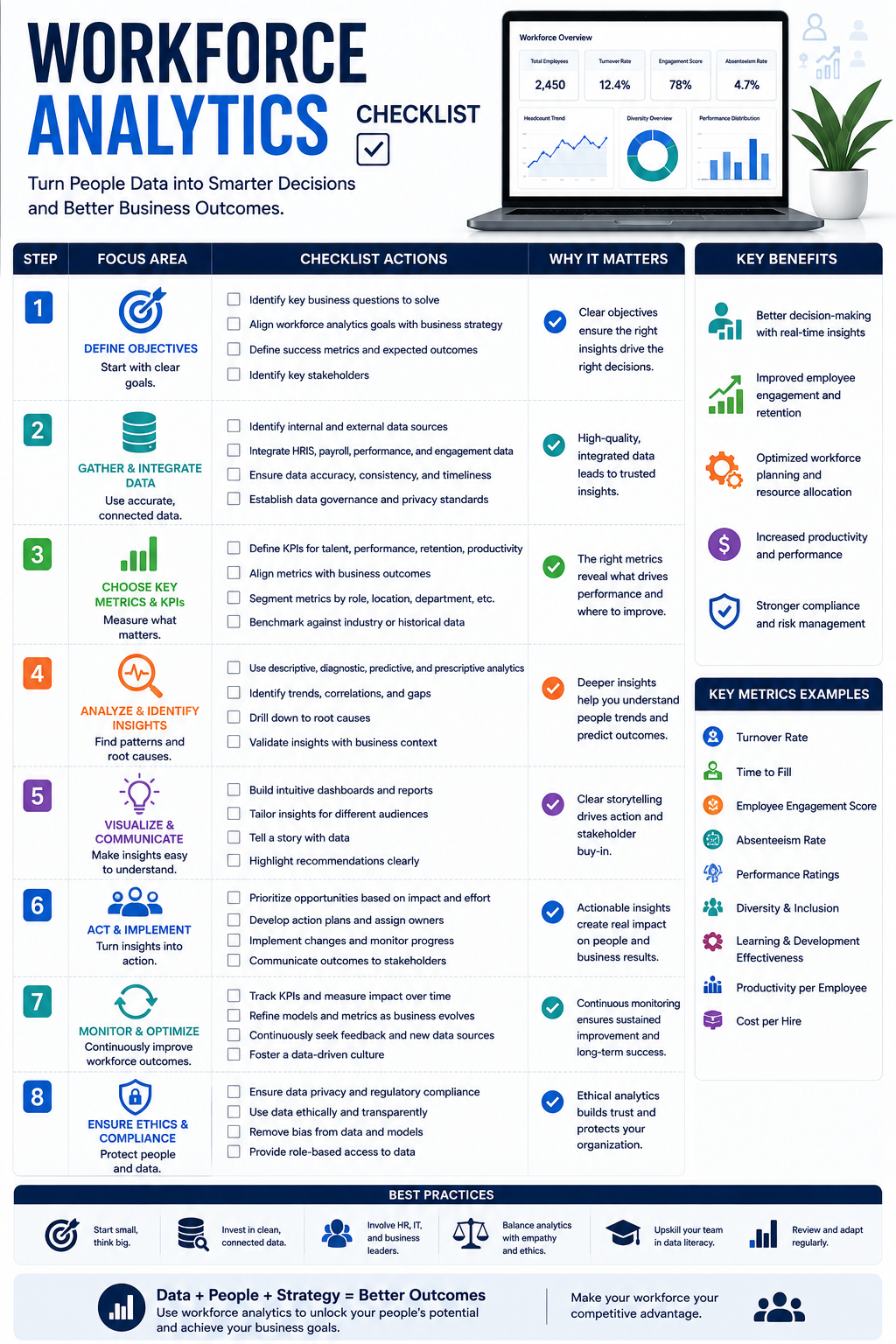
Workforce analytics is the use of workforce information to support decisions about staffing, capacity, turnover, skills, headcount, and organizational needs. It often starts with historical workforce data to show what has already happened, since descriptive analytics focuses on historical data analysis.
What workforce metrics should executives review?
The right workforce metrics depend on the decision being made. Relevant measures may involve headcount, vacancies, turnover, capacity, skills, or other workforce information tied to business priorities.
How can workforce analytics help with hiring?
Workforce analysis can help leadership determine whether hiring needs are connected to genuine capacity shortages, vacancies, growth, skills gaps, or other organizational issues.
What is staffing analysis?
Staffing analysis examines how workforce capacity and roles align with the work an organization needs to perform.
Why is turnover data important?
Turnover data can help leaders identify recurring workforce patterns that may affect staffing stability, recruiting demands, institutional knowledge, and capacity.
Can workforce analytics identify skills gaps?
It can help organizations compare existing workforce capabilities with the skills required for current operations or future business priorities.
Is workforce analytics an HR software service?
Not in this context. Masterly Consulting Group's focus is consulting and decision support rather than selling an HR software platform. The appropriate engagement depends on the organization's needs and available workforce information.
Does Masterly Consulting Group provide HR and strategic consulting?
Yes. Masterly Consulting Group currently provides business consulting, strategic planning, HR-related consulting, process optimization, executive coaching, and related organizational support.
Request a Masterly Consulting Workforce Strategy Consultation
Your next hiring decision should be based on more than a department saying it feels busy.
Professional workforce analytics can help leadership examine staffing levels, turnover data, skills gaps, capacity, headcount planning, and other workforce metrics before making decisions that affect payroll, operations, growth, and the organization as a whole.
Masterly Consulting Group provides business, HR, strategic-planning, and organizational consulting designed around the specific needs of its clients.
Call Masterly Consulting Group at (972) 236-5051 or visit MasterlyGroup.com to request a workforce strategy consultation. The firm's current contact page confirms this phone number.