Performance Improvement: What Leaders Should Measure Before Changing People or Process
When business results fall below expectations, leaders naturally want to act.
A department misses deadlines. Customer issues increase. Productivity declines. Managers report that employees are struggling. Projects take longer than expected. Leadership sees the numbers and knows something needs to change.
The harder question is what.
Is the problem an employee?
A manager?
A process?
A lack of training?
Unclear expectations?
Insufficient resources?
Poor measurement?
Changing people or redesigning a process before answering that question can treat the symptom instead of the cause.
That is why performance improvement should begin with diagnosis.
Leaders need to understand the gap between expected and actual performance, determine what is contributing to it, and decide which changes are most likely to address the real problem.
Masterly Consulting Group works with businesses and organizational leaders on performance, operations, organizational effectiveness, leadership, and related business challenges. Its current organizational-effectiveness work emphasizes diagnosing root causes and examining structure, processes, decision rights, accountability, workflows, and execution systems before solutions are selected.
Performance Improvement and Performance Management Start With the Performance Gap
Before leadership changes anything, the organization needs a clear definition of the problem.
"We need better performance" is not specific enough.
A performance gap is the difference between the result the organization expects and what is actually happening.
For example, leadership may expect customer requests to receive a response within an established period, but actual response times are consistently longer.
That creates something concrete to investigate.
The organization can ask:
What result did we expect?
What result are we getting?
How large is the difference?
Where does the gap occur?
How consistently does it occur?
Who or what influences the result?
Business leaders need to understand performance gaps against clear objectives and measurable benchmarks so they can examine a specific problem instead of relying on general impressions about who or what is underperforming.
Performance Metrics and Key Performance Indicators Need to Measure the Right Problem
Businesses usually have data.
The problem is deciding which data matters.
Performance metrics should help leaders understand whether the organization is producing the outcomes that matter, choose the right performance metrics, and track progress when results begin to move away from expectations.
A leadership team might review measures related to:
- Quality
- Timeliness
- Customer outcomes
- Productivity
- Completion rates
- Rework
- Revenue or financial performance
- Operational consistency
The appropriate measures depend on the organization and the problem being examined.
Activity Is Not the Same as Performance
A team can be very busy without producing the expected result.
Employees may attend meetings, answer emails, update systems, and complete tasks while an important customer or operational outcome continues to decline.
Measuring only activity can hide the problem.
Performance measurement should help leadership connect what people and processes are doing with the result the organization actually needs, so tracking performance shows whether work is actually helping measure progress toward that outcome.
Organizational Performance Is Bigger Than Individual Performance
When results decline, it is easy to focus immediately on employees.
Sometimes individual performance is the issue.
But organizational performance is shaped by more than individual effort. Performance metrics can be used at the individual and team performance, organizational level, and across the entire organization.
Employees work within processes.
Managers set priorities.
Systems control information.
Leadership assigns resources.
Organizational structures define authority.
Metrics influence behavior.
A capable employee can struggle inside an unclear system.
A strong manager can be limited by conflicting priorities or insufficient resources.
A department can perform well internally while repeatedly experiencing problems at cross-functional handoffs.
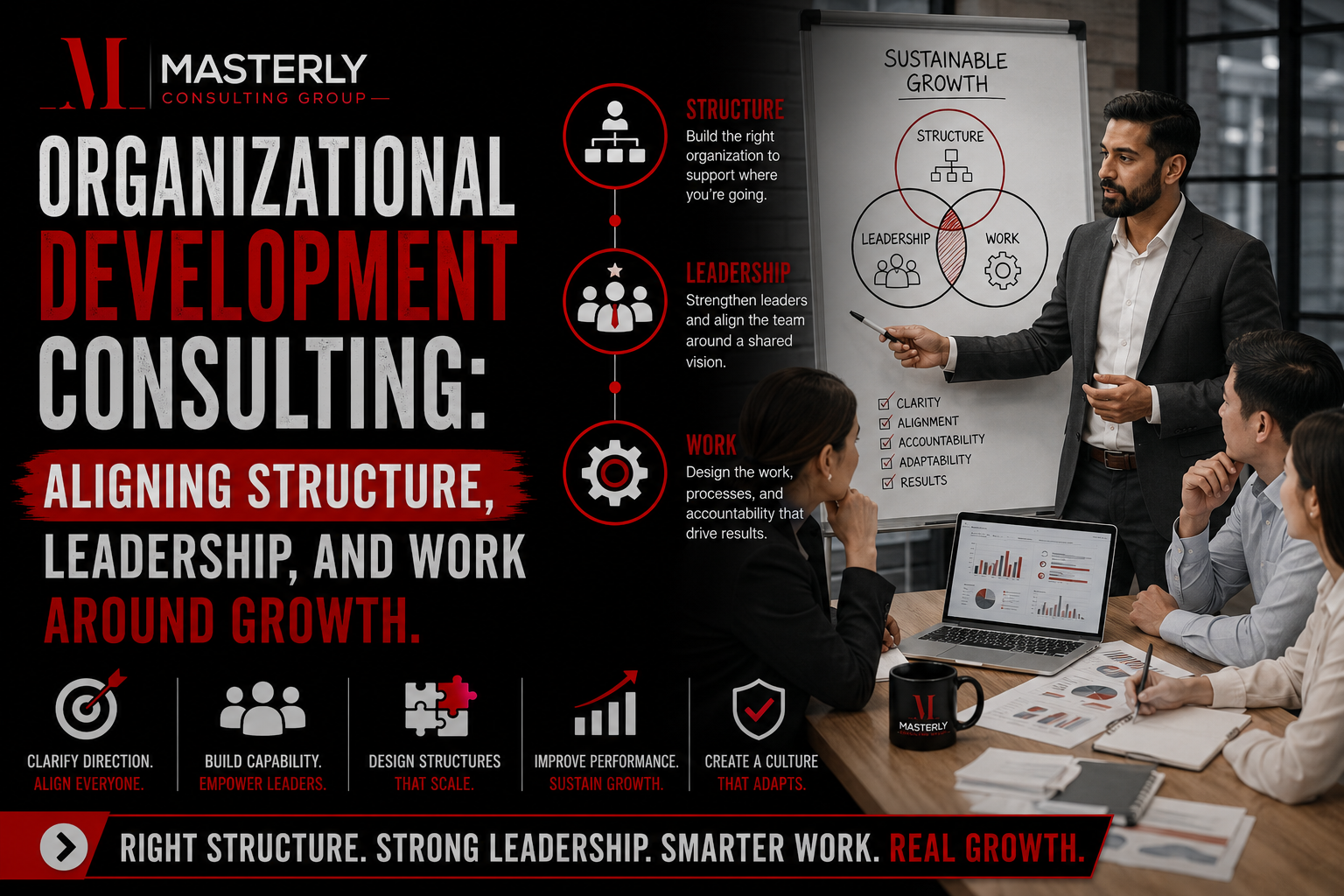
Masterly Consulting Group's organizational-development guidance makes this distinction directly, noting that organizational effectiveness involves the larger relationship between people, structures, leadership, capabilities, and organizational goals. High productivity and employee satisfaction can indicate the environment supports performance.
That means a performance problem should not automatically become a people problem.
Look at Expectations Before Changing the Employee
One of the first questions in a performance review should be simple:
Was the expected result clear?
Employees cannot reliably meet expectations they do not understand.
Imagine a manager telling an employee to improve customer service.
What does improvement mean?
Faster responses?
Higher customer satisfaction?
Fewer escalations?
More complete documentation?
Better communication?
Without a clear standard, the employee and manager may have different definitions of successful performance.
Leaders should determine whether expectations were specific enough to guide behavior, whether performance goals supported broader company objectives, and whether employees understood how their work would be evaluated.
Clear expectations do not guarantee strong results.
They make meaningful evaluation possible.
Clear targets paired with the right tools can raise productivity and reduce mistakes.
A Capability Gap Requires a Different Response
Sometimes employees understand exactly what is expected but do not yet have the knowledge or ability required to perform successfully.
That may indicate a capability gap.
Perhaps a manager has been promoted into a role requiring skills they have not previously needed.
A department may be using new technology.
A company may have changed its operating model.
Employees may now need to complete more complex work.
These situations are different from unclear expectations or unwillingness to perform.
A capability problem may require development, training, coaching, analysis of skills gaps, different support, or another response appropriate to the circumstances.
Performance improvement can also support employee development by revealing training needs.
Masterly Consulting Group's organizational-development work addresses the connection between organizational performance, leadership, capability, structure, and change rather than treating performance only as an individual employee issue.
Process Performance Can Make Good Employees Look Ineffective
Employees may be doing their jobs correctly while the overall process still produces poor results.
That is why process performance belongs in a performance-improvement assessment, and teams need to measure performance across the workflow, not just at the individual level.
Consider a client onboarding process.
Sales collects information.
Operations receives the account.
Finance establishes billing.
A service team begins delivery.
If information is lost between sales and operations, the customer may experience delays.
Leadership could blame the operations employee receiving the account.
But the real problem may be the handoff.
Changing the employee would not correct the process.
Smoother business processes can improve customer satisfaction and reduce costs.
When repetitive manual tasks slow work, automation can improve efficiency by cutting processing time.
Stronger processes also support scalability as operations grow.
Look for Repeated Friction
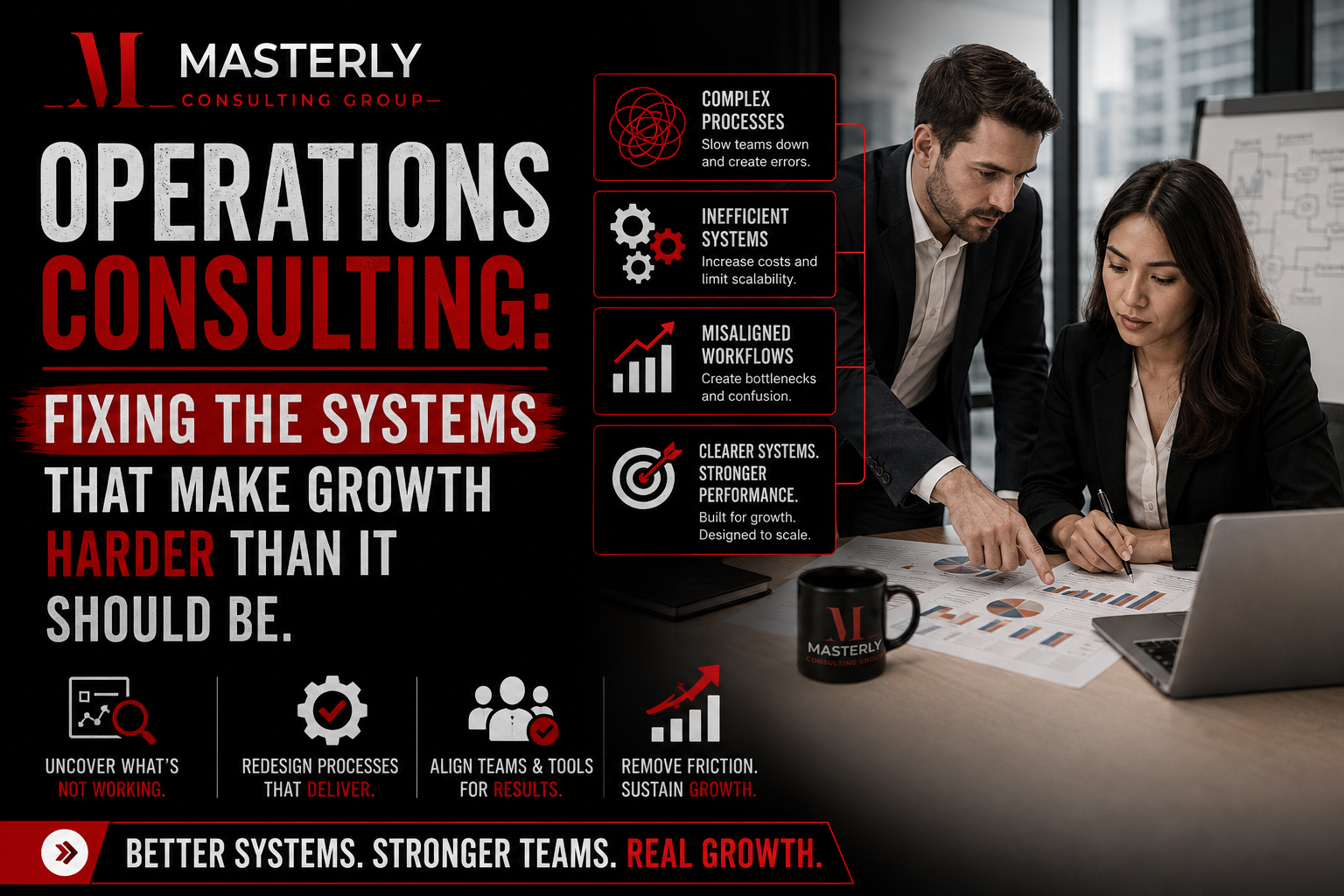
Process-related performance problems can include:
- Repeated approvals
- Incomplete handoffs
- Duplicate work
- Rework
- Missing information
- Unclear ownership
- Manual workarounds
- Slow decisions
- Systems that do not support the workflow
Repeated friction often signals potential issues that leadership should identify early rather than treating each delay as an isolated mistake.
These methods help identify areas where workflow design is limiting results.
These problems can reduce performance even when the people involved are capable and committed.
Resources Can Create or Widen a Performance Gap
An organization may establish reasonable expectations but fail to provide what employees need to meet them.
Resources can include more than headcount.
Employees may need appropriate technology.
Managers may need reliable information.
Teams may need enough time.
Departments may need access to subject-matter expertise.
Employees may need clear authority to make routine decisions.
Before concluding that people need to work harder, leadership should examine whether the organization has created the conditions required for successful performance.
A resource constraint does not excuse every performance problem.
It does change the diagnosis because resources affect whether the organization can deliver value.
Manager Accountability Is Part of Performance Improvement
Managers play an important role in turning organizational expectations into daily execution.
That makes manager accountability part of the performance system.
Managers need to understand what outcomes their teams own.
They also need enough visibility to track progress and identify problems before those problems become larger.
For example, if an important metric has declined for six months but nobody reviewed it until the end of the year, the problem is not limited to employee performance.
The management process also deserves examination.
Manager accountability may include clear expectations, timely feedback, appropriate follow-through, escalation, decision-making, and regular review of meaningful results.
Regular coaching can improve employee engagement and show employees their work is valued.
Engaged management is associated with 3.6 times more engaged employees.
Employee engagement can lift morale across teams and reduce burnout, especially when well-being and support reinforce a sustainable work-life balance.
Masterly Consulting Group's current organizational-effectiveness materials connect accountability with actual responsibility and decision authority and emphasize recurring performance rhythms rather than accountability in name only.
Incentives Can Influence Organizational Performance
People respond to what organizations reward, recognize, and measure when those signals are tied clearly to success and broader business goals.
That can produce unintended consequences.
Suppose a customer-service team is measured almost entirely on how quickly employees close cases.
Employees may learn to prioritize speed.
Recognition should also celebrate milestones and acknowledge high performance, not just speed-based output.
If customer satisfaction and resolution quality are also important but rarely reviewed, the measurement system may encourage behavior that conflicts with the larger business goal.
The same issue can appear in sales, operations, management, and other functions.
A performance assessment should therefore ask whether incentives and measures encourage the outcomes leadership actually wants.
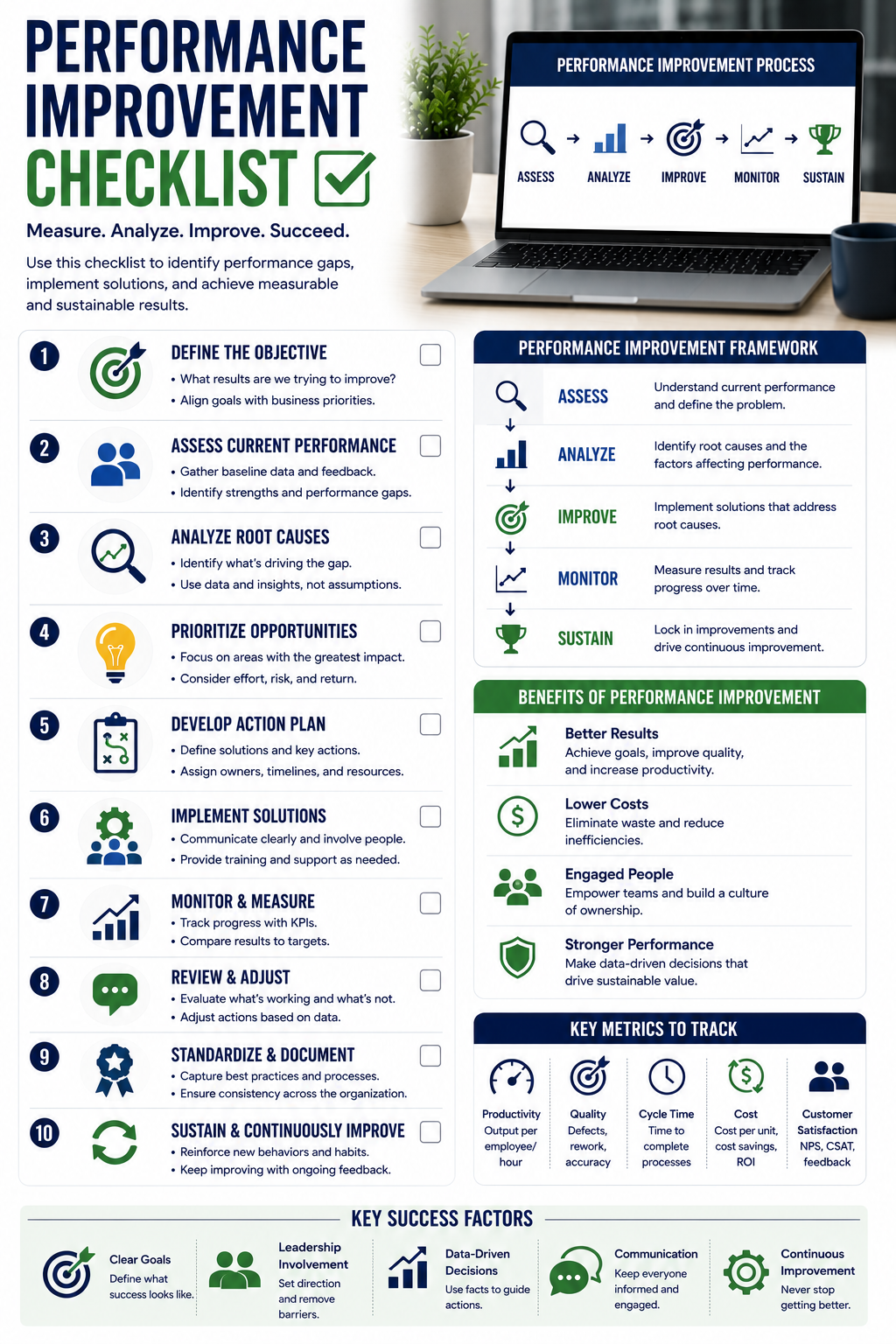
A Practical Performance Improvement Framework
Before deciding on corrective action, leadership can examine seven areas as part of effective performance management.
1. Expected Performance
What result should be occurring?
The expected result needs to be clear enough to evaluate against measurable objectives and show whether you can achieve it.
2. Actual Performance
What is happening now?
Use reliable information where available to measure progress rather than relying only on perception.
3. Performance Metrics
Are the right outcomes being measured, and do leaders review those measures often enough to act?
4. Capability
Do employees and managers have the knowledge and skills required to meet expectations?
5. Process
Does the workflow support successful execution, or is process performance and operational performance creating delays, rework, or confusion?
6. Resources and Authority
Do people have the tools, information, capacity, and appropriate authority needed to perform?
7. Management Follow-Through
Are leaders reinforcing expectations, addressing barriers, reviewing results, and maintaining accountability?
This framework helps move the conversation from "Who is the problem?" to "What is creating the performance gap?"
An Improvement Plan Should Match the Cause
An improvement plan becomes useful only when it addresses the issue leadership has identified, and a performance improvement plan fits only when the response should match an employee-specific cause.
Different causes require different responses.
A performance improvement plan should support employee performance only when the diagnosis points to an employee-specific issue.
If expectations are unclear, the organization may need greater role or goal clarity.
If a capability gap exists, development may be appropriate.
If a process is broken, changing the workflow may matter more than changing the people.
If managers do not follow through, management practices may need attention.
If measurement is weak, leadership may need better visibility before making larger decisions.
If resources are insufficient, the company may need to address capacity or tools.
This is why diagnosis matters.
Applying the same solution to every performance problem can waste time while the underlying issue remains.
Performance Improvement Should Not Become More Process Than Necessary
Organizations can overcorrect.
In practice, performance management systems often change over time, and 74% of businesses updated them in the last five years, but that does not mean adding more layers always helps.
A missed deadline leads to another approval.
A quality problem creates another form.
A communication problem produces another meeting.
Soon, employees spend more time managing the performance system than performing the work.
The purpose of performance improvement is not to create bureaucracy.
It is to identify the conditions limiting results and make focused changes that improve execution.
Good structure should make expectations and accountability clearer.
It should not make routine work unnecessarily difficult.
Team Performance and Organizational Performance Are Related but Different
A performance problem may appear inside a specific team while the cause sits elsewhere in the organization, making that team look weaker than its peers when the real issue is upstream.
For example, a team may struggle because roles overlap, decision rights are unclear, or cross-functional handoffs repeatedly fail.
Masterly Consulting Group's existing team performance: What Leaders Should Fix Before Adding More Meetings or More People resource examines these team-level issues, including role clarity, accountability, handoffs, decision ownership, and operating rhythms.
Recommended internal link: Link the phrase team performance above to that existing article. It provides useful supporting context for team-level barriers while allowing this page to maintain its broader performance improvement intent.
For a broader authority link, the existing Organizational Effectiveness Consultant page is also relevant because it addresses diagnosis, accountability, processes, workflows, performance rhythms, and execution systems.
When Outside Performance Improvement Support Makes Sense
Leadership teams can resolve many performance problems internally.
Outside support becomes more useful when the symptoms cross several functions or the organization has repeatedly tried to improve results without solving the underlying issue.
Professional review may be valuable when:
- Performance metrics are declining but leaders disagree about why
- Employees are being blamed for problems that may involve processes
- Managers apply different standards across departments
- Rework and delays continue despite repeated interventions
- Leadership cannot distinguish a capacity problem from a capability gap
- Accountability is unclear
- A major organizational change has affected performance
- Previous improvement efforts have not produced lasting clarity
An outside perspective can help separate symptoms from causes without assuming the answer in advance.
Masterly Consulting Group Helps Leaders Diagnose Performance Before Choosing the Solution
Masterly Consulting Group works with entrepreneurs, business owners, professional managers, and organizations on business consulting, executive coaching, organizational effectiveness, and operational improvement. Its public materials emphasize customized strategies, identifying areas for improvement, and supporting growth based on the needs of the organization.
Its organizational-effectiveness work also focuses on diagnosing root causes before selecting interventions and examines decision rights, workflows, accountability, execution systems, and resource allocation. This helps align performance improvement with company objectives and broader organizational growth.
That perspective is important for performance improvement.
A weak result may involve people.
It may involve management.
It may involve process.
It may involve capability, resources, measurement, incentives, or several factors at once.
The purpose of a professional assessment is to develop a clearer picture of the problem before leadership commits to the solution.
The exact assessment, recommendations, coaching, implementation support, and other services should be defined based on the agreed engagement scope.
Frequently Asked Questions About Performance Improvement
What is performance improvement?
Performance improvement is the process of identifying the gap between expected and actual results, examining the causes, and determining what changes may improve performance.
What is a performance gap?
A performance gap is the difference between the result an organization expects and the result it is currently achieving.
What are performance metrics?
Performance metrics are measures used to evaluate results, progress, quality, productivity, timeliness, or other outcomes relevant to the organization, with examples including quality, productivity, timing, customer results, or financial outcomes.
What affects organizational performance?
Organizational performance can be influenced by expectations, people, capabilities, leadership, business processes, resources, systems, incentives, structure, and accountability.
What is a capability gap?
A capability gap exists when the knowledge, skills, or abilities available do not fully support the performance the organization requires.
Why should leaders examine process performance?
Process performance can reveal delays, rework, weak handoffs, unclear ownership, or other workflow problems that may affect results even when individual employees perform their assigned tasks.
What is manager accountability?
Manager accountability means managers have clear responsibility for relevant outcomes and appropriately review performance, address barriers, provide direction, and follow through.
What should an improvement plan address?
An improvement plan should address the specific cause of the performance gap rather than applying the same response to every performance problem.
When should a company seek outside performance improvement support?
Outside support may help when performance problems cross teams, causes remain unclear, previous interventions have not solved the problem, or leadership needs a structured assessment before making significant changes.
Discuss a Performance-Improvement Assessment With Masterly Consulting Group
Poor results tell leadership that something needs attention.
They do not automatically reveal what needs to change.
Before replacing people, redesigning processes, adding training, changing technology, or creating another management requirement, leaders need a clearer understanding of the performance gap.
Performance improvement can help examine organizational performance, performance metrics, manager accountability, process performance, capability gaps, resources, and other conditions that may be influencing results.
Masterly Consulting Group can work with leaders to examine those issues and determine an appropriate path based on the organization's needs and the agreed engagement scope.
Call Masterly Consulting Group at (972) 236-5051 or visit masterlygroup.com to discuss a performance-improvement assessment with Masterly Consulting Group.