Decision Making Process: How Leadership Teams Move From Debate to Accountable Action
Leadership teams rarely struggle because nobody has an opinion.
They struggle because everyone has one.
A major decision reaches the executive table. Finance sees one risk. Operations sees another. Sales wants speed. Leadership wants more information. Several meetings later, the same issue is still open.
Even after a decision is made, another problem can appear.
One executive believes the team approved one direction. Another remembers something different. Employees receive mixed instructions. Nobody is completely sure who owns the next step.
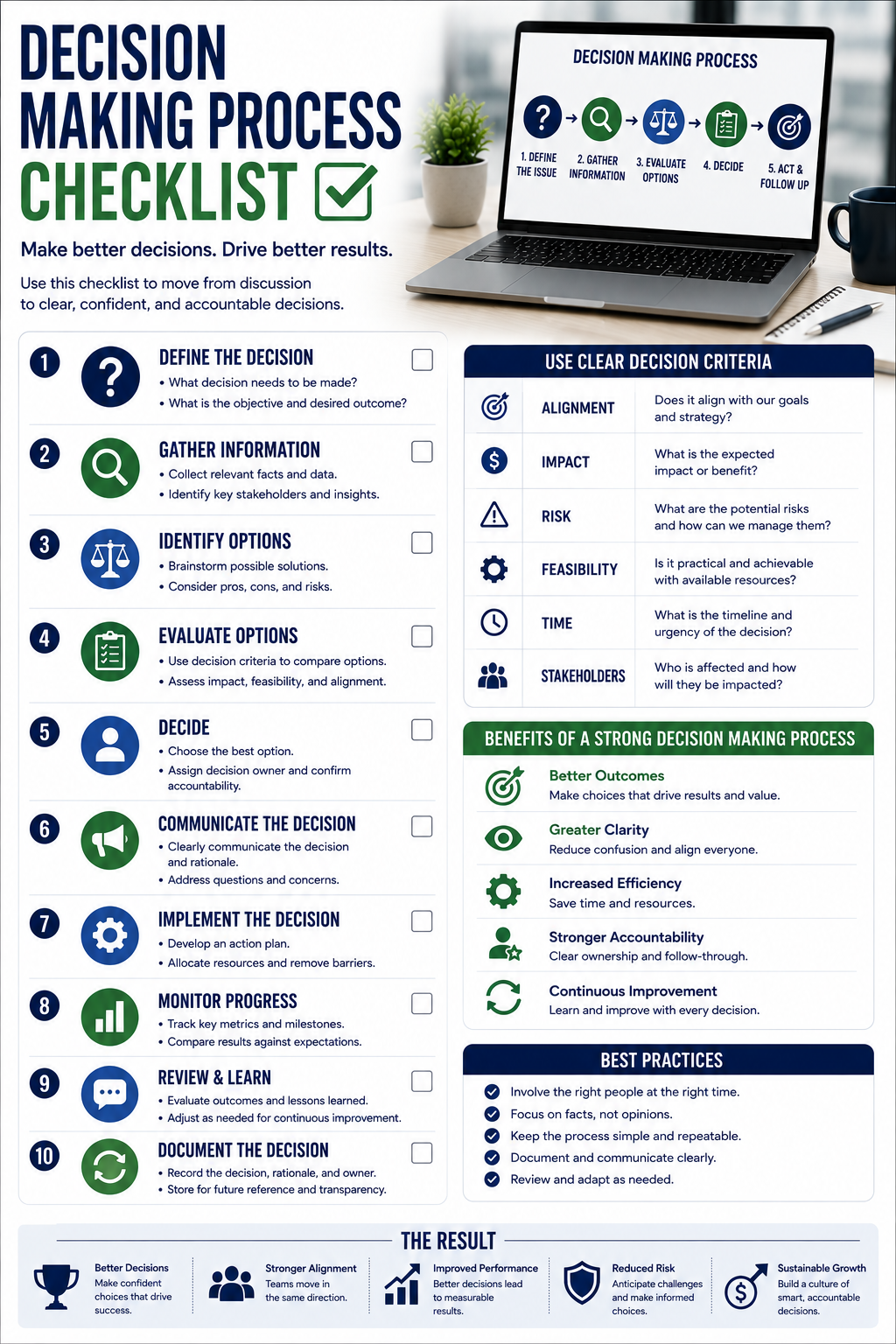
The problem is not always poor judgment. It may be an unclear decision making process—a structured method for defining the question, reviewing evidence, evaluating alternatives, selecting an option, communicating the decision, and assigning responsibility for follow-through.
Important business decisions need enough structure to define the question, set decision criteria and tradeoffs, establish decision ownership and deadlines, communicate the outcome, and create accountability for what happens next.
This page is for business owners, founders, CEOs, senior executives, and leadership teams who want better decisions, stronger accountability, clearer communication, and more consistent leadership execution.
Masterly Consulting Group currently provides executive coaching focused on better decisions, stronger accountability, clearer communication, and leadership effectiveness for founders, CEOs, senior executives, and other decision-makers.
For leaders dealing with repeated debate, delayed action, mixed messages, or weak execution, outside support can help build clearer decision frameworks and turn decisions into accountable follow-through.
A Decision Making Process Should Define the Question First
Leadership teams can spend significant time discussing a problem without agreeing on what they are actually deciding.
Consider a company experiencing slower growth.
One executive believes the question is whether the company should increase marketing.
Another believes the real issue is sales capacity.
A third thinks leadership needs to decide whether to enter another market.
Those are different decisions.
Without a clearly defined question, leaders may present good evidence that answers completely different problems.
A stronger decision making process starts by identifying the decision that actually needs to be made.
For example:
"Should we enter Market A during the next planning period?"
is clearer than:
"What should we do about growth?"
The clearer question gives leadership something concrete to evaluate.
A Decision Framework Creates Structure Without Removing Judgment
Executives still need judgment.
A decision making framework does not replace it.
Instead, the framework supports effective decision making by helping leaders evaluate competing perspectives using a shared, structured process.
A useful leadership decision may need clarity around:
- The question being decided
- The available evidence
- The alternatives under consideration
- The decision criteria
- The tradeoffs
- The decision owner
- The deadline
- The communication plan
- The follow-through required afterward
Not all decisions need this level of formality, but identifying the decision that actually needs to be made is the first step in a stronger decision making process.
Without this structure, discussions can expand indefinitely.
One meeting creates another request for information. Another executive introduces a new option. The deadline moves. Meanwhile, managers are waiting for direction.
A framework helps leadership understand when the conversation has produced enough information to move.
Decision Criteria Help Leaders Compare Options Consistently
Most difficult leadership decisions involve tradeoffs.
A company may choose between three technology investments.
One has lower cost.
One has stronger capabilities.
One can be implemented faster.
Which option is best?
The answer depends on the decision criteria leadership agrees matter most and the relative importance of each.
Criteria might include:
Strategic fit.
Cost.
Implementation risk.
Customer impact.
Operational capacity.
Time to implement.
Leadership attention.
Long-term flexibility.
The exact criteria depend on the decision.
A useful leadership decision may need clarity around benefits, quality, and other relevant information.
Not all decisions need this level of formality, but high-impact choices usually do.
What matters is establishing what is critical and crucial before personal preferences take over the conversation.
Criteria Make Tradeoffs Visible
Suppose the least expensive option requires significantly more internal effort.
Leadership now has a clearer tradeoff to discuss.
Is the lower financial investment worth the operational burden?
That is a better conversation than simply asking which option everyone prefers.
The decision criteria create a common language for evaluating the different alternatives, weighing their relative importance and improving the quality of the comparison so the team is less likely to make the wrong decision.
Every Major Decision Needs a Decision Maker
One of the most common sources of executive confusion is unclear authority.
Everyone participates in the discussion.
Several people provide recommendations.
A committee reviews the information.
But who actually decides?
The decision owner should be clear before the process reaches the final stage.
The decision owner is not necessarily the person who knows the most about every part of the issue.
They are the person with the authority and responsibility to make or confirm the final decision within the organization's governance structure, whether that authority sits with a single person or remains formally assigned within a broader group.
The decision criteria create a common language for evaluating different alternatives more consistently.
Unclear tradeoffs increase the risk of the wrong decision.
Input and Authority Are Different
A finance leader may provide financial analysis.
Operations may identify execution risks.
Human resources may explain workforce implications.
Other executives, relevant stakeholders, and middle managers may challenge assumptions, surface different opinions, and help build shared understanding.
All of that input from group members can improve the decision.
It does not mean every participant has equal authority over the final choice.
Separating input from decision rights can reduce repeated debate and unclear ownership.
One person should clearly own the final call before the process reaches the last stage, even when others are involved.
Masterly Consulting Group's operating-model guidance similarly emphasizes defining decision rights, functional ownership, governance, and accountability so organizations know who has authority to act.
More Evidence Does Not Always Create a Better Decision
Leaders should make informed decisions.
But requests for more information can also become a way of delaying commitment.
Another report.
Another forecast.
Another meeting.
Another scenario.
At some point, the organization reaches a point where additional information provides limited additional value, leading to analysis paralysis and, over time, decision fatigue.
A structured decision making process should help leadership distinguish between evidence that could materially change the decision and information that is merely interesting, avoiding common mistakes and improving decision making without sacrificing accuracy.
Questions can include:
What evidence do we already have?
What important assumption remains untested?
Would additional information realistically change the decision?
What is the cost of waiting?
What happens if no decision is made?
This matters because delaying a decision is itself a decision with consequences.
Business Decisions Need Clear Alternatives
Leadership discussions often become difficult because one option is treated as the only possible choice, which can lead to weak choices before proper problem solving has happened.
A good decision framework makes alternatives visible.
The options may include:
Proceed now.
Proceed with a narrower scope.
Delay until a specific condition is met.
Choose a different approach.
Do not proceed.
The purpose is not to create an endless list of possible solutions.
It is to make sure leadership understands the meaningful solutions available.
Comparing real alternatives also makes assumptions and tradeoffs easier to identify. Common mistakes include including too many criteria, which complicates the decision-making process.
Deadlines Prevent Decisions From Staying Open Forever
Some decisions deserve significant analysis.
They still need a deadline.
Without one, an important decision can remain open while employees continue working under uncertainty.
Teams may delay projects because they expect leadership to change direction.
Managers may avoid committing resources.
Different departments may begin acting on their own assumptions.
A decision deadline tells the organization when leadership needs to move from discussion into commitment.
The deadline should reflect the importance and complexity of the issue, but it should still exist.
Accountability Begins After the Decision
Organizations often treat the decision meeting as the finish line.
It is actually the transition point.
Once leadership decides, accountability needs to move from the person making the decision to the people responsible for execution.
That means the organization should know:
Who owns implementation?
What should happen next?
What resources are available?
What deadlines matter?
They still need a deadline. Setting strict time limits can help prevent analysis paralysis in the decision making process.
What problems require escalation?
How will leadership review progress and maintain control over future execution?
Without these answers, a good strategic decision can still produce weak execution.
Decision Accountability Is Not the Same as Blame
Accountability should clarify responsibility.
It should not create a culture where employees avoid decisions because they fear being blamed whenever outcomes are uncertain.
High-level business decisions often involve incomplete information.
The organization needs clarity about who owns the choice, who owns execution, and how results will be reviewed. It is actually the transition point where the decision moves into execution and control, which also helps teams act with more confidence.
That supports stronger leadership without pretending every decision has a guaranteed outcome. Without these answers, a good strategic decision can still produce weak execution and weaker future results.
Decision Communication Determines What the Organization Hears
A leadership team can reach perfect agreement in the conference room and still create confusion outside it.
That happens when decision communication is inconsistent, even though the primary goal is to increase confidence in who owns what, not create fear.
One executive tells their team the decision is final.
Another says leadership is still considering options.
A third explains the decision differently.
Employees no longer know which message to trust.
Decision communication should answer basic questions:
What was decided?
Why was it decided?
What changes because of the decision?
What does not change?
Who owns the next step?
When does the change take effect?
What questions still remain open?
Not every employee needs every detail behind an executive decision.
They do need enough clarity to act consistently.
Leadership Decisions Need Follow-Through
The strongest decision framework still fails if leadership does not follow through.
A team may approve a new priority but continue funding competing projects.
Leadership may delegate authority and then override routine decisions.
Executives may announce a new operating direction without changing meeting agendas, metrics, or responsibilities.
Employees notice these contradictions.
Repeated inconsistency teaches the organization that leadership decisions are temporary.
Follow-through strengthens credibility.
It shows employees that decisions influence how the organization actually operates.
A Practical Leadership Decision Framework
For complex business decisions, leadership teams can organize the decision around eight questions.
1. What Exactly Are We Deciding?
Define the question clearly enough that leaders are discussing the same issue.
2. Who Owns the Decision?
Identify the decision owner and clarify who provides input.
3. What Evidence Matters?
Determine which information is necessary to evaluate the choice.
4. What Are the Real Alternatives?
Compare meaningful options rather than treating the first proposed solution as the only path.
5. What Decision Criteria Will We Use?
Agree on the standards that will determine which option best fits the organization.
6. What Tradeoffs Are We Accepting?
Every major decision gives something up. Make those consequences visible.
7. When Must the Decision Be Made?
Set a realistic deadline so the issue does not stay open indefinitely.
8. How Will We Communicate and Execute It?
Define decision communication, implementation ownership, and accountability before the meeting ends.
The framework does not make difficult decisions easy.
It makes the process clearer.
Executive Leadership Coaching Can Strengthen Decision Discipline
Business owners often become the default decision-maker because they built the company.
That can work when the business is small.
As the organization grows, the same pattern can create a leadership bottleneck.
Managers wait for the owner.
Executives escalate decisions that should sit lower in the organization.
The owner carries more decisions than one person can reasonably evaluate.
Executive leadership coaching can help business owners examine these patterns and strengthen how they approach authority, delegation, communication, and accountability.
Masterly Consulting Group's current Executive Leadership Coaching for Business Owners service specifically addresses strategic decision-making, leadership accountability, delegation, communication, and the shift from working inside the business toward leading the organization.
Recommended internal link: Link the phrase Executive Leadership Coaching for Business Owners to the existing Masterly Consulting Group service page. It supports the buyer's coaching intent while allowing this article to own the decision making process methodology.
When Outside Leadership Support Makes Sense
Leadership teams can handle many decisions internally.
Outside coaching or consulting becomes more useful when decision problems become repetitive.
Examples include:
Leadership repeatedly revisits decisions that were supposed to be final.
The business owner remains involved in too many operational choices.
Executives disagree about who has authority.
Meetings produce discussion without commitment.
Managers wait for executive approval for routine decisions.
Employees receive conflicting messages after leadership meetings.
Important decisions are delayed because the team keeps requesting more information.
Decisions are made, but nobody clearly owns implementation.
These patterns can signal a leadership-system problem rather than one difficult decision.
Masterly Consulting Group's current executive coaching services are built around strengthening decision making skills so leadership teams can make effective decisions with clearer authority, better delegation, stronger communication, greater accountability, and sharper strategic priorities.
Masterly Consulting Group Helps Leaders Create Greater Decision Clarity
Masterly Consulting Group works with business owners, founders, CEOs, executives, and senior leaders through structured executive coaching engagements designed around leadership responsibilities, organizational needs, and the relationships that support alignment across the business.
For leaders struggling with decision structure, repeated friction can prevent effective decisions, so the value of coaching is not receiving an outside person to make the decision for them.
Leadership still owns the choice.
The value is creating greater discipline around the way decisions are framed, evaluated, delegated, communicated, and carried into execution, with leadership playing a vital role in how those decisions move through the organization.
That can help the business owner move away from becoming the answer to every question and toward building a leadership structure in which appropriate decisions can be made with clearer authority and accountability.
The exact coaching objectives, engagement structure, and support should be defined based on the needs of the business owner and organization.
Group Decision Making in Complex Systems Requires a Clear View of the Current Situation
Group decision making becomes more difficult when leaders are working within complex systems that involve several teams, priorities, and existing systems. Before choosing between a top down or bottom up approach, leadership should gather data that reflects the current situation and establish clear criteria so important decisions based on that information support the organization’s goals. With consistent practice, leaders can create a more disciplined decision process that combines useful input from across the organization with clear authority, accountability, and follow-through.
Frequently Asked Questions About the Decision Making Process
What is a decision making process?
A decision making process is a structured method for defining a question, reviewing evidence, evaluating alternatives, selecting an option, communicating the decision, and assigning responsibility for follow-through.
What is a decision framework?
A decision framework gives leaders a consistent structure for evaluating important choices, including evidence, alternatives, criteria, authority, tradeoffs, and deadlines.
What are decision criteria?
Decision criteria are the standards leaders use to compare options, such as strategic fit, cost, risk, customer impact, capacity, or timing.
What is a decision owner?
A decision owner is the person with clear authority and responsibility for making or confirming a specific decision.
Why does accountability matter after a decision?
Accountability establishes who is responsible for implementation, deadlines, outcomes, and escalation once the decision has been made.
What is decision communication?
Decision communication explains what was decided, why it matters, what changes, who owns the next steps, and what employees need to do differently.
Why do leadership teams keep revisiting decisions?
Repeated debate can result from unclear decision authority, weak criteria, missing deadlines, unresolved assumptions, or inconsistent follow-through.
Can executive coaching help business owners make better leadership decisions?
Executive coaching can provide structured reflection, outside perspective, accountability, and support around decision-making habits. It can also strengthen collaborative decision making, especially when group decisions start to break down because authority, criteria, or deadlines are unclear. Masterly Consulting Group currently includes strategic decision-making among its executive leadership coaching focus areas.
Does coaching mean the coach makes business decisions for the owner?
No. The business owner or appropriate organizational leader remains responsible for the decision. Coaching supports clearer thinking, leadership habits, communication, and accountability.
Discuss Leadership Decision Structure and Operating Clarity With Masterly Consulting Group
When every major issue requires another meeting, another opinion, or another approval from the owner, the organization may need more than another conversation.
It may need a clearer decision making process.
Masterly Consulting Group works with business owners and executive leaders to strengthen strategic decision-making, leadership accountability, communication, delegation, and organizational clarity.
Call Masterly Consulting Group at (972) 236-5051 or visit masterlygroup.com to discuss leadership decision structure and operating clarity with Masterly Consulting Group.