Business Planning: Turning Growth Goals Into Owners, Timelines, and Operating Decisions
A business can have ambitious goals and still lack a usable plan.
Leadership wants to grow revenue, improve margins, hire strategically, launch new services, enter new markets, strengthen operations, or improve customer experience.
The goals may be clear.
The execution often is not.
Who owns each priority?
What has to happen first?
What assumptions are behind the plan?
What resources will be required?
What happens if capacity is already stretched?
When will leadership review progress?
Without those answers, planning can become a document rather than a management tool.
That is where business planning matters.
A practical plan connects growth goals with owners, timelines, budgets, operating decisions, and a clear review rhythm. It helps leadership turn broad ambition into work the organization can actually execute.
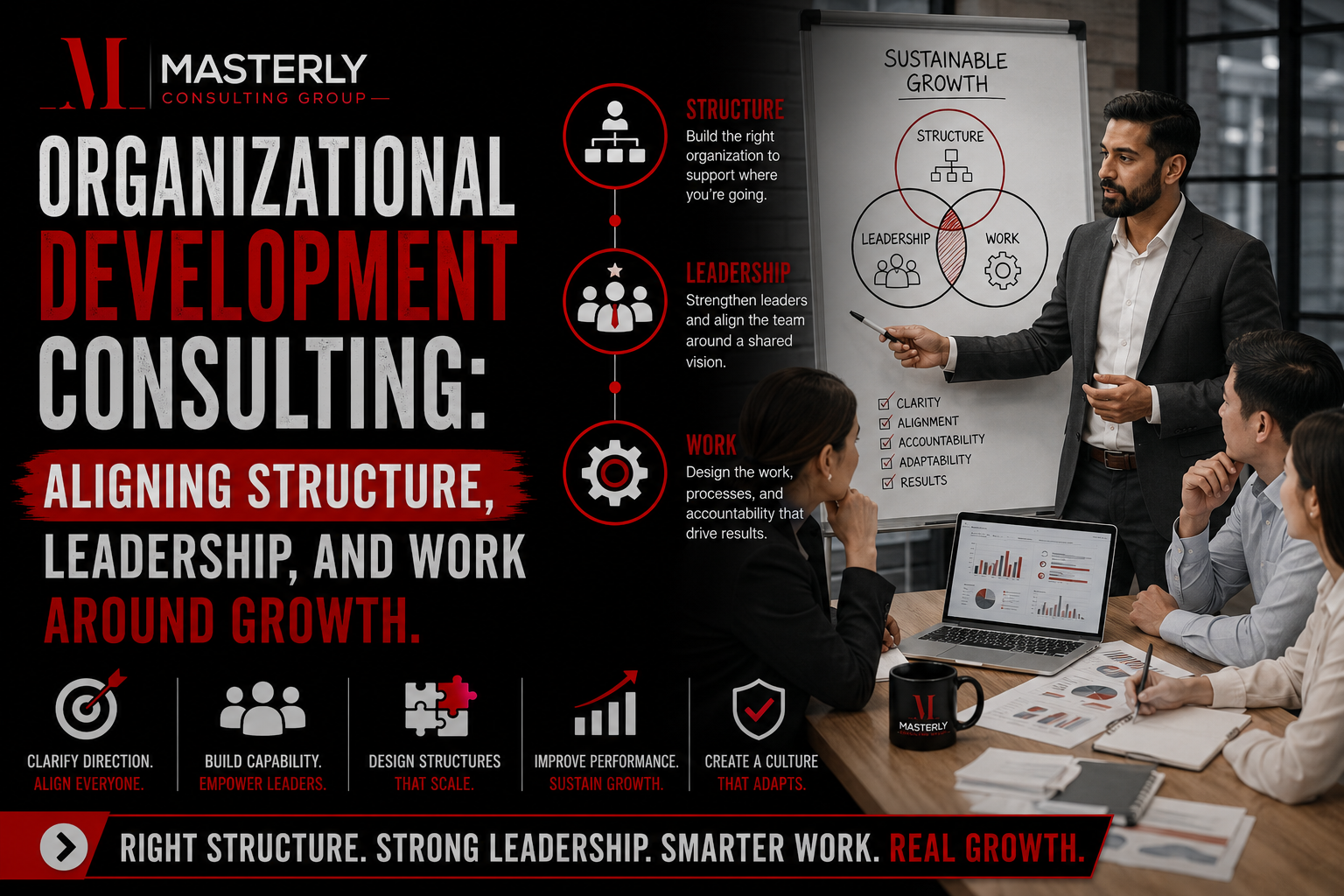
Masterly Consulting Group currently provides strategic planning, business growth, process optimization, implementation support, and ongoing evaluation as part of its consulting work.
Business Planning Should Start With What the Business Is Actually Trying to Change
A useful business planning process begins with a specific business need.
"We want to grow" is not enough.
Leadership needs to define what growth means.
Does the company want to increase revenue from existing customers?
Expand into another market through market research?
Launch another service for target customers?
Improve margins by sharpening its target market focus?
Increase capacity?
Reduce operational risk?
The answer matters because each direction creates different priorities and operating consequences.
For example, a company planning to enter a new market may need more than a sales target.
Leadership may also need to consider staffing, delivery capacity, marketing, technology, cash requirements, management attention, and decision ownership as part of a practical strategic roadmap.
The plan needs to reflect the full business impact.
A Growth Plan Needs Assumptions, Not Just Targets
A growth plan often contains numerical goals.
Those goals are useful, but the assumptions behind them matter just as much.
Leadership needs to define what growth means and clarify the business idea at the outset.
Suppose leadership plans for a major increase in sales.
That target may assume:
Existing customers will continue buying.
New leads will arrive at a certain rate.
The sales team can handle more opportunities.
Operations can deliver more work for target customers.
Hiring can happen on schedule.
Technology can support higher volume.
For example, a company planning to enter a new market may shape its targets around a clearly defined target market, early customer interviews, and market research that reveals customer needs and market demand.
It may also rely on customer demographics, buyer behavior, market trends, and consumer behavior staying close to expectations.
Those assumptions influence whether the plan is realistic.
A strong business planning process makes them visible.
Assumptions Help Leadership See Risk Earlier
When assumptions are documented, leadership can ask better questions.
What if hiring takes longer than expected?
What if demand grows faster than operations can handle?
What if a key service line underperforms?
What if costs rise?
The purpose is not to predict every possible problem.
It is to understand what the plan depends on.
Business Priorities Need Clear Tradeoffs
Many planning meetings produce too many priorities.
Grow sales.
Improve operations.
Hire better people.
Launch a new system.
Improve customer experience.
Strengthen leadership.
Reduce costs.
All may be important.
They cannot always receive equal attention at the same time.
A strong plan identifies true business priorities.
A priority should influence where leadership time, money, people, and attention go. That is how business strategy turns into action and where a real competitive advantage starts to take shape.
If every initiative is labeled important, the organization does not really have priorities. A solid plan should also include a risk assessment and contingency strategies when key assumptions fail, because protecting focus is often what preserves a competitive edge.
Priorities Should Guide Daily Decisions
Suppose leadership says operational stability is the top priority for the next six months.
A strong plan identifies true business priorities within the overall strategy and gives clearer direction for business decisions.
That should influence decisions about:
Hiring.
Technology.
New projects.
Customer commitments.
Management attention.
Resource allocation.
Planning becomes useful when it gives managers a basis for saying yes, no, or not yet, so leadership time, money, people, and attention reinforce company focus and competitive advantage.
If every initiative is labeled important, decision making gets weaker. Focus helps preserve a competitive edge.
An Operating Plan Connects Strategy to Execution
A long-term goal may explain where leadership wants the business to go, but priorities should guide daily decision making.
An operational plan explains what the company needs to do next.
It should translate direction into practical work.
That can include:
Owners.
Timelines.
Milestones.
Resources.
Dependencies.
Measures.
Decisions.
A business may want to expand into two new markets.
The operational plan should make clear what has to happen before that expansion is realistic.
Does the company need to hire first?
Does it need stronger systems?
Does it need a different sales process?
Does leadership need to assign a market owner?
If operational stability is the top priority, that clarifies company focus before expansion. Planning becomes useful when it gives managers a basis for saying yes, no, or not yet in business decisions. In some cases, that also means addressing supply chain management, facilities, equipment, technology, personnel, production processes, and quality control so daily operations stay aligned with broader goals.
The more specific the operating plan becomes, the easier it is to see whether the growth goal is truly executable.
Masterly Consulting Group's current strategic management guidance emphasizes this same connection between long-term direction and operating decisions, resource allocation, goals, accountability, and execution.
Owners Matter More Than General Responsibility
A plan can fail even when everyone agrees with it.
One reason is unclear ownership.
A leadership team may say:
"Sales will own this."
"Operations will handle that."
"Marketing will support the launch."
Those statements may still leave too much uncertainty.
Who is responsible for the final outcome?
Who makes decisions when problems occur?
Who reports progress?
Who owns cross-functional dependencies?
Clear ownership strengthens accountability.
One Priority Can Involve Many People but Still Need One Owner
A growth initiative might involve finance, operations, marketing, and sales, and the operating plan should align with the operational plan for executing it.
Many people contribute, including the company's management team where roles and responsibilities need to be clear.
Leadership should still know who is accountable for moving the initiative forward.
That owner does not perform every task.
They maintain responsibility for the result, and the plan should translate direction into practical work across the company’s day-to-day operations.
Timelines Should Reflect Dependencies
Planning timelines often fail because they are based on desired dates rather than the sequence of work, even when the management team contributes to a priority and one person remains accountable.
Suppose leadership wants a new service launched by October.
Before that happens, the business may need to:
Define the service.
Set pricing with clear pricing strategies.
Develop the delivery process.
Train employees.
Update systems.
Create marketing materials tied to the marketing strategy.
Prepare sales with practical sales strategies.
Test the workflow.
Each task may depend on the one before it.
A realistic action plan recognizes those dependencies.
The question is not simply:
"When do we want this done?"
It is:
"What must happen before this can be done well?"
Business Planning Should Include Operating Capacity
Growth uses capacity.
New customers create work.
New markets require management attention.
New services require processes.
New employees require training and supervision.
A company can create a strong growth plan on paper and still struggle if its operating capacity cannot support it.
That is why leadership should consider:
Current workload.
Available people.
Management bandwidth.
Technology limits.
Cash requirements and financial resources.
Process maturity.
Existing commitments.
A plan should not assume unlimited capacity.
It should reflect what the organization can realistically absorb.
Annual Planning Should Not Be the Only Time the Plan Is Reviewed
Annual planning gives leadership an opportunity to step away from daily activity and establish direction.
That is useful.
But an annual plan created once a year can become outdated quickly.
Customers change.
Opportunities appear.
Costs shift.
Employees leave.
Projects take longer than expected.
New risks emerge.
Leadership needs a reasonable way to revisit the plan.
A company can create a strong growth plan on paper and still struggle if its operating capacity and limited financial resources cannot support it.
That is where a planning cadence becomes important.
A Planning Cadence Keeps the Plan Active
A planning cadence is the recurring rhythm leaders use to review priorities, progress, assumptions, and decisions.
The exact rhythm depends on the business, but even an annual plan needs regular check-ins.
The important point is that the plan does not disappear after the planning meeting.
Leadership might periodically review:
Are priorities still correct?
Are milestones on schedule to track progress?
Have assumptions changed?
Are resources sufficient to hit revenue targets?
Are owners accountable for measurable goals?
Do timelines need to change?
Are new decisions required to measure success?
Masterly Consulting Group's operating-model and strategic-management guidance both emphasize recurring management rhythms, accountability, ownership, and evaluation rather than treating planning as a one-time exercise.
The Action Plan Should Make the Next Step Obvious
A strong action plan gives people clarity.
Employees should not have to read a long strategy document and guess what applies to them.
A practical action plan should answer:
What needs to happen?
Who owns it?
When does it need to happen?
What other work does it depend on?
How will progress be reviewed?
What decision is needed if the work gets off track?
This makes the plan easier to manage.
Business Planning Should Connect Budgets to Priorities
A plan that requires resources should reflect those resources.
If leadership says expansion is a priority but the budget does not support expansion, the organization receives conflicting signals.
The same applies to staffing, systems, marketing, operations, and financial plans.
The budget does not have to be final before planning begins.
But leadership should understand the likely financial implications of major priorities, including realistic financial projections and the expected impact on cash flow.
That often means reviewing cash flow statements alongside other assumptions before committing resources.
Planning and resource allocation should reinforce each other.
How will progress be reviewed through key performance indicators?
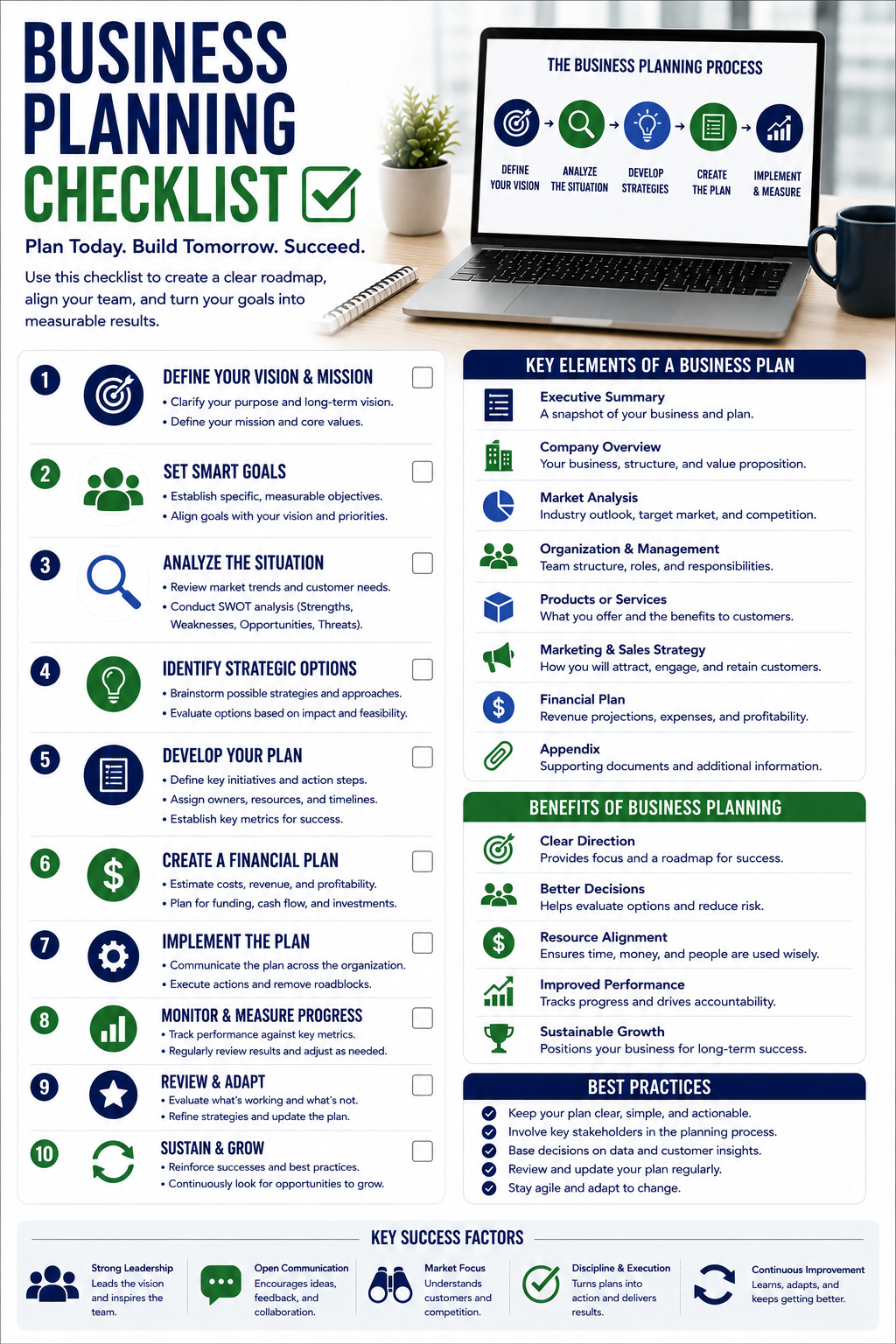
A Practical Business Planning Framework
A useful business planning process can be organized around seven areas, with a comprehensive business plan giving leadership a clear view of goals, strategy, cash flow, and resources.
A plan that requires resources should reflect those resources and the cash flow needed to support them.
Leaders also need to understand the likely financial implications of major priorities through budgets, cash flow statements, and financial projections, which should typically cover at least three to five years.
That makes planning and resource allocation part of a wider management discipline that supports broader financial plans.
1. Goals
Define what leadership wants the business to achieve, from the company's vision to the company's goals and the decisions that shape the company's future.
A useful business planning process can be organized around seven areas that also support a comprehensive business plan.
2. Assumptions
Identify what must be true for those goals to remain realistic.
3. Business Priorities
Choose which initiatives deserve the most attention.
4. Owners
Assign clear accountability for each major priority.
5. Resources and Capacity
Determine what people, money, systems, and management attention will be required.
6. Timeline and Action Plan
Sequence work based on dependencies and realistic deadlines.
7. Planning Cadence
Establish how leadership will review progress and make adjustments.
This structure keeps business planning connected to execution rather than documentation.
Business Planning Is Different From Writing a Business Plan
A business plan may be useful for certain purposes.
But ongoing business planning is broader than producing a document.
The business planning process is about management.
It connects goals with assumptions, priorities, ownership, resources, timelines, and review cycles.
It asks what leaders will actually do with the plan after the meeting ends.
That distinction matters for established businesses that already understand what they sell and who they serve but need greater clarity around growth and execution.
When Professional Business Planning Support Makes Sense
Leadership teams can handle many planning activities internally, and a traditional business plan may be useful for specific funding or stakeholder needs while business planning is the broader discipline of setting direction, making decisions, and adjusting over time.
But ongoing business planning is broader than producing a document. Traditional business plans are typically detailed and comprehensive, and lenders and investors often ask for them. A lean startup business plan is quicker to write, high-level, and focused on key elements only.
Outside support becomes more useful when:
- Goals remain broad and difficult to execute
- Annual plans contain too many priorities
- Department plans conflict
- Owners are unclear
- Growth is creating capacity concerns
- Timelines regularly move
- Leadership does not revisit assumptions
- The same initiatives appear in the plan every year without progress
- The company needs structure around a major growth period
Professional support can help organize the planning conversation and bring greater discipline to the decisions leadership needs to make. It can also help leadership choose the right format, whether that is a more well-crafted business plan with an executive summary and financial detail, often running 15 to 25 pages, or a lighter planning approach. That distinction matters because a successful business plan supports clearer decisions, while the broader planning process is what helps build a successful business.
Business Planning Should Connect With the Operating Model
Business planning becomes harder when ownership and decision rights are unclear.
A priority may be correct, but the organization still needs to know who has authority to act.
Masterly Consulting Group's existing operating model: How Growing Companies Clarify Decisions, Ownership, and Execution article addresses how growing organizations establish decision rights, functional ownership, accountability, and management rhythms. A well crafted business plan serves as a communication tool and reference point for a successful business plan when leaders need alignment around growth and decision-making. Businesses with a plan grow 30% faster than those without. Formal plans increase viability chances by 16% for entrepreneurs.
Recommended internal link: Link the phrase operating model above to that article. It supports the execution and ownership side of this topic without competing directly with the primary business planning intent.
A second natural supporting resource is Masterly Consulting Group's Strategic Management article, which focuses on translating long-term direction into resource allocation, operating goals, performance measures, and execution.
Masterly Consulting Group Helps Turn Planning Into Operating Decisions
Masterly Consulting Group currently describes a consulting process that includes initial consultation, strategic planning, implementation support, and ongoing evaluation, giving clients a reference point for ownership, authority, and execution decisions. Its public business consulting work also includes strategic planning, business growth, process optimization, and related operating needs, including refining a company description for internal clarity and external communication.
That approach matters because business planning should not stop with the planning session.
A useful engagement needs to connect goals with priorities.
Priorities need owners.
Owners need timelines.
Timelines need realistic capacity.
The plan needs a review rhythm.
Masterly Consulting Group can help leadership bring greater structure to those decisions based on the specific needs and scope of the engagement, whether the goal is to secure funding, prepare funding requests, or present a stronger case to potential investors.
The objective is not to create a longer planning document.
It is to create a clearer management system for turning the organization's goals into action.
Frequently Asked Questions About Business Planning
What is business planning?
Business planning is the process of connecting business goals with assumptions, priorities, owners, resources, timelines, operating decisions, and review cycles.
What is a business planning process?
A business planning process gives leadership a structured way to decide what the company wants to achieve, what needs to happen, who owns the work, and how progress will be reviewed.
What is an operating plan?
An operating plan translates business goals into specific responsibilities, timelines, resources, milestones, and execution requirements, while the operational plan in the broader business planning process helps leadership make informed decisions about what the company wants to achieve, what needs to happen, who owns the work, and how progress will be reviewed.
What is a growth plan?
A growth plan defines how a company intends to pursue expansion or other growth objectives and what operational resources and actions those goals require, while an operating plan, or operational plan, translates business goals into execution requirements. It should show how the business model supports that direction, where the strongest opportunities for future growth are, and what marketing plan will be used to reach the right audience. It may also outline the marketing and sales strategy that turns those goals into revenue.
What is annual planning?
Annual planning is a recurring leadership process used to establish priorities, goals, budgets, and major initiatives for an upcoming planning period.
Why are business priorities important?
Clear business priorities help leadership decide where to direct time, money, people, and attention when several initiatives are competing.
What is an action plan?
An action plan identifies the specific work, owners, timing, and dependencies required to move a priority forward.
What is a planning cadence?
A planning cadence is the recurring rhythm leadership uses to review progress, assumptions, priorities, and new decisions after the initial plan is created.
Does Masterly Consulting Group provide business planning support?
Masterly Consulting Group currently provides strategic planning and business consulting with implementation support and ongoing evaluation. The exact scope of a business-planning engagement should be confirmed based on the organization's needs.
Discuss a Structured Business-Planning Engagement With Masterly Consulting Group
Growth goals are useful only when the organization can translate them into decisions and action.
Effective business planning connects those goals with assumptions, business priorities, owners, budgets, timelines, operating capacity, and a clear planning cadence.
Masterly Consulting Group helps leadership teams bring greater structure to planning so priorities can move beyond discussion and into execution.
Call Masterly Consulting Group at (972) 236-5051 or visit masterlygroup.com to discuss a structured business-planning engagement with Masterly Consulting Group.