Business Communication: Building Clear Expectations Across Leaders, Managers, and Teams
A company can communicate constantly and still leave people confused.
Employees receive emails, chat messages, meeting invitations, project updates, announcements, and instructions throughout the day. Yet important questions remain unanswered.
Who made the decision?
Who owns the next step?
Which message is final?
When should a manager escalate an issue?
Was the meeting meant to share information or make a decision?
Who needs to document what happened?
These are not simply communication-style problems. They can be signs that the organization lacks a clear business communication system: the structured exchange of information, decisions, expectations, and feedback needed to coordinate work and support organizational goals.
Effective communication connects information with decisions, ownership, channels, escalation, documentation, accountability, and the operating model behind how work actually gets done. For leaders, managers, and teams trying to improve internal communication and operational clarity, these are the practical levers that reduce confusion, strengthen decision-making, and make execution more consistent for employees and customers.
Masterly Consulting Group works with organizations on business consulting, organizational effectiveness, operational improvement, leadership, and executive coaching. Its current organizational-effectiveness work addresses decision rights, accountability, workflows, escalation paths, management rhythms, manager and meeting communication, and execution systems, all of which influence how information moves through an organization.
For growing businesses, improving communication is not about sending more messages. It is about making important messages easier to understand, trust, document, and act on.
Business Communication Is an Operating Issue
When leaders hear that communication needs improvement, the first response may be another meeting or another company announcement.
Those solutions can help in the right situation.
But communication problems often begin deeper inside the operation.
Imagine leadership decides to change an important customer process.
Executives understand the reason.
Managers receive part of the information.
Employees hear about the change through different channels.
One department starts immediately. Another waits for formal approval. A third continues using the old process.
The company communicated.
The organization still did not create clarity.
Strong business communication should connect the message to the operating decisions behind it.
Effective Business Communication Separates Information From Action
Not every message requires action.
That distinction should be obvious.
Employees need to know whether communication is:
For awareness.
Requesting input.
Asking for a decision.
Assigning responsibility.
Changing a process.
Escalating a problem.
Confirming an agreed action.
Without that distinction, employees spend time trying to determine what a message means for them.
Effective business communication reduces this uncertainty.
Clear message purpose improves understanding.
A useful message should prioritize clarity by making its purpose clear and, when action is required, identify what needs to happen next.
Internal Communication Needs Clear Channels
Modern businesses have more ways to communicate than ever, with communication channels now spanning everything from email to meetings and shared tools.
Email.
Chat.
Video calls.
Project-management platforms.
Shared documents.
Dashboards.
Text messages.
Meetings.
The number of channels is not necessarily the problem. The growth of technology is part of why modern businesses have so many options, but the real problem appears when nobody knows which channel should be used for what.
Important approvals happen in chat.
Project changes get buried in email.
Decisions live only in meeting notes.
Employees receive conflicting instructions through different platforms.
A clearer internal communication structure defines where important types of information belong.
The Channel Should Match the Purpose
Organizations may need different channels for different communication needs.
Language barriers can lead to misunderstandings in business communication, which makes channel choice and message format more important.
An urgent operational issue may require real time communication.
A formal decision may require documentation through written communication.
A project update may belong in the system where the project is managed.
A sensitive management issue may require verbal communication in a direct conversation.
The goal is not to force every message into one platform.
It is to make communication predictable enough that employees know where to look and how to respond.
Decision Rights Affect Communication Clarity
Communication becomes difficult when nobody knows who has authority.
Employees may receive input from several leaders and treat every comment as a new direction.
Managers may communicate tentative discussions as final decisions.
Teams may continue debating an issue after the decision owner has already made the call.
Clear decision rights help solve this problem.
Masterly Consulting Group's current operating-model guidance emphasizes clarifying who owns important decisions, where accountability sits, how functions coordinate, and which issues require executive involvement.
When decision authority is clear, communication can become clearer too.
Employees can distinguish between advice, discussion, and a decision they are expected to execute.
Manager Communication Connects Leadership With Daily Work
Senior leaders can announce a priority.
Managers usually have to translate it.
That makes manager communication an important part of the operating system. It also directly shapes employee engagement through clear expectations and meaningful feedback that support employee satisfaction.
Suppose leadership announces that customer retention is now a major business priority.
Employees need more than the announcement.
What changes for their team?
Which activities receive more attention?
What should managers measure?
What decisions can employees make differently?
Which existing priorities have changed?
Managers help connect broad direction with daily expectations.
If different managers interpret the message differently, teams may begin executing different versions of the same strategy.
Companies with engaged employees see 19.2% growth in operating income, while low engagement costs the global economy trillions annually.
Clear communication can reduce employee turnover by 50%, which helps organizations avoid high turnover.
That is why manager communication should be connected to leadership alignment, decision clarity, and operational expectations.
Meeting Communication Should Have a Job
Effective meetings often become the default solution people reach for when communication problems show up.
Something is unclear, so another meeting is scheduled.
Verbal communication includes meetings, calls, and presentations, so meetings should be used deliberately rather than by default.
Soon the organization has:
Leadership meetings.
Department meetings.
Project meetings.
Status meetings.
Cross-functional meetings.
Weekly check-ins.
Employees spend more time communicating about work while still struggling to move the work forward.
The problem may not be too few meetings.
It may be that existing meetings lack a clear purpose.
Is the Meeting for Information, Discussion, or Decision?
Effective meeting communication should clarify what a meeting is expected to accomplish, whether it is held in face to face meetings or another format.
Some meetings exist to share information.
In virtual meetings, decision-making or problem-solving can be slower than in-person discussion.
Some are for problem-solving, and face meetings can be especially useful when complex topics need immediate discussion.
Some require a decision.
Some review performance and accountability.
Confusing these purposes can create frustration.
A decision meeting that ends with "we will discuss it again next week" may not be functioning as a decision forum.
Masterly Consulting Group's operating-model guidance describes a governance rhythm as recurring leadership reviews, operating meetings, decisions, and performance discussions that keep execution moving. It also emphasizes that meetings should support specific decisions or accountability rather than exist as repeated status forums, and that clear agendas paired with the right format create space for questions and clarification.
Escalation Should Tell Employees When to Raise an Issue
Employees should not have to escalate every problem.
They also should not have to guess when leadership needs to become involved.
A clear escalation structure helps define when an issue moves to another level.
That may depend on factors such as:
- Decision authority
- Customer impact
- Financial significance
- Operational disruption
- Time sensitivity
- Cross-functional conflict
- Risk to an important business priority
The exact thresholds depend on the organization.
What matters is clarity.
Without it, employees may escalate routine matters and create leadership bottlenecks. Others may wait too long to raise problems that require senior attention.
Masterly Consulting Group's organizational-effectiveness materials specifically identify escalation paths and thresholds as part of a broader operating system for improving decision-making and execution.
Written Communication and Documentation Prevents Decisions From Changing With Memory
A productive meeting can still create confusion a week later, especially when business writing is missing.
One executive remembers one decision.
Another remembers a different version.
A manager believes the deadline was Friday.
The project owner thought it was the following month.
Important decisions should not depend entirely on memory.
Useful documentation can capture:
What was decided.
Who owns the action.
What deadline was established.
What remains unresolved.
Who needs to be informed.
When the issue will be reviewed again.
This does not mean documenting every conversation.
The goal is to preserve the information required for execution and accountability, and to convey information consistently across owners and teams.
Communication Systems Should Reduce Noise
A strong organization does not necessarily communicate more.
It communicates with greater purpose through communication systems and communication processes.
Communication systems should help employees determine:
Where information belongs.
Who needs it.
Who can make the decision.
What requires action.
What requires escalation.
Where the final decision is documented.
How progress is reviewed.
Without this structure, employees may compensate by copying more people, scheduling more meetings, and sending more follow-up messages.
The volume increases.
Clarity does not, because every company relies on clear communication systems for execution.
Team Clarity and Employee Engagement Depend on Consistent Messages
Team clarity means people understand enough about priorities, responsibilities, decisions, and expectations to do their work.
Consistent messages also support better collaboration across teams.
That becomes harder when messages conflict.
Imagine the CEO tells employees to prioritize speed.
A department leader emphasizes quality.
A manager tells the team to reduce costs.
None of those goals is automatically wrong.
The problem is that employees may not know how to handle the tradeoff.
Effective communication increases productivity by up to 25%.
Which priority wins when they conflict?
Leadership communication should provide enough context for managers and teams to make those decisions consistently and build stronger relationships.
Masterly Consulting Group's current team-performance guidance similarly connects role clarity, accountability, decision ownership, handoffs, operating rhythms, and leadership communication with effective execution.
A Practical Business Communication Strategy and Framework
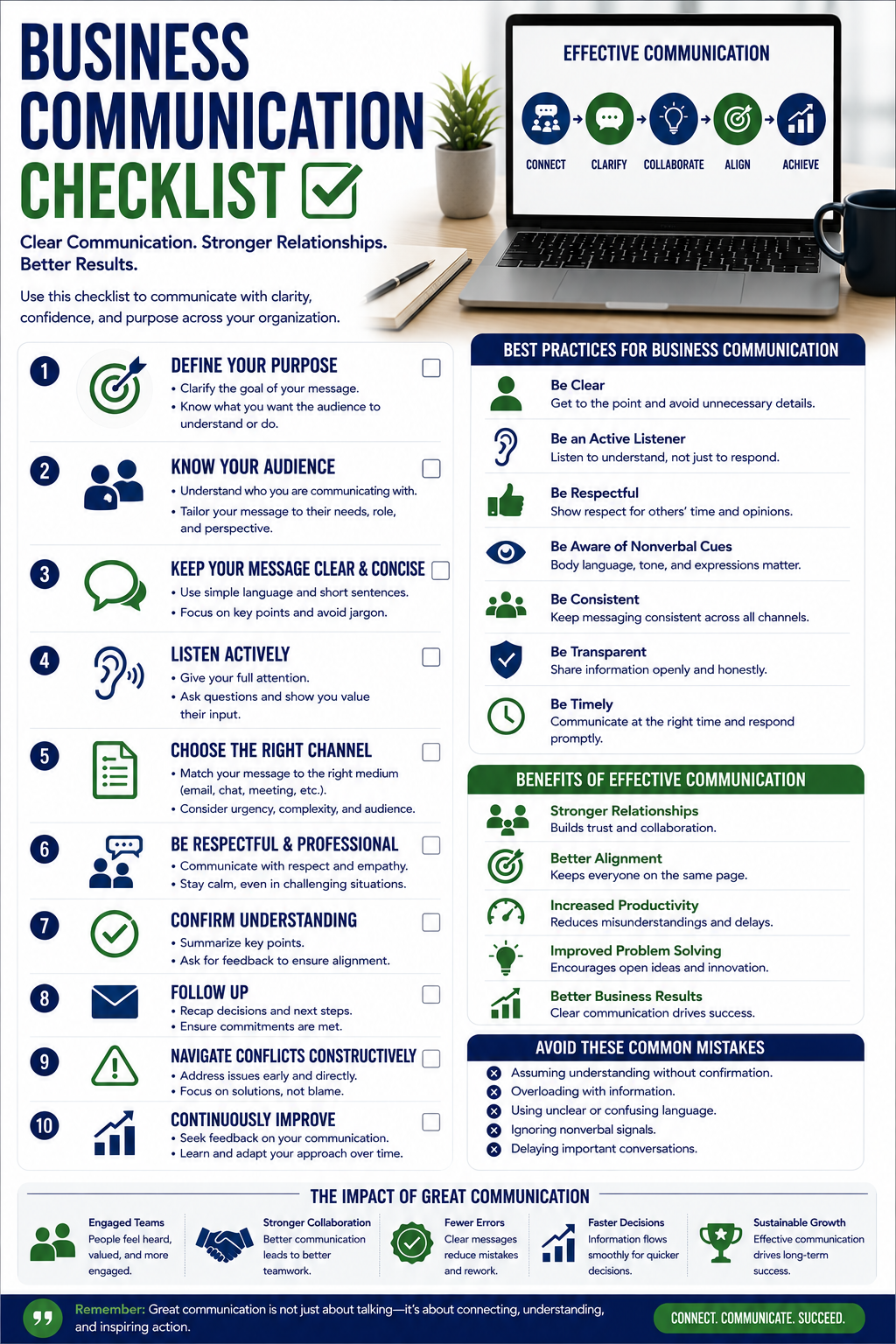
Organizations reviewing their internal communication can examine seven areas as part of a clear communication strategy.
1. Purpose
Why is the communication happening?
Determine whether the purpose is awareness, input, action, decision, or accountability.
2. Owner
Who owns the message or decision?
Employees should know whose direction is authoritative.
3. Audience
Who actually needs the information?
Sending everything to everyone can make important communication easier to miss.
4. Channel
Where should the communication occur?
Match the channel to the purpose, urgency, and need for documentation by choosing the right communication methods.
5. Action
What should happen after the communication?
When action is required, make the expectation clear.
6. Escalation
What conditions require the issue to move upward or to another function?
7. Documentation and Follow-Through
Where will decisions, owners, deadlines, and unresolved issues be recorded and reviewed?
This framework helps move communication from message delivery to operating clarity.
More Communication Does Not Automatically Create Better Communication
Organizations can overcorrect.
Employees report communication problems, so leadership sends more emails.
A missed handoff produces another meeting.
A misunderstood decision creates another approval process.
Soon employees face more messages and more administrative work without greater clarity. That added friction also consumes valuable time.
The goal should be enough communication to support good decisions and coordinated execution.
If employees can understand what matters, who owns it, what happens next, and when they need to escalate, the communication system is doing useful work.
Business Communication Affects the Customer Experience
Customers do not see internal communication systems.
They experience their results.
That directly affects customer satisfaction.
A weak handoff can force a customer to repeat information.
Conflicting internal messages can create inconsistent answers.
Poor escalation can delay the resolution of an important issue and prevent timely responses.
An undocumented decision can result in two departments making different promises.
For that reason, internal communication is not simply an employee issue.
It can influence consistency, responsiveness, trust, and the organization's ability to deliver what it promises.
Business Communication Should Connect With the Operating Model
Many communication problems are really ownership or coordination problems that undermine organizational practices.
If employees do not know who makes a decision, communication remains unclear.
If two departments do not understand where responsibility transfers, another email may not solve the handoff.
If meetings lack decision authority, additional discussion may not create progress.
Masterly Consulting Group's Operating Model: How Growing Companies Clarify Decisions, Ownership, and Execution resource addresses decision rights, functional ownership, cross-functional coordination, governance rhythms, and accountability so communication can connect to the operating model and help teams reach organizational goals.
Recommended internal link: Link the phrase operating model to that existing article. It supports the structural side of effective business communication without competing directly with this page's primary business communication intent.
When Outside Communication and Operating Support Makes Sense
Many communication issues can be corrected internally.
Outside support may become useful when:
- Leadership messages are interpreted differently across departments
- Managers do not know which decisions they own
- Important information is scattered across too many channels
- Meetings produce discussion without decisions
- Employees regularly escalate routine issues
- Critical problems are not escalated soon enough
- Cross-functional handoffs create repeated confusion
- Decisions are made but not documented
- Employees receive conflicting priorities
- Communication problems continue despite adding more meetings or tools
These patterns can indicate that the organization needs more than communication training.
It may need clearer operating structure and more deliberate communication strategies.
Masterly Consulting Group Helps Connect Communication With Execution
Masterly Consulting Group works with organizations on business consulting, organizational effectiveness, process improvement, leadership, and executive coaching. Its current public materials emphasize decision rights, ownership, accountability, cross-functional workflows, escalation paths, governance, and execution systems.
Those areas directly affect how communication works inside an organization. That is one reason business communication is important to day-to-day execution. Effective communication can increase productivity by up to 25%.
A communication problem may begin with an unclear decision.
A meeting problem may begin with missing ownership.
An escalation problem may begin with undefined authority.
A manager communication problem may begin with leadership misalignment.
For organizations experiencing these patterns, the goal should not be communication activity for its own sake. The goal should be a clearer system in which leaders, managers, and teams understand what information matters, who owns decisions, how action is communicated, and where accountability sits to support long-term business success.
The exact consulting scope should be defined around the organization's specific communication and operating needs.
Why Business Communication Is Important Across the Entire Organization
Understanding why business communication is important means looking beyond emails and meetings. Strong communication helps the entire organization create mutual understanding, make informed decisions, support transparent communication, and ensure employees feel informed about priorities and expectations. That may include face to face conversations, technical communication, external communication, and the use of communication technologies such as shared collaboration tools, including Google Drive, especially during remote work. Clear communication also helps human resources, managers, and leaders with addressing concerns, discussing new business ideas, and building a supportive environment where employees understand both spoken messages and important nonverbal cues. The importance of communication becomes especially clear when teams must coordinate an organized activity across departments, locations, or work arrangements.
Frequently Asked Questions About Business Communication
What is business communication?
Business communication is the structured exchange of information, decisions, expectations, and feedback needed to coordinate work and support organizational goals. Effective business communication also relies on strong communication skills to make purpose, audience, and action clear, and it is a two way street that requires feedback and active listening.
What makes effective business communication?
Effective business communication is clear about purpose, audience, ownership, action, channel, documentation, and follow-through. It also relies on active listening, which is essential for understanding client and employee needs.
What is internal communication?
Internal communication is the exchange of information within an organization among leaders, managers, employees, departments, and teams. Internal communications is the function or practice that helps coordinate messaging inside an organization so updates stay clear, consistent, and useful across the business.
Why is manager communication important?
Manager communication helps translate leadership decisions and business priorities into expectations employees can understand and act on. In practice, managerial communication affects employee engagement and maintaining positive relationships, while also shaping how management interact with employees day to day.
What are communication systems?
Communication systems are the channels, practices, responsibilities, and routines an organization uses to share information and support decisions, from email and meetings to instant messaging for quick internal coordination. In practice, that can include a shared collaboration space such as Microsoft Teams, depending on how the organization works.
How can meeting communication improve?
Meeting communication becomes clearer when participants understand whether the meeting exists to share information, solve a problem, make a decision, or review accountability.
What is escalation in business communication?
Escalation is the process for moving an issue to the appropriate person or level when defined conditions require additional authority, attention, or action.
How does business communication support accountability?
Clear communication identifies decisions, owners, expectations, deadlines, and follow-through so people understand what they are responsible for. Accountability improves when same level and cross-level responsibilities are clear.
Can communication problems actually be operating problems?
Yes. Repeated communication problems can result from unclear decision rights, ownership, handoffs, escalation paths, or management routines rather than the wording of individual messages. They can also involve nonverbal communication, especially in meetings and leadership interactions. This includes body language and facial expressions. Visual communication also uses charts and diagrams to convey information. Masterly Consulting Group's current operating-model and organizational-effectiveness guidance addresses these underlying structural issues.
Discuss Communication and Operating-System Improvements With Masterly Consulting Group
More emails, meetings, and messages will not solve a system that leaves employees unsure about decisions, ownership, escalation, or accountability.
Strong business communication connects leadership direction with manager communication, clear channels, documented decisions, appropriate escalation, and the follow-through teams need to execute.
Masterly Consulting Group helps organizations examine the operating conditions behind communication problems so leaders can create greater clarity across teams and functions, support positive relationships, and improve execution. Its public business consulting work includes process optimization and organizational improvement, while its organizational-effectiveness guidance addresses decision rights, workflows, accountability, governance, and execution.
Call Masterly Consulting Group at (972) 236-5051 or visit masterlygroup.com to discuss communication and operating-system improvements that support great communication across the business.