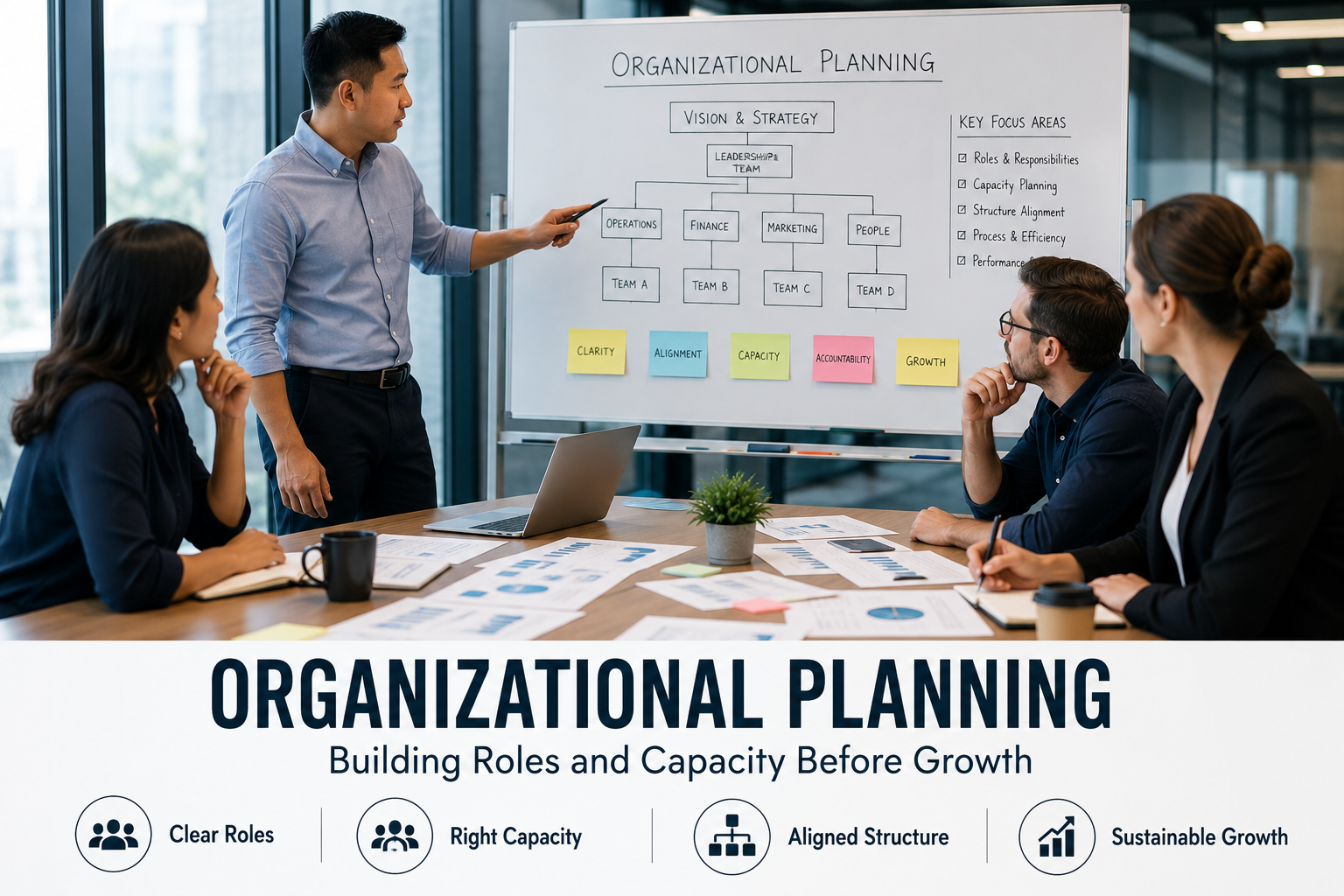
Organizational Planning: Building Roles and Capacity Before Growth
Growth can expose weaknesses that were easy to manage when an organization was smaller.
A founder may have been able to make most important decisions personally. A small team may have communicated without formal processes. Everyone may have understood who handled what.
Then the organization grows.
New employees join. New customers arrive. More projects compete for attention. Leaders take on more responsibilities. Decisions require more coordination. Suddenly, the structure that worked before begins creating delays, confusion, and unnecessary pressure.
This is where organizational planning becomes important.
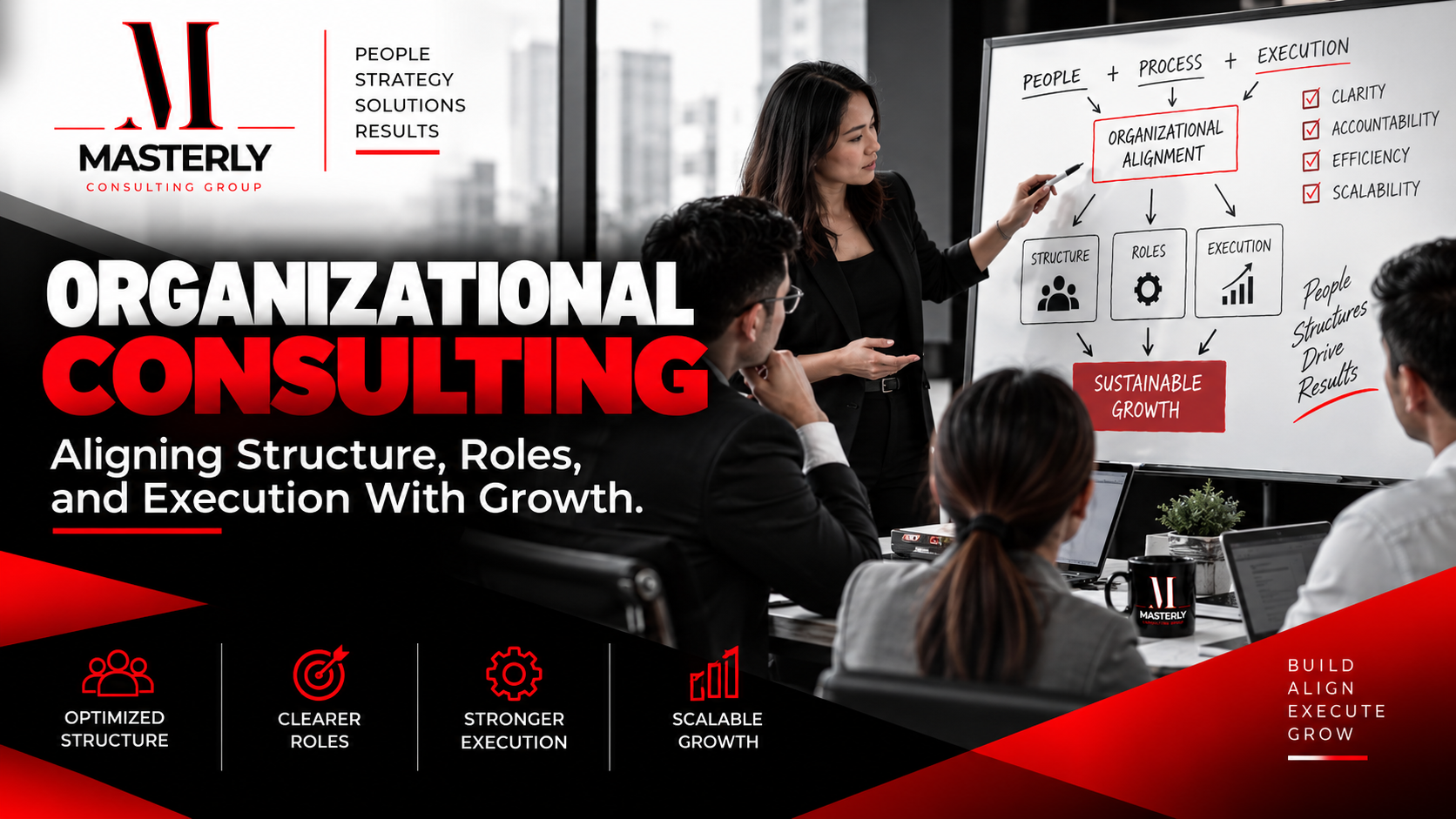
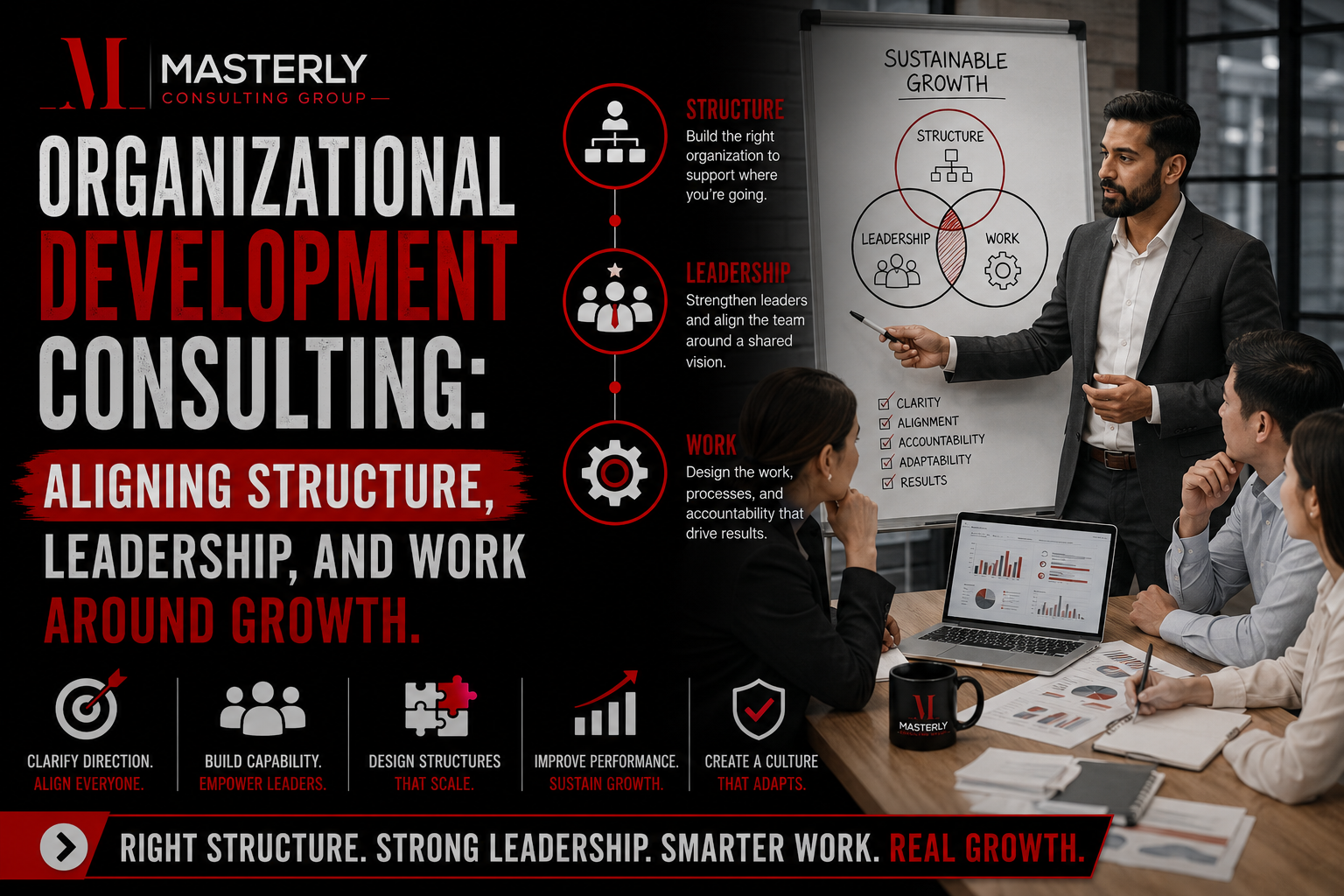
Organizational planning helps leadership make sure the company's structure, roles, resources, and capacity can support where the business is going. It connects growth goals with the people and operating capabilities needed to achieve them.
Masterly Consulting Group works with founders and leadership teams to develop customized strategies that address growth, operations, leadership, and organizational challenges. Its consulting approach includes planning, implementation support, and ongoing evaluation.
When Growth Outpaces Your Organization
A company can have enough demand to grow but still lack the structure to handle that growth well.
You may recognize the problem when:
- Leaders are making too many day-to-day decisions
- Employees are unsure who owns important responsibilities
- Managers have overlapping or unclear roles
- Projects are delayed because teams are stretched too thin
- New hires are added without a clear organizational purpose
- Departments are working toward different priorities
- Leadership cannot easily see where additional capacity is needed
- Employees are spending too much time solving problems that should have clear owners
- Growth creates more work without creating enough organizational capacity
These issues can make growth feel harder than it should.
The business may be successful, but the organization supporting that success may not be ready for the next stage.
That is not simply a staffing problem.
It can be an organizational planning problem.
Organizational Planning Should Connect Growth With Capacity
Growth requires more than a revenue target.
It requires the organization to have the people, responsibilities, processes, leadership structure, and resources needed to support that target.
For example, a company planning significant growth may need to consider whether its current leadership team can manage additional employees and customers. It may also need to evaluate reporting relationships, decision rights, technology, processes, and management capacity.
This is where organizational growth planning can provide value.
Instead of asking only, "How much do we want to grow?" leadership can consider the larger question:
"What organization do we need in order to support that growth?"
Masterly Consulting Group's strategic planning work focuses on connecting organizational priorities with decisions, ownership, timelines, and execution.
That connection matters because growth plans can fail when the organization is expected to deliver more without the structure or capacity to support it.
The Cost of Unclear Roles and Limited Capacity
When roles are unclear, work does not simply become inconvenient.
It can become expensive.
Two employees may unknowingly perform the same work while another important responsibility has no clear owner.
A manager may approve decisions that should belong to another leader.
An executive may become the final approval point for routine issues.
Employees may wait for direction instead of moving work forward.
Customers can eventually feel the effects through slower service, inconsistent communication, or missed commitments.
These problems can also affect employee confidence.
People want to understand what they are responsible for, who makes decisions, and how their work contributes to the organization's goals.
As the business grows, these questions become harder to answer informally.
A clear organizational structure can provide the foundation needed for accountability and better execution. Masterly Consulting Group's organizational effectiveness work addresses decision-making, accountability, role clarity, structure, processes, and execution systems.
Organizational Capacity Planning Before You Need It
One of the biggest planning mistakes is waiting until the organization is already overwhelmed.
By that point, leadership may be hiring under pressure, restructuring departments quickly, or moving responsibilities without enough time to consider the broader impact.
Organizational capacity planning gives leadership a forward-looking view of what the business will need.
That can include questions about:
- Leadership capacity
- Management responsibilities
- Staffing needs
- Operational workload
- Technology requirements
- Process capacity
- Decision-making authority
- Department structure
- Financial resources
- Future growth demands
The objective is not to predict every detail of the future.
Business conditions will change.
The objective is to make sure leadership has enough visibility to prepare for likely demands and make informed decisions as circumstances change.
Masterly Consulting Group's business planning approach similarly connects goals with owners, timelines, budgets, operating decisions, capacity, and a review rhythm.
Your Organization Should Support Your Strategy
The types of organizational planning work best as connected layers rather than separate efforts, linking strategic plan direction with tactical planning, operational planning, and contingency planning.
If the company's strategy changes, the organization may need to change with it.
For example, entering a new market may require new expertise. Expanding services may require additional management capacity. Improving customer experience may require different processes or technology. Rapid growth may require stronger leadership layers.
The organization has to support the direction. Strategic planning sets long-term goals for 3-5 years, while tactical planning turns those goals into 1-2 year actions.
This is why organizational planning can be closely connected to strategic planning, operational planning, contingency planning, and organizational effectiveness.
Masterly Consulting Group's strategic management work focuses on connecting long-term direction with priorities, resource allocation, operating goals, accountability, performance measures, and execution. Operational planning focuses on daily activities over roughly 3-12 months.
The goal is not to create organizational complexity.
The goal is to create enough structure to support the business without adding unnecessary layers.
When Leadership Needs an Outside Perspective
Founders and executives often know their organizations extremely well.
That knowledge is valuable, but it can also make it difficult to step outside the daily operation and evaluate whether the current structure still fits the business.
An outside consultant can help leadership examine the organization from a broader perspective.
Masterly Consulting Group works with businesses, colleges, universities, and school districts and develops customized solutions based on each organization's needs. Its public consulting process includes consultation, planning, implementation support, and ongoing evaluation.
Outside support can be particularly useful when:
- The organization is entering a major growth period
- Leadership responsibilities are becoming unclear
- The current structure no longer fits the business
- Departments are becoming disconnected
- Leaders are overloaded with operational decisions
- A restructuring is being considered
- The organization needs additional capacity
- Growth goals require new capabilities
- Leadership wants an objective assessment before making structural changes
The consultant's role is not to make decisions for the leadership team.
It is to provide structure, analysis, and recommendations that help leadership make better decisions.
How Masterly Consulting Group Supports Organizational Planning
Masterly Consulting Group takes a customized approach to the organizational planning process, using a structured process tailored to the organization rather than assuming every organization needs the same structure.
The firm's broader consulting services include strategic planning, business growth, process optimization, operational improvement, digital transformation, executive coaching, and implementation support.
For an organizational planning engagement, the work can be tailored to the specific challenge facing the organization.
Depending on the engagement, this may include support for an effective organizational planning process that is iterative, not linear:
- Reviewing the current organizational structure
- Clarifying leadership and management roles
- Identifying gaps in organizational capacity
- Assessing responsibilities and accountability
- Connecting staffing needs with growth objectives and resource needs
- Reviewing decision-making structures
- Identifying operational bottlenecks
- Supporting organizational restructuring
- Aligning organizational needs with strategic priorities
- Developing a practical plan for implementation with measurable goals and key performance indicators, including frameworks such as OKRs and KPIs
This helps leadership track progress and monitor progress during implementation.
This approach helps leadership look beyond simply adding more employees.
Sometimes the answer is additional capacity.
Sometimes it is clearer responsibilities.
Sometimes it is a better process, stronger management structure, improved technology, or different allocation of resources.
The right answer depends on the organization's goals and current operating challenges.
Building an Organizational Structure That Can Support the Next Stage
Growth should not require leadership to constantly work around the organization.
If every increase in customers, employees, or projects creates another layer of confusion, the business may need to examine its organizational foundation.
Effective organizational planning gives leadership a clearer way to think about that foundation.
The question is not simply whether the organization can handle today's workload.
It is whether the organization is positioned to support the direction leadership wants to pursue next.
That means considering roles, capacity, accountability, decision-making, resources, and operating needs before they become urgent problems.
Connecting Organizational Strategy to Strategic Goals and Daily Operations
Effective organizational planning connects an organization's mission statement and long-term organizational strategy with clear strategic goals and the work required to achieve them. A complete organizational plan can bring together financial planning, resource allocation, marketing strategies, succession planning, program management, and the needs of different business units. It also supports informed decision making by reviewing financial health, performance metrics, and potential risks before they affect the organization. Rather than treating planning as a one-time exercise, leadership can use detailed planning to connect strategic thinking with day-to-day operations, helping the business move forward and achieve strategic objectives. Whether an organization exists to grow a business, strengthen operations, or serve a broader mission, a well-aligned plan provides a clearer path toward long-term organizational success.
Frequently Asked Questions About the Organizational Planning Process
What is organizational planning?
Organizational planning is a structured process of aligning an organization's structure, roles, resources, and capacity with the organization's mission, strategic direction, organizational goals, and future needs.
Why is organizational planning important for growing businesses?
Growth can create new demands on employees, managers, processes, and leadership. Organizational planning helps align the entire organization with the company's goals and ensures the business has the structure and capacity needed to support the organization’s long-term goals as the business grows.
What is organization planning?
Organization planning is another way of describing the work of evaluating and shaping an organization's structure, responsibilities, resources, and operating needs to support its goals. Effective organizational planning creates a clearer framework for business operations, sharper ownership across teams, and better support for day-to-day work.
What is organizational growth planning?
Organizational growth planning connects a company's growth goals and growth strategy with the people, structure, processes, resources, and capabilities required to support expansion planning.
What is organizational capacity planning?
Organizational capacity planning evaluates whether an organization has enough people, leadership capacity, processes, resources, and operational capability to meet current and expected demands. It often considers operational efficiency and the internal capabilities needed to support that demand. Operational planning defines the daily activities required to meet tactical goals.
When should a company consider organizational planning?
It can be valuable during rapid growth, restructuring, leadership changes, market expansion, operational challenges, or when the current organizational structure no longer supports business goals. Companies should also revisit plans quarterly and annually. Regular reviews help adapt plans to market developments. Leaders should document changes between planning cycles and set up feedback loops to support adjustments.
Can organizational planning help clarify employee roles?
Yes. Organizational planning can help leadership evaluate responsibilities, reporting relationships, decision rights, and accountability, and it can also define tactical goals, task assignments, and specific tasks so important work has clear ownership.
Does organizational planning mean restructuring the company?
Not always. The appropriate solution may involve restructuring, but it could also involve clearer roles, improved processes, additional capacity, technology, or changes in decision-making, and a swot analysis can help assess internal factors, including internal strengths and weaknesses, before changes are made. Contingency planning is also part of organizational planning; it is a proactive tool, not just a crisis management document, and it supports business continuity. It can address potential risks such as supply chain disruptions and should define response strategies and communication protocols in advance.
Does Masterly Consulting Group provide organizational planning services?
Masterly Consulting Group provides customized consulting for businesses and educational organizations, including strategic planning, organizational effectiveness, operational improvement, business growth, and implementation support tied to strategic objectives and successful execution. Engagements can also include regular review meetings to track progress on specific initiatives.
Request a Strategy Consultation
If your organization is growing faster than its structure can support, waiting for the problem to become urgent can make the eventual solution more difficult.
Organizational planning can help leadership examine the roles, capacity, responsibilities, and operating structure needed for the next stage of growth. It can also help prioritize projects, strengthen project management, and connect project plans to growth-related decisions.
Masterly Consulting Group provides customized consulting designed around the organization's specific goals, challenges, and size. Its process includes planning, implementation support, and ongoing evaluation to support senior leadership, department heads, and team leaders in implementation.
If you are preparing for growth, restructuring responsibilities, or dealing with capacity and operating challenges, Masterly Consulting Group can help you evaluate what needs to change and develop a practical path forward.
Call (972) 236-5051 or visit Masterly Consulting Group to request a strategy consultation.
Build the structure and capacity your organization needs for its next stage of growth.