Clery Act Audits Are Increasing: What Educational Institutions Need to Prepare For
Educational Institutions Are Facing Greater Compliance Pressure Than Ever
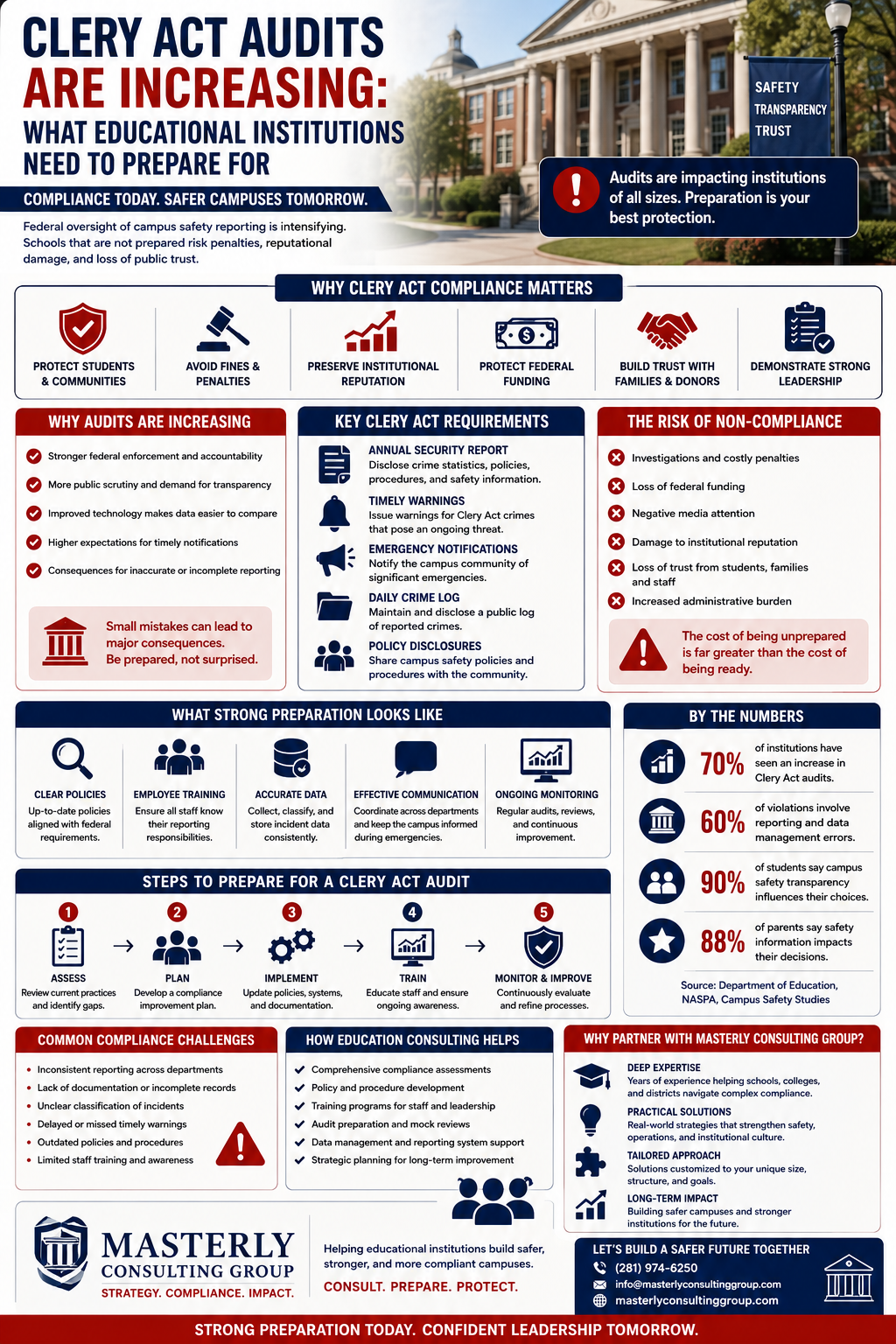
Across the country, schools, universities, and other educational institutions are experiencing growing pressure to strengthen campus safety procedures and improve federal compliance efforts. Clery Act audits have become more common, and many leaders in higher education are realizing that even small reporting mistakes can create major financial and reputational consequences. What once seemed like a routine compliance requirement is now becoming a serious operational priority for many campuses.
Educational leaders are discovering that federal oversight surrounding campus safety reporting is becoming more detailed and aggressive. Institutions that fail to maintain accurate records, provide timely notifications, or properly document incidents may face investigations, penalties, and public scrutiny. As a result, many schools are seeking education consulting guidance to help reduce risk and improve preparedness before an audit occurs.
At Masterly Consulting Group, we work with universities, k 12 districts, and private schools that want to strengthen compliance procedures while creating safer learning environments for students, teachers, and staff. Our education consulting services help educational organizations prepare for complex regulatory expectations while supporting long-term institutional growth and operational stability.
Clery Act Audits Are No Longer Rare Events
Many educational leaders once believed Clery Act audits only affected large universities with national attention. Today, audits are impacting institutions of all sizes, including smaller colleges, community campuses, and school systems that may not have extensive internal compliance resources.
Federal agencies continue increasing their focus on campus safety reporting, emergency procedures, and crime disclosure requirements. Schools that previously operated with outdated reporting systems or inconsistent compliance practices are now discovering that regulators expect far more detailed documentation and oversight than in previous years.
This shift has created urgency for education leaders who understand that poor preparation can place an institution at serious risk. Compliance failures can affect funding, reputation, public trust, and overall student outcomes.
Understanding the Purpose of the Clery Act
The Clery Act was created to improve campus safety transparency and help students, families, and employees make informed decisions about educational environments. The law requires colleges and universities to collect, classify, and disclose specific crime statistics and safety information.
Educational institutions must provide annual security reports, maintain crime logs, issue timely warnings, and establish emergency notification procedures. These obligations are intended to ensure students and families have access to important safety information while attending or considering schools.
Although the law primarily impacts higher education institutions receiving federal financial aid, its broader influence has encouraged many educational organizations to strengthen safety reporting and compliance practices overall.
Why More Audits Are Happening Now
Several factors are contributing to the increase in Clery Act audits nationwide. Federal regulators are placing stronger emphasis on accountability, transparency, and accurate campus safety reporting. Public attention surrounding campus incidents has also increased pressure on institutions to demonstrate stronger compliance practices.
Technology has made it easier for investigators to compare public reporting records against internal documentation. At the same time, students, parents, and community members are demanding greater transparency from educational leaders regarding safety concerns.
Educational institutions that fail to maintain organized systems for documentation, reporting, and communication may quickly find themselves struggling during audit reviews.
Compliance Failures Can Damage Institutional Reputation
For many schools and universities, the greatest concern is not always the financial penalty associated with a failed audit. Public trust can be severely damaged when institutions appear unprepared or unable to meet federal reporting obligations.
Students and families increasingly evaluate campus safety when choosing schools. A compliance investigation involving inaccurate reporting or delayed emergency notifications can negatively affect enrollment, donor confidence, and overall institutional reputation.
Educational leaders must recognize that strong compliance practices are now directly connected to long-term organizational growth and community confidence.
Educational Leaders Are Being Asked Tougher Questions
Campus leaders are facing growing scrutiny regarding how safety incidents are documented, classified, and communicated. During audits, institutions may be asked to demonstrate how they train employees, monitor reporting procedures, and maintain communication systems across departments.
In many cases, schools struggle because different departments operate independently without coordinated compliance oversight. Campus police, student affairs, housing departments, athletics, and academic leadership may all maintain separate systems that fail to align properly.
Without clear strategic planning and implementation procedures, institutions may unintentionally create reporting inconsistencies that increase compliance risk.
Higher Education Institutions Face Unique Challenges
Higher education campuses often operate like small cities with multiple buildings, departments, student organizations, and housing systems. This complexity creates unique compliance challenges that many institutions underestimate.
Universities must coordinate reporting across campus security, student services, counseling departments, athletics, healthcare offices, and local law enforcement agencies. Each department may collect important data tied to Clery Act obligations.
Educational institutions lacking strong communication systems may struggle to gather accurate information quickly during emergencies or audits.
K 12 Districts Are Also Paying Closer Attention
Although the Clery Act primarily applies to colleges and universities, many k 12 districts are increasing focus on compliance-related safety planning and reporting practices. Public concern regarding campus security has encouraged districts to improve emergency procedures and documentation systems.
K 12 schools are recognizing that strong compliance systems help support students, improve communication with families, and reduce operational confusion during crises. District leaders are also learning from higher education institutions facing public scrutiny over reporting failures.
As a result, many districts are investing in education consulting support to strengthen campus safety operations and improve long-term preparedness.
The Role of Education Consulting in Compliance Preparation
Education consulting plays an increasingly important role in helping schools navigate evolving regulatory expectations. Many educational leaders lack the internal resources or deep expertise necessary to evaluate compliance gaps independently.
Education consultants help institutions assess existing practices, identify weaknesses, and develop stronger reporting systems. Consulting services often include policy reviews, employee training, audit preparation, and implementation guidance designed to improve institutional readiness.
At Masterly Consulting Group, our team works directly with schools, universities, and educational organizations seeking practical solutions for complex compliance concerns.
Education Consulting Services Support Long-Term Stability
Strong education consulting services provide more than temporary fixes for immediate audit concerns. Institutions benefit most when compliance planning becomes part of broader operational strategy and long-term institutional development.
Schools that invest in compliance infrastructure often improve communication systems, documentation procedures, emergency planning, and leadership coordination across departments. These improvements support not only compliance but also student outcomes and overall institutional stability.
Educational institutions that wait until an audit begins may find themselves rushing to correct problems under intense pressure.
Institutions Need Strong Reporting Procedures
One of the most common weaknesses identified during audits involves inconsistent or incomplete reporting procedures. Many schools struggle to maintain accurate records because employees lack clarity regarding their responsibilities.
Institutions should establish clear procedures for:
- Incident reporting
- Emergency notifications
- Crime classification
- Documentation storage
- Communication protocols
- Employee responsibilities
Strong reporting systems help educational leaders respond more effectively during emergencies while improving overall compliance readiness.
Campus Employees Need Proper Training
Many compliance failures occur because employees simply do not understand their obligations under federal regulations. Teachers, administrators, security personnel, and student support staff may unintentionally fail to report incidents correctly if they lack appropriate guidance.
Training programs should help employees:
- Recognize reportable incidents
- Understand timelines
- Follow reporting procedures
- Document information accurately
- Communicate concerns properly
Institutions that prioritize ongoing training often create stronger cultures of accountability and preparedness.
Technology Is Changing Compliance Expectations
Technology continues transforming how educational institutions manage safety reporting and compliance operations. Modern systems allow campuses to organize data more efficiently, monitor reporting activity, and improve emergency communication processes.
At the same time, regulators increasingly expect institutions to maintain reliable digital records and documentation systems. Schools relying on outdated spreadsheets or inconsistent manual processes may struggle during audits.
Educational leaders should evaluate whether their current technology systems adequately support long-term compliance needs and institutional growth.
Data Accuracy Matters More Than Ever
Audits frequently reveal inconsistencies between reported statistics and internal documentation. These discrepancies may result from communication breakdowns, unclear classification procedures, or poor data management practices.
Educational institutions should establish systems that allow departments to share information consistently while maintaining accurate records. Strong data management practices improve institutional transparency and reduce the likelihood of reporting errors.
Accurate data also helps leaders make informed decisions regarding campus safety improvements and operational planning.
Students and Families Expect Transparency
Modern students and families expect educational institutions to communicate openly about safety concerns and campus conditions. Public confidence can quickly decline if schools appear unprepared or unwilling to provide accurate information.
Parents increasingly evaluate safety procedures, emergency response capabilities, and campus culture when selecting educational environments. Institutions that demonstrate strong compliance practices often strengthen trust within the broader community.
Educational organizations must recognize that transparency has become a central expectation in modern education systems.
Strong Communication Helps Support Students
Compliance planning is not solely about avoiding penalties. Effective safety systems help support students during emergencies, protect campus communities, and improve institutional response capabilities.
Schools with strong communication systems are often better prepared to respond quickly during incidents involving students, faculty, or visitors. Timely notifications and organized reporting procedures help reduce confusion during stressful situations.
Educational leaders should focus on building systems that prioritize both regulatory compliance and student well-being.
Leadership Teams Must Work Together
Many institutions struggle with compliance because departments operate independently without shared oversight or coordinated strategy. Campus safety, housing, student affairs, legal counsel, and executive leadership must communicate consistently to maintain strong reporting practices.
Successful institutions often create cross-functional compliance teams responsible for monitoring procedures, reviewing incidents, and improving coordination across departments.
Collaboration allows educational leaders to identify weaknesses earlier and respond more effectively to changing compliance expectations.
Strategic Planning Reduces Long-Term Risk
Institutions that treat compliance as an ongoing strategic planning priority are often better positioned during audits. Reactive approaches may temporarily solve immediate problems but rarely create lasting operational improvements.
Strong strategic planning allows educational leaders to:
- Identify reporting gaps
- Improve emergency response systems
- Strengthen employee training
- Enhance communication procedures
- Allocate resources effectively
Educational institutions should view compliance planning as part of broader institutional growth and operational excellence.
Universities Must Adapt to Evolving Expectations
Universities are facing increasing pressure to modernize safety procedures and improve institutional accountability. Federal oversight continues evolving as public concern regarding campus safety remains high.
Educational leaders who fail to adapt may face growing operational challenges in the future. Institutions should regularly review policies, evaluate reporting systems, and update emergency procedures to remain aligned with current expectations.
Continuous improvement helps universities strengthen both compliance readiness and public trust.
Colleges Need Better Internal Coordination
Many colleges struggle because reporting responsibilities are spread across multiple departments with inconsistent oversight. Different offices may interpret regulations differently or fail to communicate incidents effectively.
Educational organizations should create centralized systems that improve coordination and reduce reporting confusion. Clear accountability structures help institutions respond more effectively during audits and emergencies.
Strong operational coordination also improves efficiency and reduces unnecessary administrative stress.
Community Trust Is Hard to Rebuild
Once public trust is damaged, rebuilding institutional credibility can become extremely difficult. Compliance failures involving campus safety often receive significant public attention, especially when reporting errors involve serious incidents.
Students, families, faculty, and community members expect educational leaders to prioritize safety, transparency, and accountability. Institutions that appear disorganized or unprepared may struggle to restore confidence after an audit investigation.
Preventive planning remains far more effective than crisis management after public controversy develops.
Educational Leaders Must Remain Informed
Regulatory expectations continue evolving, making it essential for educational leaders to remain informed about compliance trends and reporting requirements. Schools that rely on outdated assumptions may unknowingly expose themselves to increased risk.
Educational organizations should regularly review federal guidance, monitor audit trends, and evaluate whether current policies remain effective.
Partnering with education consulting professionals can help leaders stay informed while reducing operational uncertainty.
Education Systems Are Becoming More Complex
Modern education systems involve increasingly complicated operational structures, technology platforms, and regulatory obligations. Universities, k 12 districts, and private schools must balance academic priorities with growing compliance responsibilities.
As institutions expand services and operations, maintaining consistent oversight becomes more difficult. Compliance challenges often emerge when communication systems fail to keep pace with organizational growth.
Educational leaders should regularly assess whether existing processes adequately support current operational demands.
Teachers and Staff Play Important Roles
Teachers, counselors, housing staff, coaches, and administrators all contribute to campus safety and reporting systems. Employees who interact directly with students may become critical sources of information during incidents requiring documentation or investigation.
Institutions should ensure employees understand how their responsibilities connect to broader compliance procedures. Clear guidance helps staff respond appropriately during emergencies while improving institutional consistency.
Strong employee support systems also encourage more effective communication across departments.
Educational Institutions Need Reliable Resources
Many schools struggle because they lack the internal resources necessary to manage growing compliance expectations effectively. Smaller institutions especially may have limited staff dedicated to regulatory oversight or audit preparation.
Partnering with education consultants allows institutions to access specialized expertise without placing excessive strain on internal teams. Consulting support can help schools strengthen procedures while improving operational efficiency.
Educational organizations should evaluate whether current staffing and systems adequately support long-term compliance needs.
Innovation Can Improve Compliance Systems
Innovation is becoming increasingly important as educational institutions modernize safety operations and reporting procedures. Digital platforms, centralized reporting systems, and automated communication tools can improve efficiency while reducing administrative confusion.
Schools that embrace innovation often create more responsive and organized systems capable of adapting to changing regulatory demands.
At the same time, institutions should ensure new technology solutions align with operational goals and staff capabilities.
Educational Organizations Need Strong Partnerships
Many educational organizations benefit from working with experienced consulting partners capable of providing objective assessments and practical recommendations. Outside expertise often helps institutions identify weaknesses that internal teams may overlook.
A strong consulting partner can provide:
- Compliance evaluations
- Policy development
- Employee training
- Strategic planning
- Operational guidance
- Audit preparation support
Collaborative partnerships often strengthen institutional confidence and long-term preparedness.
Compliance Preparation Requires Ongoing Attention
Preparing for audits is not a one-time project. Institutions must continuously evaluate procedures, update systems, and improve communication practices as regulations evolve.
Educational leaders should establish regular review processes designed to monitor compliance performance and identify emerging concerns before they become major problems.
Continuous improvement helps institutions remain flexible while supporting safer educational environments.
Student Outcomes Are Connected to Campus Safety
Students perform better academically when they feel safe and supported within their educational environment. Effective campus safety systems contribute to stronger student outcomes by reducing uncertainty and improving confidence within the community.
Educational institutions that prioritize transparency, communication, and preparedness often strengthen both operational performance and student engagement.
Campus safety should be viewed as part of broader educational excellence rather than simply a regulatory obligation.
Families Expect Schools to Be Prepared
Parents and families increasingly expect educational institutions to demonstrate strong emergency planning and communication capabilities. Public concern regarding school safety continues influencing enrollment decisions and community trust.
Institutions that invest in preparedness often create stronger relationships with families while improving confidence across the broader community.
Educational leaders should recognize that safety planning directly affects institutional reputation and long-term growth.
Educational Leaders Must Plan for the Future
The future of education will likely involve even greater emphasis on compliance accountability, operational transparency, and safety preparedness. Institutions that begin strengthening systems now will often be better positioned to adapt to future regulatory changes.
Long-term planning helps schools reduce operational risk while creating more stable and organized environments for students, teachers, and staff.
Educational organizations that delay action may eventually face far greater challenges under increasing public and regulatory scrutiny.
Coaching and Guidance Help Institutions Improve
Many educational leaders benefit from coaching and guidance when navigating complex compliance responsibilities. External support often provides fresh insights and practical recommendations that improve institutional decision-making.
Education consulting professionals help leaders develop stronger systems while supporting long-term operational goals.
Institutions that seek proactive guidance are often better prepared to respond confidently during audits and emergencies.
Educational Consulting Helps Institutions Discover Hidden Risks
Many schools do not realize weaknesses exist within their reporting systems until an audit exposes the problems publicly. Education consulting evaluations often help institutions discover overlooked vulnerabilities before they create major operational consequences.
Identifying risks early allows educational leaders to develop corrective action plans while reducing long-term exposure.
Preventive assessments often save institutions significant time, stress, and financial cost in the future.
Institutions Need Deep Expertise During Complex Audits
Complex audits often require specialized knowledge that internal teams may not possess. Educational organizations facing investigations or compliance reviews benefit from working with professionals who understand federal reporting expectations and audit procedures.
At Masterly Consulting Group, our team provides deep expertise designed to help institutions strengthen compliance systems and improve operational confidence.
Our consulting approach focuses on practical implementation, institutional support, and long-term improvement strategies tailored to each client’s needs.
Education Consulting Supports Organizational Growth
Strong compliance systems often support broader organizational growth by improving communication, operational consistency, and leadership coordination. Educational institutions that invest in education consulting frequently strengthen multiple areas of campus operations simultaneously.
Improved systems help leaders create more organized environments that better support students, teachers, and staff.
Long-term operational stability often begins with proactive planning and strategic institutional support.
Masterly Consulting Group Helps Educational Institutions Prepare
At Masterly Consulting Group, we understand how quickly compliance expectations are changing for schools, universities, and educational organizations. Institutions today face growing pressure to improve safety reporting, strengthen operational systems, and protect community trust.
Our education consulting services help educational leaders evaluate current practices, identify compliance gaps, and implement practical solutions designed to improve long-term preparedness. We partner with k 12 districts, colleges, universities, and private schools seeking stronger operational confidence and safer learning environments.
Our team works closely with clients to create tailored strategies that support institutional growth, student outcomes, and regulatory readiness.
How Education Strategy Consulting Helps Institutions Prepare for Regulatory Challenges
Strong education strategy consulting allows schools and universities to identify operational weaknesses before they become major compliance problems. Many educational leaders struggle to balance safety responsibilities, student expectations, and changing federal requirements without a clear long-term plan. Strategic guidance helps institutions improve communication systems, strengthen reporting procedures, and create more organized operational structures. Schools that invest in proactive planning are often better prepared to respond to audits, emergencies, and evolving regulatory expectations. Long-term success in modern education requires leadership teams to think beyond immediate concerns and develop sustainable systems for the future.
Early Childhood Education Programs Also Require Strong Safety Planning
Many people associate federal compliance concerns only with universities, but early childhood education programs also face growing pressure to maintain safe and organized learning environments. Young children depend heavily on structured supervision, clear emergency procedures, and consistent communication between staff and families. Educational leaders responsible for early learning programs should regularly review policies and operational procedures to ensure children remain protected in all situations. Safety planning at the early childhood level can help strengthen parent confidence and improve overall institutional stability. Strong preparation also helps schools respond more effectively when unexpected incidents occur within the learning environment.
Education Services Play a Major Role in Institutional Success
Modern schools and universities rely on a wide range of education services to support students, improve operations, and maintain regulatory readiness. Services involving safety planning, compliance evaluations, leadership development, and employee training are becoming increasingly important as institutions face more public scrutiny. Educational leaders who invest in strong support systems often create more organized and stable environments for students, teachers, and staff. Comprehensive education services can also help institutions improve communication, reduce operational confusion, and strengthen long-term planning efforts. Schools that fail to modernize their systems may struggle to keep pace with changing expectations across the education sector.
Funding Strategies Can Influence Campus Safety Improvements
Many educational institutions face financial limitations when trying to improve safety systems, reporting procedures, and emergency communication tools. Effective funding strategies can help schools prioritize critical upgrades without overwhelming operational budgets. Educational leaders often need to balance technology investments, employee training, facility improvements, and compliance initiatives while managing limited resources. Careful planning allows institutions to strengthen campus safety gradually while still maintaining academic priorities and student support services. Schools that delay important improvements due to financial uncertainty may eventually face much larger costs tied to compliance failures or public investigations.
State Education Agencies Continue Increasing Oversight Expectations
State education agencies across the country are placing greater emphasis on accountability, transparency, and institutional preparedness. Educational leaders are being asked to demonstrate stronger operational oversight, particularly regarding student safety, emergency procedures, and reporting practices. Schools and universities that lack organized systems may find it difficult to respond effectively to increased scrutiny from regulators and public officials. Institutions that maintain clear documentation and strong communication systems are often better prepared during evaluations or compliance reviews. Educational organizations should expect oversight expectations to continue evolving in the coming years.
Student Performance Is Often Connected to School Safety and Stability
Educational research continues showing that student performance is closely connected to the overall learning environment and sense of safety within a school or campus. Students tend to perform better academically when they feel supported, informed, and protected by institutional leadership. Confusion, poor communication, or unsafe conditions can create stress that negatively affects academic outcomes and student engagement. Educational leaders who prioritize operational stability often strengthen both campus culture and academic performance over time. Strong safety planning should be viewed as part of a broader commitment to educational excellence.
Becoming a Global Leader Requires Strong Institutional Accountability
Educational institutions striving to become a global leader in academics, research, or student engagement must also demonstrate strong accountability and operational preparedness. Reputation plays a significant role in how schools attract students, families, donors, and faculty members from around the world. Institutions that experience compliance failures or public safety controversies may struggle to maintain trust and credibility on a national or international level. Educational leaders should recognize that operational excellence and regulatory readiness directly support long-term institutional reputation. Schools with organized systems are often better positioned for sustained growth and leadership within the education sector.
Talent Strategy Is Becoming More Important in Education Leadership
Many educational institutions are realizing that strong talent strategy planning is essential for maintaining effective campus operations and long-term stability. Schools depend on experienced leaders, trained employees, and organized teams to manage increasingly complex responsibilities tied to compliance and student safety. Institutions that fail to invest in employee development and leadership preparation may struggle during emergencies or operational challenges. Strategic staffing and professional development can help schools improve communication, accountability, and institutional readiness. Strong internal leadership teams often play a major role in preventing operational breakdowns before they occur.
Understanding Student Needs Helps Improve Campus Safety Planning
Educational leaders must consider student needs carefully when developing emergency procedures, reporting systems, and campus communication strategies. Modern students expect transparency, fast communication, and strong institutional support during difficult situations. Schools that fail to address student concerns effectively may experience declining trust and increased public criticism following safety incidents. Understanding how students respond during emergencies can help institutions create more effective operational plans and communication systems. Student-centered planning often strengthens both campus culture and institutional preparedness.
Schools Must Develop Skills Needed for Modern Compliance Challenges
Educational institutions now require new operational skills to manage growing regulatory demands and safety responsibilities effectively. Leaders, administrators, and staff members must understand how to respond to emergencies, maintain documentation, and communicate accurately during high-pressure situations. Schools that invest in training and operational development often improve institutional coordination and reduce long-term compliance risk. Strong organizational skills also help educational teams adapt more effectively to changing federal expectations and evolving campus needs. Institutions that fail to modernize operational practices may struggle during audits or investigations.
Clear Instruction Helps Employees Respond More Effectively
One of the most common causes of compliance failures is unclear instruction provided to employees responsible for reporting incidents or managing safety concerns. Teachers, administrators, and staff members may unintentionally make mistakes when procedures are poorly explained or inconsistently enforced. Educational institutions should establish clear operational guidance that helps employees understand their responsibilities during emergencies and reporting situations. Strong instruction improves accountability while reducing confusion across departments and campus operations. Schools that communicate expectations clearly often create more organized and responsive environments.
Educational Experiences Can Affect Students Throughout Life
Campus safety and institutional preparedness can have a lasting impact on a student’s educational experience and overall life. Students who feel unsafe or unsupported may struggle academically, emotionally, and socially during their time at school. Educational leaders should recognize that operational failures can affect far more than regulatory compliance alone. Strong communication systems and organized emergency procedures help create stable learning environments that support student growth and long-term success. Schools that prioritize student well-being often strengthen trust across the entire educational community.
Teaching Environments Must Support Safety and Stability
Strong teaching environments depend on more than academic instruction alone. Teachers perform best when schools maintain organized operations, clear communication systems, and effective emergency procedures. Educational institutions that fail to support staff properly during crises may experience increased stress, confusion, and operational disruption within classrooms. Stable learning environments allow teachers to focus more effectively on supporting students and improving academic outcomes. Safety planning should always remain part of broader institutional leadership and operational strategy.
Educators Need Ongoing Support and Guidance
Modern educators face growing responsibilities that extend beyond traditional classroom instruction. Teachers and staff members are increasingly expected to recognize safety concerns, follow reporting procedures, and respond appropriately during emergencies. Many educators benefit from ongoing guidance and professional support designed to improve confidence and operational understanding. Schools that invest in employee development often create stronger cultures of preparedness and accountability. Continuous support also helps staff adapt to changing educational and compliance expectations over time.
Protecting Children Requires Strong Institutional Planning
Educational institutions responsible for protecting children must maintain clear procedures, organized communication systems, and effective operational oversight. Parents expect schools to create environments where children feel secure, supported, and protected during the learning process. Institutions that fail to prepare adequately for emergencies or reporting obligations may place both students and organizational reputation at serious risk. Strong planning helps schools respond more effectively during crises while maintaining public trust within the community. Safety preparedness should always remain a central priority for educational leadership teams.
A Strong Vision Helps Institutions Navigate Complex Challenges
Educational organizations facing increased regulatory pressure need a clear long-term vision for operational stability and institutional growth. Schools that react only to immediate problems often struggle to maintain consistency during periods of change or crisis. A strong institutional vision helps leaders prioritize safety, communication, accountability, and long-term preparedness across departments. Educational institutions with organized leadership structures are often better positioned to navigate evolving compliance expectations successfully. Long-term planning creates stronger foundations for future institutional success.
Classrooms Function Better When Schools Are Organized
Well-organized schools create more stable classrooms where students and teachers can focus more effectively on learning and instruction. Operational confusion, inconsistent procedures, and poor communication often create stress that eventually affects the classroom environment. Educational leaders who strengthen reporting systems and emergency preparedness often improve overall campus culture as well. Stable operations allow teachers to concentrate on supporting students rather than responding to preventable administrative problems. Organized institutions are generally better equipped to handle both routine operations and unexpected emergencies.
Institutional Ability to Respond Quickly Matters During Emergencies
A school’s ability to respond quickly during emergencies can significantly affect student safety, public confidence, and operational stability. Educational institutions should regularly evaluate whether communication systems, leadership structures, and reporting procedures support fast and coordinated responses. Delayed action during crises often increases confusion and public concern within the community. Institutions that practice emergency planning and strengthen operational coordination are often better prepared to manage difficult situations effectively. Quick and organized response systems can reduce both safety risks and reputational damage.
Educational Leaders Must Lead During Times of Uncertainty
Strong leadership becomes especially important when schools face public scrutiny, operational challenges, or compliance concerns. Educational leaders must lead with transparency, organization, and confidence during difficult situations affecting students, staff, and families. Institutions that lack clear leadership direction often struggle to maintain public trust during crises or investigations. Effective leadership helps schools communicate more clearly, coordinate departments more effectively, and maintain operational stability under pressure. Long-term institutional success often depends heavily on leadership preparedness.
Governments Continue Expanding Educational Oversight Expectations
Governments at both the state and federal level continue expanding expectations regarding educational accountability, reporting accuracy, and student safety preparedness. Educational institutions should expect oversight requirements to remain a major operational priority in the future. Schools and universities that delay modernization efforts may eventually face greater operational and financial challenges tied to compliance failures. Institutions that proactively improve systems are often better positioned to respond effectively to evolving government expectations. Long-term preparedness helps reduce uncertainty while strengthening institutional resilience.
Educational Institutions Should Explore Proactive Compliance Planning
Many schools wait until an investigation or audit occurs before addressing weaknesses within their operational systems. Institutions should instead explore proactive planning strategies designed to identify risks before they escalate into larger problems. Preventive evaluations often help educational leaders improve communication, strengthen documentation systems, and enhance campus preparedness more effectively. Proactive planning also reduces the pressure associated with responding to compliance concerns under tight deadlines. Educational organizations that explore long-term solutions are usually better prepared for future operational challenges.
Strong Compliance Planning Can Support Long-Term Career Development
Educational leaders, administrators, and staff members often discover that strong operational planning also supports long-term career development within the education sector. Professionals who understand compliance expectations, crisis management, and institutional operations are increasingly valuable to schools and universities facing growing public scrutiny. Experience managing complex educational challenges can strengthen leadership opportunities and professional advancement over time. Institutions that invest in leadership development often build stronger internal teams capable of supporting long-term organizational success. Career growth within education increasingly depends on operational awareness and strategic leadership skills.
Speak With Masterly Consulting Group About Education Consulting Services
Educational institutions cannot afford to assume current systems are fully prepared for increased federal scrutiny and evolving compliance expectations. Clery Act audits are becoming more common, and schools that delay preparation may face unnecessary operational and reputational risks.
Masterly Consulting Group provides education consulting services designed to help schools, universities, and educational leaders strengthen reporting systems, improve operational readiness, and support safer campus environments. Our team understands the challenges educational organizations face and works directly with clients to develop practical solutions tailored to their unique needs.
Contact us at (888) 209-4055 to book a free consultation. We can discuss your institution’s current compliance concerns, evaluate existing procedures, and help your organization prepare for the growing expectations facing modern education institutions.