Business Process Improvement: Removing Bottlenecks Without Breaking What Already Works
Growth can expose problems that were easy to ignore when your company was smaller.
A process that worked with five people may become slow with twenty. A task that once moved directly from one employee to another may now pass through several departments. Team members may repeat work because no one knows what has already been completed. Projects can stall because ownership is unclear.
These problems do not always mean your entire operation needs to be rebuilt.
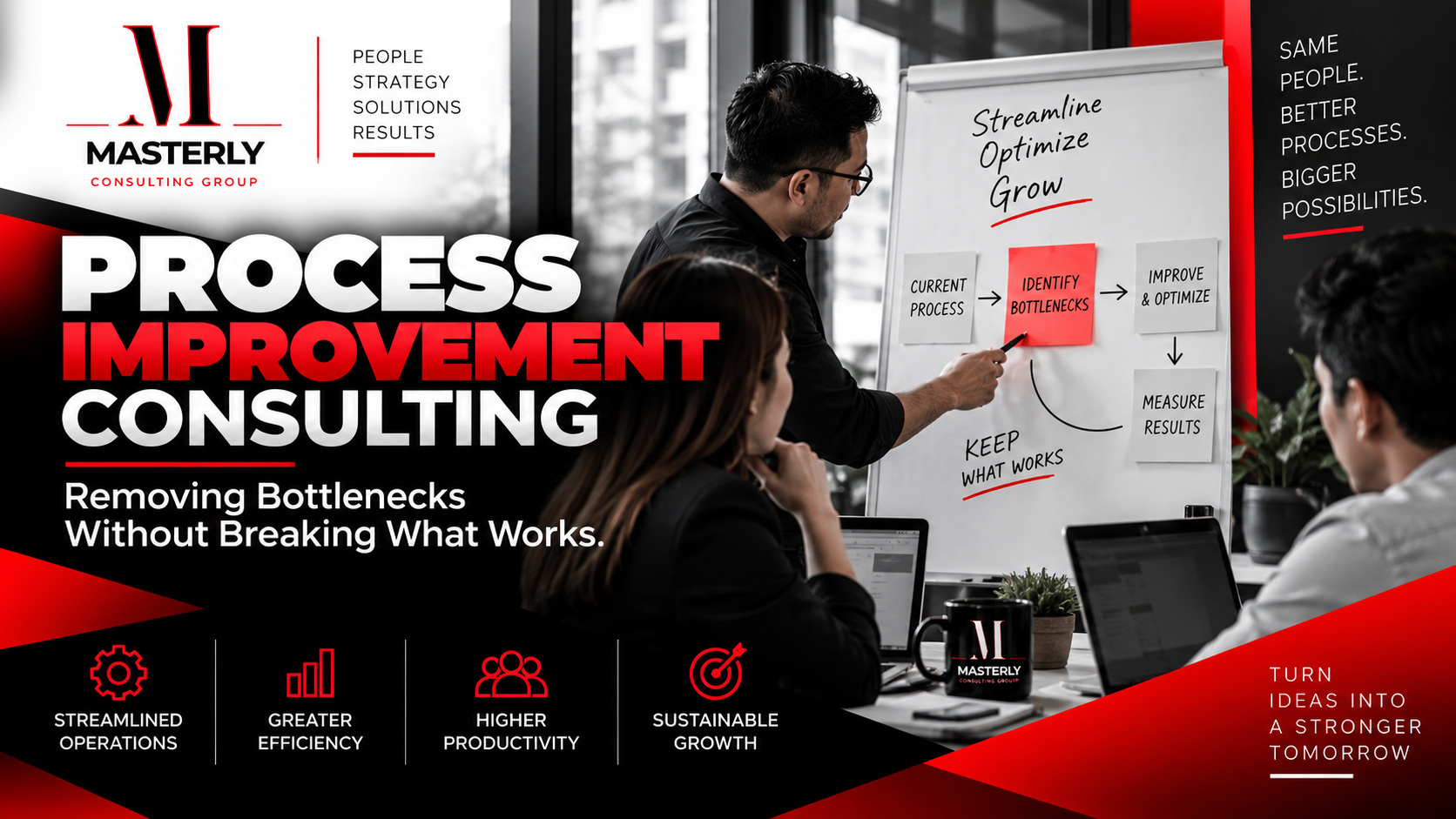
Professional business process improvement focuses on understanding how work currently moves through your organization, identifying where execution breaks down, and improving the parts that create unnecessary delay, confusion, or duplication.
Masterly Consulting Group helps growing businesses examine their operational systems and develop practical improvements without assuming everything that already works needs to change.
Growth Can Turn Small Workflow Problems Into Larger Business Problems
Operational problems often develop gradually.
At first, one employee handles several responsibilities. Then the company hires more people. New departments form. Additional systems are introduced. Customers increase. Leaders delegate work that they once managed personally.
The business has grown, but the process may still depend on informal habits created years earlier.
That can lead to problems such as:
- Work sitting between departments because the next owner is unclear
- Multiple employees completing the same task
- Managers spending time correcting preventable communication problems
- Projects slowing down because approvals are inconsistent
- Important information being stored in different places
- Employees creating their own versions of the same process
These issues can affect more than productivity.
They can influence customer experience, employee frustration, leadership time, and the organization's ability to handle additional growth.
Business Process Improvement Starts With Understanding How Work Actually Gets Done
A written policy may describe how a process is supposed to work.
Daily operations can look very different.
Professional business process improvement looks at the real workflow.
Where does the process begin? Which people or departments touch it? Where are decisions made? What information is required? Where does work wait? Where does confusion regularly appear?
This is where professional outside perspective can be valuable.
Internal teams often know individual parts of a process very well, but each department may see only its own portion of the workflow.
Masterly Consulting Group can help leadership examine the process across the organization rather than looking at each task in isolation.
Process Mapping Can Make Hidden Bottlenecks Easier to See
One reason operational problems continue is that no one has a clear view of the entire process.
Process mapping can help create that view.
The purpose is not to produce complicated diagrams for their own sake. It is to understand how work moves from one stage to another and where responsibility changes hands.
For example, a customer request may move through sales, operations, finance, and customer service.
Each team may perform its own part correctly.
The problem may exist between those teams.
A handoff can create delay if the next person does not know the task is ready. Information may need to be entered again because systems are not aligned. A manager may become an unnecessary approval point for routine decisions.
Seeing the complete workflow can make these problems easier to identify and help teams identify inefficiencies.
Workflow Improvement Should Reduce Friction, Not Add More Steps
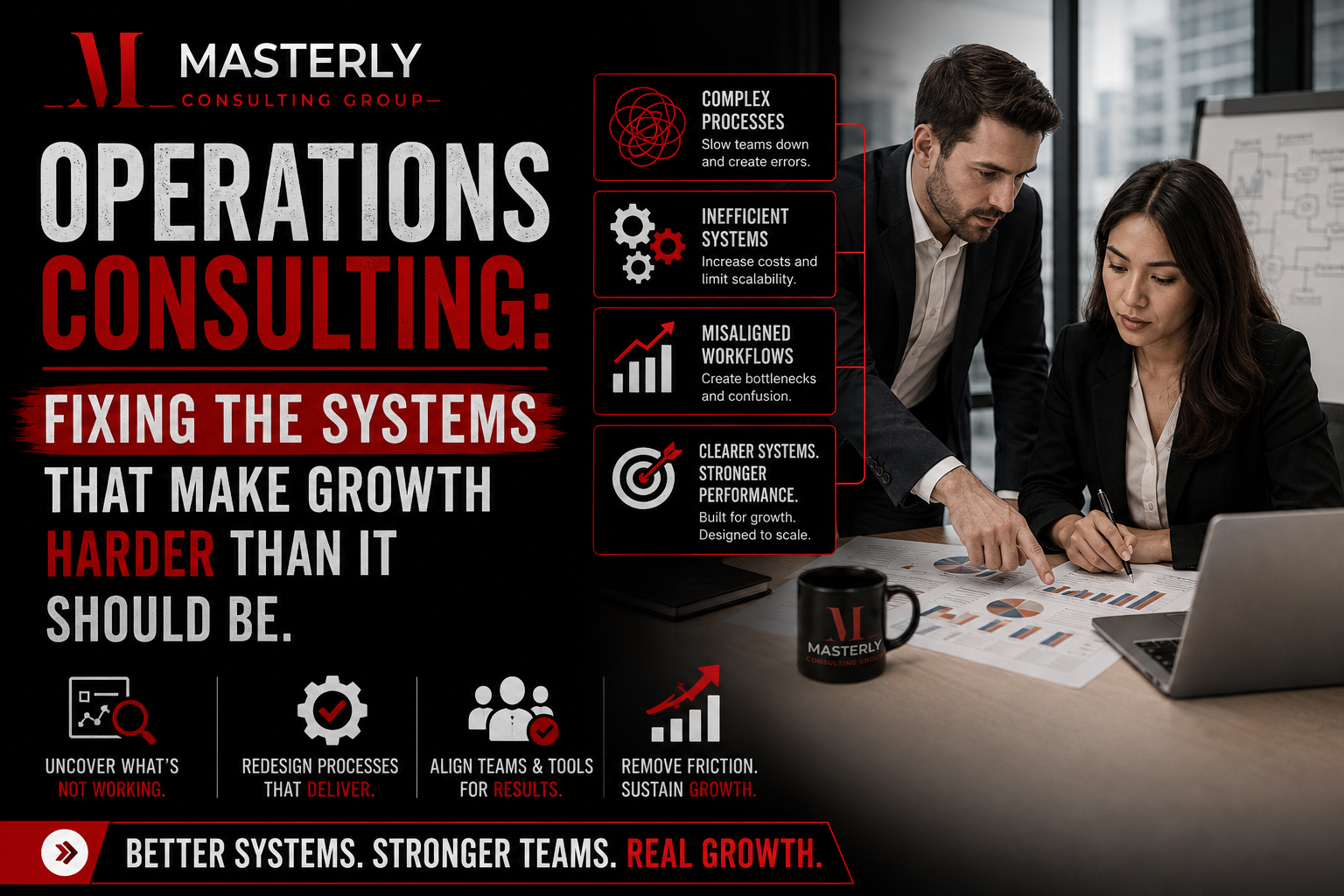
Organizations sometimes respond to a broken process by adding another approval, meeting, spreadsheet, or reporting requirement.
That can make the problem worse.
Effective workflow improvement should reduce unnecessary friction, with connected process changes that reduce waste and elevate performance.
The goal is to make responsibilities clearer and work easier to move through the organization.
That may involve examining communication, ownership, staffing structure, technology, timelines, or other parts of the operating process to streamline processes.
The appropriate solution depends on the business.
Masterly Consulting Group does not approach process improvement as a reason to add complexity. Existing company material emphasizes that consulting should help create clarity, stronger accountability systems, better team coordination, and more organized workflow planning.
Unclear Ownership Creates Expensive Delays
One of the most common operational questions is also one of the simplest:
Who owns this?
If several people believe someone else is responsible, the work may stop.
If several people believe they are responsible, the work may be duplicated.
Clear ownership helps employees understand who moves a process forward, who provides information, who makes a decision, and when responsibility transfers to another person or team.
This does not mean one person performs every task.
It means the organization can see where responsibility sits at each stage.
Better ownership can also reduce the amount of time leaders spend stepping into routine processes simply because no one else knows who should decide what happens next, while also helping with addressing bottlenecks so work moves forward faster.
Business Process Optimization Should Protect What Already Works
A company does not need to replace every process simply because some inefficient processes exist.
That is an important distinction.
Employees may already have effective systems that support customers, maintain quality, or help teams work quickly.
Professional business process optimization should identify those strengths as well as the problems.
A consulting engagement should not create disruption just to make the organization look different.
The objective is to determine which existing processes should remain, which should be simplified, and which may require a more significant change.
That approach can be especially valuable for established businesses where long-time employees understand practical details that may not appear in formal documentation.
Operational Efficiency Matters When Demand Increases
An inefficient process may remain manageable when work volume is low.
Growth changes that equation.
More customers can mean more approvals, communications, transactions, projects, and internal coordination, so optimized workflows also improve agility and adaptability as demand shifts.
If every additional customer creates more manual steps, management involvement, or repeated work, growth can place increasing pressure on the organization.
Improving operational efficiency can help leadership address those systems before rising demand magnifies their weaknesses and lower operational costs as volume grows.
Masterly Consulting Group's existing consulting material recognizes this connection between growth and systems, noting that businesses without sufficient operational structure can struggle to support increased demand, and that operational efficiency remains a priority for many organizations.
Technology May Be Part of the Problem or Part of the Solution
Not every workflow problem is caused by people.
Sometimes the process has grown around technology that no longer fits the business, and the wrong software solutions can make the gap worse instead of fixing it.
Employees may enter the same information into several systems, creating manual tasks that slow work down. Departments may maintain separate spreadsheets because the main system does not support the way they work. Important updates may depend on email because there is no clear shared workflow.
Technology can create efficiency through workflow automation, but it only helps when the automation matches the process.
Before investing in new systems, leadership should understand the workflow the technology is expected to support. If the firm is evaluating technology support, advanced analytics tools analyze large datasets to identify patterns and trends.
A clear operational process can make technology decisions more useful because the organization knows what problem it is trying to solve. With workflow management systems projected to grow at 30.6% CAGR by 2028, and with 30% of hours currently worked in the U.S. economy potentially automated by 2030, workflow design should come first.
Process Improvement Also Requires Leadership Alignment
Operational improvements can fail when business leaders send mixed messages, which is especially costly for growing businesses when 83% see process optimization as a key driver of value.
One manager may support a new workflow while another continues using the old one.
Employees then have to decide which process to follow.
That is not simply a training problem.
It is a leadership alignment problem.
Masterly Consulting Group's existing approach connects operational change with clear communication, structured implementation, employee training, and leadership alignment.
For growing businesses, this matters because changing a process often affects several teams.
Leadership should understand the purpose of the change and the responsibilities connected to it.
Better Processes Can Improve the Customer Experience
Customers may never see your internal workflow, but they can experience its problems.
A delayed handoff can become a slow response.
Duplicate work can create conflicting information.
Unclear ownership can cause a customer to be transferred from one person to another.
Inconsistent processes can produce different experiences depending on which employee handles the request.
For this reason, process improvement can support both internal operations and external service, including customer satisfaction, which Total Quality Management treats as a core part of continuous improvement.
A clearer internal process can help employees understand what happens next and who is responsible for moving the customer forward, which also helps protect service quality.
Your Employees Should Not Have to Work Around Broken Systems
Good employees often create temporary solutions when a process stops working.
They build personal spreadsheets.
They develop informal checklists.
They message colleagues directly instead of using the official workflow.
These workarounds can keep operations moving, but they can also hide the underlying problem.
When one employee leaves, the workaround may disappear with them.
Growing companies benefit from turning critical operational knowledge into clearer organizational systems rather than depending entirely on individual memory or informal habits, which supports employee engagement and employee satisfaction while fostering a culture of regular feedback and ongoing enhancements.
Masterly Consulting Group Focuses on Practical Process Improvement
Masterly Consulting Group works with organizations that need greater clarity in how work moves through the business.
The focus is not on replacing processes simply to create change.
It is on understanding operations, analyzing goals, applying process improvement methodologies, developing customized strategies, and supporting implementation. That approach is consistent with Masterly Consulting Group's existing consulting philosophy.
For businesses experiencing delays, duplicated work, unclear ownership, or inconsistent execution, that may mean examining the workflow from beginning to end.
The goal is a more practical operating structure that employees can understand and leadership can manage over time by monitoring performance metrics.
Business Process Improvement Should Support the Larger Operation
Strong business operations depend on more than individual employees working harder. Processes, systems, technology, and leadership decisions all affect how work moves through the organization. When those parts are disconnected, teams may spend too much time on manual work, duplicate information, repeat repetitive tasks, or correct problems caused by unclear ownership and human error.
Professional process improvement looks at the larger operating environment.
That may involve relationships between project management, human resources, resource allocation, inventory management, supply chain management, technology, and other parts of the organization. The primary focus should remain on the specific business problems creating delay, confusion, or unnecessary use of resources.
Masterly Consulting Group helps leadership examine those connections so decisions about improving processes remain tied to practical business goals.
Business Process Management Can Create More Consistent Execution
Business process management focuses attention on how recurring work is organized and managed across the business.
A process may involve several employees, departments, systems, approvals, and decisions before it is complete. When those responsibilities are unclear, the work can consume resources without producing the level of consistency leadership expects.
A clearer operating structure can help organizations streamline operations by identifying unnecessary steps and improving how responsibilities move between teams.
The objective is not simply to create a new process.
It is to develop a workflow that makes sense for the business and supports more consistent execution.
Process Improvement Is Different From Business Process Reengineering
Organizations researching operational consulting may encounter terms such as business process reengineering.
Reengineering can involve significant redesign of how work is performed. That may be appropriate in some circumstances, but every operational problem does not require a complete rebuild.
Sometimes the better approach is improving what already works.
Masterly Consulting Group evaluates operational needs in context rather than assuming major disruption is always necessary. The appropriate level of change depends on the process, business, and problem leadership is trying to solve.
Technology Can Reduce Repetitive Work When It Supports the Right Process
Technology frequently becomes part of process-improvement conversations.
Businesses may consider enterprise resource planning, robotic process automation, workflow systems, or other software designed to reduce repetitive tasks and connect information across departments.
Software can also support specialized areas such as financial forecasting, inventory control, project management, or software development workflows.
But automation does not automatically fix a weak process.
Automating unnecessary steps can simply make the wrong process operate faster.
Before technology is added, leadership should understand what the workflow needs to accomplish.
Appropriate automation may help reduce manual work, support minimizing errors, or produce fewer errors in repetitive activities. The result depends on the process, technology, implementation, and people using the system.
Operational Excellence Requires More Than One Improvement Project
Operational excellence is not created by fixing one workflow and then ignoring operations.
Organizations change.
Customer expectations shift. Teams grow. Technology changes. Products and services evolve. Processes that once worked well may eventually create new problems.
That is why process improvement often emphasizes continuous improvement rather than assuming every workflow can be permanently perfected.
An improvement cycle gives leadership a way to revisit important processes as business conditions change.
The goal is to implement improvements that make sense today while remaining willing to evaluate the operation again when the business requires it.
Continuous Improvement Should Remain Connected to Business Goals
Improvement for its own sake can create unnecessary change.
The organization needs a reason for modifying a workflow.
Leadership may want to reduce delays, create clearer ownership, improve the customer experience, boost productivity, or make better use of available resources.
Those objectives provide context for process decisions.
For businesses pursuing sustainable growth, process improvement should support the larger direction of the company rather than becoming a collection of unrelated efficiency projects.
Data Can Help Leadership Understand Operational Problems
Operational decisions can benefit from evidence.
Depending on the process, leadership may review statistical data, performance information, workload patterns, customer feedback, or other information that provides actionable insights.
Organizations may also compare relevant industry benchmarks when those benchmarks are credible and appropriate to the specific operation.
The goal is not to overwhelm leaders with numbers.
Data should help clarify the problem.
Historical approaches to operational improvement have included ideas related to the scientific method, economic quality control, and methods such as lean manufacturing. These concepts have influenced how organizations think about quality, waste, consistency, and process performance.
Masterly Consulting Group focuses on practical application rather than requiring clients to become experts in process-management theory.
Process Improvement Can Look Different Across Industries
The process behind a professional-services company will not look identical to a production process in manufacturing.
A manufacturer may focus on producing high quality products, supply-chain coordination, inventory, and reducing production delays.
A service organization may focus more heavily on client handoffs, internal communication, project workflow, or response times.
Technology businesses may have different operational needs related to software development and project coordination.
The key elements of a process-improvement engagement should therefore reflect the organization rather than a generic template.
Even when two companies experience similar symptoms, the underlying causes can be very different.
Customer Focus Should Remain Part of Operational Improvement
Internal efficiency matters, but operations ultimately support the organization's larger purpose.
That often includes serving customers.
A customer focus can help leadership evaluate whether a process improves the experience outside the organization as well as inside it.
A workflow that saves internal time but creates confusion for customers may not represent a true improvement.
Likewise, a process that increases a team's productivity while creating additional errors somewhere else may simply move the problem.
Professional process review should consider the entire workflow and the people affected by it.
Better Processes Can Support Fewer Errors and Clearer Accountability
Organizations often want processes that produce fewer mistakes, reduce delays, and give employees clearer direction.
Achieving that can involve several factors.
The process itself needs to make sense. People need to understand their responsibilities. Technology should support the workflow. Information should be available when it is needed.
These are some of the key features of a more dependable operating environment.
Reducing unnecessary complexity can also make it easier for employees to identify when something is wrong rather than relying on informal workarounds.
For leadership, this can create better visibility into where a process needs attention.
Masterly Consulting Group Helps Organizations Improve the System Behind the Work
Process improvement is ultimately about enabling organizations to operate with greater clarity.
The goal is not to apply every management concept available.
It is to understand the company's actual operation, identify the processes creating friction, and determine what changes deserve attention.
Masterly Consulting Group helps businesses evaluate workflows alongside broader considerations such as operational structure, project management, resource allocation, technology, and business goals.
That allows leadership to make process decisions with the larger organization in mind.
Whether the issue involves repetitive work, unclear handoffs, technology limitations, inconsistent execution, or inefficient use of resources, professional support can help the company move from recognizing the problem to deciding how to address it.

Frequently Asked Questions About Business Process Improvement
What is business process improvement?
Business process improvement is the review and refinement of business workflows to address problems such as delays, duplication, unclear responsibilities, unnecessary steps, or inconsistent execution. It is a systematic approach to improving business processes so work flows more efficiently, consistently, and with fewer avoidable errors.
What is process improvement?
Process improvement focuses on making an existing business process work more effectively. It often involves continuous improvement, where each process change is reviewed over time rather than treated as a one-time fix. The appropriate changes depend on the workflow and organization.
What is business process optimization?
Business process optimization involves evaluating how work is completed by reviewing current processes and identifying opportunities to improve efficiency, clarity, coordination, or use of resources to reduce costs.
What is workflow improvement?
Workflow improvement addresses how tasks, information, decisions, and responsibilities move through a business process. It helps streamline workflows by reducing delays between people and steps.
What is process mapping?
Process mapping provides a structured view of how a process moves through different steps, employees, departments, or decision points. It also helps identify root causes when delays, duplication, or confusion appear across a workflow.
Can business process improvement help with duplicated work?
Yes. Duplicate work can be a sign of unclear ownership, poor communication, or disconnected processes. Professional review can help determine why the duplication is happening. It should also be reviewed against key performance indicators to confirm whether changes are improving the process over time, since monitoring performance metrics is crucial for sustained improvements in BPI.
Can process improvement help with handoff delays?
Potentially. Handoff delays may result from unclear responsibility, missing information, unnecessary approvals, or other workflow problems that deserve review.
Does process improvement mean replacing our existing systems?
Not necessarily. Effective process improvement should consider what already works and focus change where it is actually needed. In some cases, that includes process automation, but only where it supports a workflow that already works well.
Can process improvement improve operational efficiency?
Improving workflows can support greater operational efficiency, although specific business results depend on the organization, implementation, and other factors. One way some organizations evaluate those improvements is with the operational efficiency ratio, which measures costs and time invested against project outcomes.
Does Masterly Consulting Group provide business process improvement consulting?
Growing businesses experiencing workflow delays, unclear ownership, duplication, or inconsistent execution can contact Masterly Consulting Group to discuss their business process improvement needs. Support can also include reviewing workflows across different business functions.
Request a Process-Improvement Consultation with Masterly Consulting Group
Your company may not need a complete operational rebuild.
It may need a focused plan for improving business processes.
Masterly Consulting Group helps growing businesses examine the workflows behind delays, duplication, unclear ownership, and inconsistent execution.
Professional business process improvement can help leadership understand where work is getting stuck, what is creating unnecessary friction, and which processes deserve attention so delays and friction are fixed before growth magnifies them and erodes competitive advantage, without disrupting systems that already work.
Visit MasterlyGroup.com or call (972) 236-5051 to request a process-improvement consultation with Masterly Consulting Group.