Strategic Workforce Planning: Matching Future Roles and Skills to the Growth Plan
A company can have an ambitious growth plan and still be unprepared for the people decisions that growth creates.
Leadership plans to enter another market, expand a service line, introduce new technology, or increase capacity. Revenue goals are established. Operational targets are discussed. Yet one critical question remains unclear: Who will perform the work when the business gets there?
Without strategic workforce planning, organizations can reach an important stage of growth only to discover that roles are unclear, critical skills are missing, managers are overloaded, or hiring decisions are being made in response to immediate pressure.
The better time to confront those questions is before the pressure arrives.
Strategic workforce planning connects the business plan with future roles, capacity, capabilities, and leadership decisions. It gives executives a clearer way to think about the workforce the organization may need as its priorities change.
Growth Can Expose Workforce Problems That Were Easy to Ignore
A smaller organization can often operate through flexibility.
Employees wear several hats. Senior leaders step into operational problems. Responsibilities move between people as needs arise.
That flexibility can become harder to sustain as the business grows.
Imagine a company planning to expand into three new markets.
Its current sales leader also handles major accounts. Operations depends heavily on one experienced manager. Several employees have responsibilities that developed informally over time. Nobody has clearly determined which capabilities the organization will need when the expansion is fully underway.
The company might respond by hiring as problems appear.
But reactive hiring does not necessarily answer the larger question.
What should the future workforce actually look like?
That is where workforce strategy becomes important.
Strategic Workforce Planning Connects People Decisions to the Business Plan
Workforce planning should not begin with a list of job openings.
It begins with the organization's direction.
If a business expects to grow, restructure, introduce technology, enter new markets, or change how services are delivered, those decisions may change what work needs to be performed.
Leadership can then consider which roles, capacity, and capabilities support that future state.
This creates a clearer relationship between business strategy and workforce decisions.
Masterly Consulting Group currently identifies strategic planning, business growth, process optimization, change management, leadership development, and executive coaching among its consulting and coaching areas. Its executive coaching services focus on helping leaders improve performance and decision-making while navigating organizational challenges.
For business leaders, strategic workforce planning is therefore not simply an HR conversation, but part of talent strategy tied to business objectives. It is a strategic leadership conversation. Aligning workforce strategies with organizational strategy helps support organizational goals and stronger business outcomes.
Workforce Strategy Should Look Beyond Today's Organization Chart
An organization chart tells leaders who occupies positions today.
A workforce strategy asks what the organization may require tomorrow.
Those are different views.
Suppose a company expects a major part of its growth to come from a service that currently represents only a small part of the business.
The current organization chart reflects today's workload.
The future business plan may require different management capacity, technical knowledge, customer support, or operational leadership.
Simply duplicating today's structure may not support tomorrow's business.
Leadership needs to consider how the work itself may change as market trends and technological advancements shape future scenarios.
Scenario planning helps leaders test workforce strategies against market shifts before they affect execution.
Future Skills Can Matter as Much as Future Jobs
Planning only by job title can miss an important part of the picture.
Organizations also need to think about future skills so they have the right skills in place for future needs.
Technology may change how work is performed. Growth may require managers to lead larger teams. Expansion may increase the importance of financial, operational, analytical, communication, or technical capabilities.
Sometimes the future need does not require an entirely new department.
Leaders should identify skills gaps early so they can address skills gaps through skills development or role changes.
The organization may need existing roles to develop different capabilities.
That creates an important distinction.
A workforce gap is not always a headcount gap.
Sometimes the organization has enough people but lacks a capability it will need to execute the next stage of its plan.
Capability Gaps Can Become Business Constraints
A capability gap reflects a difference between current workforce capabilities and what the organization will need.
That gap may remain almost invisible until business conditions expose it.
For example, leadership approves expansion, but few managers are prepared to lead larger teams.
A company introduces a new system, but the workforce lacks the skills needed to use it effectively.
The business grows rapidly, but important decisions still depend on one senior executive because management capability has not grown with the company.
These are not simply staffing issues.
They can affect execution.
Identifying gaps through gap analysis provides valuable insights for informed decisions about talent management.
Identifying capability gaps earlier gives leaders more time to consider how the organization should respond. Unresolved talent gaps can also limit the company’s ability to remain competitive.
Headcount Planning Should Follow the Work
"We need ten more employees next year" is a headcount target.
It is not necessarily headcount planning.
A more strategic conversation asks why additional capacity is needed.
What work is increasing?
Which roles are affected?
Is the work temporary or ongoing?
Does the organization need more people performing the same work, or different skills altogether?
Could technology or process changes alter the capacity requirement?
Those questions help prevent headcount from becoming disconnected from business strategy.
The objective is not simply determining how many employees the company might employ or reacting to short-term workforce demand.
That is different from operational planning, where demand forecasting should follow the expected work.
It is understanding what capacity the growth plan requires.
Role Planning Can Clarify Accountability Before Growth
Growth can make vague responsibilities expensive.
When a team is small, two leaders may comfortably share responsibility for an area.
As the company expands, shared responsibility can become unclear accountability.
Who owns the result?
Who makes the decision?
Which responsibilities belong with a new role?
Which should remain with current leadership?
Role planning allows leadership teams to consider these questions before the organization becomes dependent on an unclear structure.
Reviewing job families can also clarify accountability as the business scales.
This is particularly important when senior leaders themselves need to change how they work.
An executive who personally approves every major decision at one stage of the company may need to delegate more authority at the next.
That is where workforce planning and executive development can intersect.
Talent Planning Is Broader Than Recruiting
Recruiting answers an important question: Who should we hire?
Talent planning begins earlier as part of a broader talent strategy.
It considers whether future capability should come from hiring, developing current employees, changing responsibilities, redesigning work, succession planning, talent acquisition, or another appropriate workforce decision as part of sound talent management.
That distinction matters because not every workforce challenge requires an external hire.
A company may already have employees capable of assuming greater responsibility with appropriate development.
Another organization may have strong people but no one with a critical specialized capability.
In those cases, a broader talent pool can matter when future talent needs cannot be met internally.
Leadership needs enough clarity to distinguish those situations.
Strategic workforce planning provides a framework for making those decisions intentionally rather than automatically opening another job requisition.
Strong planning can also improve internal mobility and support retention by matching people to growth opportunities.
A Practical Strategic Workforce Planning Framework
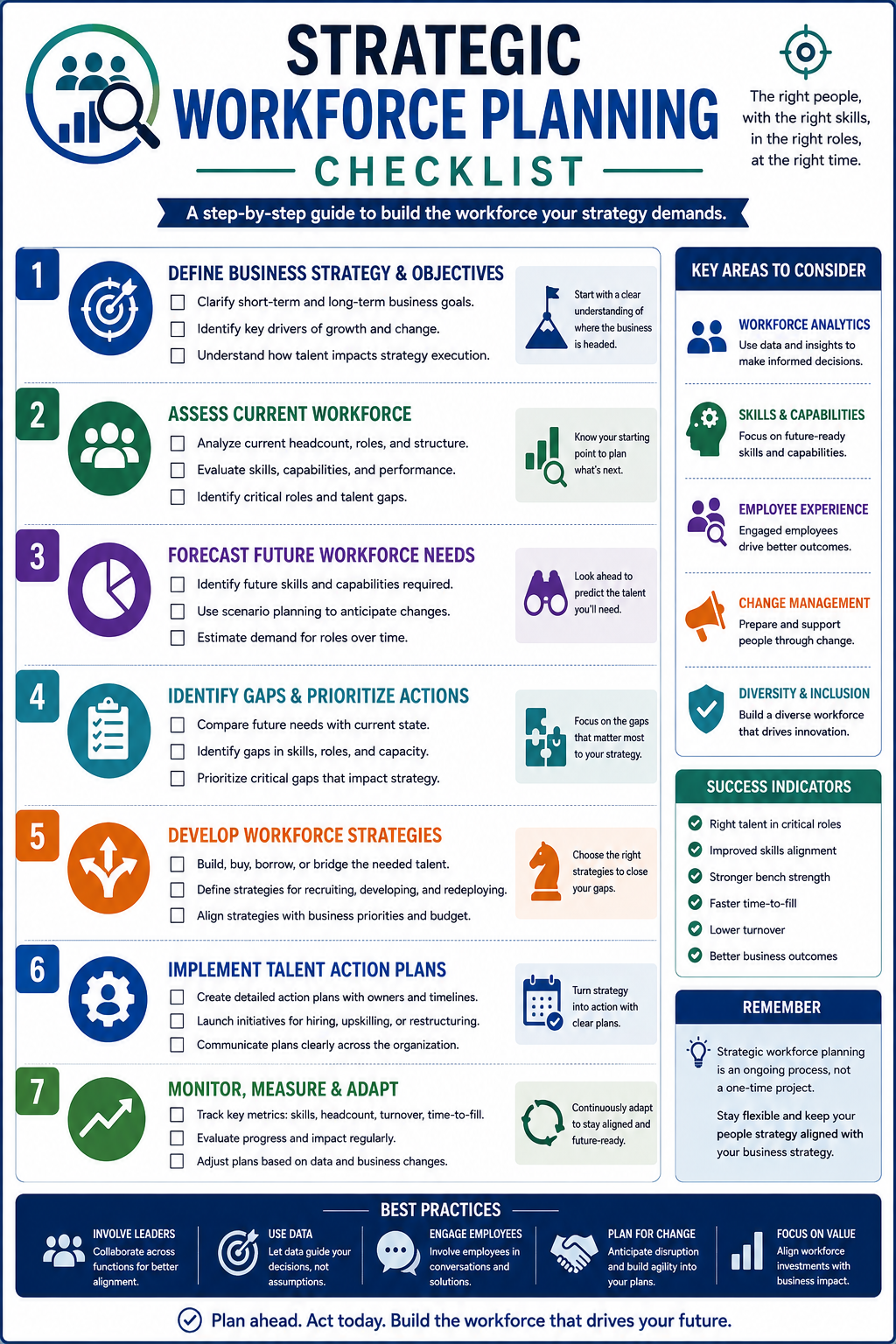
Leadership teams can organize the conversation around four questions: direction, work, capability, and people—a practical strategic workforce planning process and one of several strategic workforce planning models. Many organizations use a six-step process that begins with agreement on business goals, while this framework groups the work into four leadership questions.
Direction: Where Is the Business Going?
Start with the growth plan.
Key stakeholders and business leaders should align early on organizational objectives before workforce planning begins.
What is changing in the organization over the planning period?
The purpose is to establish the future business context before discussing staffing.
Work: What Will Need to Be Done?
Consider how growth changes the work itself by requiring leaders to assess the workforce capabilities needed for the work ahead, not just tasks.
New markets, customers, technology, services, and operating models may create different responsibilities. This is also where organizations estimate workforce demand across functions as the operating model changes.
Capability: What Must the Organization Be Able to Do?
Identify the knowledge, leadership capacity, technical abilities, and other future skills required to execute the plan, and leaders should identify skills gaps and talent gaps in the capabilities required to execute the plan.
A thorough analysis of the current workforce helps identify trends and supports development initiatives.
This can reveal capability gaps before they become urgent. This holistic approach helps mitigate risks before gaps affect delivery.
People: What Workforce Decisions Support That Future?
Only then does the conversation move toward headcount planning, talent planning, talent acquisition, development initiatives, internal mobility, role changes, and other workforce decisions.
This order matters.
The goal is to successfully plan for the right talent rather than react after gaps appear.
Starting with people before understanding the future work can lead to solving today's problem instead of preparing for tomorrow's business.
Strategic Workforce Planning Can Strengthen Executive Decision-Making
Workforce decisions frequently involve uncertainty.
Growth projections change.
Technology evolves.
Priorities move.
No planning process can eliminate that uncertainty.
The purpose is to give leaders a stronger framework for making decisions within it.
Strategic workforce planning tools and workforce planning software can provide valuable insights for more informed decisions.
Executives can discuss assumptions openly.
Which growth plans would require additional capacity?
Which roles become critical if expansion accelerates?
Where does the organization depend too heavily on one person's knowledge?
Which leadership positions may need stronger successors?
Scenario planning helps leaders anticipate future workforce needs under different growth assumptions.
These conversations can reveal organizational risks that are easy to overlook when leaders remain focused on immediate operations.
Masterly Consulting Group describes its executive coaching work as helping leaders improve decision-making, leadership skills, change management, and adaptation.
That makes executive coaching a relevant supporting resource when workforce plans require leaders themselves to change how they delegate, communicate, make decisions, or lead through growth.
Workforce Planning Should Not Become a Static Spreadsheet
A workforce plan is part of an ongoing process based on assumptions about the future.
Those assumptions can change.
Leaders should regularly review and update workforce plans to keep them aligned with organizational goals, current data, and trends.
A market expansion may move faster than expected.
Technology may reduce certain capacity needs while creating new skill requirements.
A new business priority may introduce roles that were not part of the original plan.
For that reason, workforce planning should support ongoing leadership decisions rather than become a document that is created once and forgotten.
The value comes from maintaining alignment between the business direction and the workforce needed to support it, and continuous data monitoring helps leaders track progress and adjust workforce initiatives over time.
Poor Workforce Planning Can Affect the Brand Too
Customers rarely see an organization's workforce plan.
They can still experience its consequences.
Rapid growth without enough capacity may affect responsiveness.
Unclear roles may create inconsistent customer experiences.
Managers who are stretched too thin may struggle to support employees effectively.
A lack of specialized capabilities can make it harder to deliver new services as intended.
The workforce sits behind the customer experience.
For that reason, planning future capability is not simply an internal administrative exercise. It can influence whether the organization can deliver on the promises its brand makes.
Visual Explainer: Connecting the Growth Plan to the Workforce
Business Growth Plan Where is the organization going?
↓
Future WorkWhat work will growth create or change?
↓
Roles and CapacityWhich responsibilities and headcount will be needed?
↓
Future Skills What are the right skills employees and leaders will need to support future talent needs?
↓
Capability Gaps Where are the skills gaps and talent gaps between today's workforce and the future state?
↓
Talent Decisions What combination of development, role planning, talent acquisition, succession, talent management, or other workforce actions should leadership consider?
The purpose is to create a visible connection between business growth and workforce decisions.
Masterly Consulting Group Supports Leaders Facing Growth Decisions
Strategic workforce questions are ultimately leadership questions.
They require executives to make choices about priorities, capacity, accountability, talent, and how the organization needs to evolve. During growth, business leaders often need outside support with aligning workforce strategies to organizational objectives.
Masterly Consulting Group works with businesses on strategic planning and growth, process optimization, change management, and executive coaching. The firm's executive coaching services are designed to support leaders in improving performance, decision-making, leadership development, and organizational change.
For leadership teams evaluating their future workforce, that combination can support broader conversations about how the business plan connects with leadership capability and organizational execution. It can also strengthen organizational resilience when the business is preparing for change.
Internal Link Recommendation: Link this section to the Executive Coaching service page using anchor text such as executive coaching for strategic leadership decisions. Masterly Consulting Group currently lists Executive Coaching as a core consulting service.
Frequently Asked Questions About Strategic Workforce Planning
What is strategic workforce planning?
Strategic workforce planning connects future business priorities with the roles, capacity, skills, and talent the organization may need to execute those priorities. In practice, strategic workforce planning takes a longer-term view of future roles, the right skills, workforce capabilities, and how they support organizational goals.
How is workforce strategy different from hiring?
A workforce strategy considers the broader workforce required to support business goals. It can also include workforce management, talent acquisition, and development decisions aligned with business objectives. Hiring is one possible response to a workforce need, but it is not the entire strategy.
What are capability gaps?
Capability gaps are differences between the capabilities an organization currently has and those it expects to need to perform future work. They are often identified through gap analysis of current workforce capabilities against future needs.
What are future skills?
Future skills are capabilities employees or leaders may need as business priorities, technology, responsibilities, or operating conditions change. They are often shaped by market trends, technological advancements, and changing employee expectations.
What is headcount planning?
Headcount planning considers the workforce capacity and roles that may be required to support expected work. It is not only about how many employees may be needed, but about projected workforce demand tied to the work the business expects to deliver. Strategic planning connects those decisions with business needs rather than treating headcount as an isolated number.
What is role planning?
Role planning considers how responsibilities, decision-making authority, and accountability may need to change as the organization evolves.
How does talent planning fit into workforce planning?
Talent planning considers how the organization may address future workforce needs through approaches such as employee development, succession, role changes, or external hiring. It helps organizations anticipate future future talent needs, improve internal mobility, and support retention.
Can executive coaching support strategic workforce planning?
Executive coaching can support leaders who need to strengthen strategic thinking, decision-making, delegation, change management, and other leadership capabilities connected with organizational growth. Masterly Consulting Group currently provides executive coaching focused on leadership performance and decision-making.
Request a Strategic Workforce Planning Consultation
Your growth plan should not reach the execution stage before leadership starts asking who will perform the work.
Strategic workforce planning can help leadership connect workforce strategies with business objectives and future talent needs, alongside future skills, headcount planning, capability gaps, talent planning, and role planning.
Masterly Consulting Group works with executives and organizations on strategic planning, business growth, organizational challenges, and executive leadership development.
Regular review and data-driven planning help organizations remain competitive as priorities change.
Call Masterly Consulting Group at (972) 236-5051 to discuss how your future workforce can better align with your organization's growth plan.