Stakeholder Management: How Leaders Keep Decisions Moving When Priorities Compete
A spokesperson can walk into an interview with strong talking points and still create problems for the organization.
The issue may not be speaking ability.
The executive may be representing employees who want one message, board members who expect another, customers who need reassurance, legal advisers focused on risk, and senior leaders who have not agreed on what can be said publicly. One difficult question can expose those differences.
This is where stakeholder management becomes part of executive media preparation.
Leaders and spokespersons need more than confidence in front of a camera. They need to understand which stakeholders matter, what those audiences need to hear, who has decision rights, where sensitive issues require escalation, and how public statements fit the organization's larger priorities.
Masterly Consulting Group provides executive media training for executives, attorneys, university leaders, corporate spokespersons, government officials, nonprofit executives, board leaders, and other professionals whose communication can affect organizational reputation and public trust. Training can include communication strategy, interview preparation, realistic practice, crisis communication, camera presence, and stakeholder communication.
Stakeholder Management Becomes More Important When the Audience Gets Larger
A private leadership discussion may involve five people.
A media interview can reach thousands.
Employees may hear it.
Customers may hear it.
Investors, regulators, board members, community partners, donors, students, patients, or industry colleagues may hear it too.
That means a spokesperson is rarely speaking only to the journalist asking the question.
The interview may reach several audiences at the same time.
Masterly Consulting Group specifically identifies stakeholder communication as part of executive media preparation and notes that media interviews can reach employees, customers, investors, regulators, and community partners simultaneously.
This creates a difficult leadership challenge.
A statement that reassures one stakeholder group may raise concerns with another. An answer that sounds precise to an executive may sound unclear to employees. A technical explanation may satisfy internal experts but confuse the broader public.
Strong stakeholder management helps the leader prepare for those competing needs before the interview begins.
Stakeholder Analysis Clarifies Who Key Stakeholders Are Listening
A spokesperson should not treat every audience as though it has the same concerns.
Stakeholder analysis helps identify the people and groups affected by the communication and what may matter to each one.
Consider an organization announcing a major operational change.
Employees may want to know how their work will be affected.
Customers may want reassurance about service continuity.
Board members may focus on business impact.
Community partners may have questions about local effects.
Journalists may focus on conflict, accountability, or consequences.
The spokesperson needs one consistent organizational position, but that message must make sense across different audiences.
This is not about creating a different version of the truth for each group.
It is about understanding what questions each audience is likely to ask and making sure the organization's public communication remains clear, accurate, and consistent.
Stakeholder Engagement Starts Before the Interview
Problems often begin when leadership waits until the interview is scheduled to determine what the organization believes.
Effective stakeholder engagement should happen earlier, because identifying stakeholders early can help prevent costly surprises.
Before a high-visibility appearance, the organization may need input from executives, communications staff, legal advisers, operational leaders, subject-matter experts, or other people with relevant knowledge.
Their involvement can help clarify facts, identify sensitive subjects, surface disagreements, and determine what the spokesperson can responsibly address.
But involving more people does not automatically improve the message.
Too many late opinions can produce a statement that sounds vague or contradictory.
The better objective is structured engagement.
A stakeholder engagement plan should define objectives and strategies for involving stakeholders before the interview.
Who needs to provide information?
Who needs to review the message?
Who needs to approve it?
Who should be informed without controlling the final wording?
Those distinctions can prevent unnecessary confusion when the pressure increases.
Decision Rights Matter Before Difficult Questions Arrive
Imagine an executive is asked a question about a developing issue during a live interview.
The organization has discussed the topic internally, but no one established who has authority to approve a public position.
Now the spokesperson has seconds to decide what can be said.
That is a poor time to discover unclear decision rights.
Decision rights define who has authority over important choices.
In media preparation, that may include determining:
- who approves key messages;
- who can authorize a public statement;
- who controls communication during a crisis;
- who can confirm sensitive facts;
- when a spokesperson should decline to speculate; and
- which issues must be escalated before a response is given.
The spokesperson should not be forced to invent organizational policy in front of a reporter.
Executive media training can help leadership identify these gaps before the public conversation happens.
Influence Mapping Helps Leaders Understand Hidden Pressure
Formal titles do not always show where influence sits.
A board chair may have significant authority.
An internal subject-matter expert may control information needed for an accurate response.
A regulator may shape the environment even without participating directly in the interview.
Employees may strongly influence how the public statement is interpreted internally.
Customers or community groups may affect the reputation consequences that follow.
Influence mapping helps the organization recognize these relationships.
The purpose is not to manipulate stakeholders.
It is to understand the communication environment.
A spokesperson who knows where influence sits can prepare more thoughtfully for questions, objections, and reactions that may arise after an interview is published.
Stakeholder Communication Requires Message Discipline
A leader may be speaking to several audiences, but the organization still needs a consistent message.
That is where stakeholder communication and message discipline work together.
Masterly Consulting Group's current executive media training process includes identifying key messages, talking points, communication priorities, and audience expectations within a stakeholder communication plan, while a communication plan and stakeholder engagement plan should outline objectives and strategies for involvement so leaders can maintain a consistent message during interviews and public appearances.
Consistency matters because modern media moves quickly.
A statement given during a long interview may later become a short video clip.
An answer delivered to a local reporter may be quoted in another publication.
Employees may see a social media excerpt without hearing the full interview.
Investors or customers may read only one sentence.
A spokesperson therefore needs to communicate in a way that can withstand being repeated outside the original conversation.
That requires preparation, not memorized slogans.
Alignment Should Happen Before the Camera Turns On
Leaders often assume alignment exists because everyone attended the same meeting.
Then the interview preparation begins and disagreements appear.
One executive wants to emphasize growth.
Another wants to minimize attention.
The legal team wants narrow language.
Operations wants the spokesperson to explain practical details.
Communications wants a simple public message.
The problem is not that these perspectives exist.
The problem is discovering them too late.
Executive media preparation can create a controlled environment where leadership identifies those differences and resolves the most important ones before the spokesperson faces external questions.
The goal is not perfect agreement on every word.
The goal is enough alignment that the spokesperson understands the organizational position, communication priorities, boundaries, and approved next steps.
Escalation Protects Leaders From Making Decisions They Do Not Own
A spokesperson should know when a question moves beyond their authority.
That makes escalation an important part of communication preparation.
Some questions can be answered immediately.
Others may require additional facts.
Some may touch legal, financial, personnel, regulatory, or operational issues that require review.
A well-prepared spokesperson understands that saying something quickly is not always better than responding carefully.
Escalation gives the organization a defined path for difficult issues.
Instead of improvising, the leader knows when a matter should move to the appropriate decision-maker or adviser before a complete response is provided.
This can be especially important during crisis situations when information is changing and the pressure to respond quickly is high.
Masterly Consulting Group includes crisis communication within its executive media training services and helps leaders prepare for sensitive issues and demanding interviews.
Media Pressure Can Expose Internal Stakeholder Problems
A difficult interview does not always create the organizational problem.
Sometimes it reveals one that was already there.
A reporter asks whether leadership agrees on a major decision.
The spokesperson hesitates because the answer is unclear.
A journalist asks about employee concerns.
Leadership discovers that internal communication has not kept pace with the public announcement.
Earlier stakeholder feedback and active engagement can reduce resistance when changes are announced.
A spokesperson provides one explanation while another executive gives a different account later that day.
Those moments can weaken credibility.
Masterly Consulting Group identifies inconsistent answers, contradictory public statements, weak preparation for difficult questions, and inconsistent communication among leadership teams as communication problems its executive media training is designed to address.
The issue is larger than presentation skill.
It is organizational alignment becoming visible to the public.
Stakeholder Management Protects Reputation During High-Visibility Moments
Public communication can affect how people judge leadership.
A calm, clear response can strengthen confidence.
An inconsistent or poorly coordinated response can raise new questions beyond the original issue.
This matters because media audiences may include people who already have a relationship with the organization.
Employees may wonder whether leadership understands their concerns.
Customers may question whether the organization is stable.
Boards may evaluate executive judgment.
Community partners may reconsider trust.
For leaders and spokespersons, stakeholder management helps connect public communication with those broader relationships by providing the structure and systems for decision-making, while engaging stakeholders is about how leaders work with people and sustain stakeholder relationships.
Effective leaders use both management and engagement strategies together, building trust while protecting reputation.
The purpose is not to control every reaction.
No organization can do that.
The purpose is to enter the interview knowing who is affected, what the organization stands for, what can be said, what cannot yet be confirmed, and who owns decisions when difficult issues arise.
Executive Media Training Creates a Controlled Place to Practice Pressure
Knowing the message is different from delivering it under pressure.
A leader may understand the organizational position perfectly in a conference room and struggle when a reporter interrupts, challenges an assumption, or asks the same question several different ways.
That is why realistic practice matters.
Masterly Consulting Group's executive media training includes interview preparation and realistic practice sessions. Its published program also addresses difficult questions, message discipline, crisis communication, camera presence, posture, eye contact, pacing, vocal delivery, and executive presence.
This gives leaders an opportunity to identify communication weaknesses before they become public.
A practice session may reveal that a message is too technical.
It may show that stakeholder priorities have not been resolved. Over a third of product managers wish for clearer project strategies, which shows how often leaders enter high-pressure communication without a clear enough plan for better outcomes.
It may expose a question no one prepared for.
Those discoveries are useful when they happen during training rather than during a live interview.
Masterly Consulting Group Provides Customized Executive Media Training
Executive communication should reflect the organization and situation.
Masterly Consulting Group currently states that each spokesperson training engagement is customized around the client's industry, communication goals, audience, organizational priorities, and upcoming interview opportunities. Training may be delivered virtually or in person throughout the United States.
The service is designed for leaders whose communication affects organizational reputation, stakeholder confidence, and public trust.
This includes executives, attorneys, university leaders, healthcare executives, corporate spokespersons, public information officers, government officials, investor relations professionals, nonprofit executives, board leaders, subject-matter experts, and crisis-response teams.
The goal is not simply to make a leader look comfortable on camera.
It is to prepare that leader to communicate strategically when the organization has something important at stake.
Strong Stakeholder Relations Help Complex Projects Keep Moving
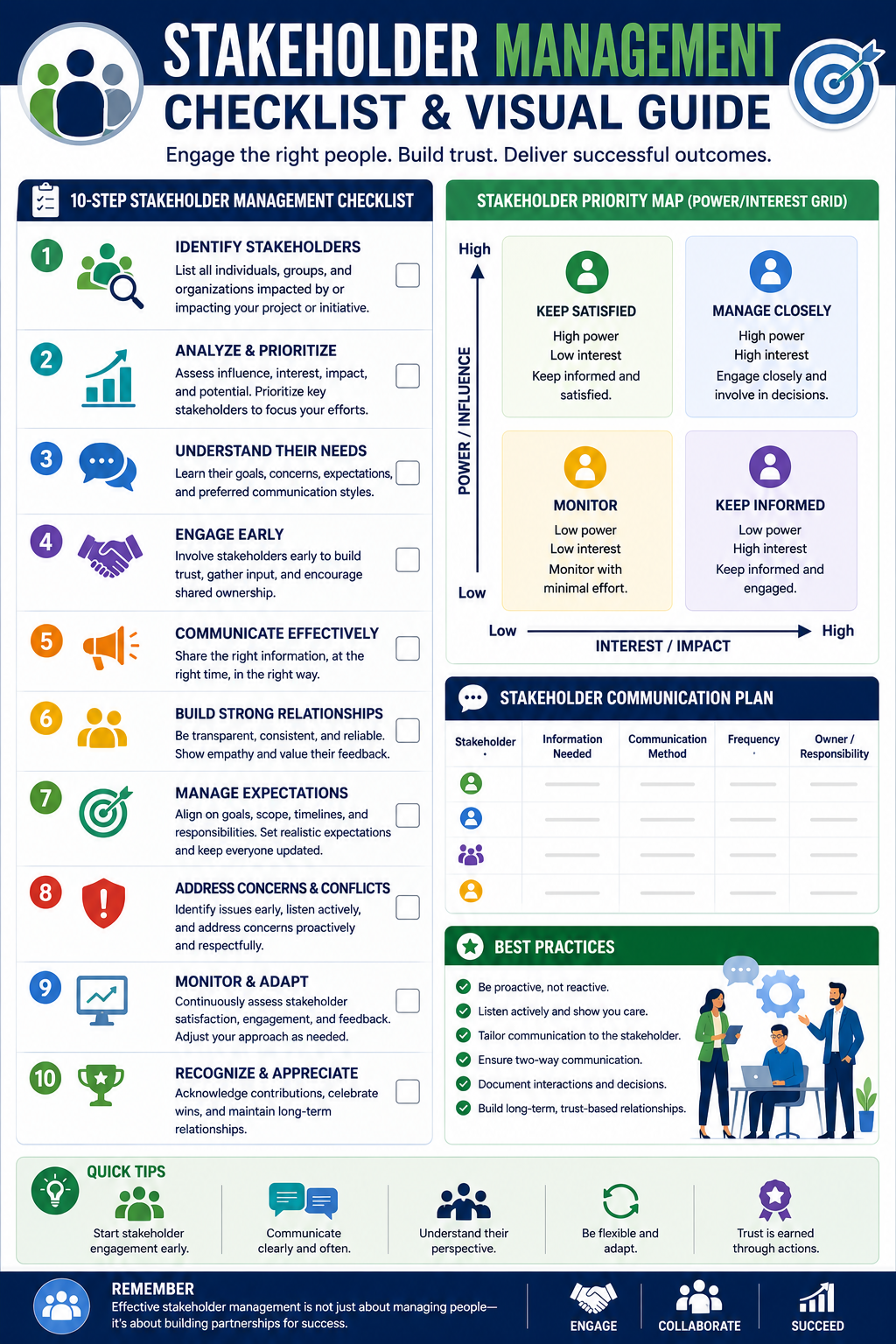
In project management, project managers often coordinate a project team, executives, vendors, and other key stakeholders whose priorities may not always match. At first glance, it may seem that every person should receive the same status updates, but not all stakeholders have the same high interest, high influence, or decision making authority. Strong stakeholder relations begin with identifying the appropriate stakeholders, understanding stakeholder needs, and creating meaningful engagement that supports a shared understanding of project goals, potential risks, available resources, and the project's progress. A stakeholder register can help clarify the key players, while strategically planning communication for different stakeholders, particularly those with greater influence, can improve collaboration and keep decisions moving for the right strategic reasons. This becomes even more important when leaders are overseeing multiple projects and balancing input from various stakeholders and other stakeholders across the organization. The goal is not simply more communication. It is to align the people who matter most, surface useful insights, support better decisions, and create the conditions for project success, a successful project, and measurable progress.
Frequently Asked Questions About Stakeholder Management and Executive Media Training
What is stakeholder management?
Stakeholder management is the process of identifying the people and groups affected by an initiative or communication, understanding their influence and expectations, and coordinating decisions and communication appropriately; the stakeholder management process focuses on the structure and systems used to coordinate decisions and communication.
Why does stakeholder management matter before a media interview?
A spokesperson may be communicating with employees, customers, investors, regulators, board members, and the public at the same time. Preparation helps the leader understand those audiences and maintain a consistent organizational position. In a project context, identifying stakeholders early helps prevent costly surprises once public scrutiny begins.
What is stakeholder analysis?
Stakeholder analysis identifies the groups affected by the communication and considers their priorities, influence, expectations, and information needs. Their interest and priorities can shift across the project lifecycle, so this analysis should be revisited as the situation develops.
What are decision rights?
Decision rights clarify who has authority to approve messages, make important organizational decisions, or determine how sensitive issues should be addressed.
What is influence mapping?
Influence mapping helps identify people or groups whose authority, knowledge, relationships, or reactions may significantly affect the organization or communication.
What is escalation in media preparation?
Escalation identifies when a question or issue needs to move to another leader, adviser, or decision-maker rather than being answered immediately by the spokesperson.
Does stakeholder alignment mean every leader must agree on everything?
No. Alignment means leadership has enough clarity about the organizational position, priorities, responsibilities, and approved direction to communicate consistently.
What does executive media training include?
Masterly Consulting Group currently provides customized media training that can include communication strategy, interview preparation, realistic practice, crisis communication, camera presence, message discipline, and stakeholder communication. Where relevant, we also apply stakeholder engagement best practices across planning, assessment, classification, engagement, and evaluation.
Who is Masterly Consulting Group's executive media training designed for?
The current program is designed for executives, attorneys, university leaders, healthcare executives, corporate spokespersons, public information officers, government officials, nonprofit leaders, board members, investor relations professionals, subject-matter experts, and crisis-response teams.
Discuss How to Improve Decision-Making and Stakeholder Alignment Across a Complex Initiative
When your leader or spokesperson faces the public, internal disagreements do not stay internal for long.
Unclear stakeholder management, conflicting priorities, undefined decision rights, and inconsistent communication can become visible through one difficult interview or poorly prepared statement.
Masterly Consulting Group provides customized executive media training that helps leaders prepare for high-visibility communication through strategy, interview preparation, realistic practice, crisis communication, stakeholder communication, and executive presence.
If your organization is preparing an executive, attorney, spokesperson, university leader, board member, or subject-matter expert for an important public appearance, prepare the stakeholder environment as carefully as the talking points.
Call Masterly Consulting Group at (972) 236-5051 to discuss how to improve decision-making, stakeholder alignment, and executive communication before the next high-visibility moment.