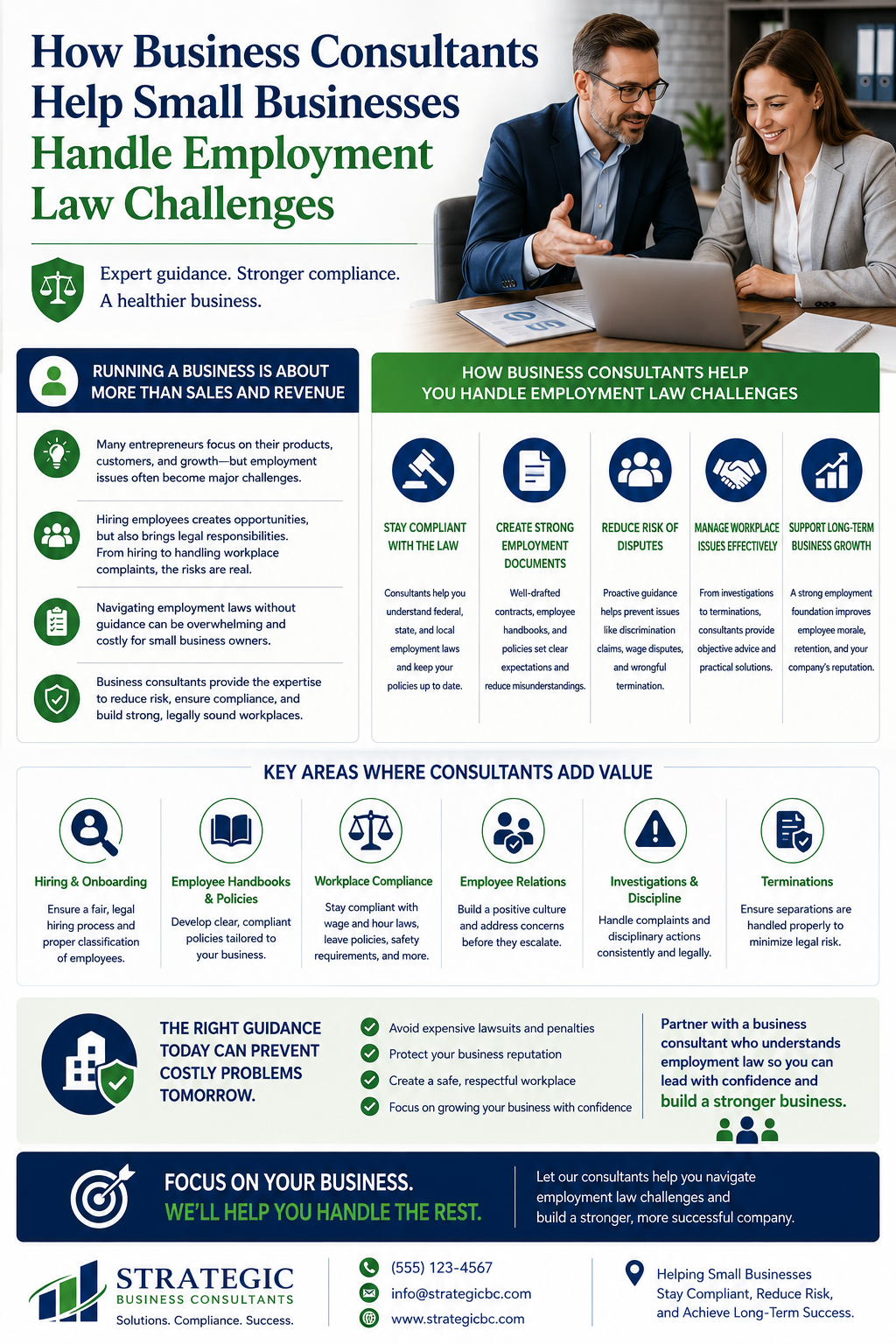
How Business Consultants Help Small Businesses Handle Employment Law Challenges
Running a Business Is About More Than Sales and Revenue
Many entrepreneurs start a company because they are passionate about a product, service, or idea. They often spend countless hours developing their offerings, building customer relationships, and growing revenue. What surprises many new owners is how quickly employment issues become one of the biggest challenges they face.
Hiring employees creates opportunities for growth, but it also introduces legal responsibilities. From recruiting workers and drafting agreements to responding to workplace complaints, employment-related issues can affect every aspect of a company. For many small business owners, navigating these requirements without guidance can feel overwhelming.
This is where experienced consultants become valuable. Business leaders frequently seek outside expertise to help them reduce risk, improve compliance, and create workplace practices that support long-term success. The right guidance can help companies avoid costly mistakes before they become serious problems.
Why Employment Law Matters for Small Business Growth
Employment laws exist to protect both employers and employees. While large corporations often have dedicated legal departments and extensive human resources teams, many small business organizations operate with limited internal support.
As a result, owners may unintentionally overlook important requirements related to hiring, employee classification, workplace conduct, or documentation. Even a simple oversight can create legal and financial challenges.
Business consultants help identify potential risks and provide practical advice designed to keep companies compliant while supporting growth objectives.
Small Businesses Face Unique Challenges
A growing small business often operates differently than large corporations. Owners wear multiple hats and may be responsible for hiring, payroll, marketing, operations, and customer service all at the same time.
Because responsibilities are spread across many functions, employment compliance can sometimes receive less attention than it deserves.
Professional consulting support helps business leaders remain focused on growth while reducing exposure to legal concerns.
The Cost of Employment Mistakes
Employment disputes can become expensive very quickly.
Potential costs may include:
- Legal fees
- Settlement expenses
- Lost productivity
- Damage to company reputation
- Increased employee turnover
Taking proactive steps is usually far less expensive than responding to a lawsuit after a problem occurs.
The Growing Role of Consultants in Modern Business
The consulting industry has expanded significantly over the past decade. Organizations increasingly rely on outside specialists to provide objective insights and solve complex problems.
Today's consultants assist companies in various areas including compliance, management, finance, marketing, technology, and workforce development.
For many business owners, working with experienced consultants provides access to knowledge and resources that may not exist internally.
Why Companies Turn to Consulting Firms
Many consulting firms specialize in helping organizations navigate challenges that require specialized skills.
Rather than hiring a full-time employee for every issue, businesses can access expert support when needed.
This approach often provides flexibility while controlling overall cost.
Accessing Expertise Without Expanding Payroll
One of the biggest advantages of consulting is access to expertise without permanently increasing staffing expenses.
Business owners can obtain strategic guidance while maintaining operational efficiency.
This flexibility makes consulting particularly attractive to growing businesses.
Understanding Employment Law Risks
Employment law affects nearly every stage of the employee lifecycle.
From the moment a company posts a job opening until an employee leaves the organization, numerous regulations may apply.
Understanding these obligations is essential for long-term business success.
Hiring Practices Require Careful Attention
The hiring process creates some of the earliest compliance obligations.
Employers must ensure recruiting practices are fair, consistent, and aligned with applicable laws.
Improper interview questions or inconsistent hiring procedures can create unnecessary risk.
Documentation Matters
Accurate records help protect both employers and employees.
Proper documentation demonstrates that decisions were made using objective criteria rather than improper considerations.
Business consultants frequently help organizations improve documentation procedures.
How Business Consultants Support Hiring Practices
Hiring the right people is one of the most important responsibilities facing any business owner.
Strong hiring decisions contribute to productivity, customer satisfaction, and workplace culture.
Poor hiring decisions often lead to turnover, performance issues, and legal concerns.
Creating Consistent Hiring Processes
One of the most valuable services consultants provide is helping companies create structured hiring procedures.
Standardized processes reduce bias and improve consistency across recruitment activities.
They also help organizations demonstrate compliance if questions arise later.
Developing Effective Job Descriptions
Clear job descriptions establish expectations before recruitment begins.
They help employers identify qualified candidates while providing objective criteria for hiring decisions.
Consultants often assist businesses in developing descriptions that accurately reflect job responsibilities.
Employment Applications and Legal Compliance
Many employers underestimate the importance of properly designed employment applications.
Questions that seem harmless may create compliance concerns depending on applicable laws.
Reviewing employment forms helps reduce unnecessary risk.
Eliminating Problematic Questions
Employment applications should focus on qualifications and job-related criteria.
Consultants often review forms to ensure they align with current employment standards.
This review process helps businesses avoid preventable mistakes.
Supporting Fair Hiring Practices
Fair hiring procedures strengthen workplace culture while reducing legal exposure.
Employees are more likely to trust organizations that demonstrate transparency and consistency.
Interview Processes and Employment Risk
Interviews provide valuable opportunities to evaluate candidates, but they can also create compliance concerns.
Managers may unintentionally ask questions that should not be part of the hiring process.
Providing training and guidance helps reduce these risks.
Structured Interviews Improve Consistency
Structured interviews use standardized questions and evaluation methods.
This approach helps ensure applicants are assessed fairly.
Consistent procedures also improve hiring outcomes.
Training Hiring Managers
Many supervisors receive little formal training regarding employment law.
Business consultants often offer training programs that help managers understand appropriate hiring practices.
This investment can reduce risk while improving recruitment quality.
Why Employment Contracts Matter
Employment agreements establish expectations between employers and employees.
A well-written contract helps clarify responsibilities, compensation, confidentiality obligations, and workplace policies.
These agreements often become important references if disputes arise later.
Defining Expectations Clearly
Clear contracts reduce misunderstandings.
Employees understand their obligations while employers gain greater clarity regarding workplace expectations.
This transparency benefits both parties.
Protecting Business Interests
Many businesses rely on contracts to protect proprietary information and customer relationships.
Consultants frequently work with clients to identify areas where additional protections may be appropriate.
Creating Workplace Policies That Support Compliance
Workplace policies help establish expectations regarding employee behavior and company procedures.
Without clear policies, employees may have different interpretations of acceptable conduct.
Consistent policies create structure and reduce confusion.
Employee Handbooks Provide Guidance
Employee handbooks help communicate workplace expectations.
Topics often include attendance, performance standards, workplace conduct, benefits, and complaint procedures.
Consultants assist organizations in developing policies that align with their specific needs.
Supporting Organizational Development
Strong workplace policies contribute to organizational development and long-term stability.
Employees perform better when expectations are clearly communicated.
Businesses also benefit from greater consistency across departments.
The Relationship Between Human Resources and Employment Law
Human resources plays a critical role in employment compliance.
Even smaller organizations without dedicated HR departments must address many of the same issues facing larger companies.
Business consultants frequently help bridge this gap.
Human Resources Challenges for Small Businesses
Smaller organizations often lack internal HR expertise.
As a result, managers may be responsible for handling employment concerns without adequate support.
Consulting professionals can provide guidance when internal resources are limited.
Improving Workplace Processes
Employment compliance often requires ongoing monitoring and process improvement.
Consultants help companies create systems that support consistency and accountability.
Why Strategic Planning Matters for Employment Compliance
Many employment problems occur because organizations react to issues rather than planning ahead.
Strategic planning allows businesses to identify potential risks before they become significant challenges.
This proactive approach often reduces both cost and stress.
Aligning Growth With Compliance
As businesses grow, employment obligations often become more complex.
Strategic planning helps ensure workforce practices evolve alongside organizational growth.
This alignment supports long-term success.
Preparing for Future Workforce Needs
Growth requires preparation.
Consultants help organizations create plans that address staffing, compliance, and operational objectives simultaneously.
These plans support sustainable expansion while reducing risk.
Discrimination Claims Can Create Significant Business Risks
Few workplace issues create more concern for employers than allegations of discrimination. Even when claims ultimately lack merit, they can consume valuable time, financial resources, and management attention.
Small business owners are often surprised by how quickly a workplace complaint can escalate into a formal investigation. This is why proactive planning and proper workplace policies are so important.
Experienced consultants help organizations identify potential vulnerabilities before they become larger problems.
Understanding Workplace Discrimination
Discrimination claims often arise when employees believe they were treated unfairly during hiring, promotion, compensation, discipline, or termination decisions.
Whether the claim involves age, race, gender, disability, religion, or another protected characteristic, employers must be prepared to demonstrate that employment decisions were based on legitimate business factors.
Proper documentation often plays a critical role in defending employment actions.
Consistency Reduces Risk
One of the most effective ways to reduce discrimination concerns is maintaining consistency.
When managers apply policies uniformly and document decisions appropriately, businesses are better positioned to address questions if they arise later.
Addressing Harassment Complaints Before They Escalate
Workplace harassment allegations can damage employee morale, disrupt operations, and expose businesses to legal liability.
Many organizations mistakenly assume that harassment issues only occur in large corporations. In reality, businesses of every size can face these challenges.
Taking complaints seriously demonstrates a commitment to maintaining a professional workplace.
Creating Clear Reporting Procedures
Employees should understand how to report workplace concerns.
Clear reporting channels encourage individuals to raise issues before they become more serious.
Consultants frequently help organizations develop complaint procedures that support fairness and accountability.
Investigating Complaints Promptly
Delays often make workplace problems worse.
Prompt investigations help businesses gather accurate information while demonstrating a commitment to addressing employee concerns.
Why Employee Training Matters
Many workplace issues can be prevented through proper education and communication.
Training helps employees understand expectations while providing managers with tools to address challenges appropriately.
A proactive approach often reduces risk significantly.
Building Awareness Across the Organization
Training programs may cover topics such as:
- Workplace conduct
- Anti-harassment policies
- Reporting procedures
- Leadership responsibilities
- Documentation standards
These initiatives help create a more informed workforce.
Helping Managers Respond Effectively
Supervisors are often the first individuals to receive complaints.
Providing training helps ensure managers understand how to respond appropriately and consistently.
How Consultants Help Businesses Develop Compliance Programs
Effective compliance programs are rarely created overnight.
Successful programs require planning, evaluation, and ongoing improvements.
Business consultants assist organizations by identifying risks and developing practical solutions tailored to their operations.
Assessing Existing Policies
Before recommending changes, consultants often assess current workplace practices.
This evaluation helps identify strengths, weaknesses, and opportunities for improvement.
The findings provide a foundation for future development.
Creating Action Plans
Once risks have been identified, consultants help create action plans designed to address specific needs.
These plans often include policy revisions, training initiatives, documentation improvements, and management guidance.
The Importance of Documentation in Employment Matters
Documentation remains one of the strongest tools available to employers.
Accurate records help demonstrate that employment decisions were based on objective criteria rather than personal opinions or improper considerations.
Strong documentation also supports transparency.
Performance Evaluations Matter
Regular performance reviews help establish clear expectations.
They provide employees with feedback while creating records that support future employment decisions.
Maintaining Employment Records
Organizations should maintain records related to hiring, promotions, discipline, training, and performance.
These materials often become important if disputes arise.
How Management Consulting Firms Support Employment Compliance
Many management consulting firms assist organizations with employment-related concerns as part of broader operational improvement initiatives.
These firms combine expertise in leadership, compliance, management, and organizational performance.
Their objective is often to help businesses operate more effectively while reducing risk.
Looking Beyond Immediate Problems
Rather than focusing solely on individual complaints, management consulting firms often evaluate broader workplace systems.
This approach helps identify underlying issues that may contribute to recurring challenges.
Supporting Organizational Improvement
Long-term success often requires continuous improvement.
Consultants help organizations strengthen workplace practices while supporting overall business objectives.
Employment Policies Should Align With Business Goals
Employment compliance should not exist separately from business strategy.
The most effective organizations align workplace practices with broader organizational goals.
This approach supports both compliance and growth.
Integrating Compliance Into Operations
Employment considerations influence many aspects of business operations.
Hiring, training, supervision, and performance management all contribute to organizational success.
Supporting Sustainable Growth
Businesses that establish strong employment practices early often experience fewer disruptions as they expand.
This foundation supports long-term development.
The Role of Market Research in Workforce Planning
Many employers associate market research with customer acquisition, but it can also influence workforce decisions.
Understanding labor market conditions helps organizations make informed hiring and compensation decisions.
Research-driven planning supports stronger outcomes.
Evaluating Workforce Trends
Market research helps businesses understand industry conditions, compensation expectations, and workforce availability.
This information supports better staffing decisions.
Improving Recruitment Strategies
Organizations that understand labor market dynamics often attract stronger candidates.
Research can help businesses refine recruitment efforts and improve results.
Why Business Plans Should Address Employment Issues
A comprehensive business plan should include workforce considerations.
Many entrepreneurs focus heavily on revenue goals while overlooking employment requirements.
Addressing workforce needs early reduces future challenges.
Planning for Future Hiring
Business plans should consider projected staffing requirements.
Growth often creates new hiring needs that require preparation.
Aligning Workforce and Business Objectives
Employment planning supports broader organizational goals.
When workforce strategies align with growth objectives, businesses are often better positioned for success.
Employee Discipline Requires Consistency and Documentation
One of the most challenging responsibilities for any business owner is managing employee performance issues. While many leaders want to give employees opportunities to improve, they must also protect the organization from unnecessary risks.
Inconsistent discipline practices can create confusion and increase the likelihood of workplace disputes. A structured process helps employees understand expectations while providing documentation that supports management decisions.
Business consultants often help organizations develop discipline procedures that are fair, consistent, and aligned with company goals.
Creating Clear Performance Standards
Employees perform best when they understand what success looks like.
Clearly defined expectations help reduce misunderstandings and provide a framework for evaluating performance. This approach supports accountability throughout the organization.
Managing Difficult Conversations
Many managers receive little formal training on handling disciplinary discussions.
Consultants can offer training and practical advice that helps supervisors address performance concerns professionally and effectively.
Contract Management Helps Reduce Employment Risks
Employment-related agreements play an important role in protecting both businesses and employees.
A well-structured contract can define responsibilities, compensation terms, confidentiality expectations, and other important workplace obligations. These agreements help reduce ambiguity and provide clarity during disputes.
Strong contract management is often an overlooked component of employment compliance.
Reviewing Existing Agreements
Businesses should periodically review employment agreements to ensure they remain relevant and aligned with current operations.
As organizations grow, workplace expectations and responsibilities often change.
Supporting Compliance Objectives
A properly drafted contract supports transparency and helps establish consistent expectations throughout the workforce.
This structure benefits both employers and employees.
Why Risk Management Matters for Small Businesses
Risk management involves identifying potential challenges before they become costly problems.
Employment-related issues represent one of the most significant risks facing growing companies. Proactive planning helps organizations address concerns before they disrupt operations.
Consultants frequently help businesses evaluate vulnerabilities and implement practical solutions.
Identifying Workplace Risks
Common employment risks may include:
- Inconsistent policies
- Inadequate training
- Poor documentation
- Unclear reporting procedures
- Compliance gaps
Addressing these concerns early often prevents larger issues later.
Building a Prevention-Focused Culture
The most successful organizations focus on prevention rather than reaction.
A proactive mindset helps businesses reduce legal exposure while improving workplace stability.
Project Management Supports Workplace Improvements
Implementing new employment policies or compliance initiatives often requires careful coordination.
Project management principles help organizations execute these changes efficiently while minimizing disruption.
Consultants frequently assist with planning, implementation, and evaluation activities.
Coordinating Multiple Initiatives
Employment improvements may involve policy updates, training programs, documentation changes, and technology upgrades.
Project management helps ensure these activities remain organized and aligned.
Improving Accountability
Clearly defined responsibilities help organizations track progress and maintain momentum throughout improvement efforts.
The Role of Technology in Employment Compliance
Modern businesses rely heavily on technology to manage workforce activities.
From recruiting platforms and payroll systems to employee communication tools, technology influences many aspects of employment management.
Selecting the right systems can improve efficiency while supporting compliance objectives.
Using Technology to Improve Processes
Digital tools help businesses streamline documentation, training, scheduling, and reporting functions.
These improvements often reduce administrative burdens while increasing consistency.
Supporting Organizational Growth
As companies expand, technology becomes increasingly important.
Effective systems help businesses manage larger workforces without sacrificing oversight.
Information Technology and Workforce Management
Information technology plays a vital role in protecting employee data and maintaining operational efficiency.
Businesses must ensure that sensitive workforce information is handled appropriately and stored securely.
Consultants often provide guidance regarding information technology practices that support compliance and risk management.
Protecting Employee Information
Employment records frequently contain sensitive personal and financial information.
Proper safeguards help organizations protect this data while maintaining trust.
Improving Operational Efficiency
Technology solutions can reduce manual processes and improve overall management effectiveness.
This efficiency often supports better decision-making across the organization.
How Management Consultants Help Businesses Solve Complex Problems
Management consultants assist organizations in addressing challenges that affect performance, compliance, and growth.
Unlike narrowly focused advisors, management consultants often evaluate broader organizational issues and recommend comprehensive solutions.
Their work frequently spans multiple departments and operational functions.
Bringing an Objective Perspective
Internal teams sometimes struggle to identify underlying causes of workplace problems.
An external perspective can reveal opportunities that might otherwise be overlooked.
Supporting Long-Term Success
Management improvements often produce benefits that extend beyond immediate compliance concerns.
Stronger systems support stability, productivity, and future growth.
The Consulting Industry Continues to Evolve
The consulting industry has expanded significantly as businesses face increasingly complex challenges.
Organizations now seek support in areas ranging from workforce compliance and leadership development to technology integration and operational improvement.
This growth reflects the increasing value of specialized expertise.
Demand for Specialized Knowledge
Businesses often require assistance with issues that fall outside their core competencies.
Consultants provide access to specialized knowledge without requiring permanent staffing increases.
Expanding Service Areas
The consulting industry continues developing new solutions to meet changing business needs.
This evolution helps organizations remain competitive in a rapidly changing environment.
Why Consulting Firms Offer Broad Business Support
Many consulting firms provide services that extend beyond employment compliance.
Clients often seek assistance with strategic planning, operations, workforce development, and organizational improvement initiatives.
This broader perspective helps businesses address interconnected challenges.
Addressing Multiple Business Functions
Employment issues rarely exist in isolation.
They often influence management, operations, accounting, marketing, and overall business performance.
Supporting Comprehensive Solutions
By evaluating multiple business functions, consulting firms help organizations create more effective long-term strategies.
Business Growth Creates New Employment Challenges
Growth is exciting, but it often introduces new responsibilities.
As organizations expand, workforce management becomes increasingly complex. New hiring needs, supervisory responsibilities, and compliance obligations require additional attention.
Planning ahead helps businesses navigate these transitions successfully.
Scaling Workforce Practices
Procedures that work for a small team may not be sufficient as a company grows.
Businesses must continuously evaluate and update their practices.
Aligning Growth With Compliance
Organizations that align growth initiatives with compliance objectives are often better positioned for long-term success.
How Strategic Planning Supports Workforce Expansion
Strategic planning helps businesses prepare for future workforce needs while minimizing risk.
Rather than reacting to staffing challenges as they arise, organizations can create plans that support sustainable growth.
This approach improves decision-making and resource allocation.
Developing Workforce Plans
Workforce planning helps businesses anticipate future hiring requirements.
These plans support smoother expansion efforts.
Connecting Workforce and Business Goals
Employment strategies should align with broader organizational objectives.
This alignment helps create stronger outcomes across multiple areas.
The Value of Industry Expertise
Every industry faces unique workforce challenges.
Consultants with relevant industry experience often provide practical insights that help organizations avoid common mistakes.
Industry expertise can accelerate problem-solving and improve results.
Learning From Real-World Experience
Industry experts have often worked with organizations facing similar challenges.
Their experience provides valuable perspective and actionable recommendations.
Applying Proven Solutions
Businesses benefit when successful strategies can be adapted to their specific circumstances.
Relevant expertise often shortens the learning curve.
Why Small Business Consultants Are Valuable Partners
Many small business consultants focus specifically on helping entrepreneurs overcome operational and workforce challenges.
Their services often combine compliance guidance, management support, and strategic planning.
This combination provides meaningful value for growing organizations.
Helping Small Business Owners Focus on Growth
Business owners frequently spend significant time addressing employment concerns.
Consultants help reduce that burden by providing practical guidance and support.
Creating Stronger Foundations
Well-structured policies, procedures, and workforce practices support long-term stability and success.
Business Consultant Dallas Companies Often Seek for Growth Support
Many organizations searching for a business consultant Dallas businesses trust are looking for guidance that goes beyond basic problem-solving.
They want experienced professionals who understand how employment practices, management systems, and strategic planning affect overall performance. By working with knowledgeable advisors, companies can build stronger workplace foundations while preparing for future opportunities.
The right consultant helps organizations make informed decisions that support both compliance and growth.
Research and Data Improve Business Decisions
Strong employment strategies should be supported by data whenever possible.
Research helps organizations understand workforce trends, industry benchmarks, and emerging challenges.
This information supports more informed business decisions.
Using Research to Identify Opportunities
Workforce research can reveal opportunities for improvement in recruiting, retention, and employee engagement.
These insights help businesses remain competitive.
Supporting Better Business Decisions
Organizations that rely on data rather than assumptions are often better equipped to address workforce challenges successfully.
Accounting and Finance Considerations in Employment Decisions
Employment decisions affect far more than staffing levels. They also influence budgeting, profitability, and long-term financial performance.
Successful businesses evaluate accounting and finance considerations before making significant workforce changes. Understanding compensation expenses, benefits costs, and training investments helps organizations make informed decisions.
Consultants often help clients align workforce planning with financial objectives.
Balancing Growth and Cost
Every hiring decision carries a financial commitment.
Business leaders must evaluate salary expenses, benefits, insurance obligations, and operational requirements when planning future growth.
Using Financial Data to Guide Decisions
Reliable financial information helps organizations identify opportunities while avoiding unnecessary risks.
Strong planning often results in better business decisions and improved operational stability.
Consultancy Services Help Businesses Adapt to Change
The modern business environment continues to evolve rapidly.
Many organizations seek consultancy support when navigating workforce challenges, regulatory changes, or periods of expansion. Consultants bring experience from multiple industries and provide objective recommendations that support organizational success.
Effective consultancy relationships often create long-term value.
Addressing Specific Needs
Every company faces unique challenges.
Consultants tailor recommendations to address specific needs rather than relying on generic solutions.
Providing Practical Guidance
Businesses benefit most from solutions that can be implemented effectively.
Practical advice helps leaders move forward with confidence.
Marketing Strategies Influence Hiring Success
Many business owners do not immediately connect marketing and recruiting efforts.
However, effective marketing strategies often improve an organization's ability to attract qualified candidates. A strong employer reputation can make recruitment easier and reduce hiring challenges.
Workplace culture frequently influences both customer perception and employee interest.
Building an Employer Brand
Organizations that communicate their values clearly often attract stronger applicants.
Candidates want to work for businesses that demonstrate professionalism and stability.
Supporting Recruitment Goals
Marketing efforts can complement hiring initiatives by increasing awareness and visibility.
This approach often strengthens recruitment outcomes.
Why Networking Matters for Business Growth
Successful businesses rarely operate in isolation.
Building a strong professional network helps organizations access valuable resources, identify opportunities, and solve problems more effectively.
Consultants often help companies expand their professional connections.
Creating Valuable Relationships
A strong network may include legal professionals, accountants, technology providers, industry leaders, and strategic partners.
These relationships can provide support when challenges arise.
Connecting With Industry Professionals
Networking events, professional associations, and industry groups often create opportunities to connect with individuals who offer valuable insights.
These relationships can contribute to long-term success.
Acquisitions and Employment Planning
Growth sometimes occurs through acquisitions rather than organic expansion.
When organizations acquire other companies, employment issues often become a significant consideration.
Proper planning helps reduce disruptions during transitions.
Evaluating Workforce Impacts
Acquisitions may affect reporting structures, policies, compensation systems, and workplace culture.
Careful evaluation helps organizations prepare for these changes.
Supporting Smooth Transitions
Consultants help businesses develop plans that support integration efforts while minimizing disruption.
Consulting Firms Provide Access to Industry Experts
One reason businesses work with consulting firms is access to experienced professionals with diverse backgrounds.
Industry experts bring valuable perspectives that can help organizations address challenges more efficiently.
Their insights often help companies avoid costly mistakes.
Learning From Broader Experience
Consultants frequently work with multiple organizations facing similar issues.
This experience allows them to identify practical solutions quickly.
Applying Best Practices
Businesses benefit when proven methods can be adapted to their specific circumstances.
This approach often improves results while reducing uncertainty.
How Consulting Expertise Focuses on Long-Term Success
The most effective consulting relationships extend beyond solving immediate problems.
Consulting expertise focuses on helping organizations build stronger systems, improve decision-making, and create sustainable growth strategies.
This long-term perspective often produces meaningful business improvements.
Building Strong Foundations
Successful organizations rely on strong leadership, clear policies, and effective management systems.
Consultants help create those foundations.
Supporting Future Development
Long-term planning allows businesses to prepare for future challenges while pursuing growth opportunities.
Why Organizations Need Access to Specialized Skills
Modern business challenges often require specialized skills that may not exist internally.
Rather than hiring full-time specialists for every issue, organizations can access targeted expertise through consulting relationships.
This approach offers flexibility while controlling expenses.
Solving Complex Problems
Specialized knowledge often accelerates problem-solving.
Businesses can benefit from expertise in compliance, management, technology, and workforce development.
Improving Organizational Effectiveness
Targeted expertise helps organizations improve performance while supporting strategic goals.
Technology Continues to Transform Workforce Management
Technology influences nearly every aspect of modern business operations.
From recruiting systems and training platforms to performance management tools, technology helps organizations improve efficiency and maintain consistency.
Businesses that leverage technology effectively often gain competitive advantages.
Streamlining Administrative Functions
Automation can reduce repetitive tasks and improve accuracy.
This allows leaders to focus on higher-value activities.
Supporting Better Decision-Making
Technology provides data and insights that support stronger management decisions.
Why Small Business Owners Benefit From Outside Perspectives
Even experienced leaders can become so focused on daily responsibilities that they overlook potential opportunities or risks.
Outside advisors provide fresh perspectives that help organizations evaluate challenges objectively.
This perspective often leads to stronger outcomes.
Seeing Beyond Immediate Problems
Consultants help identify root causes rather than simply addressing symptoms.
This approach supports more effective solutions.
Encouraging Better Business Decisions
Objective analysis often improves strategic thinking and decision-making processes.
Organizations benefit from informed recommendations supported by experience and research.
Lessons From Leading Management Consulting Firms
Many respected management consulting firms have demonstrated the value of strategic planning, workforce development, and organizational improvement.
Organizations such as the Boston Consulting Group have shown how data-driven decision-making and long-term planning can support sustainable growth.
While small businesses face different challenges than large corporations, many of the same principles apply.
Adapting Proven Concepts
Smaller organizations can benefit from structured planning and process improvement initiatives.
These practices often improve efficiency and reduce risk.
Applying Strategies at Any Size
Effective management principles can support organizations regardless of size or industry.
Masterly Consulting Group Helps Businesses Navigate Employment Challenges
Employment law issues can be intimidating for any business owner. Hiring decisions, workplace policies, employee complaints, contract management, and compliance concerns all require careful attention. The reality is that many businesses do not have the internal resources needed to manage these responsibilities effectively.
At Masterly Consulting Group, we help businesses develop practical solutions for workforce challenges while supporting long-term organizational success. Our consulting expertise focuses on helping clients improve management practices, strengthen compliance efforts, enhance workplace policies, and create strategies that support sustainable growth.
Whether your organization needs assistance with strategic planning, workforce development, compliance reviews, management improvements, hiring practices, or operational guidance, our team is committed to helping you make better business decisions with confidence.
Protect Your Business Before Problems Become Costly
Many employment disputes can be avoided through proper planning, consistent policies, and proactive management. Waiting until a complaint, investigation, or lawsuit occurs often increases both financial and operational challenges.
Businesses that invest in planning today are often better prepared to navigate tomorrow's challenges. By working with experienced consultants, organizations gain access to knowledge, resources, and expertise that support long-term success.
If you are interested in strengthening your employment practices, improving workplace compliance, or developing strategies that support growth, Masterly Consulting Group is ready to help.
Comprehensive Consulting Services Support Employment Compliance
Many businesses seek professional consulting services because employment challenges often affect multiple departments and operational functions. From hiring procedures and workplace policies to employee relations and compliance concerns, consultants provide guidance that helps organizations reduce risk and improve efficiency. By taking a proactive approach, businesses can strengthen internal processes while creating a more stable work environment. The right consulting support helps companies address immediate concerns while preparing for future growth.
Why Financial Projections Matter When Expanding Your Workforce
Hiring decisions should never be made without considering long-term financial impact. Accurate financial projections help business leaders evaluate payroll obligations, benefits expenses, training investments, and future staffing requirements. These projections provide valuable insight into how workforce expansion may affect profitability and operational stability. Organizations that incorporate financial planning into their employment strategies are often better positioned to support sustainable growth.
Handling Employee Matters in a Strictly Confidential Manner
Employment-related issues frequently involve sensitive information that must be handled with care. Whether addressing workplace complaints, disciplinary actions, or personnel concerns, businesses should treat these matters as strictly confidential whenever possible. Maintaining confidentiality helps protect employee privacy, preserve workplace trust, and reduce the risk of unnecessary conflict. Consultants often help organizations develop procedures that ensure sensitive information is managed appropriately.
Employment Compliance Affects Various Aspects of a Business
Employment law does not operate independently from the rest of an organization. Compliance requirements can influence various aspects of business operations, including hiring, management, training, compensation, performance evaluations, and workplace culture. Understanding how these areas connect helps organizations create stronger policies and more effective management practices. A comprehensive approach often produces better long-term results.
Using Related Information to Make Better Decisions
Strong decision-making depends on accurate data and related information gathered from multiple sources. Employment records, performance evaluations, workforce trends, and compliance reviews all provide valuable insights that support informed management decisions. Businesses that evaluate relevant information carefully are often better equipped to identify risks and implement effective solutions. This analytical approach supports both compliance and operational success.
Addressing General Questions Before Problems Escalate
Many workplace issues begin with simple misunderstandings or unresolved concerns. Encouraging employees to ask general questions about workplace policies, expectations, and reporting procedures can prevent minor issues from becoming larger disputes. Open communication helps create transparency and strengthens trust throughout the organization. Consultants frequently recommend clear communication channels as part of a comprehensive compliance strategy.
Employment Issues Often Affect Other Areas of the Organization
Workforce challenges rarely exist in isolation. Employment decisions frequently impact other areas of the business, including accounting, operations, customer service, marketing, and long-term strategic planning. When organizations recognize these connections, they can develop more effective solutions that support broader business objectives. A coordinated approach often leads to stronger outcomes across the company.
Every Person Plays a Role in Workplace Compliance
Workplace compliance is not solely the responsibility of ownership or management. Every person within the organization contributes to creating a professional and respectful work environment. Employees, supervisors, executives, and support staff all play important roles in maintaining workplace standards. Clear expectations and ongoing training help ensure everyone understands their responsibilities.
Why Location Can Influence Employment Requirements
Employment laws and regulations may vary depending on the organization's location and operational structure. Businesses operating in multiple jurisdictions often face additional compliance considerations that require careful attention. Understanding how local requirements affect workplace policies helps reduce risk and support consistency. Consultants can help organizations evaluate these obligations and develop appropriate responses.
An Example of Proactive Employment Planning
As an example, consider a growing company preparing to double its workforce over the next year. Rather than waiting for hiring challenges or employee complaints to arise, leadership works with consultants to review policies, update documentation, improve training programs, and strengthen reporting procedures. This proactive approach reduces risk while creating a stronger foundation for future growth. Planning ahead often proves far less costly than responding to problems after they occur.
Specialized Fields Such as Engineering Have Unique Workforce Challenges
Industries such as engineering often face specialized employment concerns related to recruiting qualified professionals, managing technical teams, and maintaining compliance across complex projects. These organizations frequently require customized workforce strategies that address industry-specific challenges. Consultants with relevant experience can help businesses develop practical solutions that align with both operational goals and compliance requirements.
Contact Masterly Consulting Group for a Free Consultation
Every business faces unique workforce challenges. Whether you are hiring your first employee, expanding operations, updating workplace policies, or addressing employment-related concerns, having the right guidance can make a significant difference.
Contact Masterly Consulting Group at (888) 209-4055 to book a free consultation. Our team will answer your questions, discuss your goals, and help identify practical solutions tailored to your organization's needs. We are committed to helping businesses create stronger workplaces, reduce risk, and build a foundation for long-term success.