Strategy Execution: Turning Priorities Into Measurable Work
Leadership teams often know what they want the business to achieve. They may want to increase qualified leads, improve customer retention, enter a new market, strengthen operations, or create more reliable reporting.
The difficulty begins when those goals must become daily work.
Priorities remain in presentations. Employees receive different instructions. Projects begin without clear owners. Technology is added without a defined purpose. Leadership meetings focus on activity, but no one can clearly explain whether the strategy is working.
Effective strategy execution connects business priorities with specific initiatives, owners, systems, measures, and review points. It helps the organization move from broad goals to coordinated action.
Masterly Tech provides done-for-you strategy execution support for founders and leadership teams solving growth and operating problems. We help translate priorities into measurable work, connect the required systems, and create practical visibility into progress.
When a Strong Strategy Fails to Reach Daily Work
A company can have a thoughtful strategic plan and still struggle to produce results. In fact, many organizations find that strategy breaks down not in planning, but in execution.
Leadership teams often know the organization's strategy and the strategic goals they want the business to achieve. Yet organizations struggle when teams interpret priorities differently, and poor communication makes it harder for everyone to stay on the same page.
As the gap between planning and action grows, the organization becomes busy without becoming more effective. This is one of the most common challenges in strategy execution, and a key reason organizations fail to turn direction into results.
Common signs of weak strategy execution include:
- Too many priorities competing for attention
- Projects without clear owners
- Goals that are not connected to measurable outcomes
- Employees who do not understand how their work supports the plan
- Systems that cannot provide reliable progress data
- Meetings focused on updates instead of decisions
- Initiatives that remain active long after they stop adding value
- Departments working toward conflicting objectives
- Leadership changing direction before results can be evaluated
- Important work depending on spreadsheets and personal reminders
The problem is often not a lack of effort. It is a lack of structure connecting the strategy to the work, including translating a strategic vision into measurable work.
Strategy Execution Requires Clear Strategic Objectives and Priorities
When every goal is described as urgent, teams cannot determine what matters most.
A business may want to increase revenue, improve service, launch a new offer, update its CRM, strengthen reporting, reduce costs, and automate internal processes at the same time. Each goal may be valid, but the organization may not have the capacity to pursue all of them equally.
Masterly Tech helps leadership teams set clear goals and define strategic objectives so the business can keep strategic focus on the work that best supports overall organizational goals. We examine the expected business outcome, the work involved, the systems affected, and the resources required, including resource allocation decisions and the practical demands of allocating resources across competing initiatives.
Clear priorities allow the organization to make better decisions about time, budget, technology, and employee capacity. They also make it easier to stop projects that do not support the agreed direction and protect long-term competitive advantage.
Strong strategic execution does not depend on doing everything. It depends on completing the right work in the right order.
Why Poor Execution Affects the Brand and Business
Customers do not experience a company’s strategic plan. They experience the way the business operates.
If leadership sets clear goals or strategic objectives around faster response times but inquiries still sit unanswered, customers experience the execution gap. If the company promises a consistent service but each department follows a different process, the brand feels unreliable.
Poor execution can lead to:
- Delayed customer responses
- Inconsistent service delivery
- Missed revenue opportunities
- Repeated operational problems
- Employee frustration
- Unnecessary technology costs
- Weak leadership reporting
- Reduced trust across teams
The impact can extend beyond one project. Employees may become less confident in new initiatives if previous plans were announced but never completed. Leaders may also begin making decisions based on incomplete or outdated information, which increases risk and makes it harder to adapt when priorities shift.
Masterly Tech helps leadership teams clarify strategic focus and improve resource allocation when deciding what needs immediate action, so teams are not pulled in too many directions at once. Clear priorities allow the organization to make better decisions in support of organizational goals and long-term competitive advantage.
A dependable execution structure helps the organization protect its reputation by making sure its operations support its promises.
Turn Strategic Priorities Into Defined Initiatives
Broad goals do not provide enough direction for employees to act.
A goal such as “improve customer experience” may involve website changes, faster lead routing, revised onboarding, new service standards, CRM updates, and employee training. Without clear boundaries, teams may work on different parts of the problem without creating a connected result. Weak execution also increases business risk: by 2026, strategic drift may cost organizations $1.4 trillion annually.
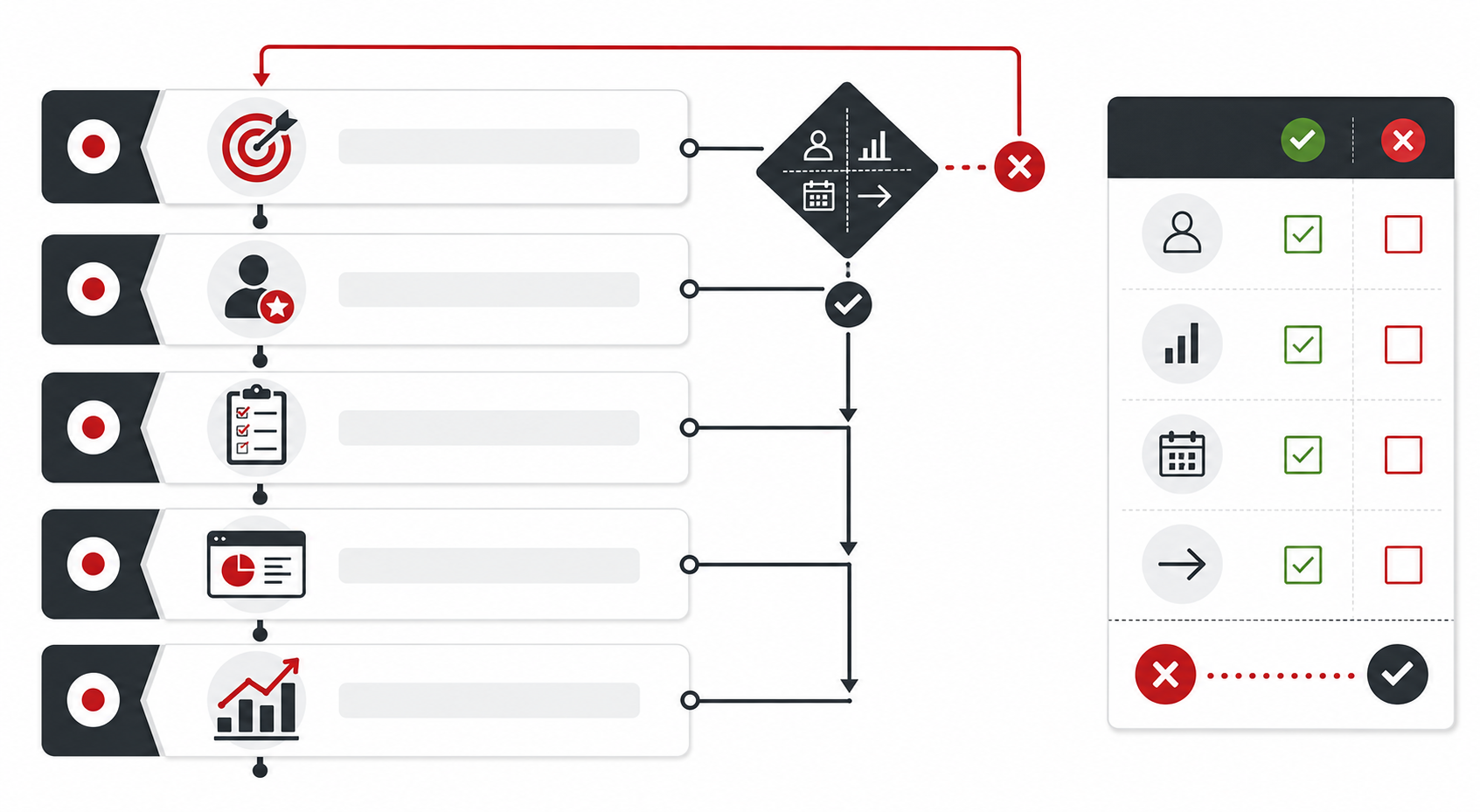
Masterly Tech helps convert priorities into defined strategic initiatives. For successful strategy execution, each initiative should have a clear purpose, owner, expected outcome, time frame, and connection to the strategy.
This structure covers the key components needed to turn plans into execution:
- The business problem being addressed
- The desired result
- The work included in the initiative
- The work outside the current scope
- The person responsible for progress
- The teams and systems involved
- Important decision points
- Measures of success
- Risks and dependencies
- Review dates
Defined initiatives allow leadership to see whether the organization is executing strategy or simply completing unrelated tasks. Clear, transparent communication also builds team trust, reduces confusion, and keeps effort aligned to strategic outcomes during strategy execution.
Strategy Implementation Needs Clear Ownership and Resource Allocation
A project can involve several departments without having one clear owner.
Marketing may depend on sales. Sales may depend on operations. Operations may depend on technology. When responsibility is spread across the entire organization, important decisions may belong to no one.
Clear ownership does not mean one person completes every task. It means one person is responsible for coordinating the work, raising issues, and reporting progress so employees understand how their efforts contribute to strategic outcomes.
Masterly Tech helps business leaders define ownership for successful strategy execution across strategic initiatives, tasks, systems, and decisions. This reduces confusion about who should act and who has authority to approve a change.
Each initiative should have a clear purpose, owner, expected outcome, time frame, and connection to the strategy’s strategic outcomes.
Effective strategy implementation also requires leadership ownership. Senior leaders must resolve conflicts between priorities, protect needed resources, and make decisions when a project reaches a barrier.
Without that support, teams may understand the strategy but remain unable to carry it out.
Connect Systems to Strategic Work
Technology should support strategy execution rather than operate as a separate set of projects.
If the company wants to improve lead conversion, its website, forms, CRM, automation, and reporting systems may all need to support the same process. If business leaders want better customer retention, the entire organization may need reliable customer status, service records, follow-up workflows, and performance data aligned around the same priorities.
Masterly Tech reviews whether the current systems can support the agreed priorities. We identify where data, automation, reporting, platform configuration, or missing capabilities may be blocking progress and limiting operational excellence.
Our work may involve:
- CRM stages and ownership
- Website lead capture
- Workflow automation
- Marketing and sales handoffs
- Data standards
- Internal notifications
- Project tracking
- Customer onboarding
- Reporting dashboards
- System integrations
The goal is not to add technology to every initiative. It is to make sure the necessary tools support the intended business process, so ownership is clear and employees understand how their efforts contribute.
Measure Outcomes Instead of Activity Alone
Teams often report completed tasks because tasks are easy to count.
They may report the number of emails sent, pages created, meetings held, or workflows launched. These measures show activity, but they do not always show whether the strategy produced a useful result.
A project to improve lead response should measure more than whether a CRM workflow was installed. Leadership may also need to know how quickly qualified leads receive contact, how many receive follow-up, and whether more opportunities move forward. In OKR-based planning, that is where key results help teams track meaningful progress instead of just completed activity.
Masterly Tech helps connect strategic priorities with practical measures and close the gap between strategy and execution. We distinguish between work completed, early signs of progress, and business outcomes.
Useful measures should help leadership answer questions such as:
- Is the initiative moving toward its intended result?
- Are teams completing the most important work?
- Where is progress delayed?
- Which assumptions are proving incorrect?
- Are the systems producing reliable data?
- Does the initiative still support the business priority?
- What decision is needed next?
Masterly Tech reviews whether the current systems can support the capabilities required for execution and operational excellence. We identify where data, automation, reporting, or platform configuration may be blocking progress. That matters because 15% of software projects fail entirely due to execution issues.
Clear measurement allows leaders to make informed adjustments instead of waiting until the end of a project to learn that it did not work.
Create a Useful Review Rhythm for Continuous Improvement
Strategy execution needs regular review, but more meetings do not guarantee better oversight.
A useful review should focus on progress, risks, decisions, and next steps. It should not become a long list of task updates that could have been shared elsewhere.
Nearly 60% of senior executives struggle to bridge strategy and execution without clear measures.
Masterly Tech helps connect strategic priorities with practical measures so leadership can track progress, compare results with targets, and see where decisions are needed. Masterly Tech helps establish a practical review rhythm based on the size and urgency of the initiative. Some work may require weekly review, while longer-term priorities may be reviewed monthly or quarterly as conditions evolve.
A clear review structure can show:
- Current status
- Results compared with targets
- Work completed
- Upcoming milestones
- Delays and risks
- Decisions needed
- Changes in scope or priority
- Assigned next actions
This structure helps leaders address problems while they are still manageable.
Executing Strategy Across Teams
Many strategic priorities cross department boundaries.
A customer acquisition goal may require marketing, sales, operations, finance, and technology to work together. Each team sees the goal from a different perspective and may use different systems or measures, so aligning teams around shared priorities matters early.
Masterly Tech helps create a shared operating view of the initiative to support cross functional alignment. This allows teams to understand their responsibilities, dependencies, and expected contribution.
When the organization is executing strategy effectively, employees do not need to understand every detail of the full plan. They do need to understand the priority, their role, the expected result, and where to raise a problem.
This creates alignment without adding unnecessary complexity to daily work.
Adjust the Plan Without Losing Direction
A strategy should provide direction, but execution must account for new information and still support the long term strategy.
Customer needs may change. A technology limitation may appear. Challenges will inevitably arise. A project may require more resources than expected. A measure may show that an earlier assumption was wrong.
Changing the plan is not automatically a failure. The problem occurs when priorities change without clear reasoning, communication, or documentation, because that weakens clear focus.
Masterly Tech helps leadership create review points where assumptions and results can be evaluated as part of continuous improvement. If a change is required, we help clarify what is changing, why it is changing, and how the adjustment affects owners, timelines, systems, and measures. Masterly Tech helps create a shared operating view of the initiative by aligning teams and supporting cross functional alignment across departments.
This allows the organization to adapt to evidence without losing focus.
Done-for-You Strategy Execution Support From Masterly Tech
Masterly Tech works with founders and leadership teams that need to turn priorities into coordinated, measurable action through implementing the systems, rhythms, and accountability needed for effective execution and successful strategy implementation.
Our services may include:
Strategic Priority Review
We assess current goals, mission alignment, active initiatives, operating problems, technology needs, and leadership concerns. Masterly Tech provides the structure and technology support needed for implementing priorities, effective execution, and successful strategy implementation to stay connected to real work.
Initiative Definition
We translate priorities into defined work with clear outcomes, boundaries, owners, measures, and decision points that support a successful strategy. We assess current goals, the organization's mission, active initiatives, operating problems, technology needs, and leadership concerns.
Execution Planning
We develop a practical structure for timelines, responsibilities, dependencies, risks, and review dates.
Systems Alignment
We identify the CRM, automation, reporting, data, website, and workflow changes required to support the initiative.
Measurement and Reporting
We help define progress measures, business outcomes, and reporting views that leadership can use.
Review and Decision Support
We create a review rhythm that keeps attention on barriers, priorities, decisions, and next actions.
Masterly Tech provides the structure and technology support needed to keep strategy implementation connected to real work.
Frequently Asked Questions About Strategy Execution
What is strategy execution?
Strategy execution is the process of turning business priorities into defined initiatives, assigned work, measurable outcomes, and regular leadership decisions.
What is the difference between strategy and strategy implementation?
Strategy defines the direction and priorities. Strategy implementation organizes the people, systems, resources, and work needed to act on them.
Why does strategy execution fail?
Common causes include too many priorities, unclear ownership, weak measures, limited resources, disconnected systems, limited visibility, and delayed leadership decisions.
How does Masterly Tech support executing strategy?
Masterly Tech helps define initiatives, assign ownership, align systems, establish measures, and create a practical review structure.
Can strategic execution include CRM and automation work?
Yes. Strategic execution may require CRM, automation, reporting, website, data, or integration changes to support the business priority.
How should leadership measure strategy execution?
Leadership should review completed work, early progress indicators, business outcomes, risks, and decisions needed to keep the initiative moving.
Does strategy execution require new technology?
Not always. Masterly Tech first reviews whether current systems can support the work before recommending additional tools.
How long does a strategy execution engagement take?
The timeline depends on the number of priorities, systems, teams, and initiatives involved. Masterly Tech defines the scope after reviewing the organization’s needs.
Request a Strategy Consultation
If your organization has clear priorities but needs to improve strategy execution by turning them into measurable work, Masterly Tech can help.
Our done-for-you strategy execution services connect strategy implementation, ownership, technology, reporting, and leadership review to support successful strategy execution. We help founders and leadership teams move from discussing priorities to executing strategy through clear and practical action.
Visit Masterly Consulting Group or call (888) 209-4055 to Request a Strategy Consultation.